














































































Oren urged Israel to quickly pivot towards a strategic military partnership, while Schanzer warned a hasty move could leave Israel vulnerable
92NY
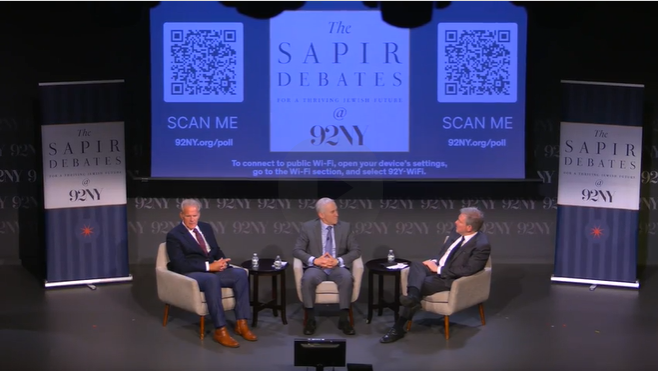
Michael Oren and Jonathan Schanzer debate over U.S. aid to Israel, moderated by Bret Stephens.


 Add JewishInsider on Google
Former Israeli Ambassador to the U.S. Michael Oren and Foundation for Defense of Democracies executive director Jonathan Schanzer squared off Monday evening in New York over whether Israel would be better off weaning itself from U.S. military aid.
Oren argued that Jerusalem should shift toward a strategic partnership before political winds in Washington dictate more unfavorable terms, while Schanzer warned that abandoning the arrangement mid-war could leave Israel exposed.
Audience members were unswayed by either argument: Polled before and after the debate, 39% still agreed that Israel would be better off without American aid, while 61% disagreed. The discussion, part of the 92nd Street Y’s SAPIR Debates series, was moderated by Bret Stephens, editor-in-chief of SAPIR and a New York Times columnist.
Despite taking opposing sides, Oren and Schanzer largely agreed that the U.S.-Israel relationship should eventually move from a traditional military aid arrangement toward a strategic partnership centered on shared defense technology and cooperation. Their disagreement focused on how quickly to make that transition and whether Israel could afford to do so amid continuing regional threats.
“I’m not sure we have more than a couple of months, and so we have to move very, very quickly,” Oren said, warning that a potentially less supportive Congress after the midterm elections could leave Israel with little control over the timing of a transition away from American assistance. He also noted that “there’s already a dialogue going on with the Trump administration about how we can move [the U.S.-Israel relationship] to a partnership.”
Oren argued that Israel’s reliance on U.S. assistance gives American administrations leverage over Israeli military decisions, particularly during wartime, while projecting an image of dependence that he said undermines Israel’s standing as a sovereign nation, pointing to the Obama administration’s withholding of certain munitions shipments during the 2014 Gaza conflict and the Biden administration’s decision to hold shipments of 2,000-pound bombs during the more recent Gaza war.
“Being dependent or being perceived as being dependent on America, it was unbecoming to our status,” Oren said. “It was sending the wrong message to our neighbors in the region — a message of weakness, a dependency — and it was exposing us to blackmail.”
Oren also argued that the existing aid arrangement restricts Israel’s ability to independently develop, purchase and sell military technology, potentially limiting the growth of its defense industry.
As an example, Oren criticized the phaseout of offshore procurement – the portion of U.S. aid Israel could spend on its own defense industry. He said the previous MOU allowed Israel to spend 26.3% of the funds in Israel, supporting local jobs and the development of capabilities tailored to Israel’s needs. However, he claimed that under the Obama-era MOU, offshore procurement was gradually eliminated.
“We cannot sell to whom we want to sell. We have to buy what we’re told to buy,” Oren said, arguing that such restrictions impact Israel’s economy and its ability to develop “capabilities that we need that the United States doesn’t necessarily need.”
Schanzer acknowledged that American assistance can come with political constraints but argued that the immediate military risks of relinquishing it outweigh the potential benefits of greater independence.
“I don’t believe that Israel would be winning the war that it’s winning right now were it not for this aid, and not just the money, but the weapons, the training, everything,” Schanzer said. “The United States has helped to create the army that Israel has, and I don’t like the idea of Israel without this moving forward.”
Furthermore, Schanzer argued that the loss of U.S. assistance would also carry diplomatic weight that extends beyond the battlefield.
“If the United States cuts off Israel or if Israel decides that it no longer wants to take aid from the United States, there is literally no other country out there that will be willing to defend Israel at the U.N.,” Schanzer said.
Schanzer argued Israel should try to maintain the assistance for now, while warning that building a defense industrial base and replacing U.S. systems could take years.
“To develop a fifth-generation fighter [jet] takes 23 years, with multiple countries,” Schanzer said. “Is Israel going to try to do that in the middle of this war? That feels like an enormous undertaking.”
He also emphasized the financial importance of American assistance during wartime, arguing that its contribution to Israel’s defense budget increases significantly when the country is engaged in prolonged military operations.
“It’s only 15% except when war breaks out. Then it’s 35%,” Schanzer said, referring to what he described as the share of Israel’s defense budget covered by American assistance in 2024.
Schanzer further warned that ending U.S. military financing could have consequences beyond the loss of direct assistance, potentially jeopardizing Israel’s ability to purchase American weapons in the future.
“You start with the financing, and then it goes to sales, and then who knows where it goes? Goes to punitive measures. Goes to sanctions,” Schanzer said.
Oren agreed that “the greatest significance of the aid was strategic and psychological. It sent a message, an unequivocal message to everybody in the region: the United States stands behind this country, the State of Israel.” However, he rejected Schanzer’s concerns, arguing that American defense manufacturers have strong economic incentives to continue selling weapons to Israel, while the Israeli military’s use of American equipment serves as a valuable demonstration of its effectiveness.
The former ambassador also suggested that Washington and Jerusalem could restructure their defense relationship by placing certain forms of military support under Pentagon programs rather than traditional foreign assistance, similar to arrangements with other major U.S. allies.
Schanzer, meanwhile, reiterated his support for eventually pursuing such a partnership but maintained that Israel should preserve American military assistance for as long as possible while its current conflicts continue.
“I think Michael and I, we’re probably 100% in agreement that that’s where it needs to go,” Schanzer said. “The question is, in my mind, can Israel get rid of the aid quickly?”
“I think doing it in the middle of a war is, well, scary at best, reckless at worst,” he added.
Herzog’s comments come as liberal Jewish leaders, including Rabbi Rick Jacobs and David Saperstein of the Reform movement, repudiated Amb. Leiter’s harsh criticism of J Street

Aspen Security Forum
Former Israeli Ambassador to the U.S. Michael Herzog
Former Israeli Ambassador to the U.S. Michael Herzog said on Thursday that he does not view J Street, the progressive Israel advocacy group, as a pro-Israel organization, weighing in on the escalating war between his successor, Ambassador Yechiel Leiter, and J Street.
Leiter said earlier this week that he views J Street as a “cancer within the Jewish community,” citing its calls for restricting arms sales and U.S. aid to Israel, and calling group “two-faced” for purporting to be pro-Israel. J Street’s president, Jeremy Ben-Ami, has also accused Israel of genocide.
“To me, to be pro-Israel is to draw a clear line between criticizing Israeli government policies — and supporting anti-Israel agendas and libels de-legitimizing the State of Israel,” Herzog said on X. “To be pro-Israel is to go from pronouncing support for Israel’s right to exist (thank you for the generosity…), to supporting the provision of the means critical to defending that very existence.”
“To be pro-Israel is to listen to Israelis; In our vibrant democracy, most Israelis share the view that j-street doesn’t qualify as pro-Israel,” Herzog continued.
J Street did not immediately respond to a request for comment.
Unlike Leiter, a longtime close political ally of Israeli Prime Minister Benjamin Netanyahu, Herzog was appointed to his role by former Prime Minister Naftali Bennett, after Bennett’s coalition defeated Netanyahu in 2021, though Herzog remained in his role after Netanyahu was elected, until January 2025. Herzog’s brother, Isaac, is Israel’s president.
His comments criticizing J Street underscore the skepticism that Israeli leaders from across the ideological spectrum have towards the progressive advocacy organization.
The comments came as J Street rallied more than 500 Jewish leaders calling on Leiter to rescind his remarks and apologize for using language that “dehumanizes fellow Jews.” Signatories include Rep. Jerry Nadler (D-NY); former U.S. Ambassadors to Israel Dan Kurtzer and Tom Nides; Rabbis Rick Jacobs and David Saperstein, leaders of the Reform movement; and National Council of Jewish Women CEO Jody Rabhan.
At the same time, Leiter on Thursday morning offered a strong defense of the Reform movement, condemning Likud MK and Social Equality Minister Mai Golan for comments lambasting the denomination and telling a prominent Reform rabbi, “You’re marrying dogs in your delusional synagogues.”
Leiter said on X that he condemns “in the strongest terms Minister Mai Golan’s verbal attack on MK Gilad Kariv and on Reform Judaism in general.”
“As an Orthodox Jew and as Israel’s representative to the United States I find her words disgusting and reprehensible, worthy of excoriation and rebuke,” Leiter said. “Theological, political, and ideological differences are fine, even necessary for a healthy people. But there is a line that cannot be crossed, it is a line that divides debate from hate and separates altruism from populism. Too many are crossing the line.”
Leiter said he plans to meet in person with Reform leaders to apologize on Israel’s behalf.

Photo credit: Embassy of Israel
Historian Michael Oren, former Israeli Ambassador to the U.S. and Knesset Member in the 20th Knesset, discussed the lesser-known story of the U.S. the Balfour Declaration in a new podcast from The Washington Institute for Near East Policy.
Hosted by David Makovsky, the think tank’s Ziegler distinguished fellow and director of the project on Arab-Israel relations, “Decision Points,” a series of ten episodes, is the first podcast focused on the history of the U.S.-Israel relationship since the creation of the Jewish State. It features 30-minute conversations with key scholars and book authors.
Oren: “[Former President] Woodrow Wilson was — if you read his memoirs, his remarks, those of his wife Edith in particular — sort of what you call a garden-variety antisemite. And yet… he went against the advice of all of his senior counselors, including his Secretary of State Robert Lansing, his personal political adviser Col. Edward House, who were adamantly opposed to Zionism… But it was Wilson’s restorationist worldview, which at this precise moment in history… met up with a peculiar geostrategic situation that [was] obtained in 1917,” pointing to the Communist revolution in Russia and the fear that the Germans would issue a similar declaration.
Key relationship: The relationship between President Wilson and Louis Dembitz Brandeis, whom he respected when Wilson was governor of New Jersey, was key in persuading the U.S. to throw its support behind Arthur Balfour’s declaration when he visited the U.S. in 1917, Oren explains in detail. “Balfour was convinced that if he can get Wilson to sign on to this idea it will persuade the British government because they so need America in the [first World] War and he’s not getting anywhere with Wilson’s advisors. He needs to actually get into the Oval Office, he’s not getting there. He turns to Brandeis… Brandeis says to Balfour, ‘Don’t worry, I got it.’ He goes into the Oval Office, has maybe a half-an-hour meeting and walks out with Wilson’s approval of what would later become the Balfour Declaration. A pivotal moment in Middle Eastern history, Jewish history, and Israel history certainly, that short meeting between Brandeis and Wilson.”
The audience: Makovsky tells Jewish Insider that people are now consuming information differently than in the past — the number of podcast listeners has increased sharply in 2019, according to a recent survey — “and I think it’s very important for those of us who care about U.S.-Israel relations to basically meet people where they are through new media. The idea of interviewing authors who have written about different periods of the U.S.-Israel relationship is that by the end of ten episodes, people will feel they have a better grasp of the trajectory, the arc of history when it comes to this relationship.”
Essential alliance: Talking about the Balfour Declaration, Makovsky said those events are a reminder of the idea of alliances: “We are at a time where people are saying that we could withdraw from the Middle East. We don’t really need allies. But you know, we saw this with al-Baghdadi too, that it ultimately takes a village, so to speak, of allies that made the capture possible. Zionism always believed in two ideas and did not see it as a contradiction. It believed in the idea of self-reliance, but also making sure that you have very good ties with the leading countries of the time, which [in 1917] are Britain and the United States. I think that was the key to Zionism’s success. And I think that is also good advice for the United States today that we need allies. We need the multipliers and having allies are critical or American influence in the Middle East and beyond.”
Please log in if you already have a subscription, or subscribe to access the latest updates.
 Continue with Google

 Continue with Apple