














































































Greenspan served for 19 years as Fed chair under four different presidencies
Zach Gibson/Bloomberg via Getty Images
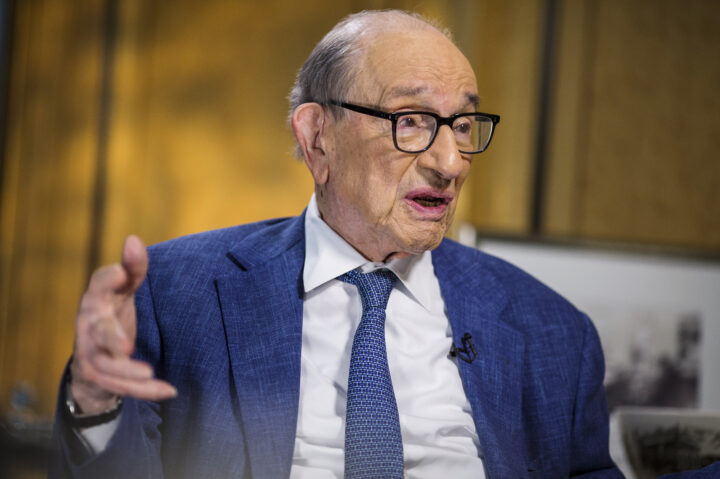
Alan Greenspan, former chairman of the Federal Reserve System, speaks during a Bloomberg Television interview in Washington, D.C., U.S., on Wednesday, July 24, 2019.


 Add JewishInsider on Google
Alan Greenspan — the influential economist who led the Federal Reserve across four presidencies and whose track record guiding economic growth earned him status as an economic “maestro” — died on Monday at age 100.
Greenspan chaired the Federal Reserve from 1987 to 2006, serving under Presidents Ronald Reagan, George H.W. Bush, Bill Clinton and George W. Bush.
He presided over the Fed during one of the longest periods of economic expansion in U.S. history, a boom stretching from 1991 to 2001 — and in 2005 was honored with the Presidential Medal of Freedom from President George W. Bush.
However, Greenspan drew criticism for championing financial deregulation, which critics argue set the stage for the 2007–2008 global financial crisis.
Greenspan was born in the Washington Heights neighborhood of New York City. His father was of Romanian Jewish descent, and his mother was of Hungarian Jewish descent. He first came to Washington as chairman of the Council of Economic Advisers in the waning days of the Nixon administration — marking his transition into policy and politics. He was married for 29 years to NBC’s chief Washington correspondent Andrea Mitchell.
On Monday, Mitchell said Greenspan died from complications of Parkinson’s disease. “He will be remembered for his brilliance and his kindness,” she told NBC.
“He was a giant of a man who helped shape the U.S. economy for decades under presidents of both parties, but was always honest in acknowledging his mistakes.”
Greenspan — who was known to talk in terms of probabilities and likelihoods — “shaped my life from our very first date in 1984,” Mitchell said. “He had irrational exuberance for baseball, the Washington Commanders, tennis, golf, and music, especially jazz.”
In 1983, The New York Times described Greenspan as “one of the most popular guests on New York’s party circuit — and one of America’s leading and most sought after economists” after he was spotted at Henry Kissinger’s lavish 60th birthday party accompanied by Barbara Walters.
The State Department official told lawmakers that ‘a new road toward normalization’ could be ‘built not on the same ideology, but on shared supply chains’
Pier Marco Tacca/Getty Images
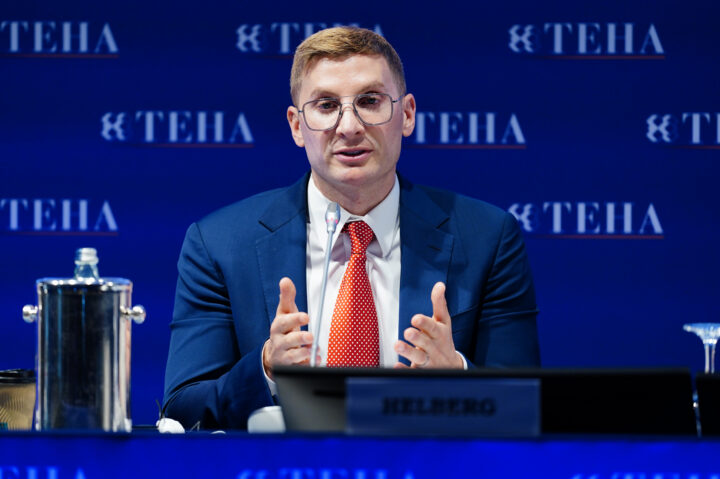
Jacob Helberg, advisor to the White House Council of Economic Advisers and U.S. Under Secretary of State designate for Economic Growth, Energy, and the Environment, attends the 51st Edition of TEHA 'Cernobbio Forum Takes Place In Italy on September 05, 2025 in Como, Italy.
Jacob Helberg, the under secretary of state for economic growth, energy and environment, told House lawmakers on Tuesday that the administration’s Pax Silica initiative could help pave a path toward normalization between Israel and Qatar.
The initiative, which has become the State Department’s flagship effort on AI and supply chain security, currently includes 10 signatories and five non-signatory participants. Israel joined the framework in December 2025, with Qatar signing on the following month.
“Consider what this coalition has already accomplished that traditional diplomacy could not. Qatar and Israel now sit inside the same economic framework,” Helberg said during a House Foreign Affairs Committee hearing on advancing national security through diplomacy. “A new road toward normalization built not on the same ideology, but on shared supply chains.”
During his testimony, Helberg also pointed to the United Arab Emirates’ early participation in the Abraham Accords, saying the UAE joined “incredibly early at great political cost to itself,” as evidence that economic and security frameworks can reshape regional relationships.
Helberg told Jewish Insider similarly upon returning from Doha for the Pax Silica signing, “My trip to the Middle East was actually incredibly significant, because this is the first time that Israel and Qatar have been brought under the same framework and signed the same document to actually agree that shared supply chains are more important than shared ideologies.”
“When people do business together, when people focus on shared goals, you inherently create, identify and focus on things that people agree on. It’s certainly my hope that this will pave the way for peace and economic integration of the region,” he continued.
But despite Helberg’s optimism, relations between Jerusalem and Doha remain deeply strained, and formal normalization appears distant.
Israel and Qatar do not maintain diplomatic ties, and Israeli and U.S. officials and policy experts remain wary of Doha’s support of anti-Western movements such as the Muslim Brotherhood and hosting of Hamas officials.
During the war in Gaza, Doha served as a key intermediary between Israel and Hamas, helping broker temporary ceasefires and hostage-release agreements. That role was disrupted on Sept. 9, 2025, when Israeli aircraft struck Hamas figures in Doha, killing a Qatari security guard and prompting the Gulf state to scale back its mediation efforts.At the urging of the Trump administration, Israeli Prime Minister Benjamin Netanyahu later spoke with Qatari Prime Minister Sheikh Mohammed bin Abdulrahman Al Thani to express regret over the strike.
Please log in if you already have a subscription, or subscribe to access the latest updates.
 Continue with Google

 Continue with Apple