













































































President Donald Trump, meanwhile, threatened Iran with military force if it doesn’t stop its proxy Hezbollah’s attacks
Fabrice COFFRINI / POOL / AFP via Getty Images
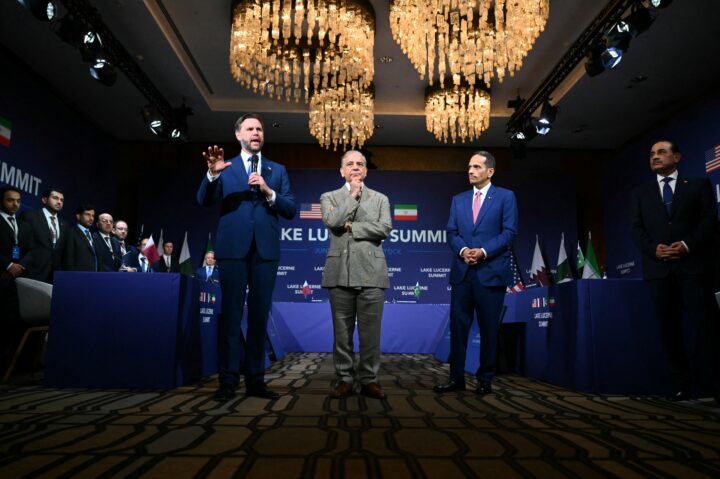
US Vice President JD Vance speaks next to Pakistan's Prime Minister Shehbaz Sharif and Qatar's Prime Minister Sheikh Mohammed bin Abdulrahman bin Jassim al-Thani during a quadrilateral meeting between the United States, Iran, Pakistan and Qatar at the Burgenstock luxury hotel complex overlooking Lake Lucerne, Switzerland, on June 21, 2026, as part of high-level talks aimed at advancing a deal to end the Middle East conflict.


 Add JewishInsider on Google
Vice President JD Vance, leading the American delegation in diplomatic negotiations this weekend with Iran in Switzerland, told reporters on Sunday that “the United States is willing to fundamentally transform our relationship with [Iran]” if the Islamic Republic’s leadership is willing to give up nuclear weapons and end its backing of terrorist proxies.
“If your leadership is willing to give up being a driver of regional instability, if they are willing to give up nuclear weapons ambitions in the long term, then the United States is willing to fundamentally transform our relationship with that country,” Vance said at a news briefing, according to The New York Times.
Vance described the approach of the U.S. delegation, which he is leading alongside White House Special Envoy Steve Witkoff and Jared Kushner, as offering an “outstretched hand” to the people of Iran.
The Iranian delegation is being led by Foreign Minister Abbas Araghchi and Parliament Speaker Mohammad-Bagher Ghalibaf. The prime ministers of Pakistan and Qatar are serving as mediators.
Vance also downplayed Hezbollah’s continued attacks against Israel, which have prompted Israeli military retaliation in Lebanon. “We’ve seen great progress over the last couple of days in ensuring that the ceasefire holds in Lebanon. These things are always a little bit messy,” Vance said.
But on Sunday morning, as Vance was holding his press conference, President Donald Trump, in a Truth Social post, called on Iran to “immediately stop” its “highly-paid PROXIES in Lebanon from causing trouble.”
“If they don’t, we’ll hit Iran very hard again, just like we did last week, only harder!” Trump wrote.
Seattle Mayor Katie Wilson said she was briefed on a 'credible threat' to the city and decided to turn on CCTV cameras around the soccer stadium for the games
Harry How/Getty Images
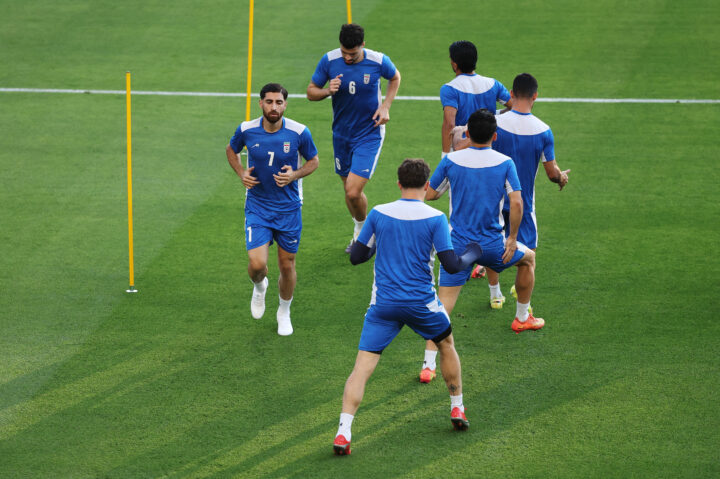
Alireza Jahanbakhsh Iran trains with teammates one day ahead of the FIFA World Cup 2026 Group G match between IR Iran and New Zealand at Centro Xoloitzcuintle on June 14, 2026 in Tijuana, Mexico.
As the Iranian national soccer team begins the 2026 World Cup amid high-level diplomatic negotiations to end the war between the U.S. and Iran, American security officials — and American Jewish communities already operating under elevated threat conditions — are facing challenges beyond soccer,
The first security and political consideration concerns the Iranian delegation itself: The United States has occasionally restricted entry for sports officials and delegations from adversarial countries — from Soviet Olympic officials during the Cold War to Cuban baseball and Iranian karate representatives in recent years.
The Trump administration, facing pressure from FIFA, did eventually issue visas several weeks ago — after months of uncertainty — to the 26 members of Iran’s national team, though more than a dozen staff members and officials associated with the team were not granted visas due to security concerns. The team is set to play on Monday and next week in Los Angeles, against New Zealand and Belgium, respectively, and against Egypt in Seattle on June 26.
“The visas necessary for Iran to compete in the World Cup, including for athletes and necessary support staff, have been issued,” the State Department told ESPN. “We will not allow the Iranian team to abuse this system to sneak terrorists into the United States under false pretenses.”
One of the people rejected is reportedly Mehdi Taj, head of the Iranian soccer federation, who was previously a commander in Iran’s Islamic Revolutionary Guard Corps. The team is also not allowed to stay on U.S. soil overnight; it relocated its training camp from Tucson, Ariz., to Tijuana, Mexico, and will return to Mexico after the final whistle of each of its matches.
The host cities are already on alert: Seattle Mayor Katie Wilson, a Democrat, said she was briefed on a “credible threat” to the city during the World Cup, which so alarmed her that she decided to turn on CCTV cameras around the soccer stadium for the duration of the games, counter to her longstanding opposition to the surveillance system.
Amid an already heightened threat environment for Jewish communities in the aftermath of the Oct. 7 attacks and amid the Iran war, thousands of fans from around the world flocking to the U.S. to cheer on their favorite teams presents an additional security challenge.
Secure Community Network, a Jewish communal security organization, told Jewish Insider that “there are no known specific threats to the Jewish community directly related to the World Cup,” though the group “has been proactively engaged with the Jewish Federation of Greater Seattle and other World Cup host cities well in advance of the tournament.”
SCN cited the 2006 shooting attack on the Seattle Jewish Federation that killed one and wounded five others, perpetrated by a Pakistani national who said he was “angry at Israel,” as “continu[ing] to inform the local community’s commitment to security and preparedness.” The Seattle and Los Angeles Jewish federations declined to comment.
Oren Segal, the Anti-Defamation League’s senior vice president of counter-extremism and intelligence, called Iran’s participation in the World Cup “a moment for vigilance, not alarm.” He predicted that the event “will likely attract some protest activity from groups seeking to leverage the global attention surrounding the tournament to advance their causes,” and said “the appropriate response is proactive coordination with local law enforcement and ensuring that community members are informed, prepared, and supported.”
Less than 24 hours before the expiration of his previous delay, Trump said he would pause the strikes ‘per Iranian government request’
Will Oliver/EPA/Bloomberg via Getty Images
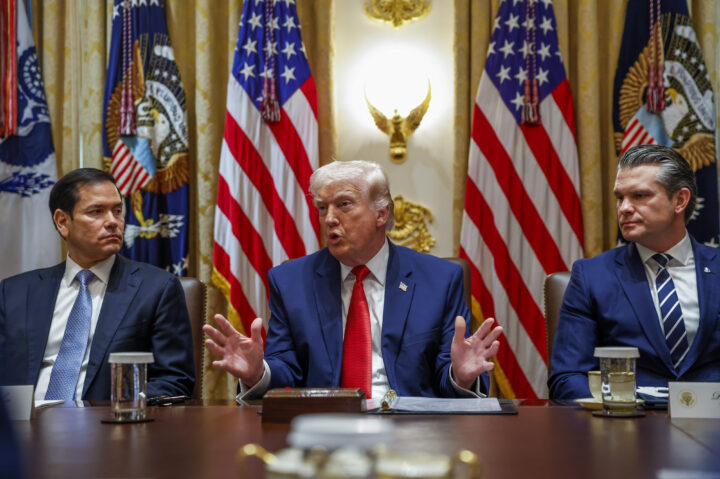
Secretary of State Marco Rubio, President Donald Trump and Defense Secretary Pete Hegseth during a Cabinet meeting at the White House in Washington, DC, US, on Thursday, March 26, 2026.
President Donald Trump announced on Thursday afternoon that he would extend his pause on plans to strike Iran’s energy infrastructure, “per Iranian government request,” for an additional 10 days amid ongoing diplomatic negotiations to end the war.
Trump wrote in a post on his Truth Social platform that he is “pausing the period of Energy Plant destruction by 10 Days to Monday, April 6, 2026, at 8 P.M., Eastern Time.”
“Talks are ongoing and, despite erroneous statements to the contrary by the Fake News Media, and others, they are going very well,” Trump added.
The post comes a few hours after the president said that he wasn’t sure if he would follow through with his five-day delay, set to expire Friday, for strikes on Iran’s energy infrastructure, which he had pushed back at the start of diplomatic negotiations on Monday.
“I don’t know yet,” Trump said when asked by reporters if the strikes would still take place Friday. “It’s a day. In Trump time, a day, you know what it is? That’s an eternity.”
Trump made the comments while speaking to reporters at the opening of his first Cabinet meeting since launching the war in Iran.
He alleged that Iranian leaders “are begging to make a deal” to end the war while criticizing press reports alleging that he was looking for a diplomatic off-ramp to the conflict, saying he has not decided whether he’ll agree to a diplomatic settlement if one were reached.
“They are begging to make a deal. Not me,” Trump said of current Iranian leadership. “They’re not fools, they’re very smart actually in a certain way and they’re great negotiators. I say they’re lousy fighters, but they are great negotiators. They are begging to work out a deal. I don’t know if we will be able to do that. I don’t know if we’re willing to do that. They should’ve done that four weeks ago. They should’ve done it two years ago.”
“The reason they want to make a deal is they have been just beat to sh*t,” he said later on, touting the U.S. military operation as a success.
During the meeting, White House Special Envoy Steve Witkoff confirmed reports that the U.S. had presented Iran with a “15-point action list” as a starting offer in peace talks between the two countries. He also confirmed that Pakistan had been acting as a mediator for the U.S. and Iran.
“We will see where things lead, and if we can convince Iran that this is the inflection point with no good alternatives for them other than more death and destruction,” Witkoff said. “We have strong signs that this is a possibility.”
Witkoff said to Trump, “You’ve instructed us that your preference is always peace and that we should make that our priority. We have delivered that message, sir, along with the 15 points for peace. Finally, we have told Iran one last thing: don’t miscalculate again.”
Trump later revealed that the “present” Iran gifted the U.S. was allowing eight oil tankers through the Strait of Hormuz, which he said proved the U.S. was speaking with the “right people” in Iran with the authority to make such decisions.
“They said to show you the fact that we’re real, and solid and we’re there, we’re going to let you have eight boats of oil, eight boats, eight big boats of oil,” Trump said of the Iranians. “And I said, ‘Well, I guess they were right,’ and they were and they were real.”
Trump then said that Iran later allowed two additional vessels to travel through the strait, which he described as an overture from the Iranians to “apologize for something they said.”
Turning to Witkoff, the president then expressed hope that he hadn’t “screwed up” their diplomatic efforts by revealing the “gift.”
The president predicted a four to five week timeline for the military campaign against Iran in several interviews over the weekend
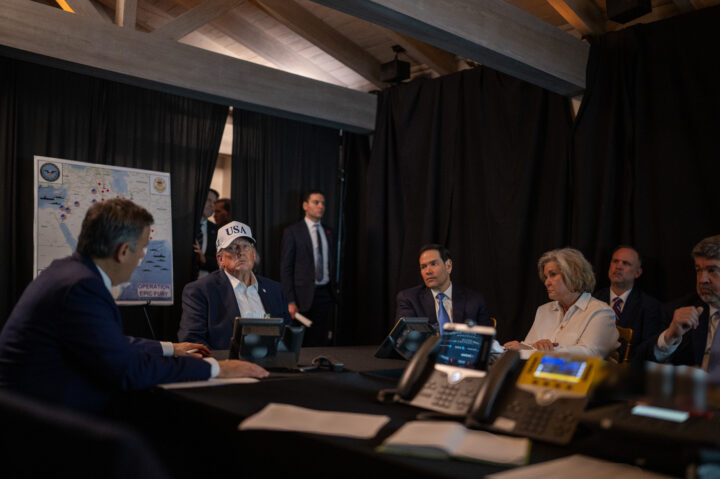
Daniel Torok/White House via Getty Images
President Donald Trump oversees "Operation Epic Fury" at Mar-a-Lago on February 28, 2026 in Palm Beach, Florida.
President Donald Trump said over the weekend that Iran’s new leadership has made overtures to restart diplomatic negotiations with the U.S. — which he plans to accept — after Iranian Supreme Leader Ayatollah Ali Khamenei was killed during Israeli and U.S. strikes in the country.
Still, the president warned that strikes would continue until their objectives had been achieved.
Trump made the comments while speaking to The Atlantic on Sunday morning, one of a series of interviews he gave after launching a joint military operation against Iran alongside Israel on Saturday. The president has been touting Operation Epic Fury to journalists as an immediate success, arguing that the removal of Khamenei and 47 others in senior Iranian leadership has provided a window for diplomacy as the U.S. military operation swiftly advances.
“They want to talk, and I have agreed to talk, so I will be talking to them,” Trump told The Atlantic. “They should have done it sooner. They should have given what was very practical and easy to do sooner. They waited too long.”
The commander-in-chief declined to say when he plans to begin engaging with the Iranians, instead noting that most of the Iranians involved in past negotiations with the U.S. are now deceased.
“Most of those people are gone. Some of the people we were dealing with are gone, because that was a big — that was a big hit,” Trump said. “They should have done it sooner. They could have made a deal. They should’ve done it sooner. They played too cute.”
Asked if he was willing to extend the bombing campaign in order to support a popular uprising in Iran, should it unfold, the president was similarly coy, telling the outlet: “I have to look at the situation at the time it happens … You can’t give an answer to that question.”
In a video posted to his Truth Social platform on Sunday afternoon, however, Trump spoke directly to the protesters, calling upon “all Iranian patriots who yearn for freedom to seize this moment, to be brave, be bold, be heroic and take back your country. America is with you. I made a promise to you, and I fulfilled that promise. The rest will be up to you, but we’ll be there to help.”
Further illuminating his thinking, Trump wrote on Truth Social on Saturday shortly after the killing of Khamenei, “We are hearing that many of their IRGC, Military, and other Security and Police Forces, no longer want to fight, and are looking for Immunity from us … Hopefully, the IRGC and Police will peacefully merge with the Iranian Patriots, and work together as a unit to bring back the Country to the Greatness it deserves. That process should soon be starting.”
“The heavy and pinpoint bombing, however, will continue, uninterrupted throughout the week or, as long as necessary to achieve our objective” of world peace, he wrote.
In an interview on Saturday evening with CBS News’ Robert Costa, Trump said he believes that the joint U.S.-Israeli attacks on Iran that killed Khamenei made diplomacy “much easier now than it was a day ago, obviously, because they are getting beat up badly.”
As for the military operation itself, Trump suggested in subsequent conversations on Sunday with The Daily Mail and The New York Times that the U.S. could be involved for another four to five weeks.
“It’s always been a four-week process. We figured it will be four weeks or so,” Trump told the U.K. tabloid. “It’s always been about a four week process so — as strong as it is, it’s a big country, it’ll take four weeks or less.”
He repeated the four to five week timeline in interviews with Axios’ Barak Ravid on Saturday and The New York Times on Sunday.
“I can go long and take over the whole thing,” Trump told Ravid by phone, “or end it in two or three days and tell the Iranians: ‘See you again in a few years if you start rebuilding [your nuclear and missile programs].’”
Trump later predicted to Ravid that, “In any case, it will take them several years to recover from this attack.”
Senate Intelligence Committee Chairman Tom Cotton (R-AR) echoed the president’s predictions, telling CBS’ “Face the Nation” on Sunday that Trump has “no plan for any kind of large-scale ground force inside Iran.”
“The president has been clear that what we should expect to see is an extended air and naval campaign that’s designed not only to continue to set back Iran’s nuclear ambitions, but most importantly, to destroy its vast missile arsenal, many more missiles than the United States and Israel have air defenses combined, as well as the missile launchers and its missile manufacturing capability,” said Cotton, one of the president’s more hawkish GOP allies on Capitol Hill.
“Now obviously one risk of that kind of campaign is that an aircraft could be shot down, and the president would never leave a pilot behind,” he continued. “So no doubt we have combat search and rescue assets in the region that are prepared to go in and extract any downed pilot. But barring that kind of unusual circumstance, the president has no plan for any kind of large-scale ground force inside of Iran.”
Dan Diker, president of the Jerusalem Center for Security and Foreign Affairs, told JI that Trump is engaged in ‘maximum pressure negotiations,’ that are ‘setting up the regime to say no.’
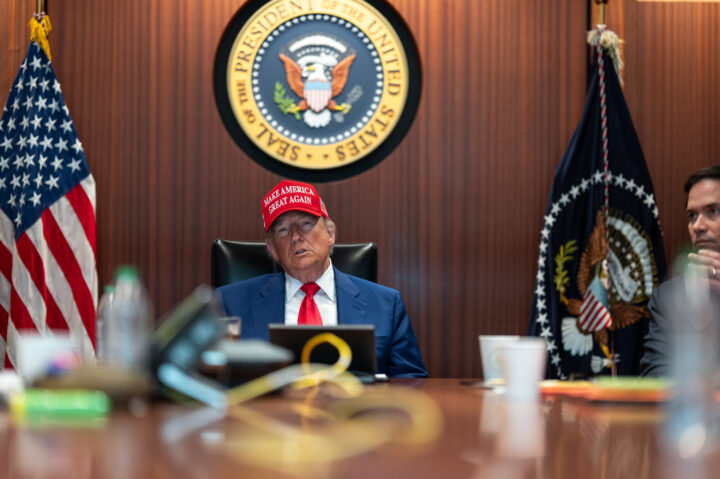
Daniel Torok/The White House via Getty Images
President Donald Trump and Secretary of State Marco Rubio (R) sit in the Situation Room as they monitor the mission that took out three Iranian nuclear enrichment sites, at the White House on June 21, 2025 in Washington, DC.
President Donald Trump, over the last week, has gradually amped up threats of a military strike against Iran, pivoting away from talk of diplomatic negotiations amid continued intransigence from Tehran.
On Wednesday, Trump wrote on Truth Social that “a massive Armada is heading to Iran … ready, willing, and able to rapidly fulfill its mission, with speed and violence if necessary. Hopefully, Iran will quickly “Come to the Table” and negotiate a fair and equitable deal – NO NUCLEAR WEAPONS – one that is good for all parties. Time is running out, it is truly of the essence!”
The president warned that “the next attack will be far worse” than last June’s Operation Midnight Hammer. “Don’t make that happen,” he added.
The regime’s mission to the United Nations responded with Trump-esque capitalization that “Iran stands ready for dialogue based on mutual respect and interests—BUT IF PUSHED, IT WILL DEFEND ITSELF AND RESPOND LIKE NEVER BEFORE!”
Ali Shamkani, an advisor to Iranian Supreme Leader Ali Khamenei who was severely injured in an Israeli airstrike on Iran last June, threatened — in Arabic, English, Hebrew, Russian and Mandarin — that “any military action by [the] US … will be considered the start of [a] war and its response will be immediate, all out and unprecedented, targeting [the] heart of Tel Aviv and all those supporting the aggressor.”
Then, amid widespread reports of secret talks between Washington and Tehran through Omani mediators came the news that they made no progress on limiting the Iranian nuclear and ballistic missile programs, and that Trump was once again weighing military action, according to CNN.
Dan Diker, president of the Jerusalem Center for Security and Foreign Affairs, told Jewish Insider that Trump is engaged in “maximum-pressure negotiations,” which are “setting up the regime to say no.”
Nadav Pollak, a lecturer at Reichman University and Israeli intelligence veteran, told JI that the latest developments were significant in that “Trump laid out terms for a deal and Iran said no, or didn’t say anything. It’s not surprising, because his terms — no nuclear program, no ballistic missiles over a certain range, no support for its proxies — are a surrender without concessions [from the U.S.], something the supreme leader can’t do.”
At the same time, Diker said, “Iran is desperate to cut a deal. … The Iranians are reaching out to cut a deal, like they always do when they feel cornered. Regime survival is the top priority of the regime.”
“I think it’s fair to assess that Trump senses he has a lot of leverage and a lot of power — and he does — and I think he’s applying maximum pressure on the regime. He knows the regime is weak, but it’s like a rabid dog … that can do anything, which can be very dangerous. They still have a lot of missiles,” he said.
Diker argued that 30 years after Israeli Prime Minister Benjamin Netanyahu first warned about the Iranian threat in a joint session of Congress, “the stars aligned in terms of Trump and Netanyahu, and they could finally get rid of this regime, but it will come at a price. … The Iranian proxies will put us in a terrible position.”
Israel is not the only country exposed to those dangers, Diker pointed out. “There is pressure on Trump from the Saudis, the Qataris, the Turks and others across the Middle East not to attack because of the distinct fear the regime will start firing rockets, missiles and drones everywhere. … Iranians will just be throwing stuff all over the Middle East, is the fear.”
In Pollak’s assessment, U.S. military action is likely: “Trump, with all his language and rhetoric, climbed too high not to do anything. He also pushed U.S. assets into the region, similar to what he did in Venezuela. …The scope of a strike is unclear. That’s anyone’s guess right now.”
The shift in Trump’s rhetoric in recent days from focusing on the anti-regime protests to stopping Iran’s nuclear program shows that he is “trying to build legitimacy for a strike,” Pollak said. “The protests against the regime was a trigger for him, but he has other objectives in mind.”
Pollak said that Shamkani’s multilingual social media posts were the first public, direct military threat from Iran towards Israel, something he said Israel’s security establishment surely took note of.
“If it wasn’t certain until yesterday that Israel will get targeted, now it is, even if it’s one barrage,” Pollak said.
Whether Israel will take part in the strikes on Iran remains an open question, Pollak said, but assessed that it is likely to happen. He pointed out that IDF Military Intelligence chief Maj.-Gen. Shlomi Binder was in Washington this week, reportedly to share information about possible targets in Iran.
Pollak pointed out that a month ago, in a press conference with Netanyahu at Mar-a-Lago, Trump said he would support Israel striking Iran if it continues to produce ballistic missiles, and if Iran tries to rebuild its nuclear weapons program, he would back Israel striking “fast.”
“I think [Netanyahu] for sure would want to take the opportunity to finish some of what we didn’t finish in June,” he said. “The question is whether Trump will let him or not.”
Diker said that “Netanyahu has been hyper-focused on ridding Israel and the world of this regime for 30 years … When Netanyahu says Trump is the best friend Israel ever had, he’s not talking about the Abraham Accords. He’s talking right now about ending the Iranian regime. Netanyahu’s eyes are on that ball.”
Please log in if you already have a subscription, or subscribe to access the latest updates.
 Continue with Google

 Continue with Apple