














































































Addressing the UNGA, Trump said, ‘Will a deal be made … or do I annihilate the Islamic Republic?’
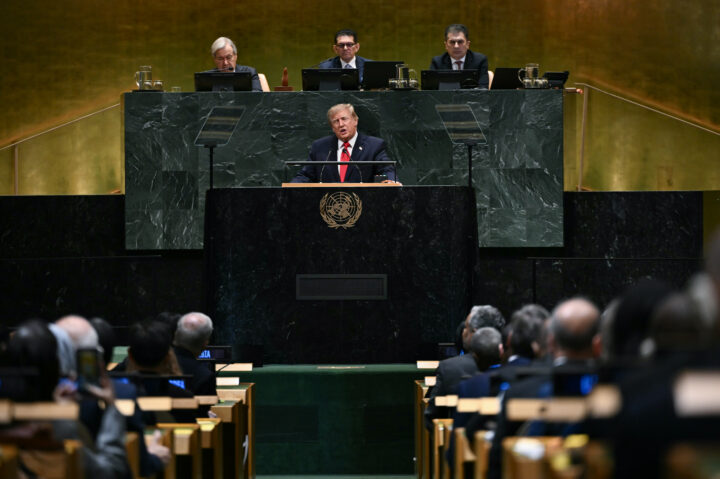
Brendan Smialowski-Pool/Getty Images
President Donald Trump speaks during the 81st United Nations General Assembly at the United Nations Headquarters on September 22, 2026 in New York City.


 Add JewishInsider on Google
President Donald Trump said on Tuesday that he faces a “big decision” between making a deal with Iran and escalating military conflict, as he predicted the sides would reach an agreement following the midterm elections.
“I have a big decision to make,” Trump told the U.N. General Assembly in New York, on the first day of the high-level week. “Will a deal be made with Iran that lets them rebuild and create a far greater country than it ever was before? … Or do I annihilate the Islamic Republic and do it quickly, never giving them a chance to kill and destroy people and countries again? Do I drive them into hell with no chance of survival and no hope of future greatness or generations?”
The president has recently made similar statements suggesting he must choose between negotiations and further confrontation, though there appear to be no serious negotiations underway and U.S. strikes have been sporadic.
"I have a big decision to make,” Trump said at the UN. “Will a deal be made with Iran that lets them rebuild and create a far greater country than it ever was before? … Or do I annihilate the Islamic Republic? … I believe we’ll make a deal right after the [midterm] election.” pic.twitter.com/LYB5f2i0Fd
— Jewish Insider (@jewishinsider) September 22, 2026
Trump said he believes an agreement with Iran will ultimately be reached after the U.S. midterm elections in November, arguing that Tehran is waiting to see how Republicans perform.
“I believe we’ll make a deal right after the [midterm] election because it doesn’t make sense for them not to,” Trump said. “They’re waiting to see how I do in the midterm election. What they don’t realize is that I’m not running.”
Even absent a deal, Trump argued that U.S. efforts in Iran have yielded success, including stopping Iran from being the “bully” of the Middle East.
“For 51 years, the fanatical Iranian regime has ruled by bloodshed and mass murder, spreading death and carnage and chaos across the entire Middle East and beyond,” Trump said. “They were the bully of the Middle East, but they are the bully no more.”
While no bilateral sit-downs between Trump and Iranian leadership were scheduled, Trump said during a meeting with Ukrainian President Volodymyr Zelensky that White House Special Envoy Steve Witkoff and Jared Kushner had a “very good meeting” with Iranian officials on Tuesday.
“It was a meeting that lasted for three hours … They had a very good meeting, very productive meeting, and they have another one scheduled in the near future,” Trump said. “We’ll see how it turns out, but, certainly, it’s to their advantage to make a deal, and if we can do that, it’s preferable.”
Prior to the meeting a U.S. official had told CNN that Trump said he would be open to arranging a meeting with Iranian officials in New York “if the conditions are right,” or delegating senior advisors traveling with him to meet with them. Axios further reported that mediating Arab countries had been trying to arrange a meeting as well.
Trump called on “all nations” to “join us in enforcing the complete economic isolation of Iran until they stop their attacks on commercial shipping, relinquish their nuclear ambitions and cease their support of terror.”
Praising international support for Washington’s stance, Trump thanked the U.N. Security Council for passing a resolution in March condemning Iranian attacks on maritime trade.
“That resolution, I’m pleased to say, received more co-sponsors from U.N. member nations than any Security Council resolution in history,” Trump said. “That’s something. Now we must be equally united in maintaining pressure.”
He added that the U.S. Navy has recently escorted more than 1 billion barrels of oil out of the Strait of Hormuz, maintaining that “more oil is flowing than at any point since the start of the war.”
He also dismissed reports suggesting the U.S. military is running dangerously low on munitions as a result of the conflict.
“We have more munitions than we could ever possibly even think of using, and we’re building them at levels that we have never done before. We are adding to our stockpiles faster than we have ever been able to do before,” he said.
Trump noted that 18 new munitions facilities are currently under construction by defense contractors, promising that the expansion will lead to the “very rapid deployment of missiles of every type and ammunition of every type,” as well as faster resupply for allies.
Turning to the Middle East more broadly, Trump touched on the situation in Gaza, where implementation of his administration’s 20-point peace plan remains stalled as Hamas refuses to disarm. The president thanked countries that joined the Board of Peace, as well as those that committed personnel to secure Gaza.
“We ended the war in Gaza, saving untold thousands of lives. We also brought home all the remaining hostages, both living and dead, every single one of them,” Trump said. “Nearly 30 countries have joined the board, which I am honored to chair, and we’re thankful to many of those member nations for contributing billions and billions of dollars to relief. I also want to thank those who have committed troops, police, and training to help stabilize Gaza, including Indonesia, Morocco, Albania, Kosovo, Kazakhstan, Egypt, Jordan and more.”
Iranian state media and Iran’s foreign ministry have said that Trump’s claims that Iranian leadership had approved the deal are ‘speculative’
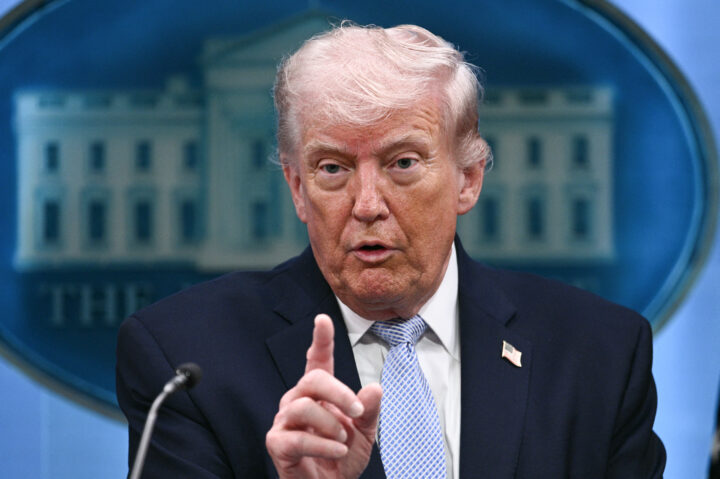
Brendan SMIALOWSKI / AFP via Getty Images
US President Donald Trump speaks about the conflict in Iran in the James S. Brady Press Briefing Room of the White House on April 6, 2026, in Washington, DC.
President Donald Trump said on Thursday that negotiations with Iran had reached a breakthrough and that he expected there to be a signing, possibly in Europe, in the coming days. With the diplomatic developments, Trump said he would cancel planned strikes against Iran, and call off an operation to take control of Kharg Island.
“Based on the fact that discussions with the Islamic Republic of Iran have been brought to the highest level of Iranian leadership and approved, I have, as President of the United States of America, cancelled the scheduled strikes and bombings against Iran this evening,” Trump posted on Truth Social.
In the Oval Office, the president said the deal was “in pretty final shape” and predicted that it would “get done over the next few days.” He also claimed that the agreement would ultimately deliver on his assurance that Iran would be prevented from having nuclear weapons and open up the Strait of Hormuz.
“The signing of the agreement will be in Europe, perhaps during the weekend,” Trump told reporters in the Oval Office on Thursday afternoon. “I won’t be able to be there, but Vice President [JD] Vance and the [White House special] envoy [Steve] Witkoff will.”
Trump also said that Iran’s supreme leader had approved the deal. However, Iranian state media and a spokesperson for Iran’s foreign ministry have reportedly asserted that Trump’s claims that Iranian leadership had provided approval are “speculative” and that “nothing has been finalized.”
The president spoke with the Emir of Qatar following the announcement and also with Israeli Prime Minister Benjamin Netanyahu. Reports indicated that Netanyahu was initially surprised by the statement. However, after the conversation between the two leaders, the Prime Minister’s Office said that Netanyahu “expressed his appreciation” for the framework and the inclusion of key objectives related to Iran’s nuclear program and support for terrorism.
The U.S. and Iran have reportedly closed vital gaps on three main issues that have prolonged diplomatic efforts, including the protocol for releasing Iranian frozen assets, reopening the Strait of Hormuz, and negotiations over Iran’s nuclear program.
The announcement came after two days of tit-for-tat strikes between the U.S. and Iran. Earlier on Thursday, Trump warned that the U.S. would hit Iran “VERY HARD TONIGHT” and threatened to seize Kharg Island, which handles roughly 90% of Iran’s oil exports.
Details of the arrangement remain unclear, but reports indicate the U.S. would end military action, lift its blockade and release $25 billion in frozen Iranian funds
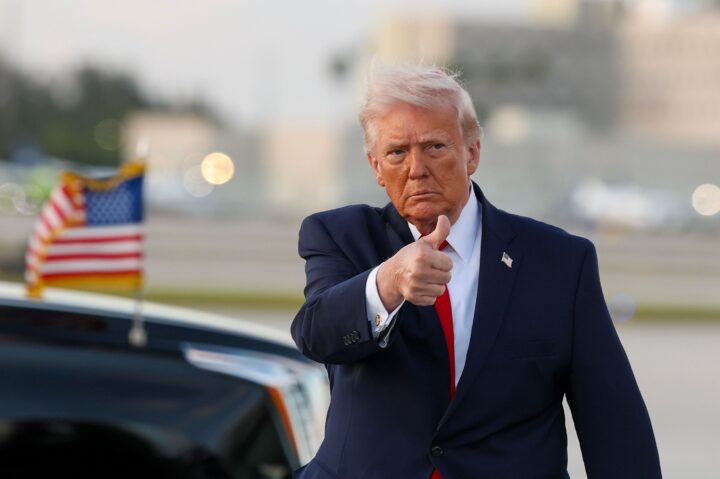
Tasos Katopodis/Getty Images
U.S. President Donald Trump waves to the media after walking off of Air Force One at Miami International Airport on April 11, 2026 in Miami, Florida.
The U.S. is nearing a deal with Iran to end the war, President Donald Trump announced on Saturday, though the precise parameters of the agreement remained unclear.
After holding a call with officials from the United Arab Emirates, Saudi Arabia, Qatar, Turkey, Pakistan, Jordan, Bahrain and Egypt, as well as a separate discussion with Israeli Prime Minister Benjamin Netanyahu, Trump said on Truth Social on Saturday afternoon that an agreement has “been largely negotiated” with “final aspects and details … currently being discussed.”
“In addition to many other elements of the Agreement, the Strait of Hormuz will be opened,” the president said.
While Trump did not offer any further details, Iranian officials had told The New York Times that a memorandum of understanding under discussion with the U.S. would end fighting on all fronts, including between Israel and Lebanon; lift the U.S. blockade of Iranian ports and allow for free movement of commercial traffic without any tolls; leave nuclear issues to be negotiated within 30 to 60 days; and see the release of $25 billion in frozen Iranian funds.
U.S. officials told the Times that, under the current agreement, Tehran has committed to giving up its stockpile of already enriched uranium, an issue that Trump has frequently stated is a U.S. priority, but the specifics as to how that transfer will occur are set to be worked out in subsequent negotiations.
A senior Iranian official denied to Reuters on Sunday that Iran’s nuclear program was a part of the initial agreement, and said that Tehran had not agreed to hand over its enriched uranium. “The nuclear issue will be addressed in negotiations for a final agreement and are therefore not part of the current deal,” the official told Reuters.
A U.S. official told Axios’ Barak Ravid that the agreement involves a 60-day ceasefire extension during which the Strait of Hormuz would be reopened and Iran would be able to sell oil freely. The draft MOU, according to Axios, includes commitments from Iran that it will never pursue nuclear weapons and to negotiate a suspension of its uranium enrichment program and the removal of its stockpile of highly enriched uranium. The draft also includes an end to the war between Israel and Hezbollah in Lebanon.
Netanyahu said in a statement on Sunday regarding his conversation with Trump the day prior that the two leaders “agreed that any final agreement with Iran must eliminate the nuclear danger,” including dismantling Tehran’s nuclear program and removing enriched uranium from the country. Trump also “reaffirmed Israel’s right to defend itself against threats on every front, including Lebanon,” Netanyahu said.
Some hawkish Senate Republicans expressed outrage on Saturday over the reported terms of the deal, calling it a defeat for the United States filled with major concessions to the Iranian regime.
As the president touts progress in talks with Tehran while escalating military pressure, analysts say the administration is keeping its options open — but will need to make a move soon
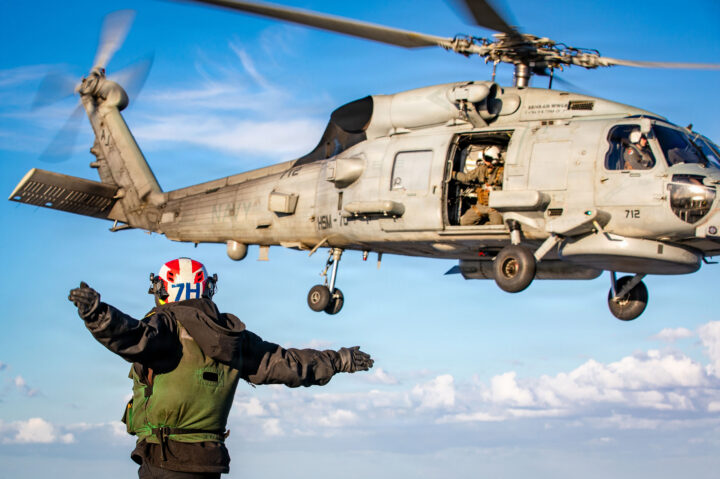
U.S. Navy via Getty Images
A U.S. Sailor signals the launch of an MH-60R Sea Hawk helicopter, attached to Helicopter Maritime Strike Squadron 70, on the flight deck of the world's largest aircraft carrier, USS Gerald R. Ford (CVN 78), while supporting Operation Epic Fury on February 28, 2026.
The Trump administration’s conflicting posturing on the war in Iran — insisting on the one hand that a diplomatic deal is within reach while also threatening to escalate strikes and potentially deploy ground troops — has left experts and former administration officials uncertain about President Donald Trump’s next move.
The president threatened in a post on his Truth Social platform on Monday morning to “conclude our lovely ‘stay’ in Iran by blowing up and completely obliterating all of their electric generating plants, oil wells and Kharg Island” if current talks fall apart and “the Hormuz Strait is not immediately ‘Open for Business.’”
But he wrote in the same post that the U.S. is engaging in “serious discussions” with Iran’s current leadership, which he described as a “new” and “more reasonable” regime than its predecessor, and said that “great progress has been made.”
Reached for comment, the White House referred Jewish Insider to Press Secretary Karoline Leavitt’s remarks at Monday’s briefing where she defended the president’s approach and repeatedly stated that Trump and his advisors are merely ensuring he has “maximum optionality” as he considers next steps.
“With respect to forces that are on the ground in the Middle East, it’s the job of the Pentagon to create maximum optionality for the commander-in-chief. It does not mean the president has made any additional decisions,” Leavitt said, adding that Trump has “decline[d] to rule … out” the use of ground troops.
On Capitol Hill, there are increasingly evident divides among Republican lawmakers about the prospect of boots on the ground. Some have argued that a ground operation would require explicit congressional authorization, and a number of otherwise-hawkish Republicans are hesitant about, if not outright opposed to, the idea of a ground operation.
In recent days, the U.S. has amassed over 3,500 more troops in the Middle East, including deploying the USS Tripoli aircraft carrier, which hosts around 2,500 Marines. Trump has also threatened to attack Iran’s oil and energy facilities and potentially escalate the war as a result of Iran’s blockade of the Strait of Hormuz — a vital passageway for the global oil trade.
Elliott Abrams, who served as Iran envoy under the first Trump administration and is now a senior fellow at the Council on Foreign Relations, told JI that the president’s decision to move more troops to the region and not exclude ground operations from future military plans is an effort to “keep his options open.”
“The massing of ground forces near Iran is both preparation for their possible use and a means of pressuring Iran to make concessions in the negotiations,” Abrams said. “There is no way of knowing what Trump will do if the negotiations fail.”
The administration is considering multiple options for the use of ground troops, including the seizure of Kharg Island, a vital economic artery for Tehran that accounts for roughly 90 percent of the country’s crude exports.
Cameron McMillan, a senior research analyst at the Foundation for Defense of Democracies, said that targets could also include the “seizure of key terrain — including relevant islands — in and around the Strait of Hormuz and securing Iranian highly enriched uranium.” However, he remained unsure whether the Trump administration would carry out such operations.
“Seizing or destroying the [highly enriched uranium] is a sensible goal if it is militarily feasible without too much risk,” Abrams said. “Taking the targets associated with the strait is, I think, both for bargaining purposes and perhaps meant to be given up only when traffic has moved through the strait freely for some time.”
Jonathan Ruhe, a fellow at the Jewish Institute for National Security of America, said that there are “real reasons to think ground operations could end up taking place.” He said that Iran “refuses to entertain Trump’s demands,” which could compel the administration to use elevated means of force in order to seize Iran’s highly enriched uranium, reopen the Strait of Hormuz or take Kharg Island “or other assets as bargaining chips.”
“The past month reaffirms that standoff air and naval power are insufficient by themselves to neutralize these targets or convince Iran to give them up,” Ruhe said. “Trump’s tendency is to employ the forces that he deploys overseas, as seen in both the Venezuela operation and the start of the current conflict. And there’s an opportunity cost to letting such well-trained U.S. forces idle indefinitely in the Middle East after pulling them from the Indo-Pacific or the homeland.”
Daniel Shapiro, a former U.S. ambassador to Israel under President Barack Obama and deputy assistant secretary of defense for the Middle East under President Joe Biden, said current talks between Washington and Tehran “look like a negotiation going nowhere.” He argued that Trump’s track record of pivoting to military action when diplomacy stalls, along with pressure to decide whether to use forces that cannot remain in the region indefinitely, suggest that ground operations could be looming.
“There is little chance that Iran, despite all punishment it has taken from U.S. and Israeli airstrikes, will make these concessions … If the [current] negotiations falter, it’s not hard to guess which way [Trump] will go,” Shapiro said.
Shapiro said that the current moment has a “similar feel to the military build-up Trump ordered throughout February” before he launched the war at the end of the month. Shapiro cautioned that any use of ground forces would indicate a “longer war” and signal that the objectives of the war are expanding “far beyond what negotiations in February were seeking to achieve.”
“With the ground forces available, they can’t just park in the region for long. Trump will, sooner than later, need to decide whether to use them or send them home,” Shapiro added.
Meanwhile, McMillan cautioned against ground operations, “especially those designed to secure and hold terrain.”
“I do not see any value in employing these forces to seize Iranian territory and would highly caution against ground operations,” McMillan said. “All of the desired objectives — with the exception of securing highly enriched uranium — can be secured through other means with substantially less risk. Seizing tankers is the most obvious if [the administration] is seeking to cut off Iran’s oil revenue.”
He also warned that the current forces being deployed might “not be enough for any large-scale ground operations for any long duration.”
“Simply deploying these units is unlikely to leverage Iran at the negotiating table, as the regime is fighting a total war that it views as existential,” McMillan continued. “Considering the profound impacts of U.S.-Israeli strikes on Iran’s ballistic missile, drone and naval capabilities, as well as its senior leadership, it is unlikely that a few more American battalions in the region will change that view or their will to continue fighting.”
Ruhe noted that Trump could be overlooking the potential costs of ground operations. He said that the president “has not adequately anticipated Iran’s retaliation” and is “discounting the uncertainties and risks of rolling the iron dice with ground operations.”
“And even if Trump is clear-eyed about the risks, he may accept them because getting the highly enriched uranium [HEU] and reopening the strait are such important goals,” he continued. Ruhe noted that such operations would likely be very complex.
“Seizing Iran’s HEU at Isfahan, Kharg Island or beachheads along the strait would be larger and more open-ended than raids on Maduro, al-Baghdadi or Bin Laden, which were in-and-out and occurred in much more tactically permissive environments,” Ruhe said. “Though Iran is being hit hard, it still has much greater military capabilities than ISIS, Venezuela or the Taliban.”
McMillan said that ground operations could also provide Tehran with leverage and risk further expanding the conflict. He also noted that any ground operation designed to seize and hold terrain in Iran is “more likely to become a liability than an asset and would draw the Trump administration closer to the war of attrition that it is trying to avoid.”
“Instead of the U.S. securing leverage, Iran would likely gain significant leverage against the U.S. by being able to employ a greater part of its arsenal against a vulnerable and isolated U.S. troop presence,” McMillan said. “If those troops were to take consistent casualties against threats that could not be removed from the air alone, expanded ground operations in the name of force protection would not be hard to imagine. That would require more forces, more resources and, in turn, likely more casualties.”
However, Richard Goldberg, a former Trump administration official, said that the use of ground operations does not necessarily signal that there will be an expanded presence and scope of U.S. involvement.
“People hear ‘boots on the ground’ and immediately think of Iraq, but we had boots on the ground in Venezuela as well — just in a very different way,” Goldberg said. “The U.S. would not be invading Iran in the sense of Iraq, but you could see a number of contingencies that might require special forces, airborne or marines for narrowly scoped missions with limited objectives, whether that’s securing nuclear material or neutralizing a threat that you can’t neutralize from the air for a variety of reasons.”
“It’s also important to remember that the military is preparing for contingencies, which may or may not ever be needed,” Goldberg added, noting that the U.S. “had Marines off of Venezuela but we didn’t use them.”
Jewish Insider’s senior congressional correspondent Marc Rod contributed to this report.
Please log in if you already have a subscription, or subscribe to access the latest updates.
 Continue with Google

 Continue with Apple