










































































In upsets for moderates, DSA-aligned Melat Kiros’ defeated Rep. Diana DeGette, and Manny Rutinel defeated Shannon Bird

(Michael Ciaglo/Getty Images)
Democratic congressional candidate Melat Kiros holds a cutout of Sen. Bernie Sanders (I-VT) as she speaks to supporters at an election-night watch party after winning the Colorado primary on June 30, 2026 in Denver, Colorado.


 Add JewishInsider on Google
Progressives in Colorado scored a number of key victories Tuesday night, including Democratic Socialists of America-aligned candidate Melat Kiros’ defeat of Rep. Diana DeGette (D-CO) in the state’s 1st Congressional District.
The Colorado results suggest that, far from being contained to a few scattered congressional districts in New York City, the momentum for far-left, anti-Israel candidates is only growing within the Democratic Party, especially within urban population centers.
Kiros, a 29-year-old doctoral student, campaigned on her hostility to Israel and faced scrutiny when she declined to call the firebombing attack on a hostage awareness march in Boulder, Colo., antisemitic. DeGette, despite a long-standing progressive record in Congress, struggled to satisfy a critical mass of Democratic voters who preferred a more radical choice, especially when it came to opposing Israel.
Sen. John Hickenlooper (D-CO) survived a scare from a little-known socialist challenger, state Sen. Julie Gonzales, but only won renomination with less than 60% of the Democratic vote. Even in the vote-rich Denver suburbs, the far-left challenger came within striking distance of the state’s well-known senator and former governor.
Former state Rep. Shannon Bird, a moderate championed by Democratic Majority for Israel, lost badly to state Rep. Manny Rutinel for the Democratic nomination in Colorado’s swing 8th District, currently held by Rep. Gabe Evans (R-CO). With most votes counted, Rutinel holds a 28-point lead over Bird, 62-34%.
As an undergraduate at the University of Florida, Rutinel attended a demonstration in 2014 that was co-organized by Students for Justice in Palestine, the extreme anti-Israel group that has expressed alignment with Hamas. A Rutinel spokesperson told JI that Rutinel did not have any affiliation with SJP and said the demonstration was focused on police brutality in the U.S.
In the state’s gubernatorial primary, Colorado Attorney General Phil Weiser, a traditional progressive who campaigned on his efforts suing the Trump administration, comfortably defeated Sen. Michael Bennet (D-CO), a leading moderate on Capitol Hill whose Washington ties proved to be a vulnerability with the anti-establishment Democratic electorate. With most votes tallied, Weiser leads Bennet by a 10-point margin, 55-45%.
Weiser, who is Jewish, was opposed by the Denver chapter of the DSA because of his support for Israel. The Republican primary was still too close to call, with state Sen. Barb Kirkmeyer holding a narrow lead.
Rep. Diana DeGette is facing a formidable challenge from DSA-backed Melat Kiros, who recently declined to call the Boulder firebombing attack antisemitic
RJ Sangosti/MediaNews Group/The Denver Post via Getty Images
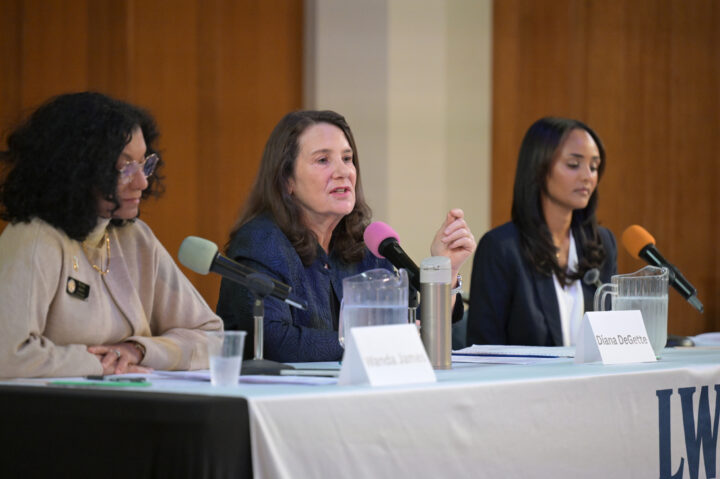
From left, Wanda James, Diana DeGette and Melat Kiros participate in a League of Women Voters Congressional District 1 candidate forum on May 28, 2026, in Denver, Colorado.
The wave of victories for Democratic Socialists of America-aligned candidates in New York City on Tuesday is buoying the hopes of progressives that the far left can pull off upsets against two Democratic incumbents in Colorado’s Tuesday primary elections.
Rep. Diana DeGette (D-CO) is facing a challenge from Melat Kiros, whose campaign has attracted substantial national attention and backing from several anti-Israel organizations and individuals including the Justice Democrats, DSA, Sunrise Movement, Jewish Voice for Peace, TrackAIPAC, the Council on American-Islamic Relations, Chris Rabb, Hasan Piker and, most recently, Sen. Bernie Sanders (I-VT).
Sen. John Hickenlooper (D-CO) is also facing a DSA-aligned challenger, state Sen. Julie Gonzales, though her campaign hasn’t garnered as much attention as Kiros’.
Just this week, in an interview with the local channel 9News, Kiros declined to call the firebombing of a hostage awareness march in Boulder, Colo. last year antisemitic.
“I don’t know what was in the heart of the perpetrator. All I know is that he went and attacked innocent people because of what they might have believed, and I don’t even know what the people that were at that protest believed too,” she said. “I don’t know what his intentions were.”
The House voted unanimously last year to condemn the attack as an antisemitic incident. Only Reps. Rashida Tlaib (D-MI) and Thomas Massie (R-KY), two of the leading anti-Israel lawmakers in Congress, voted present.
Kiros lost her job at the law firm Sidley Austin in 2023 for publishing a column denouncing hundreds of top law firms that called on law schools to do more to address antisemitism on their campuses. The column argued that calling for the elimination of Israel is not antisemitic and defended Hamas and those who have expressed support for it.
Kiros has made a complete arms embargo on Israel a central part of her campaign and has described the war in Gaza as a genocide and Israel as an apartheid state.
“I believe that our selling of arms to Israel, defensive or offensive, gives them the cover to continue the genocide that’s taking place in Palestine, and now the ethnic cleansing that’s taking place in Lebanon,” Kiros said in the local interview.
Kiros said in the interview that she did not agree with Piker that Hamas is a “lesser evil” than Israel, and denied that she thought the Oct. 7, 2023, Hamas attacks were justified.
Jim Carpenter, a Democratic political strategist in the state, predicted that DeGette “will ultimately win” but “this is certainly the toughest primary challenge she’s had in a really long time, if ever, since she was elected — lots of visibility, lots of interest.”
A poll commissioned by the Justice Democrats found Kiros leading DeGette 41-36%.
Multiple local venues recently declined to host a rally led by Kiros and Piker, which Kiros blamed on pressure from DeGette’s donors — something DeGette’s campaign has called “ridiculous.” Piker and Gonzales, citing security threats, declined to appear at a rescheduled rally in front of the state Capitol.
DeGette has been blasting Kiros over her affiliation with Piker, highlighting the streamer’s comments — supporting Hamas, dismissing sexual violence on Oct. 7, claiming that the U.S. deserved 9/11 and that he “hate[s] this country so much.”
“If Melat Kiros wants to campaign with someone who said America deserved 9/11 we’d do nothing to stop her,” a DeGette spokesperson told Colorado Newsline.
Carpenter highlighted the Sanders endorsement of Kiros as particularly valuable, noting that the senator has been popular in the state. But he also highlighted the significant influx of outside spending that has flowed into the race in favor of DeGette and targeting Kiros.
One group, Pro-Choice Majority Action, has spent more than $1.5 million boosting DeGette and attacking Kiros. Some observers have tied that spending to AIPAC, noting that the group took in close to $900,000 from EDW Action Fund, which in turn received $1 million from the AIPAC-linked United Democracy Project in May.
A UDP spokesperson did not respond to a request for comment. DeGette has not been consistently supportive of Israel, including signing a letter calling for unilateral U.S. recognition of Palestinian statehood and opposing additional offensive aid to Israel, but UDP has at times supported candidates not fully aligned with AIPAC’s policies in the interest of defeating others with more extreme records.
Rep. Pramila Jayapal (D-WA), a former Progressive Caucus chair, also recorded a last-minute video offering support for DeGette, describing her as critical to advancing Medicare for All.
Meanwhile, Justice Democrats has spent more than $500,000 supporting Kiros and opposing DeGette, and the anti-Israel American Priorities super PAC has spent $150,000 in support of Kiros.
Carpenter told Jewish Insider that, particularly in the wake of a party delegate vote earlier this year when DeGette was badly beaten by Kiros and came close to falling short of the threshold to appear on the ballot, the congresswoman has been campaigning aggressively.
Carpenter said that the anti-DeGette vote might ultimately come out split: University of Colorado Regent Wanda James is also challenging DeGette, and is likely to win support from some Black voters.
Though some in the progressive sphere have interpreted the New York City victories as a sign of momentum for an ascendant far left nationwide, Carpenter said that the results in New York don’t necessarily reflect Colorado’s own voting base.
“Colorado’s politics are very different,” he said. “All politics are local. I get the enthusiasm, and I get everybody trying to point to a trend and all of that. I just don’t think that’s going to hold in Colorado. Denver is very liberal but it’s a different kind of Democrat than the DSA.”
Gonzales is less likely to pose a serious challenge to Hickenlooper, the state’s former governor, having trailed significantly behind him in fundraising. “Gonzales just hasn’t had the resources really to compete statewide,” Carpenter said.
She’s been visible on social media and active in the Denver media market but “she just hasn’t had the ability to do paid advertising in a way that I think is any kind of real threat to Hickenlooper,” Carpenter said. Hickenlooper’s biggest vulnerabilities may be his age, 74, and a perception of him as an establishment Washington Democrat.
But Hickenlooper has also “taken this very seriously” and has been campaigning actively, reminding voters of his record during his two terms as senator and one term as governor, Carpenter said. The state also allows unaffiliated voters to choose the party’s primary in which to vote, and such voters have typically been a boon for Hickenlooper in the past, Carpenter added.
From the start of her campaign, Gonzales has made criticism of Israel a centerpiece of her bid, accusing Israel of genocide, supporting an arms embargo and fundraising based on her opposition to Israel and AIPAC. TrackAIPAC also endorsed Gonzales.
Also on Tuesday, state Rep. Manny Rutinel faces former state Rep. Shannon Bird in a primary for a key swing seat held by Rep. Gabe Evans (R-CO). Carpenter said that the race is difficult to predict and both have been strong candidates with built-in advantages and key endorsements.
Democratic Majority for Israel is supporting Bird and called the race one of its top priorities for the cycle. Bird has long been a strong supporter of Israel and vocal in opposition to antisemitism. Rutinel’s views on Israel have been less clear, and his past as a campus activist has worried some pro-Israel Democrats.
As an undergraduate at the University of Florida, according to a local news report, Rutinel attended a demonstration co-organized by Students for Justice in Palestine, but a Rutinel spokesperson, in a statement to JI, denied that Rutinel had any affiliation with SJP and said the demonstration was focused on police brutality in the U.S.
“Manny supports Israel’s right to exist and supports a two-state solution with secure borders to bring peace,” a campaign spokesperson said. Rutinel also “supports U.S. security assistance to Israel in line with the Obama administration’s 2016 memorandum of understanding,” the spokesperson added.
Carpenter said that Bird has a longer political record and deeper roots in the district, which she has leaned on in her campaign, but also may face headwinds from a perception of her as a moderate Democrat. Rutinel might benefit from the substantial Latino vote in the district.
“Bird is making the argument that because it’s a swing district that is more moderate … that’s what’s going to appeal” in the general election, Carpenter said. “That’s a harder message in a Democratic primary.”
Rutinel leaned into more of a progressive posture but “it seems to me like he’s trying to moderate that a little bit, and has gotten tripped up in a couple of debates on some of the more left progressive positions that he had taken in the past. It’s not a simple progressive-versus-establishment divide there, but it is kind of shaking out that way,” Carpenter continued.
Bird is also backed by moderate groups including the NewDems, Blue Dog PAC and Welcome PAC, as well as EMILY’s List and Elect Democratic Women.
Rutinel is backed by an array of both moderate and progressive lawmakers including Sen. Cory Booker (D-NJ) and Reps. Adriano Espaillat (D-NY), Lou Correa (D-CA), Robert Garcia (D-CA), Teresa Leger Fernandez (D-NM), Rob Menendez (D-NJ), Emily Randall (D-WA), Luz Rivas (D-CA), Linda Sanchez (D-CA) and Pat Ryan (D-NY).
The state’s gubernatorial primary is also set for Tuesday, where recent polling shows Attorney General Phil Weiser taking the lead for the first time against Sen. Michael Bennet (D-CO). The poll was conducted by a group supporting Weiser and showed that a significant portion of the voting base is still undecided.
Carpenter said that Weiser’s last-minute surge might signal that Bennet’s longtime service in Washington is being seen as a negative on the campaign trail, and he’s been tagged as not being anti-Trump enough in his time in the Senate.
But he said he didn’t think that the anti-establishment mood would necessarily be sufficient to oust DeGette or Hickenlooper, noting that Weiser himself is a well-known quantity and popular among Colorado Democrats going into the race.
“I think he benefits a little bit more from that than Gonzales or Kiros would,” Carpenter said.
Despite the success of DSA challengers at activist-dominated party meetings, analysts are skeptical they will succeed in the state’s Democratic primaries

Aaron Schwartz/Getty Images
Sen. John Hickenlooper (D-CO) listens to testimony at the Dirksen Senate Office Building on Capitol Hill on February 03, 2026 in Washington, DC.
Far-left challengers to Sen. John Hickenlooper (D-CO) and Rep. Diana DeGette (D-CO) are picking up support in internal party proceedings in what some progressives are touting as a sign of the incumbents’ vulnerabilities.
But local experts say those developments shouldn’t necessarily be read as signs that the two establishment Democrats are on their way out — the state’s Democratic Party processes tend to favor more progressive candidates, and both Hickenlooper and DeGette still have strong advantages going into the primary later this year.
In the Senate race, Hickenlooper, facing state Sen. Julie Gonzales, dropped out of the Democratic caucus nominating process, choosing to qualify for the June primary through petition signatures instead, a sign he’s facing resistance from typically left-wing party activists.
In the 1st Congressional District, far-left candidate Melat Kiros won nearly two-thirds of the Democratic Party delegates’ votes in Denver last weekend, nearly doubling DeGette’s support, and calling DeGette’s spot on the ballot into question.
Gonzales is a former member of the Democratic Socialists of America who was elected to the state Senate with the help of the group, but left the organization ahead of her run for Congress.
From the start of her campaign, she’s made criticism of Israel a centerpiece of her bid, accusing Israel of genocide, supporting an arms embargo and vowing, “I will never vote to send U.S. taxpayer dollars to Israel. Especially when communities here at home are being told there’s no money for schools or healthcare.”
Gonazales has also fundraised off of her opposition to Israel and AIPAC, calling the group’s support of Hickenlooper “repulsive and immoral,” and accusing Hickenlooper of funding “a genocide in Palestine” with taxpayer funds while depriving Americans of social services.
Another lesser-known candidate in the Senate, University of Colorado Professor Karen Breslin, is, like Gonzales and Kiros, endorsed by the extreme anti-Israel group Track AIPAC.
Kiros, 28, is running with the backing of the far-left Justice Democrats and the local DSA. Kiros has made an arms embargo on Israel one of her primary talking points, as well as described the war in Gaza as a genocide and Israel as an apartheid state. She said she was inspired to run for office in part by the defeats of anti-Israel Reps. Jamaal Bowman (D-NY) and Cori Bush (D-MO) last cycle.
Kiros lost her job at the law firm Sidley Austin in 2023 for publishing a column denouncing an open letter signed by hundreds of top law firms that called on law schools to do more to address antisemitism on their campuses. The primary premise of the column was that calling for the elimination of Israel is not antisemitic and that “conflat[ing] [antisemitism] with the geo-political question of Israel’s legitimacy is one of the greatest travesties in this conflict.”
In the op-ed, which she published a month after Hamas’ Oct. 7, 2023 attacks, Kiros wrote, “By conflating ‘calls for the elimination of the Israeli state’ with anti-Semitism, you delegitimize any solution that forces Israel to reckon with its colonial role in Palestine, including one-state solutions called for by Palestinians and Israelis alike,” she continued.
She also appeared to defend Hamas, and those who have expressed support for it, in the piece. Though she said that there was “no justification” for Hamas’ attacks, she also said that “it cannot be forgotten that violence does not occur in a vacuum” and questioned the description of “acts of Palestinian resistance” as “terrorism.”
“There has never been, in the history of the entire human race, a people whose land was violently taken from them, whose freedoms and rights were relegated to second-class citizenship, and whose very existence was systematically threatened by its occupier, who did not resist with violence in kind,” Kiros wrote. “And yet, acknowledging the seemingly obvious symptom of violent resistance to violent colonialism has led to the loss of employment and freedom to numerous individuals, particularly in places that claim to value freedom of speech.”
The piece is rife with factual errors and misrepresentations, including that Hamas only operates in Gaza and not the West Bank. It also described Israel’s founding as an act of colonialism imposed by a “brutalizing imperial power” to aid “a minority of Jewish people who subscribed to Zionism” and an effort to “discredit the indigeneity of the Palestinians and the existence of Palestine itself.”
While not as extreme as Kiros, DeGette has taken stances critical of Israel as well, including signing a letter calling for unilateral U.S. recognition of Palestinian statehood and opposing additional offensive aid to Israel.
“I have been saying for months that I would not support additional offensive weapon sales to Israel that could be used against innocent Palestinians,” she said in December. “More weapons are the last thing we need in the region. We need a permanent ceasefire, a massive surge of humanitarian aid, and lasting peace for both Israelis and Palestinians.”
Local political strategists said that, while these party processes should be a signal for both incumbents to take their opponents seriously, they aren’t necessarily a sign that either is likely to be defeated in the upcoming election. The delegates and activists who participate in such votes are generally more progressive and politically engaged than the electorate at large.
“It’s always been very much an insider game,” Jim Carpenter, a longtime Colorado political strategist, said of the process. “It’s always been … relatively easy to get your supporters into that and make an awful lot of noise that then kind of fades out in the primary. … The people who participate in the caucuses [are] a very different set of people than vote in the primary.”
“That reflects the party insiders, not the broader party rank-and-file,” Carpenter said.
The Denver area in particular has a large and active DSA contingent and progressives have tended to do well in internal proceedings in recent years, but those results have been a poor predictor and rarely reflective of the primary voting base, Carpenter said. If anything, finishing in the top spot in the internal process has sometimes been a poor omen for campaigns.
“If you’re putting money on this in Polymarket, you wouldn’t really want to use the caucuses as a leading indicator,” Rick Ridder, a longtime Democratic political strategist and pollster in Colorado, told Jewish Insider.
Ridder also emphasized that, with significant financial advantages over their opponents, both Hickenlooper and DeGette are positioned to win, noting that for more than 50 years, the candidates who have spent the most on television and digital ads have won in federal and statewide races.
Carpenter echoed that view, saying that as long as the two incumbents continue to raise money and remain active on the trail to emphasize their records and turn out their base, they should be well-positioned to win, though they have to take the challenges seriously, particularly when some Democrats are looking for generational change.
“Political prognostication is a dangerous business but I think they’ll be fine once the primary campaign really starts, and they can then more directly communicate with voters, and there’ll be a much bigger pool,” he said, noting that independents, with whom Hickenlooper has long been popular, can also vote in Democratic primaries in Colorado.
Carpenter said that Gonzales has a minimal statewide profile and has not proven to be a strong fundraiser so far, potentially leaving her with few resources to take on Hickenlooper. He added that the DSA and Justice Democrats, backing Kiros, are vocal and active, but “don’t have a constituency here.”
Hickenlooper, who also achieved ballot access through the petitioning process in 2020, has already collected the signatures necessary to qualify for the primary election, and framed his participation in the caucus process as aimed at energizing supporters.
“The campaign has already submitted the petitions needed to get on the ballot so our focus in participating in the process up to this point was to help energize the base, meet with voters, and support the work of our county parties,” Hickenlooper’s spokesperson said. “The Senator appreciates everyone who participated in the process and really enjoyed having conversations with folks across the state.”
Gonzales claimed that Hickenlooper’s decision was an attempt to avoid voters.
“How you show up matters, not just when things are easy, but especially when things are hard. I’ve spent my career walking picket lines, organizing tenants + teachers, and listening to working people across Colorado. That’s what you do when you actually want to earn people’s trust,” she said on X.
Like Hickenlooper’s campaign, DeGette’s campaign similarly downplayed the results of the delegate vote in a statement.
“Diana DeGette has worked hard for Denver for over 30 years and is grateful she is on track to make the ballot through the assembly process, despite the major technical issues with the party’s software platform and serious questions about the process,” a DeGette spokesperson told Colorado Politics, addressing the results of the delegate poll. “She enjoyed connecting with Democrats about the issues that matter to them.”
Kiros told the Denver Post the results were “a testament to the organizing we were doing and the lack of organizing [DeGette] was doing on her part — and her thinking she would coast through.”
The recent caucuses were also plagued by technical issues related to a new app-based voting system.
Hickenlooper had $3.9 million on hand as of the end of 2025, dwarfing Gonzales’ $161,000 war chest. Degette finished the year with $535,000, as compared to Kiros’ $64,000. Hickenlooper is also well ahead of Gonzales in polling.
Please log in if you already have a subscription, or subscribe to access the latest updates.
 Continue with Google

 Continue with Apple