














































































The show, which bridges Orthodox and secular perspectives with humor, will expand its reach through the production company behind Dan Senor's 'Call Me Back’
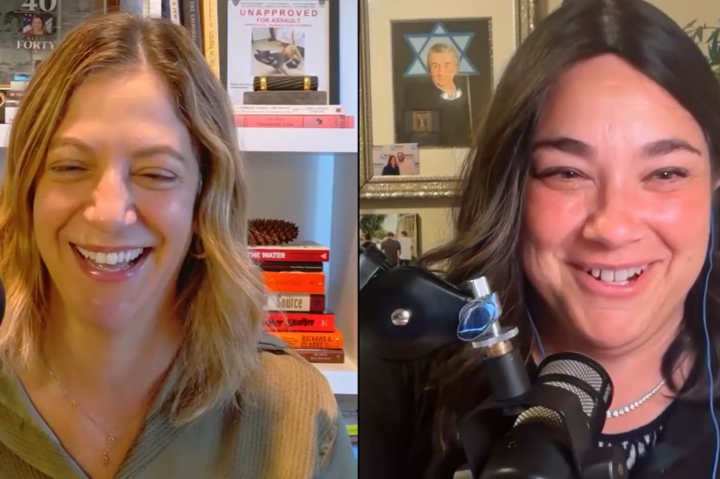
ChayaLeah Sufrin and Yael Bar Tur


 Add JewishInsider on Google
There aren’t many places where an Orthodox Chabad mother of four and a secular Israeli social media strategist can debate Jewish life, Israel and dating — and still leave the conversation laughing.
That’s the premise behind “Chosen People Problems,” the podcast hosted by ChayaLeah Sufrin and Yael Bar Tur, whose friendship grew after they appeared on another podcast together.
For the past four years, the two have built an audience by bringing their very different perspectives to conversations about the Jewish world, with the goal of making listeners — about a third of whom they said are not Jewish — feel less like they’re tuning into an interview and more like they’re overhearing friends at the dinner table. No topic is off that table: from Holocaust jokes to debating which Houthi terrorists are attractive.
“And serious stuff, too,” Sufrin told Jewish Insider in a recent interview. “Oh, very serious stuff, too. But three years post-Oct. 7 we think everyone deserves a laugh,” added Bar Tur.
Now the podcast is getting a bigger platform. “Chosen People Problems,” formerly called “Ask a Jew,” is relaunching with Ark Media, the media company behind Dan Senor’s podcast “Call Me Back.” Moving forward, listeners can expect a new weekly free episode alongside a second, exclusive “Ask Me Anything” episode for Ark+ subscribers.
“This is a dream come true for us that they approached us,” said Bar Tur. “We’re big fans of Dan [Senor] and Ark Media. We listen to ‘Call Me Back.’ We’re bringing in humor and saying the things people usually don’t say out loud, for better or worse.”
Beyond being “funny and not giving a sh*t,” as Bar Tur puts it, the duo’s appeal comes from the fact that they occupy “two parts [of Judaism] that don’t really talk to each other a lot.” That divide is not incidental to the podcast; it is what gives their conversations tension — and, they say, the potential to build bridges.
“I think that Yael really sees herself as an Israeli in a way that I can’t relate to,” Sufrin said. “I see myself as a Jew and I don’t have that Israeli identity. Yael comes at things most often from an Israeli perspective. As an Orthodox Jew, I’m often coming at things from a religious perspective, and that sometimes makes Yael uncomfortable. Sometimes the things that she says about how she views Jewish ritual or practice, I’m confused. But we talk through these things so much that it’s becoming normal.”
What keeps those differences from becoming divisive, Sufrin said, is a shared sense of what they ultimately want for the Jewish community. “The best part is both of us understand that we have the same goal in mind, and that’s to have a strong, safe, thriving Jewish world, whether it’s in Israel or the U.S.”
That combination of disagreement and common ground is also central to how they think about the podcast. “Someone described the podcast as ‘light but not shallow,’” Sufrin said. “We’re really talking about things that Jews around the country, and around the world, are talking about at their dining room tables. We’re just making it a public conversation.”
The hosts say they have found themselves agreeing more since the Oct. 7, 2023, Hamas attacks, but their differing vantage points remain part of what makes the conversations interesting. “We come from such different parts of the Jewish world that it brings something different: an added layer of bridge-building and seeing the other perspective,” Sufrin said.
When “Chosen People Problems” first launched, its conversations most often centered on pop culture or finding meaning in Jewish rituals and practices. But Oct. 7 changed the tenor of the show — and, the hosts said, the audience they were speaking to. In the aftermath of the attacks, they saw a surge of interest in Judaism from people who had previously engaged with their Jewish identities only occasionally, as anger, grief, confusion and a desire for community brought Jewish identity to the forefront of their lives.
“We were just talking about those things bluntly and it resonated,” Sufrin said. Bar Tur said many listeners felt isolated after Oct. 7, and that one of the best compliments they receive is, “I feel like I’m overhearing friends talking.” The relaunch with Ark, she said, is an effort to extend that sense of community beyond the two hosts themselves — creating a space for the Jewish diaspora to see itself as a single, if complicated, people. “It’s not just the Israeli people, or Orthodox people, or secular people,” she said. “It’s all of us.”
“Chosen People Problems” has featured guests — not always Jewish — from a broad range of backgrounds, including rabbis, journalists, political commentators, activists and comedians.
“The best guests are ones we can be ourselves with, and they can be themselves. We want people to feel like they’re listening to a conversation, not an interview,” said Bar Tur.
While not much is off limits for the show, Sufrin said a boundary is that they won’t bring on anti-Zionists. “We’re happy to talk with people who are thinking about the problems we’re facing right now, and sometimes just to laugh about it. It’s important to acknowledge there’s a problem and then be able to laugh,” she said.
Their lineup has already featured prominent figures including CNN political analyst Scott Jennings, Foundation for Defense of Democracies CEO Mark Dubowitz and Senor. So if they could have any Jewish person in the world — living or dead — sit down for an episode, who would it be?
Sufrin said she would love to talk with sex therapist Dr. Ruth Westheimer, who died in 2024.
“I would want to talk to her about choosing to be a public Jew and holding on to her passion and Jewish pride, throughout all the different iterations in her life. She went from being a fighter in the [Haganah] to being a sex guru. Her Judaism always seemed centered and central to her identity. I would just love to have a conversation with her.”
Bar Tur’s pick is Irving Berlin, the Jewish songwriter behind the iconic holiday classic “White Christmas.” She even keeps a photograph of him in her apartment.
“I love his music,” she said. “A lot of these songs written by Jews were actually about the fantasy or yearning of what it would be like to celebrate Christmas. I’d just love to hear about that time and industry, and compare notes from today.”
The Well — named for the biblical story of Eliezer finding Isaac’s wife, Rebecca — combines the best of matchmakers and technology, founder Erica Schwartz told JI
Liri Agami
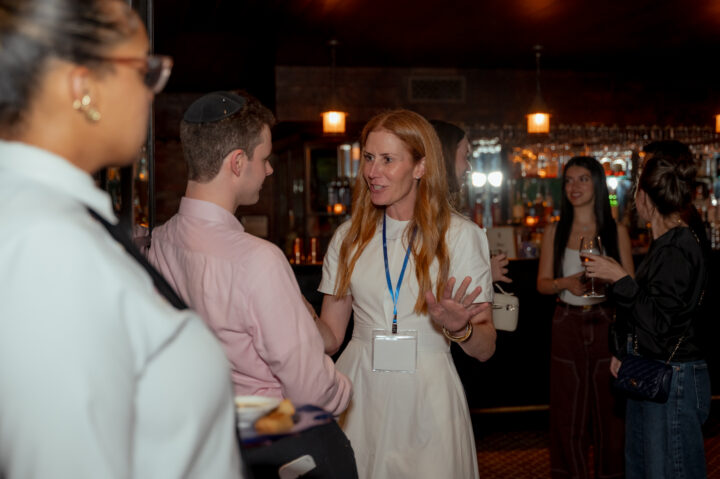
Erica Schwartz mingles with prospective users of The Well at the app's launch event on July 278, 2028, in Manhattan.
When the biblical Abraham sought a wife for his son Isaac, he dispatched his trusted servant to the city of Nahor in Mesopotamia. The servant, Eliezer, stopped at a well and prayed for a sign: the right woman would offer water not just to him, but to his camels as well. Rebecca did exactly that — and became Isaac’s match.
That story now has a modern namesake. A new dating app called The Well, slated to launch in the coming weeks, exclusively matches Jewish day school alumni. It’s aiming to fill a void for the very affiliated Jews searching for their bashert but tired of swiping.
“As I started to watch the way the world — at least in my Modern Orthodox circle — was meeting or not meeting each other, something felt very broken to me,” Erica Schwartz, the app’s founder, told Jewish Insider on Tu B’Av, the Jewish holiday of love, which began at sundown on Tuesday.
“Back in my day, we’d go to a synagogue and you’d meet and mingle outside and somebody might give you a call. Now everything is through a matchmaker and people aren’t meeting in person so everything is moving to more formal apps or shidduch résumés.”
Schwartz graduated from the Modern Orthodox Ramaz School on Manhattan’s Upper East Side, where she now serves as board chair. She also sent all six of her children to Jewish day schools. She said the aforementioned methods of dating were not “speaking to what I look at as this large middle niche I’m putting under the banner of the day school crowd, where they have a Jewish background and identity so they’re not a random Jew out there on a dating site, and they’re also not the ultra-Orthodox dater who is going to, through a matchmaker, go on six dates and then get married.”
“In that middle camp are all these day school graduates who are looking to meet somebody,” continued Schwartz. “It seems like such a natural place of overlap and connection, they just need to become aware of each other. That’s what The Well is trying to do — build a niche area of Jewish dating.”
Unlike mainstream dating apps — including other Jewish ones — known for endless swiping, The Well features no swiping at all, which makes it feel more personal, said Schwartz. She describes the platform as “human intuition and wisdom working in tandem with technology.”
The Well enters a crowded field of established Jewish dating apps — swipe-based JSwipe, application-only Lox Club and older-skewing JDate. But it’s betting that its swipe-free, day-school-verified niche can reach daters that those other platforms don’t.
Users, who must be in their 20s and 30s, begin by filling out a profile form. The first thing they’re asked to note is the day school they attended and year of graduation. Day school graduates of all backgrounds — from pluralistic to yeshiva — are welcome to join, but users must submit two names of people who can vouch that they attended that school. “That’s our current verification system. We need to see how that works and are prepared to tighten it a bit,” said Schwartz.
The profile form then prompts users to speak with a chatbot named Elli — a nod to Eliezer from the biblical story.
Elli is trained to ask follow-up questions in nuanced ways and pick up the user’s personality, said Schwartz. It asks users to describe their religious beliefs, share their profession and include key dating details like height preference or college alma mater.
Users also have the option to fill out the form manually, but Schwartz said taking advantage of Elli is preferred.
The Well also offers a small, vetted cohort of matchmakers if users wish to open their profile to them. Daters can also book an individual phone session with a matchmaker for $180, but otherwise the app is entirely free of charge.
A team of about a dozen advisors and matchmakers has been involved since the app’s inception, including two Modern Orthodox rabbis: Rabbi Elie Weinstock, senior rabbi of the Jewish Center of Atlantic Beach on Long Island, and Rabbi Daniel Kraus, director of community education at Congregation Kehilath Jeshurun in Manhattan.
“The future of Jewish dating isn’t choosing between technology and people,” Kraus told JI. “It’s combining the best of both. There are many excellent dating apps today. But no single platform can serve every community equally well. Every week I meet remarkable young adults who are ready to build Jewish homes, yet many still struggle to meet the right person. The challenge isn’t a lack of commitment. It’s creating meaningful opportunities for the right introductions.”
“The Well’s model is especially compelling because it pairs the scale and intelligence of technology with the wisdom, intuition and personal touch of experienced shadchanim [matchmakers],” continued Kraus. “Technology broadens the possibilities. People bring the judgment that no algorithm can fully replicate.”
The name itself, said Kraus, is “deeply rooted in Jewish tradition.”
“Throughout Tanach, wells are places where lives change,” he said. “Rivkah, Rachel and Tzipporah each met their future spouse at a well. While the platform is new, the mission is timeless: to help more young Jews find one another and build the next generation of Jewish families.”
The Well features two levels of profiles: public and private. The private one is only seen by Elli or a matchmaker. There’s also a dashboard where matchmakers can discuss the profiles of their clients so they can make suggestions in addition to the ones Elli makes.
Names are drawn for users every Monday and Thursday — the days biblical Jews traditionally went to the market — and they have a certain amount of time to respond; they can say “pass” or can choose to start a conversation. They can also share someone’s profile with another user in their “village,” which is the equivalent of Facebook friends.
“Some of that we’re fine tuning to make sure we’re not infringing on privacy,” said Schwartz, adding that the platform uses vanishing pictures to ensure profiles aren’t screenshotted and sent around.
Since dating apps first launched in the 2010s, they have instantly put hundreds of profiles at users’ fingertips, making them the favored method for nearly half of Americans looking for love, according to a Forbes Health survey. But apps that claim credit for matches made five or ten years ago now face user burnout, with many people saying they prefer to meet in person rather than swipe through an endless pool of potential mates. Seventy-eight percent of users report dating app burnout, according to another Forbes survey conducted last year.
Addressing this, Schwartz said The Well also features an events section of the app that will advertise social gatherings for this demographic across the country. She described that as a “crucial” component.
Before officially going live, The Well hosted an invitation-only launch event Tuesday night at the swanky Bowery Hotel on Manhattan’s Lower East Side, timed to coincide with Tu B’Av, drawing some 200 young professionals eager to mingle and learn about the app.
“What makes The Well stand out is that it rejects the culture of infinite swiping and disposable connections,” Erez Kahan, a 35-year-old who works as a relationship manager in the family office space and attended the launch event, told JI. “Instead, by thoughtfully introducing just a couple of carefully considered matches each week, it encourages people to slow down, be present and give each connection the attention it deserves. It’s a refreshingly human approach — one that values individualized care, quality over quantity and genuine intention over endless choice.”
Kahan, a graduate of The Frisch School, a Modern Orthodox school in New Jersey, said he’s particularly drawn to the symbolism behind The Well’s name — something he expressed hope to experience through the app: “A chance meeting at a well became something guided by purpose rather than endless searching.”
A new survey by Jewish Women International found that young women experienced major disruption to their dating lives in the aftermath of Oct. 7, with some now seeking out Jewish partners

Getty Images
Rear view of a young couple sitting side by side on a bench in a city park during autumn.
Nearly half (47%) of young Jewish women reported dating less as a result of increased antisemitism and other negative consequences of the Oct. 7, 2023, Hamas terror attacks, according to a new survey by Jewish Women International.
Over one-third (36%) of respondents said they’ve ended existing romantic relationships due to these dynamics, while 18% said they’ve stopped online dating altogether.
Many of the Jewish American women surveyed, who were between the ages of 20 and 34, reported other negative impacts to their romantic relationships including strained conversations (75%), arguments (53%) and decreased contact or connection (39%).
One respondent described ending a relationship over “our differing levels of Zionism” and while another experienced “tension in our relationship” on the “first anniversary of Oct. 7.” One said she “ultimately ended my relationship with my partner because he was always so angry about Gaza but never showed any anger toward antisemites, toward Hamas, or even to an antisemitic gunman who killed two of my peers.”
A vast majority (71%) of respondents said they’d changed what they’re looking for in a dating partner in the aftermath of the attacks, which for several meant seeking out exclusively Jewish partners,
“I decided to only date Jewish to avoid any blatant antisemitism, and also to ensure that there would be common ground,” one wrote. “Before October 7, like, sure, I wasn’t opposed to going on a date with someone who wasn’t Jewish, and exploring that opportunity. And now — not really so much,” another said. “Felt deeper connections to Jews I know and are strangers. Exclusively wanted to date only Jews,” another wrote.
Jewish singles have been grappling with the impact of increasingly heated antisemitic rhetoric on dating apps and among potential romantic interests for years now, as several told Jewish Insider in 2024 that they too had pivoted to seeking a Jewish partner as they waded through politically charged rhetoric on dating profiles.
Even more than their dating lives, survey respondents experienced negative impacts to their mental health (75%) and friendships (74%), with 80% reporting decreased contact in their platonic relationships. For those on college campuses, 68% said their sense of belonging was damaged in the aftermath of Oct. 7, and 63% said the same of their relationships with their classmates.
In professional settings, 39% of respondents said they’d felt pressured to minimize their Jewish identity and 18% said they’d removed Jewish content from their resumes. Several said in written responses that they’d been drawn to work in Jewish advocacy by their experiences.
“JWI has dedicated significant time and resources to a comprehensive national survey of the impact of antisemitism and misogyny on young Jewish women. Based on our findings, young Jewish women feel disenfranchised in the workplace, ostracized in social circles, and compelled to erase their Jewish identities for fear of personal safety,” said Meredith Jacobs, CEO of JWI, who added that the organization will focus its programming on “post-traumatic growth.”
“As the mothers of the next generation of the Jewish diaspora, the support these women receive will directly impact the future of Jewish peoplehood,” Jacobs continued.
The 514 respondents were largely reached through JWI’s networks, including focus groups at the organization’s leadership conference, between Nov. 11-Dec. 22, 2025.
Please log in if you already have a subscription, or subscribe to access the latest updates.
 Continue with Google

 Continue with Apple