









































































The nearly three-hour episode was one of the most public clashes between Carlson and a prominent Christian Zionist and stalwart supporter of Israel
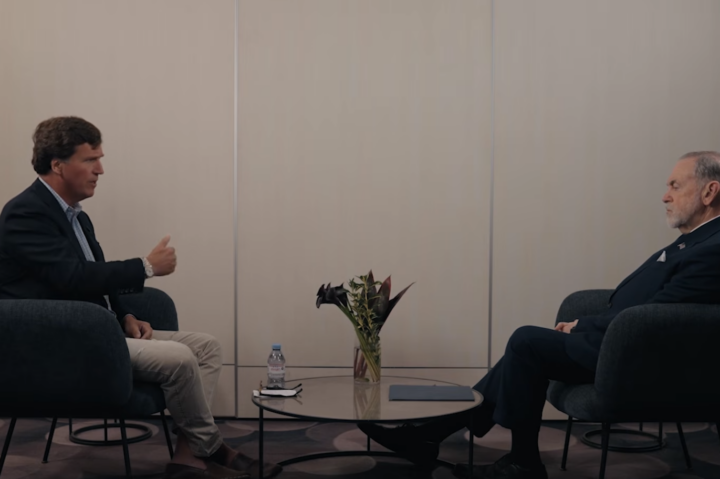
Screenshot
Tucker Carlson interviews U.S. Ambassador to Israel Mike Huckabee on Feb. 18, 2026.


 Add JewishInsider on Google
In a combative conversation with Tucker Carlson, U.S. Ambassador to Israel Mike Huckabee repeatedly corrected and pushed back against the far-right podcaster’s caricatures of Israel, the country’s war against Hamas, the historic connection of Jews to Israel and threat that Iran poses to global security.
The nearly three-hour episode, taped at the Fattal Terminal at Tel Aviv’s Ben Gurion Airport earlier this week, was one of the most public clashes between a prominent Christian Zionist and stalwart supporter of Israel and Carlson, who has emerged as a leader of a small but growing antisemitic faction on the far right.
Since being fired from Fox News in 2023, Carlson has used his online platform as a friendly venue for Holocaust revisionists and antisemitic social media influencers. Among the few times he has used his show to aggressively question guests, those he has invited on have been conservatives who support Israel, such as Sen. Ted Cruz (R-TX) last summer.
Carlson opened the episode with Huckabee, which was released on Friday, with a lengthy monologue defending his refusal to leave the airport grounds and baselessly alleging aggressive treatment by Israeli officials, including passport holds and questioning of his producers — claims that Huckabee and Israeli authorities have described as routine security procedures rather than detention.
The two men sparred throughout the hourslong interview, with tensions rising when Carlson challenged Huckabee’s references to biblical ties of Jews to the land of Israel and pressed him on the scope of land promised in Genesis 15:18 — from the Nile to the Euphrates.
Carlson asked if this meant Israel could claim “basically the entire Middle East.” Huckabee replied that “it would be fine if they took it all,” but quickly clarified that Israel was not pursuing such expansive territorial goals.
Huckabee underscored that his position was far more modest: “I’m simply saying that the people who live in Israel… have a right to have security, have safety. They have a right to be able to live in this land that they have a connection to.”
Later in the conversation, Huckabee confronted Carlson over his decision to host Anthony Aguilar, the ousted Gaza Humanitarian Foundation contractor whose claim that the IDF killed a 14-year-old was definitively disproven when the individual was located alive, having safely been extracted from Gaza with involvement from multiple countries, including U.S. diplomatic efforts in which Huckabee played a key role.
Huckabee stated bluntly: “You interviewed Tony Aguilar, who claimed that IDF soldiers killed a little boy in his presence. That didn’t happen. It did not happen. … Tony Aguilar is a liar.”
Carlson grew tense, denying he had “platformed” Aguilar in a problematic way, “I don’t know if you know whether it happened or not. I don’t know that he made it up. He seemed to believe it to me, but it’s possible he’s wrong. I’ve been wrong many times.”
Huckabee pressed back, emphasizing that this went beyond a minor error: “This is a little bit more than just missing a fact.”
The discussion again grew heated when Huckabee highlighted Hamas’ terror tactics, including its documented practice of recruiting and arming Palestinian teenagers to serve as terrorists.
Carlson immediately accused Huckabee of justifying the killing of such individuals in Israeli military operations, pressing him on whether a 14-year-old “has agency” and “deserves to die because he’s being used by adults.”
Huckabee countered by underscoring the serious security threats that Israel faces, asking what Israeli forces should do in a life-or-death scenario: “What are they supposed to do if that individual is holding a gun and he’s pointing it at someone who’s trying to save a hostage, and that’s the only way to save that hostage?”
“I’m telling you that war is a horrible thing,” Huckabee added.
The two also discussed Qatar, and Carlson’s connections to the Gulf state. Carlson argued that Christians were treated better in Qatar than in Israel. Huckabee responded that most Christians in Qatar were low-paid foreign workers, while Christians thrive in the Jewish state.
The argument then turned on the tendentious question of whether there were more Christian citizens in Qatar or Israel. Huckabee stumped Carlson by asking him what the Christian population in Qatar was, which Carlson admitted he did not know off-hand. Huckabee then pointed out that Qatar’s Christian population included fewer citizens than Israel’s.
“You’ve caught me. I don’t know,” Carlson said before pivoting topics. “I can look it up on my phone, but I was just there, and there are many. Whatever.”
The exchange drew comparisons to a viral exchange from Carlson’s interview with Cruz last summer, when Carlson promoted the fact that the Texas senator didn’t know the exact population of Iran.
The Trump administration’s Middle East envoy, along with his son Alex, is hosting a weekend breakfast conversation focused on global challenges and opportunities
CHANDAN KHANNA/AFP via Getty Images
Special envoy to the Middle East Steve Witkoff speaks during the FII Priority Summit in Miami Beach, Florida, on February 20, 2025.
Steve Witkoff, the Trump administration’s Middle East envoy, is slated to host a breakfast conversation on Saturday in Southampton, N.Y., focused on global challenges including the Israel-Hamas war, as part of the Milken Institute’s Hamptons Dialogues.
Witkoff, who will sit in conversation with Michael Milken, is co-hosting the breakfast with his son Alex, two weeks after meeting with Qatari Prime Minister Abdulrahman al-Thani in Spain to discuss ceasefire and hostage-release efforts.
The breakfast is one of the few sessions during the weekend-long confab that will touch on the Middle East. According to an agenda viewed by Jewish Insider, the conversation between Witkoff and Milken will focus on how “[e]conomic, technological, and geopolitical competition is restructuring the global order” and notes that “[s]trategic rivalry with China, instability in the Middle East, the war in Eastern Europe, and shifting alliances are testing established frameworks for cooperation.”
On Friday, Pershing Square’s Bill Ackman will speak about K-12 education and the Alpha School, a project he has promoted in recent months that eschews DEI programming and focuses on AI-driven education. Later on Friday, former Commerce Secretary Gina Raimondo and Virginia Gov. Glenn Youngkin are speaking on a panel about the U.S.’ economic advantages.
Sen. Lindsey Graham (R-SC) is slated to speak on a Sunday morning panel focused on U.S. economic security, followed by back-to-back sessions about the future of American cities, featuring NYPD Commissioner Jessica Tisch, Carlyle Group cofounder David Rubenstein and Related Companies’ Stephen Ross.
Rubenstein will again take the stage Sunday afternoon for a conversation about sports investments, which will also feature Len Blavatnik.
Other figures at the annual gathering include former First Lady Jill Biden, Sen. Bill Hagerty (R-TN), Oaktree Capital’s Howard Marks, Alphabet President and CIO Ruth Porat and actor Jerry Seinfeld.
Please log in if you already have a subscription, or subscribe to access the latest updates.
 Continue with Google

 Continue with Apple