














































































The letter, released by JINSA on the third anniversary of Oct. 7, argues that such allegations may affect the way the U.S. and its allies conduct future conflicts
Majdi Fathi/NurPhoto via Getty Images
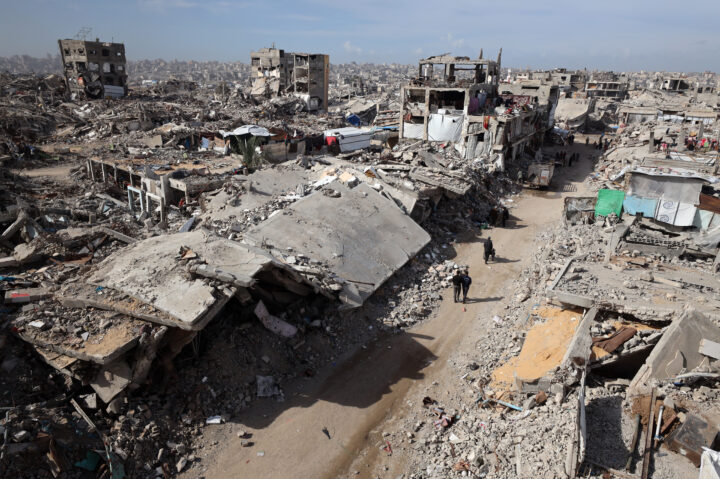
A photograph shows destroyed buildings in Jabalia, in the northern Gaza Strip, on December 9, 2025.


 Add JewishInsider on Google
A group of more than 75 American military leaders is pushing back against allegations that Israel has committed genocide in Gaza, arguing in a letter released Wednesday that the accusation is unsupported by the legal standard for genocide and contradicted by the conduct of the Israeli military during the war.
“As retired senior military leaders and legal experts, on this, the third anniversary of Hamas’s October 7, 2023 brutal attack on Israel, we reject claims that Israel committed genocide in Gaza,” the letter, released by the Jewish Institute for National Security of America, says. “The allegations that Israel committed this crime do not meet the established definition and standards of genocide, are unsupported by established facts, nor do they stand up to common sense scrutiny.”
The signatories argue that a finding of genocide requires evidence that a protected national, ethnic, racial or religious group was targeted for destruction, in whole or in part, and contend that Israel’s actions in Gaza do not meet that standard.
“Israel has neither intended to, nor destroyed, Palestinians as a group in Gaza,” the letter reads. “All the evidence, in fact, points to the contrary conclusion: that, after suffering a barbaric, indiscriminate massacre by Hamas terrorists on October 7, 2023, the Israel Defense Forces (IDF), acting in justified self-defense, went to extreme lengths to protect civilians in Gaza, including from Hamas.”
The authors also dispute arguments that the number of civilian deaths establishes genocide, saying casualty figures from Gaza are unreliable.
“Genocide is not a quantitative crime; there is no number of civilian casualties that constitutes genocide,” the letter says. “Nor are the claimed casualty numbers from Gaza credible. Issued by Hamas themselves and, at the very least, not distinguishing between civilians and combatants, they cannot be relied upon.”
They argue that the war must be viewed in the context of fighting an enemy that operates among civilians, drawing on their own experiences commanding U.S. forces in similar combat environments.
“We understand that the loss of civilian life in Gaza is tragic, but we also know that such tragic outcomes do not necessarily violate the law of armed conflict,” the letter says. “Further, established legal precedent makes clear that civilian deaths occurring during combat, however tragic, are insufficient, by themselves, to support a finding of genocidal intent.”
“Many of the signatories to this letter have commanded United States armed forces in combat against enemies who regularly hide behind civilians and put those civilians intentionally in harm’s way,” the letter continues. “Fighting under those complexities is especially difficult.”
The letter then points to the extensive measures taken by the IDF to reduce civilian casualties as evidence that the military took precautions and lacked genocidal intent during its operations in Gaza.
“The IDF has provided civilians with numerous advance warnings, leaflets, phone calls, text messages, radio and TV broadcasts, and social media notices, evacuation instructions, protected corridors, and tactical pauses to help move them out of harm’s way,” the letter says. “Repeatedly, Israel has called off strikes because of the presence of civilians.”
The authors also cite Israel’s provision of humanitarian and medical assistance to Gaza as evidence that its conduct is inconsistent with an intent to destroy Palestinians as a group.
“More than 3.5 million tons of food, 48,000 tons of medical supplies, 5,000 tons of baby food, and up to 15,000 cubic meters per day of water desalinated by Israel have been sent into Gaza,” the letter says. “Over half a million Gazan children were vaccinated during the war and some 5,000 Gazans evacuated for medical treatment abroad.”
“These are not the actions of a genocidal state but of a professional military ethically and legally committed to the protection of civilian life,” the authors add.
They condemned “inflammatory statements” by some Israeli political officials that have been cited as evidence of genocidal intent, while arguing that those remarks do not reflect the conduct of the Israeli military. The letter did not point to any specific officials, though leaders including former Israeli Defense Minister Yoav Gallant, Finance Minister Bezalel Smotrich and National Security Minister Itamar Ben-Gvir have been accused of such incitement.
“Such inflammatory statements are disgraceful,” the letter says. “Yet, while it deserves unequivocal condemnation, rhetoric from politicians uninvolved in military decision-making is in no way reflective of actual IDF operations.”
The signatories warn that how the Gaza war is judged could affect the way the U.S. and its allies conduct future conflicts, urging readers to apply what they describe as the established legal standards of the 1948 genocide convention.
“Failure to do so incentivizes future adversaries to deliberately endanger civilians and then exploit civilian suffering to portray lawful operations as genocide, weaken public support, and divide our alliances,” the letter says. “The precedent established today regarding Israel will shape the conditions under which American forces fight tomorrow.”
The candid conversation was reflective of growing Jewish concern about the humanitarian situation in Gaza
Jerritt Clark/Getty Images for Museum of Tolerance
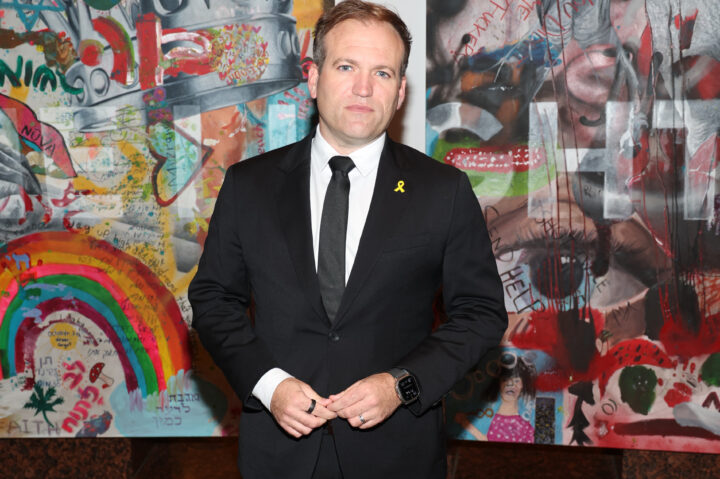
Reverend Dr. Johnnie Moore, President of the Congress of Christian Leaders attends the Museum Of Tolerance Commemoration of the one-year anniversary of the October 7 attacks at Museum Of Tolerance on October 06, 2024 in Los Angeles, California.
Faced with tough questions about the humanitarian crisis gripping Gaza from members of one of the country’s most prominent synagogues, Rev. Johnnie Moore, executive chairman of the Gaza Humanitarian Foundation, defended his organization’s actions and said reports of civilian casualties at GHF’s aid sites are overblown.
“The hunger crisis in Gaza is real, and on the same token, this crisis is being used in all kinds of different ways to advance other agendas,” Moore told members of Sinai Temple, a large Conservative synagogue in Los Angeles, in a webinar hosted on Thursday by its leader, Rabbi Erez Sherman.
“Hamas is losing control,” said Moore, a member of President Donald Trump’s evangelical advisory committee. The terrorist organization has made shutting down GHF a central demand in ceasefire negotiations with the U.S. and Israel. “We are meeting with Gazans every single day.”
As hunger worsens in Gaza, some pro-Israel American Jews are growing increasingly concerned with the humanitarian situation in the Palestinian enclave and placing some of the responsibility with GHF, which took over the aid distribution in May with backing from the United States and Israel.
Emblematic of the questions and unease that American Jews are grappling with, congregants of Sinai Temple grilled Moore, submitting questions through Sherman, about troubling reports — such as Palestinians being crushed in crowds and killed by live ammunition waiting for aid — that have plagued GHF since it started delivering food and humanitarian aid in Gaza.
Sherman told Jewish Insider that he received requests from many congregants to ask Moore “the tough questions.” That included asking about GHF’s model — which has limited food distribution sites to four locations that critics say are not easily accessible and can be dangerous.
“We’ve done a lot in two months but it’s a new operation. We’re not perfect, we’re learning every day and we’re dedicated to being direct about what we think is working and what isn’t,” Moore answered. “One of the things we’ve been doing is a very successful community distribution arm which is more like the traditional U.N. system, where through local partners we distribute thousands of boxes more directly.”
“It has always been our intention to serve everyone in the Gaza Strip,” Moore added later.
The conversation came as Senate Democrats recently argued that GHF has “failed” in its mission and “contributed to an unacceptable and mounting civilian death toll.”
Moore pushed back against what he called “disingenuous” narratives about the organization’s work.
“Many days Hamas would attribute 100 percent of the casualties in Gaza to happening inside our distribution sites,” he said. “There have been some civilian casualties of people trying to get to our distribution sites — [which] the IDF has said it is responsible for, but we think that’s a relatively small number of people, [although] one person is too much … We have not seen the Israeli military do anything that remotely aligns with accusations [of misconduct] and we can’t control anything that happens outside of our [four] distribution sites.”
“Why are people not sharing the stories of the good GHF does?” Sherman asked Moore. “Everything that comes along with good also sometimes has bad components.”
Moore said that there are “both sincere and insincere reasons” for negative media coverage. “There are people who are using this for their own political, or other, purposes.”
He went on to criticize “the broken humanitarian system [for] prolonging the war” and the United Nations for its unwillingness to partner with GHF, although a breakthrough may be coming he said, claiming that “in the last couple of days, we have some indications that some people in the U.N. system are going to defy the leadership.”
“I thought this conversation would be about food but it’s a much greater conversation,” Sherman said during the webinar. He asked Moore about the link between photos of starving Gazans and the recent news that several countries, including Canada, plan to recognize a Palestinian state.
“Whether you agree or disagree with the policies of France, the U.K., they made those decisions within the context of talking about the humanitarian crisis of hunger in Gaza, a crisis caused mainly, not entirely, but mainly by a globally designated terrorist organization,” Moore answered.
Sinai Temple runs an Israel center “established to forge an ever stronger link between Los Angeles Jewry and Israel,” according to its website. But even as most congregants identify as pro-Israel, or “Israel engaged,” as Sherman prefers to describe it, he told JI that the congregation is “a very diverse community” which, like other Jewish American communities, is wrestling with how much blame Israel bears in the Gaza crisis.
“Rev. Moore is literally at the center of the most difficult and disturbing issue in the world at the moment, so how can we not engage in this conversation? The divisiveness in the Jewish community in America is very difficult and those two parts also need the opportunity to hear from each other,” Sherman told JI, referring to those who disagree on GHF’s approach. “This is a moment where we have to balance morality and conviction.”
“We’re in the week of Tisha B’Av and when you look at the history of Jewish communities splintering, it’s no longer theoretical, it’s a real piece,” he said.
“Rev. Moore has thanked us for the courage to bring him and I think that’s an important thing for speakers to understand, that it takes courage for communities to bring narratives that might not all be agreed with,” Sherman told JI, noting that he plans to bring Ahmed Fouad Alkhatib, a Gazan outspoken against Hamas who heads the Atlantic Council’s Realign for Palestine project, as the synagogue’s next speaker.
“Let’s see what he has to say,” said Sherman. “I’m interested in the narratives of people who wouldn’t necessarily be at my Shabbat table.”
Please log in if you already have a subscription, or subscribe to access the latest updates.
 Continue with Google

 Continue with Apple