










































































While Democrat Analilia Mejia comfortably won the special election to succeed Mikie Sherrill, Jewish voters swung to the right
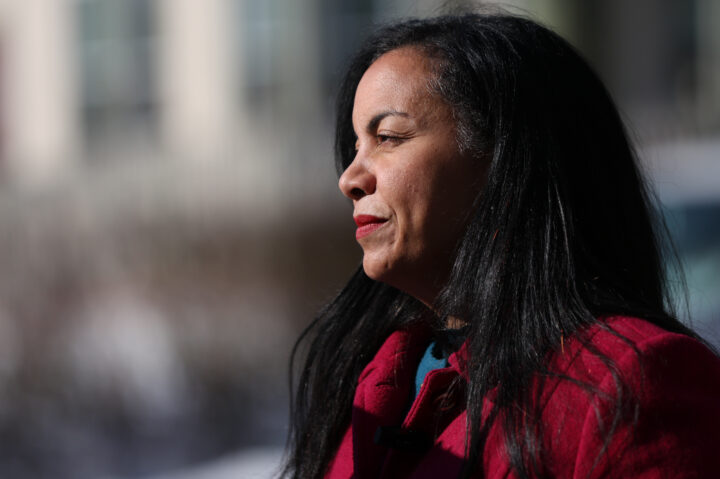
Heather Khalifa/Bloomberg via Getty Images
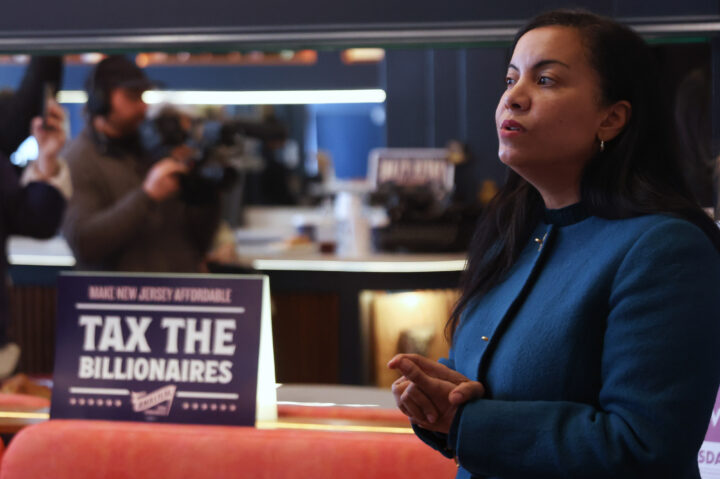
Analilia Mejia, US Democratic House candidate for New Jersey, speaks to members of the media outside of the Montclair Municipal Building on the first day of early voting in Montclair, New Jersey, US, on Thursday, Jan. 29, 2026.


 Add JewishInsider on Google
Rep.-elect Analilia Mejia (D-NJ) cruised to victory in last Thursday’s special election for New Jersey’s 11th Congressional District, but the results showed notable defections among Jewish Democrats — an early warning sign for both the left-wing Mejia and her party.
Mejia ran significantly behind other recent Democratic candidates in two municipalities that have traditionally strongly favored Democrats — Livingston Township and Millburn Township — both areas with significant Jewish populations. In Millburn, Mejia lagged 22 percentage points behind former Vice President Kamala Harris’ performance in the 2024 presidential election, and 17 percentage points behind Harris in Livingston.
Dan Cassino, the director of the Fairleigh Dickinson University Poll, said that, given that Livingston favored Democrats by 34 percentage points but Mejia won it by just two, “you could count [that] as a 32-point underperformance.”
Joe Hathaway, the GOP nominee against Mejia, worked during his campaign to attract Jewish voters, casting himself as a moderate centrist and Mejia as an antisemitic extremist.
Jeff Grayzel, the deputy mayor of Morris Township who ran in the Democratic primary against Mejia, said that the special election presented an “actual Sophie’s choice” for Jewish Democrats.
“Some Jews surely voted for her because of their anger with President [Donald] Trump. But many Jewish Democrats I spoke to refused to support Mejia because of her genocide position,” Grayzel, who had hoped to rally support from Jewish voters across the district in the primary, said. Mejia accused the Jewish state of genocide shortly after the Oct. 7, 2023, Hamas attacks on Israel.
“So some Jewish Democrats voted for Hathaway, which was evidenced by the result in Livingston, and others simply stayed home,” Grayzel continued. “We will see from voter turnout data how many Jews actually sat out this election. Unfortunately, our voice is our vote, and declining to vote will only hurt the Jewish community in the long run.”
Jason Shames, the CEO of the Jewish Federation of Northern New Jersey, said “it’s disappointing to see someone representing New Jersey or any district in America who not only doesn’t fight antisemitism but seemingly aligns with those who delegitimize Israel. Her comments on Israel’s self defense to the horrific terror attack by Palestinians [are] alarming and should not be dismissed.”
Cassino said that while Mejia outperformed other Democrats who have run in this district, she “did slightly worse than we would have expected from a generic Democrat in the special election,” given that the environment strongly favored Democrats.
Cassino said that it’s a “reasonable hypothesis” that attacks on Mejia’s stance on Middle East policy drove Democrats in Millburn and Livingston to vote for Hathaway.
“I would be really cautious, though, about saying that her stance on Palestine, or any other issue, cost her any particular number of votes, because all of these numbers are conditional on turnout,” he added, noting that all of the voters who turned out for Mejia might not have turned out for a different Democratic candidate.
Cassino said that strategists are likely to read the results to mean that attacks on Mejia’s stance on Israel were effective.
“Maybe the most important thing here is that strategists — Democrats and Republicans alike — are going to look at these results and conclude that the attacks on Mejia worked, and ramp them up in November,” he added. “They’re also likely to try and use them against any candidate where they might plausibly stick. So, I hope voters liked those ads, because they’re going to be seeing a lot more of them.”
Micah Rasmussen, the director of the Rebovich Institute of New Jersey Politics at Rider University, said that the apparent protest votes in the Jewish community “could … matter in a different election,” but this time, “Mejia picked up other votes in their place.”
“A lot is being made about these 900 or so votes, and I want to be balanced about how I see them. Yes, they were certainly noticeable. Yes, you can never take any voting bloc for granted,” Rasmussen added. “But electoral coalitions do shift. What can’t be denied is that Mejia’s current margin of 19.5 percent is larger than any other candidate for federal or statewide office since [former Rep.] Rodney Frelinghuysen’s (D-NJ) 25.2 percent win over Mark Dunec in 2014.”
The only debate in the race — held during Passover — came as Jewish voters are up for grabs in the special election
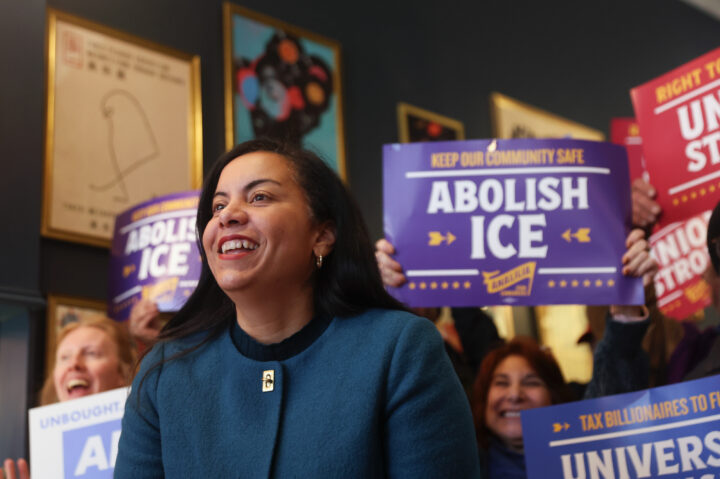
Analilia Mejia, US Democratic House nominee for New Jersey's 11th District, speaks to supporters and members of the media at Paper Plane Coffee Co. in Montclair, New Jersey
Joe Hathaway, the Republican nominee in the special election in New Jersey’s 11th Congressional District, repeatedly accused Democratic nominee Analilia Mejia, a progressive organizer, of espousing antisemitism and taking stances that would make the district’s sizable Jewish community unsafe, during their sole debate earlier this week.
Hathaway, in his opening statement, said that Mejia would “demonize thousands of members of our Jewish community.” The Randolph, N.J. city councilman has leaned into outreach to Jewish voters during the campaign.
Mejia, who won the special election primary in part because of significant United Democracy Project spending against the frontrunner, former Rep. Tom Malinowski (D-NJ), is favored to win in a district that backed Kamala Harris by eight points.
Though she had described the war in Gaza as a genocide less than a month after the Oct. 7, 2023 Hamas attack, Mejia stopped short of using that word during the debate. Instead, she said that “many individuals are feeling conflicted about what we are seeing in Gaza,” while accusing Israel and its prime minister of having committed war crimes.
“I believe that criticism of Benjamin Netanyahu and his administration is not anti-Israel any more than criticism of Donald Trump is anti-American,” Mejia said. “Neither man deserves a blank check or a blind eye.”
Hathaway responded by highlighting past instances in which Mejia has accused Israel of genocide, in spite of her dodge on the issue during the debate, and said that her positions are “radically out of touch with a district that has a thriving Jewish community that is made less safe, more dangerous by this extreme rhetoric. It has to stop.”
He accused Mejia of blaming Israel for the Oct. 7, 2023 Hamas attacks — something she denied. On Oct. 10, 2023, Mejia said that “Every fiber of my being is horrified beyond words at what is furthering in Gaza. Yet again we see how oppression & dehumanization leads to despair & unthinkable destruction,” without making direct mention of Hamas’ attack.
He also highlighted that she said during a primary candidate forum that she felt “incredible discomfort” with the idea of Israel being a Jewish state.
“I’ll stop calling you an antisemite when you stop saying things that are antisemitic and when you stop taking money from people … who shout that Jews in Israel are the same things as Nazis in Germany,” Hathaway said. “You take money from these people, you support their policies. It is completely out of touch with this district that has a thriving Jewish population. This isn’t a district where you can make those kinds of comments and people are going to be okay with it.”
He claimed that his campaign is seeing mass defections from Democratic voters “because the Jewish people of this district know there’s only one candidate they can vote for if they care about their safety and their children’s safety.”
Mejia responded by accusing Hathaway of “fearmonger[ing]” and misrepresenting her record and past statements.
“I would say it’s laughable except it’s one of the most serious topics,” Mejia said. “As a member of Congress, I would use every legislative power at my disposal to protect the rights of Jewish constituents and convene spaces to educate and to fight antisemitism because I know it’s real. … But that doesn’t mean that we cannot call the question on violations to international law and human rights.”
“We should be able to criticize the actions of a government without being called a person of hate,” she said. “We should be able to support freedom and protect our nations without turning to the very thing that we say we fight against. We have to uphold human rights, and if that’s the worst thing that I could be accused of, then I will stand with it, because I believe we have to fight for the freedom and justice of every human being.”
Hathaway fired back that “antisemitism is a bad thing to be accused of.”
Mejia responded, “and that is why I am disgusted by the fact that you are unable to see that criticism of a prime minister does not equal hate. It is disgusting and it is beneath you.”
The two candidates also debated the issue of congressional war powers, in the context of the ongoing war in Iran.
Mejia said she would not support “illegal and endless wars” or wars “without a plan to keep Americans safe.” She focused her comments primarily on the Trump administration’s posture toward America’s European allies, highlighting that the administration had lifted sanctions on Russian oil.
“I believe that we have to fight [Iran’s] nuclear threat, but more bombs do not equate [with] peace. We have to ensure that we’ve exhausted diplomacy and sanctions to keep Americans safe,” she said.
Hathaway said that Iran cannot have nuclear capabilities and that he would like to see diplomacy work, but that he supported the military action the U.S. took when diplomacy failed, praising the effectiveness of the U.S. operations.
He said he’s hopeful that the war will end soon and said he would not support deploying U.S. ground troops. He alleged that Mejia’s stance on Israel “renders her completely unable to make the right decisions for America and for our allies in Israel when it comes to a nuclear-capable Iran.”
Throughout the debate, Hathaway characterized Mejia as a radical leftist out of step with the district, and himself as a moderate who will work across the aisle. Mejia denied that she identifies as a socialist, emphasizing her longtime role as a Democratic county committee member.
Former Lt. Gov. Tahesha Way announced she would not run for the seat, allowing Mejia to run essentially uncontested in the upcoming regular election Democratic primary
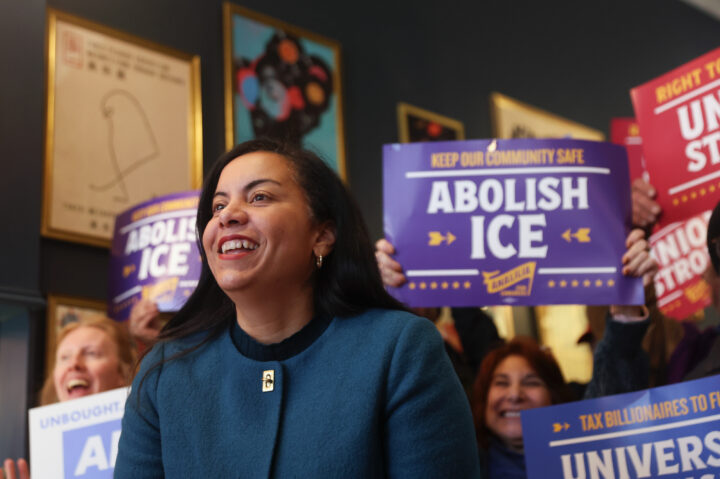
Heather Khalifa/Bloomberg via Getty Images
Analilia Mejia, Democratic House candidate for New Jersey, speaks to supporters and members of the media at Paper Plane Coffee Co. in Montclair, N.J., on Jan. 29, 2026.
Analilia Mejia, a progressive activist and organizer who won a surprise victory in the special election primary in New Jersey’s 11th Congressional District, looks to be on track to win the district’s regular election Democratic primary after several of her potential opponents declined to run.
In the days after Mejia’s surprise victory over former Rep. Tom Malinowski (D-NJ) and other more moderate candidates, there was speculation over whether she might be vulnerable to a one-on-one challenge in the regular primary on June 2. United Democracy Project, the AIPAC-linked super PAC that inadvertently helped boost Mejia, teased the possibility of further involvement in the subsequent primary.
But former Lt. Gov. Tahesha Way announced Sunday that she wouldn’t run against Mejia for the seat, leaving Mejia with no major Democratic competition; other moderate candidates in the special election primary also declined to run again, and Assemblywoman Rosaura Bagolie briefly considered a run, but decided not to pursue a bid as elected Democrats in the state quickly coalesced behind Mejia.
Several of the other Democratic special election candidates pledged not to run for the full term if they lost the special election — but Way had not made such a promise.
“Since the special primary, I have been deeply humbled by the outreach of so many who encouraged me to run in the June primary for Congress in NJ-11,” Way said in a statement. “The confidence and belief so many friends and neighbors have placed in me means more than I can say. After many conversations with my family, who are my greatest calling, and a lot of prayer, I have decided that this is not the right moment for another campaign. But make no mistake: I am not going anywhere.”
Even as the Democratic field has cleared for Mejia, her campaign has in recent days found itself at odds with the League of Women Voters.
The nonpartisan organization canceled its scheduled district-wide candidate forum — set to feature Mejia and Republican nominee Joe Hathaway, the former mayor of Randolph, N.J. — because the LWV and Mejia “could not reach an agreement with Mejia’s campaign and still maintain the League’s nonpartisan debate policy,” according to an LWV statement.
Mejia asserted that the LWV had refused to commit to diversity among the debate moderators; the LWV refuted her claim, stating its moderator is indeed a person of color but Mejia wanted to personally approve of them, which it would not allow. Hathaway accused Mejia of trying to “mislead voters and frame it as a diversity issue.”
Mejia’s stance has elicited criticism even from some fellow Democrats, including Bagolie, who criticized her comments about the LWV.
“If someone believes a debate is not worth their time, say that, it’s honest. But throwing the League under the bus is not okay,” Bagolie said. “I understand the instinct to rally behind a Democrat at all costs. I do. But we cannot excuse behavior that mirrors what we say we are fighting against.”
Hathaway, in a long-shot bid for the blue seat, has leaned into efforts to attract Jewish and pro-Israel voters in the district, and is pitching himself as a moderate with cross-party appeal.
After the rest of the state’s Democratic delegation jointly endorsed Mejia, Gottheimer said he’s ‘looking forward to sitting down with her’

GETTY IMAGES
Rep. Josh Gottheimer, D-N.J., leaves the U.S. Capitol after the House passed the One Big Beautiful Bill Act on Thursday, May 22, 2025.
New Jersey’s Democratic congressional delegation has fully lined up behind progressive activist and congressional candidate Analilia Mejia — with the exception of Rep. Josh Gottheimer.
After both of the state’s senators and several members of the congressional delegation endorsed Mejia earlier this week, most of the remaining Democratic holdouts, including Reps. Donald Norcorss, Frank Pallone and Nellie Pou, joined their colleagues on Thursday in a joint statement endorsing Mejia in both the April special general election and the June regular primary.
Gottheimer, in a statement to the New Jersey Globe, said, “Analilia and I have been in touch and I congratulated her on her win. I’m looking forward to sitting down with her and discussing issues important to Jersey and the families I represent,” but did not go as far as to offer his endorsement.
He did not provide comment to Jewish Insider.
Gottheimer is a prominent moderate and supporter of Israel, while Mejia has accused Israel of genocide.
In the joint statement shared by the Globe, the remaining New Jersey Democrats said, “Analilia Mejia is running for Congress to build an economy that works for working families, not just the billionaires and big corporations lining the Trump family’s pockets.”
The Associated Press called the race for Mejia on Thursday afternoon. She narrowly defeated former Rep. Tom Malinowski (D-NJ), with former Lt. Gov. Tahesha Way and Essex County Commissioner Brendan Gill finishing a distant third and fourth, respectively.
The near-unified support for Mejia from Democratic leaders in the state will make it increasingly difficult for any other Democrat to challenge her in the June primary, which pro-Israel advocates have seen as their last chance to stop the progressive from winning a full term in Congress.
Way is reportedly considering another run in June.
AIPAC’s super PAC may not have any candidate to support in the June primary race against the anti-Israel progressive
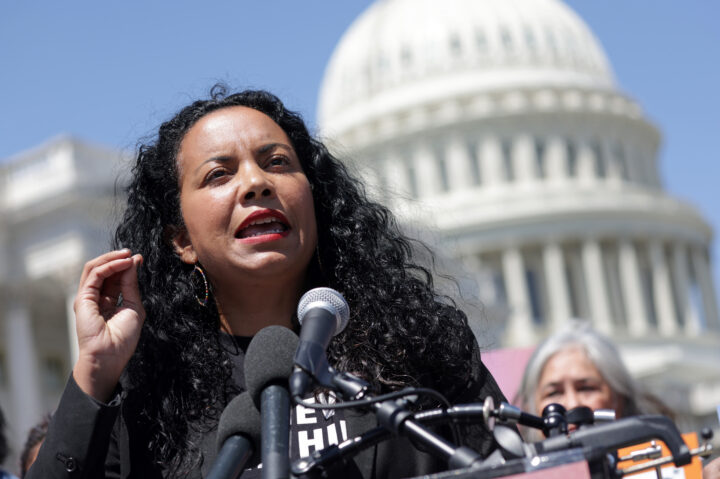
Alex Wong/Getty Images
Analilia Mejia, co-executive director of Center for Popular Democracy, speaks during a news conference outside the U.S. Capitol on April 19, 2023 in Washington, DC.
Democratic New Jersey Assemblymember Rosaura Bagolie has decided not to run against progressive activist Analilia Mejia in the 11th Congressional District primary in June, making it increasingly likely that Mejia, who has accused Israel of genocide, may not face any competition for a full term in Congress.
Bagolie, who is Jewish, first floated a run on Monday in an interview with Politico, but backed off those plans on Wednesday, after a slew of top political leaders in the state lined up behind Mejia’s campaign, both in the April special general election and the June regular primary election.
“After thoughtful consideration, I have decided that now is not the time for a congressional run in the June primary,” Bagolie said in a statement first shared with the New Jersey Globe. “I will continue to serve my constituents in the 27th [legislative] district with the same level of dedication, mindful of the trust you have placed in me.”
The AIPAC-backed United Democracy Project super PAC, which many in the state see as having inadvertently contributed to Mejia’s narrow surprise victory over Rep. Tom Malinowski (D-NJ) in the primary last week, had said following the election that it had “anticipated” a potential Mejia victory but its “focus remains on who will serve the next full term in Congress.”
But now, the pro-Israel community may be left without any challenger to back against Mejia in June. The most credible possible challenger appears to be the candidate it preferred in the special election, former Lt. Gov. Tahesha Way, who has not indicated whether she will be running for the seat again.
However, the New Jersey Globe reported on Wednesday that Way is actively considering a second run in the primary. Way was endorsed by Democratic Majority for Israel, and was seen as AIPAC’s favored candidate in the February race, though it did not endorse her or run any ads supporting her campaign.
Way, who is poised to finish with around 17% of the vote in the special election primary, would have an uphill battle to defeat the ascendant progressive, especially now that Mejia has consolidated support from many Democratic power brokers in the state, including moderate leaders.
Way’s campaign has not responded to requests for comment since primary day, including a question from Jewish Insider about the Globe’s reporting on Wednesday.
Already several members of the state’s congressional delegation have begun to coalesce around Mejia’s campaign
Heather Khalifa/Bloomberg via Getty Images
Analilia Mejia speaks to supporters and members of the media at Paper Plane Coffee Co. in Montclair, N.J., on Thursday, Jan. 29, 2026.
With progressive activist Analilia Mejia’s expected victory in the special election Democratic primary in New Jersey’s 11th Congressional District, attention is now turning to the upcoming April special general election and the June regular election primary as the last chances for moderates and pro-Israel groups to defeat her.
AIPAC’s super PAC, the United Democracy Project, which spent $2.3 million attacking former Rep. Tom Malinowski (D-NJ), said in a statement that its “focus remains on who will serve the next full term in Congress” and that it will be “closely monitoring … the June NJ-11 primary, to help ensure pro-Israel candidates are elected to Congress.”
Mejia is on track to receive less than 30% of the primary vote in a relatively moderate suburban district, creating an opportunity for a moderate candidate to challenge her. But several Jewish leaders, as well as a local analyst, said that that will be difficult to achieve.
“June is potentially irresistible for the other candidates who ran … if any of these candidates could get a one-on-one shot at making it in June,” Micah Rasmussen, the director of the Rebovich Institute for New Jersey Politics at Rider University, said. But unless the field can consolidate, Rasmussen said, it’s hard to see how the result would be any different in June.
Rasmussen said he doesn’t share the view of some Democrats that voters would be frustrated with a Democratic candidate who decides to challenge Mejia.
Though they haven’t formally endorsed her yet, other members of New Jersey’s congressional delegation appear to be coalescing around Mejia — Reps. LaMonica McIver (D-NJ), Bonnie Watson Coleman (D-NJ) and Rob Menendez (D-NJ) participated in a town hall focused on Immigration and Customs Enforcement organized by Mejia on Saturday, and Menendez — a relative moderate aligned with the state’s party machine — posted a photo with her on Sunday.
Malinowski has not yet conceded the race, but said during the primary that he would not run again in June if he lost. Essex County Commissioner Brendan Gill also does not plan to run again. That leaves the most likely moderate challenger as former Lt. Gov. Tahesha Way, who was endorsed by Democratic Majority for Israel and is believed to be AIPAC’s choice in the race.
Way is holding in third with 17% of the vote. Her campaign did not respond to a request for comment on whether she plans to run again.
Local Jewish leaders on Friday were generally pessimistic about the chances of taking Mejia down in the June primary — for the full term in Congress — but there could be a path to defeating the ascendant progressive.
“I sat on a debate stage with Analilia Mejia when she said that Israel has a right to exist, but not as a Jewish state,” Jeff Grayzel, a local Jewish leader who ran for the seat with ambitions of uniting the Jewish community behind his campaign, said. “It is said that Jews will be blessed when they stand together and will experience misfortune when they are divided. My pleas for Jewish unity in this race went unheeded. In my messaging to the Jewish community, I warned of a repeat of New York City in NJ-11, and this result is a consequence of a house divided. I pray our people can unify to find a path forward.”
Rasmussen said that Malinowski, who came closest to beating Mejia, would be the strongest candidate in a head-to-head race against Mejia in June, and Rasmussen said he could envision a scenario in which Malinowski ultimately took another shot at the seat despite his previous pledge not to.
“I think it’s a little bit tougher for Tahesha Way to do that,” Rasmussen said. “She would very clearly have outside spending with her. She’d very clearly have fundraising with her. But it’s a little tough to go from a 17% result to a majority result. We’ll see what happens. It doesn’t mean she shouldn’t think about it, she shouldn’t consider it, but it’s probably a stretch.”
Jeff Grayzel, a local Jewish leader who ran for the seat with ambitions of uniting the Jewish community behind his campaign, lamented Mejia’s victory as a disappointing development for supporters of Israel, and said the Jewish community needs to come together.
“I sat on a debate stage with Analilia Mejia when she said that Israel has a right to exist, but not as a Jewish state,” Grayzel said. “It is said that Jews will be blessed when they stand together and will experience misfortune when they are divided. My pleas for Jewish unity in this race went unheeded. In my messaging to the Jewish community, I warned of a repeat of New York City in NJ-11, and this result is a consequence of a house divided. I pray our people can unify to find a path forward.”
Though Mejia is well to the left of candidates that the district typically picks, Rasumussen said that it’s “hard to come up with a situation” where the district — drawn to favor Democrats with a highly motivated Democratic voter base in a midterm year — would become competitive for Republicans in the April 16 special general election to fill out the remainder of Gov. Mikie Sherrill’s House term.
“However, that’s not to say that Republicans won’t try,” Rasmussen said. “If I were a Republican who had the ability to invest resources, I would certainly be taking a very close look at this race on these next three elections that are going to be happening this year in this district, and trying to see if I can take advantage of the very particular circumstances.”
“I think it’s pretty clear why voters went to Mejia, and it’s not because she is a socialist or because she is the most left of any candidate in the race,” Micah Rasmussen, the director of the Rebovich Institute for New Jersey Politics at Rider University, said. “Voters were driven away from Malinowski because of that advertising. They did not view a machine candidate as a viable alternative. They saw Mejia as the candidate in the race who could most stand up to Trump … the candidate who had the clearest position on ICE.”
Rasmussen said that UDP’s advertising against Malinowski “very clearly … worked,” citing the significant drop in Malinowski’s share of the vote from the first early votes to be submitted — where he was receiving 60-70% of the vote — and votes submitted later in the cycle, as well as votes on election day.
“It’s pretty clear that the reason they went in [Mejia’s] direction is because she carved out a different position on ICE, which is very clearly on voters minds, and just convinced voters that she was the person who could best stand up to Trump, and that, it seems is what Democratic voters are looking for,” Rasmussen said.
He was skeptical of the narrative that the result was a sign of a broader voter appetite for socialist or socialist-adjacent policies in moderate suburban districts.
“I think it’s pretty clear why voters went to Mejia, and it’s not because she is a socialist or because she is the most left of any candidate in the race,” Rasmussen said. “Voters were driven away from Malinowski because of that advertising. They did not view a machine candidate as a viable alternative. They saw Mejia as the candidate in the race who could most stand up to Trump … the candidate who had the clearest position on ICE.”
The race also saw substantially higher turnout than most anticipated — surpassing 2024 primary turnout levels in not just the 11th District but every congressional district in New Jersey, according to Rasmussen — a sign of strong Democratic motivation to vote, likely spurred by President Donald Trump.
Gill’s fourth-place finish — despite entering the race as the favorite given the backing he received from New Jersey Democratic institutions — is a clear signal that the state’s Democratic machine has largely lost its ability to shape elections to its will, Rasmussen added.
The pro-Israel group spent over $2.3 million to block occasional Israel critic Tom Malinowski from getting elected — but it may have unwittingly gotten a far-left radical nominated instead.
Alex Wong/Getty Images
Analilia Mejia, co-executive director of Center for Popular Democracy, speaks during a news conference outside the U.S. Capitol on April 19, 2023 in Washington, DC.
In New Jersey’s 11th Congressional District, the AIPAC-linked United Democracy Project made a $2.3 million bet against former Rep. Tom Malinowski (D-NJ). It was clear early in the evening that the bet wasn’t paying off — but now the race could end up in what local Jewish leaders are calling a worst-case scenario.
After some outlets initially called the special primary election race for Malinowski, far-left progressive activist Analilia Mejia surged, and took a narrow lead as of the end of the evening, with most saying the race is now too close to call.
Malinowski maintained a largely pro-Israel record while in office but expressed openness during his latest congressional bid to backing policies conditioning or restricting aid. A former State Department official, he was also a leading and influential voice on foreign policy issues among colleagues.
Mejia’s views on Middle East politics are well to the left of Malinowski’s — she indicated support during a candidate forum for an offensive weapons ban, accused Israel of genocide less than a month after the Oct. 7, 2023, attacks and, as early as Oct. 10, before the Israeli invasion of Gaza began, said, “Every fiber of my being is horrified beyond words at what is furthering in Gaza.” At the same time, she has expressed support for Israel’s “right to both exist and defend itself.”
Mejia was endorsed by a laundry list of vocal Israel critics, including Sen. Bernie Sanders (I-VT) and Rep. Alexandria Ocasio-Cortez (D-NY).
Even without a final call, the results are already emboldening other Israel critics on the left, who are declaring that the results show that AIPAC has lost its sway, including candidates running against moderate, pro-Israel candidates in two key Illinois primaries.
Though some were concerned about Malinowski’s growing criticism of Israel since leaving office, other Jewish leaders had been puzzled by UDP’s decision to attack a lawmaker they saw as an ally during his previous congressional term — particularly when a more strident Israel opponent such as Mejia was in the race.
Now, some believe that UDP’s attacks on Malinowski, which attacked the former congressman’s vote in 2019 for Immigration and Customs Enforcement and his stock trading while in office, may have pushed voters toward Mejia, rather than toward a more moderate candidate, leaving pro-Israel advocates in an even worse position than if it had not intervened.
“Some of the worst fears of the Jewish community in New Jersey have been realized,” one Jewish leader said, referring to Mejia’s surge. “This was a possible byproduct of them stepping into the race. I don’t know how much of this is to blame on AIPAC specifically, but I think there needs to be a serious after-action report if the intent to push out Malinowski had this unintended consequence of propping up a very, very progressive candidate. … If she were to win, this would be far worse than Malinowski winning.”
The leader added that Jewish and moderate voters were ultimately split among former Lt. Gov. Tahesha Way, who was rumored to have AIPAC’s tacit backing and was endorsed by Democratic Majority for Israel, and Essex County Commissioner Brendan Gill — a longtime New Jersey political hand and the anticipated frontrunner, who ultimately failed to carry his home county.
While attacking Malinowski, UDP did not air positive messaging about any of the candidates to push voters toward its preferred choice.
“Jewish organizations need to rethink their strategy, or I fear that they are slowly pushing themselves into irrelevance,” the leader continued, pointing to the New York City mayoral race as a similar result when Jewish and moderate voters failed to coalesce to stop a far-left candidate. “People are winning elections without their support — they’re basically beating them.”
Another said AIPAC and UDP had “played it wrong in every step” — raising money for Way, whom the source said always had little chance of winning, and then spending heavily to go after Malinowski despite the Jewish community’s largely positive relationship while he was in office, potentially pushing Malinowski further left.
“If AIPAC’s definition of pro-Israel now excludes even someone like me, who passionately supports Israel but won’t commit to a blank check for anything [Israeli Prime Minister Benjamin Netanyahu] might want, there won’t be enough pro-Israel people left in America to sustain the relationship,” Malinowski said when UDP first began running ads against him.
In a statement, UDP spokesperson Patrick Dorton said the group had anticipated a potential Mejia victory but suggested UDP may get involved in the upcoming June primary for the next full term. Thursday’s primary election was only for the remainder of Gov. Mikie Sherrill’s term in the House, through January 2027.
“The outcome in NJ-11 was an anticipated possibility, and our focus remains on who will serve the next full term in Congress,” Dorton said. “UDP will be closely monitoring dozens of primary races, including the June NJ-11 primary, to help ensure pro-Israel candidates are elected to Congress.”
Mejia gained attention relatively late in the shortened race, and was not initially viewed as a major contender. Additionally, turnout in the race — expected to be low for a Thursday special election primary with poor road conditions from a recent winter storm — ended up surpassing the 2024 primary election.
Should UDP be interested in trying to take another swing at the Democratic nominee, it may have two opportunities to do so: the upcoming special general election, where the far-left Mejia might be uniquely vulnerable to a GOP challenge, or the primary for the November midterm election. Beating Mejia in the latter primary would likely require consolidation among moderate Democrats.
“If I was an AIPAC official, I’d be wondering, ‘How am I going to go to the same donors that I got money from to run this whole campaign against Malinowski and now I’m going to have to do the same thing to take out the person that I accidentally got elected?’” one Jewish leader said, presuming a Mejia win.
The result could also raise questions about AIPAC and UDP’s strategy in other upcoming races. In Illinois’ 9th Congressional District, a Jewish activist in the community raised concerns to JI weeks ago that pro-Israel attacks on Evanston Mayor Daniel Biss could ultimately end up peeling off voters to far-left influencer Kat Abugazaleh, who is avowedly anti-Israel.
But thus far, the strategy in that race appears to be different. An outside group that many in the community believe to be backed by pro-Israel donors recently began running positive ads boosting the pro-Israel favorite, state Sen. Laura Fine, rather than attacking her challengers.
Please log in if you already have a subscription, or subscribe to access the latest updates.
 Continue with Google

 Continue with Apple