










































































In a letter obtained by JI, the New York Republican asked Bessent to review whether the U.K. and other countries' trade restrictions on Israeli settlement goods merit inclusion on the department's international boycott list
Ken Cedeno-Pool/Getty Images
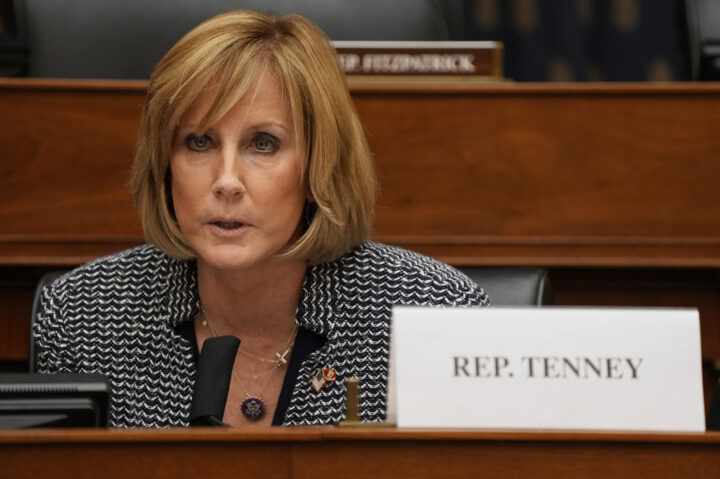
Rep. Claudia Tenney speaks as at the House Committee on Foreign Affairs on March 10, 2021 in Washington, DC.


 Add JewishInsider on Google
Rep. Claudia Tenney (R-NY) urged the Trump administration on Wednesday to review whether the United Kingdom and other countries imposing trade restrictions and additional sanctions on Israeli settlements places those countries in violation of U.S. anti-boycott laws — and to consider whether the effort merits a response from the United States.
Tenney sent a letter, obtained by Jewish Insider, to Treasury Secretary Scott Bessent asking him to review whether these countries’ targeting of West Bank settlements meets the criteria for being included on the Treasury Department’s international boycott list. She also asked Bessent to assess the implications of these trade restrictions for American businesses.
The New York lawmaker cited the anti-boycott provisions in the U.S. tax code, specifically noting how Section 999(a)(3) “reflects the United States’ bipartisan commitment to opposing foreign boycotts against friendly nations, particularly those aimed at Israel.”
“Under this law, the Treasury Department is required to maintain a list of countries that condition commercial participation on compliance with an unsanctioned international boycott,” Tenney wrote. “Inclusion on this list imposes specific tax reporting requirements and potential penalties for U.S. individuals and businesses engaged in certain activities in those countries.”
Tenney’s letter comes after U.K. Foreign Secretary Ed Miliband unveiled a sweeping new sanctions regime targeting Israeli settlements. France, Canada, Denmark, Finland, Iceland and Poland also announced plans to implement similar sanctions or support in a joint statement on Tuesday with Ireland, Spain, the Netherlands, Norway and Belgium, which have already taken similar measures.
“All of these efforts are part of a broader effort aligned with the global Boycott, Divestment, and Sanctions (BDS) movement, which seeks to economically isolate Israel,” Tenney wrote. “Such policies not only promote economic discrimination, but also create legal uncertainty for U.S. companies operating in these countries.”
Tenney urged Bessent to “examine expeditiously whether these growing policies by European countries require or may require participation in or encouragement of an international boycott within the meaning of Section 999(a)(3). If the criteria are met, then these countries should be added to the boycott list without delay to ensure that U.S. companies are informed of their reporting obligations and protected from unintended legal exposure.”
“The United States must send a clear signal that efforts to economically isolate Israel will carry consequences, and that U.S. law designed to combat such discrimination will be enforced,” Tenney wrote.
The Treasury Department did not respond to JI’s request for comment.
The bill declares that 'Houthi efforts to indoctrinate Yemenis into a violent, anti-Semitic, and extremist worldview are a threat to a Yemeni-led peace process and to regional stability'
Mohammed Hamoud/Anadolu via Getty Images
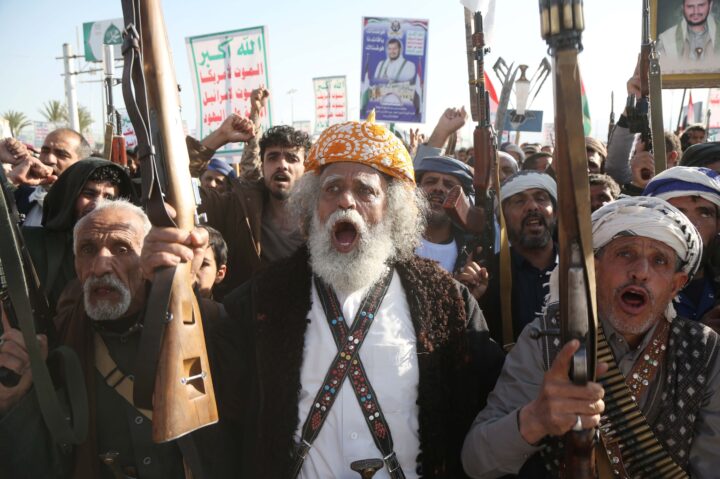
Thousands of Houthi supporters gather to mark Independence Day in Sanaa, Yemen, on November 30, 2025.
Sens. Dave McCormick (R-PA) and Jacky Rosen (D-NV) are pushing for additional sanctions on the Houthis in response to the group’s violations of human rights and hostage-taking in a new bill set to be introduced Friday.
The pair are the chair and ranking member, respectively, of the Senate Foreign Relations Committee’s Middle East subcommittee.
The Houthi Human Rights Accountability Act would require the administration to assess whether members of the Houthis have committed gross violations of human rights, obstructed the delivery of humanitarian aid or have been involved in taking American hostages or supporting hostage-taking, qualifying them for sanctions under U.S. law.
The bill also declares that it is the sense of Congress that “Houthi efforts to indoctrinate Yemenis into a violent, anti-Semitic, and extremist worldview are a threat to a Yemeni-led peace process and to regional stability” and that “it is counter to United States policy to provide support to the Houthis in Yemen.”
The legislation requires the administration to report to Congress on such Houthi indoctrination efforts, the threats the group poses to regional stability, obstacles to humanitarian aid delivery in Houthi-controlled areas of Yemen and human rights abuses committed by the Iran-backed terror organization.
The bill would sunset five years after its passage.
Companion legislation advanced through the House Foreign Affairs Committee by a unanimous vote last week.
“The Houthis have terrorized the Yemeni people, the region, and Americans for far too long,” Rosen said in a statement. “With Iran’s support, the Houthis have prevented crucial, lifesaving aid from reaching civilians and unlawfully detained humanitarians and diplomats, including current and former local staff of the U.S. Mission in Yemen just this week. I’m proud to introduce this bipartisan bill to hold the Houthis accountable. I’ll continue working across party lines to support efforts to combat Iranian-backed aggression and stabilize the Middle East.”
The Houthis have for several years detained current and former local staff of the U.S. embassy in Yemen. The administration on Wednesday issued a statement condemning those arrests and detentions.
“The Houthis’ campaign of terror and destruction remains a threat to global maritime trade, our regional allies, and the people of Yemen,” McCormick said. “The severity of the Houthi menace is magnified by their human rights abuses, antisemitism, and their continued theft of international humanitarian aid. This bipartisan, bicameral bill will ensure Houthi terror remains on the global agenda and position the United States at the forefront of efforts to steadily increase pressure on the group.”
Please log in if you already have a subscription, or subscribe to access the latest updates.
 Continue with Google

 Continue with Apple