









































































Former French PM Valls: France has made itself irrelevant in the Middle East and fails to protect Jews
In an interview with JI, Valls said Macron ‘doesn’t understand the Jewish issue or Islamism at all’
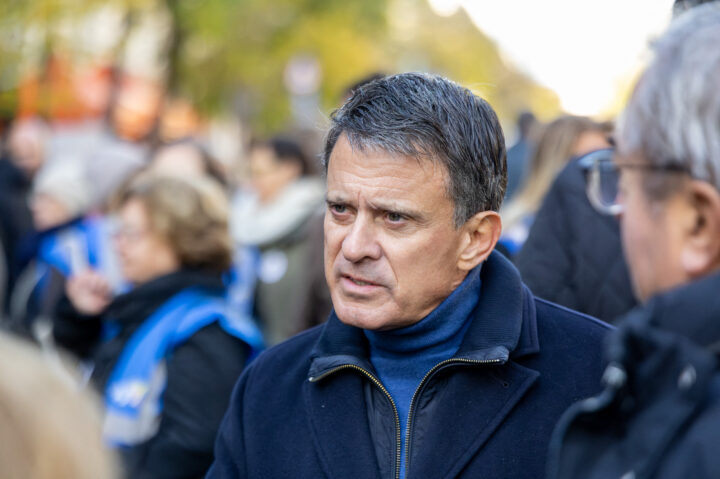
(Benjamin Vodant / Hans Lucas / AFP via Getty Images)
Former Prime Minister Manuel Valls at the conclusion of the commemorative ceremony for the terrorist attack that took place at the Bataclan in Paris, France, on 13 November 2026.


 Add JewishInsider on Google
French diplomacy is stuck in the past, damning itself to irrelevance in the Middle East and making French Jews more vulnerable to antisemitism, former French Prime Minister Manuel Valls told Jewish Insider in an interview on Sunday.
During Valls’ tenure under then-President Francois Hollande from 2014-2016, a wave of Islamist terrorist attacks took place in Paris, including at the Hyper Cacher kosher supermarket, the headquarters of satirical magazine Charlie Hebdo and at the Bataclan concert venue.
At the time, Valls, then a member of the Socialist Party’s moderate wing, established himself as an outspoken opponent of Islamism, as well as a friend of French Jews. At a memorial event following the attack at Hyper Cacher, Valls expressed regret that Jews were leaving France because they felt unsafe, famously saying that “France without Jews is not France.”
The former French prime minister spoke to JI through a translator in Tel Aviv, ahead of his appearance at Monday’s European Leadership Network Jerusalem Summit, organized by the major pro-Israel advocacy organization operating in Europe.
Valls returned to French politics in 2024, when he was appointed by former French Prime Minister François Bayrou as the minister of the overseas, responsible for 13 French territories outside of the country’s mainland, a position he held for less than a year. He emerged from the government as a strident critic of French President Emmanuel Macron’s policies towards Israel.
In January, Valls called Macron’s unconditional recognition of a Palestinian state in 2025 a “grave error” that legitimized Hamas and relied on “outdated Oslo-era formulas.”
“France and other European countries remained with a passé diplomatic language, saying that to solve the Israeli-Palestinian conflict we need a two-state solution, that it’s the only option that will ensure the security of Israel and Palestinian rights. Blah, blah, blah,” he said on Sunday.
Valls pointed out that “for 30 years, they are continuing like this, without taking into account 9/11, the rise of Islamism, developments on the Palestinian side and the new geopolitical map since [the] Oct. 7 [2023 Hamas attacks].”
Macron had initially set conditions for the Palestinian Authority, including government reform, an election and the removal of incitement against Israel from its textbooks. Valls said that soon after, in July 2025, he warned in a cabinet meeting that “the unconditional recognition of a Palestinian state will not lead to any changes, will eliminate France’s influence and will endanger French Jews.” In September, France recognized a Palestinian state anyway.
“A year later, there has been no breakthrough,” Valls noted. “The Palestinian Authority did not respect its commitments … French Jews have never felt so vulnerable, and France is having difficulty fulfilling its role [as a mediator] in Lebanon or in relations between Syria and Israel, nor between Israel and the Gulf states.”
“Thirty years later we are trying the same things and we have never been farther from a Palestinian state,” he added.
Valls argued that France needs to have “special, strategic relations with Israel, without denying our historic connection with Lebanon and Syria.”
“France could have fulfilled its role, but first it has to free itself from the old-fashioned diplomatic language and take reality into consideration, [such as] the danger of Islamism, and the danger of diplomatic terror Iran is trying to lead in Europe. I hope the future French government will be able to grasp this reality.”
Valls spoke out against an “obsession with Israel” in the government.
“When we were attacked at the Bataclan, France led a coalition to fight ISIS in Raqqa and Mosul. Thousands were killed. Who are we to criticize Israel, a democratic country that went through Oct. 7? It’s a democracy. Can a country allow an organization that wants to destroy and eliminate it to attack?” Valls said. “Hamas thought that Iran, Syria and Hezbollah would join them [after the Oct. 7 attacks]. That was not a demonstration out of despair. It was an attack to destroy Israel. Every country must defend itself.”
“Our diplomacy must be measured, or we’re just feeding the hatred,” he added.
Valls argued that Israel is at the front of the West’s battle against Islamism: “It’s the same phenomenon everywhere and we have a shared enemy: Islamists. Of course it’s different geographically and there is a different political reality, but Islamists hate democracy, women’s rights, homosexuality … and Israel is the only democracy in the region. The Bataclan attack and the Nova [music festival] attack are the same vision, the same hatred.”
This position is controversial in Europe, and not one shared by Macron, but Valls said he is trying to convince leaders on the continent to change their minds. He said he saw “very positive changes” in Berlin.
The former prime minister argued that many European leaders do not see Israel’s fight against Islamism, Iran and its proxies as their own “because they don’t understand that the best way to fight antisemitism is to support Israel.”
“Antisemitism today is expressed by anti-Zionism, hating Israel and Jews. The movement is rooted for the past 20-30 years in Islamists in Europe and the French left in academia, politics and media. By repeating the words ‘apartheid,’ ‘colonization,’ and ‘genocide,’ and now the Nazification of Israel, they changed Western opinion,” he lamented. “It wasn’t fought enough in Europe, nor in the U.S.”
Valls said that he has tried for years to understand why Macron has failed to properly address antisemitism in France.
“I think ignorance explains part of these failures. In 2015 [when Macron was economy minister under Valls], he first distanced himself from me after the Bataclan attack and said that France has part of the blame for young people becoming terrorists because of their social and political situation. That is the old sociological excuse,” he recounted.
“When Macron was elected president two years later, he understood that the situation is more complicated. It’s not the economy or who is president,” Valls said.
He added that he does not think that Macron has thought deeply about the nature of Islamism and that antisemitism is at its core.
Macron has only been to Israel three times, with each visit amounting to a few hours, Valls argued: “When you don’t come here, you don’t know the region, you miss the Jewish issue and you make mistakes. Add in the diplomatic line described earlier, and you have your answer.”
In addition, Valls said, “Macron did not properly evaluate the ramifications of the Oct. 7 Hamas attack and the antisemitic tsunami, which started not after Israel’s first strike on Hamas but on the evening of [the Hamas attack], because it was all prepared in advance.”
Valls noted that Macron did not participate in the march against antisemitism in Paris soon after Oct. 7, in order to not be divisive.
“You aren’t dividing France; you need to enlist all of France against antisemitism,” Valls said. “It was a key moment, for the first time in 200 years, some of the extreme right was at [the march] for the republic and against antisemitism.”
Also absent were Jean-Luc Mélenchon, leader of the French far left, and some trade unions because they falsely claimed it was a rally of support for Israeli Prime Minister Benjamin Netanyahu, Valls recalled.
“Everyone is against antisemitism when it is about the Holocaust or history or the far right, but for 20 years, antisemitism is hatred of Israel and Jews mixed together. [Macron] doesn’t understand the Jewish issue or Islamism at all,” he stated.
Asked if the current incitement case against author Michel Houellebecq for remarks he made against French Muslims broadly was an example of not understanding the dangers posed by Islamism, Valls distanced himself from the writer’s statements, which he called “inaccurate.”
However, he said, “the fight about the terminology must be fought. I don’t use the term Islamophobia. We have to show what the Muslim Brotherhood really is.”
“There is a de facto, documented alliance between Islamists and the left in France,” Valls said. “The Muslim Brotherhood determines the discourse and [where] the word ‘Islamophobia’ [applies].”
Europe, Valls said, is fighting on two fronts. The first is Ukraine, in which “the future of Europe hangs in the balance,” and the second is “the domestic front of all European societies against Islamism. … The Muslim Brotherhood wants to capture the youth of all of these communities” of Muslims in Europe.
“At the end of the 1990s, early 2000s, things changed. Among them were the first antisemitic acts [in France] at the start of the Second Intifada: rocks thrown at people walking to synagogue and attacks on synagogues by young people from the Muslim world,” Valls, who was a member of France’s Socialist Party for nearly 40 years, recalled. “The left just covered its eyes. It didn’t want to see this reality, which is uncomfortable for them. Attacks from the right they can handle, but if they [criticize attacks] from the new proletariat — the migrants, the children of Muslim immigrants and the minorities — they will lose them.”
By ignoring the problem, the French left was able to build a longstanding alliance, he added, noting that this is common in the European left, including Mélenchon in France, and that it spread to parts of the American left, as well.
Mélenchon’s party was “marginal,” Valls said, “and they took advantage of Oct. 7 … The Palestinian flag and kefiyeh became a unifying factor on issues of migration, minorities, ‘Islamophobia.’ It succeeded for them.”
The American Jewish Committee’s office in Paris released a poll last week showing that 82% have been victims of an antisemitic act, and 66% consider France to be unsafe for Jews. The vast majority of French Jews, 86%, believe that Mélenchon contributes to the rise of antisemitism, while 68% say the same of far-right presidential candidate Marine Le Pen. The difference is even more stark when French Jews were asked if they would consider leaving the country due to the result of next year’s presidential election: 69% of French Jews said they would if Mélenchon won, while only 31% said they would if Le Pen won.
Valls repeated his statement from last decade that “France without Jews is not France anymore,” but acknowledged that there is a “crisis” of antisemitism impacting Jews across Europe and in the U.S.
Still, he said that “most French forcefully reject antisemitism and even support Israel. In the Senate and National Assembly, all proposals to condemn or sanction Israel are rejected. On the French left, there remains a majority that is morally, intellectually and politically unstained [by antisemitism].”
“There is a fear among French Jews, and Mélenchon is very scary … gravity is pulling in Mélenchon’s direction,” Valls said. “I am a political person, and it is my job to make sure that there won’t be a second round [in the presidential election] between Le Pen and Mélenchon. There needs to be a candidate in the second round that will get rid of Mélenchon.”
Valls expressed hope that the new leader of the Socialist Party, Raphaël Glucksmann, who said he would not align with Mélenchon, could be that person.
“We have to hope and to fight,” he said.
Valls also had a warning for American Jews.
“I was at an antisemitism conference in Jerusalem four or five years ago, and an American representative was very sure of herself and said that what happened in Europe will never happen in the U.S., and now we see the same phenomenon of antisemitism spreading. You can’t compare it to the 1930s, but antisemitism is now very diffuse; it’s not just traditional Christian antisemitism or the far right, it’s the left, too,” he said.
Valls pointed out that polls show that young people across the West have negative views of Israel and antisemitism is growing.
“We have to understand that there is an alliance of the far left with Islamists. Wokeism, which was born in the U.S., also contributed,” he said.
Valls recounted that in his youth, the European left lamented “American cultural imperialism,” and said that Islamists do the same and, in return, spread their hatred through the West: “That is the work of the Muslim Brotherhood, but also Al Jazeera and other Arab [media] networks.”
In the U.S., he added, “I see Democratic leaders who are aware of these issues, but the connection between supporting Israel and fighting antisemitism must be strengthened and not undermined as it has been in Europe and the U.S.”
“Be very careful on the left and right. You need national unity against antisemitism,” Valls said.
More Stories
TEHRAN TARGET
Ex-Mossad chief: Only regime change will stop Iran from getting nuclear weapons
Coin of the Realm
Israeli mentalist Lior Suchard to join Trump at exclusive cryptocurrency dinner
DOUBLING DOWN
El-Sayed says Israel should not identify with a faith, pushes back on antisemitism concerns
MOMENT OF TRUTH
Harmeet Dhillon calls out bigotry, antisemitism within MAGA movement
Daily Kickoff
The Shenzhen stakes for Israel
SPLIT SCREEN
Trump reiterates he would launch Iran war again despite political consequences
Please log in if you already have a subscription, or subscribe to access the latest updates.
 Continue with Google

 Continue with Apple