









































Columbia takes steps to reach Title VI deal with federal government
Among other commitments, the university announced it would refuse to recognize or meet with the anti-Israel student group Columbia University Apartheid Divest
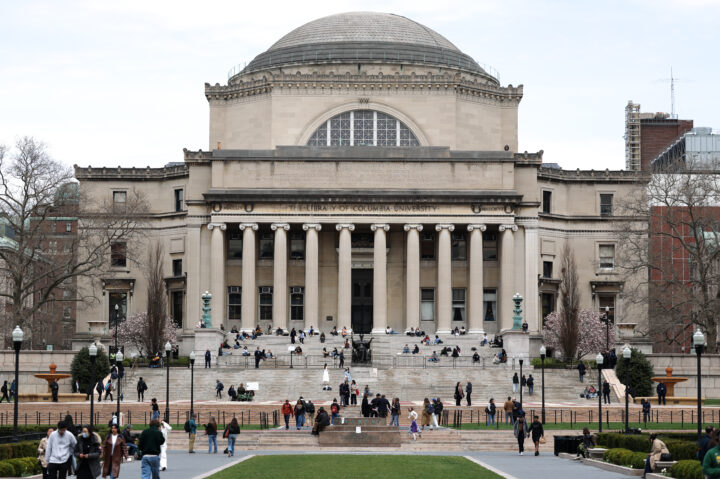
CHARLY TRIBALLEAU/AFP via Getty Images
Students are seen on the campus of Columbia University on April 14, 2025, in New York City.


 Add JewishInsider on Google
Columbia University announced on Tuesday it would implement several commitments in an effort to reach a deal with the Trump administration to restore the $400 million in federal funding that was cut by the government in March due to the university’s record dealing with antisemitism.
The steps include the university further incorporating the International Holocaust Remembrance Alliance’s working definition of antisemitism by requiring its Office of Institutional Equity to embrace the definition; appointing a Title VI coordinator to review alleged violations of the Civil Rights Act; requiring antisemitism training for all students, faculty and staff; and refusing to recognize or meet with “Columbia University Apartheid Divest,” a coalition of over 80 university student groups that Instagram banned for promoting violence.
“Our work toward an agreement with the federal government has put a harsh spotlight on many of the difficult issues regarding discrimination and harassment we’ve seen on our campuses,” Claire Shipman, the university’s acting president, said in a statement. “The fact that we’ve faced pressure from the government does not make the problems on our campuses any less real; a significant part of our community has been deeply affected in negative ways.”
Shipman said that “any government agreement we reach is only a starting point for change.”
Brian Cohen, executive director of Columbia’s Hillel, welcomed the steps taken by the university, “including the unequivocal recognition that there is an antisemitism problem on campus and that it has had a tangible impact on Jewish students’ sense of safety and belonging,” he wrote on X.
“I hope this announcement marks the beginning of meaningful and sustained change,” said Cohen.
Columbia was rocked by several high-profile incidents last academic year, including a sit-in in February at its affiliate, Barnard College, where a staff member was assaulted. In May, more than 100 masked anti-Israel demonstrators stormed the university’s main library — disrupting students studying for finals by banging on drums and chanting “Free Palestine.” Still, the university saw relatively fewer anti-Israel disruptions since it first entered into negotiations to restore federal funding.
The slashing of Columbia’s funds marked the first time a university faced a suspension of federal funds since the Title VI of Civil Rights Act of 1964 was implemented six decades ago. Several other elite universities, including Harvard and Cornell, followed suit with billions of dollars stripped by the government due, at least partially, to concerns around antisemitism.
More Stories

PROBLEMATIC POST
Top Michigan Democratic fundraiser shared Veterans Day post honoring Nazi officer grandfather
BARAKA'S BACKING
In progressive pivot, N.J. congressional candidate Brian Varela secures Newark Mayor Ras Baraka’s endorsement

BUDAPEST BEAT
The Orthodox Jewish GOP donor vying to be U.S. ambassador to Hungary
WEIGHING IN
As Iran war continues, Senate and House set for long-shot votes to cut it short

problematic podcast
Platner sat for lengthy interview with antisemitic conspiracy theorist, said he was ‘longtime fan’ of his show
NEBRASKA NOS
Most Democratic candidates in key Nebraska swing seat say they’ll reject pro-Israel support
Please log in if you already have a subscription, or subscribe to access the latest updates.