














































































In an interview with JI, Shapiro said he ‘[hasn’t] really thought about’ whether he would appear on Hasan Piker’s stream but that he hasn’t been invited
Peter W. Stevenson/The Washington Post via Getty Images
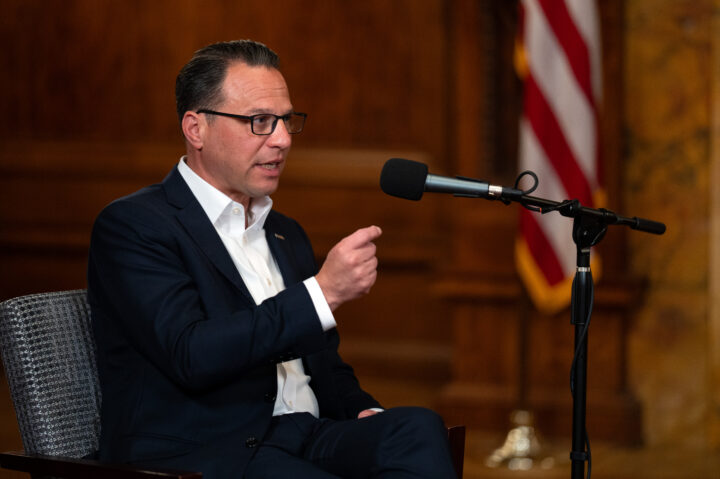
Pennsylvania Gov. Josh Shapiro sits for an interview at the Pennsylvania State Capitol on June 11, 2025.


 Add JewishInsider on Google
PITTSBURGH — On the eve of the NFL Draft on Wednesday, Pittsburgh, the host city, was in full spectacle mode. Israel, 6,000 miles away, was abuzz for a very different reason: the country was celebrating Yom HaAtzmaut, marking 78 years of independence.
As he jumped between draft events, Pennsylvania Gov. Josh Shapiro shared his thoughts about both.
“I think we’re here to celebrate an iconic event in sports and sports in general. Sports has the power to bring people together, and we need more of that in our society,” Shapiro told Jewish Insider in an interview following a “unity dinner” in Pittsburgh that brought together 100 Black and Jewish students from local universities.
At the event — organized by New England Patriots owner Robert Kraft’s Blue Square Alliance Against Hate, in partnership with Hillel International, the United Negro College Fund, the NFL and the Pittsburgh Steelers — Shapiro appeared on a panel with Kraft and retired Steelers quarterback Charlie Batch. NFL Commissioner Roger Goodell stopped by to introduce the event.
“The fact that the commissioner and Robert decided to dedicate a portion of draft week to finding ways to come together to a unity dinner, I felt that it was not just something I should do, but a responsibility of mine,” said Shapiro.
Asked about Yom HaAtzmaut, Israel’s independence day, Shapiro expressed affection for Israel. He also called for America to do more to rein in its government.
“I’ve always been really clear that I have a love for Israel, even while I have real concern about the leadership of Israel,” said Shapiro.
A growing number of progressive lawmakers have in recent weeks called for an end to U.S. aid to Israel, including funding for Israel’s Iron Dome missile-defense system, a position adopted by the progressive Israel advocacy group J Street. Shapiro declined to endorse that position.
“In the case of Israel, you have a country that is constantly being attacked with missiles and other weapons that put civilians at risk, and America is invested in providing assistance like Iron Dome to protect innocent civilians from those terrorist attacks,” said Shapiro. “I think that is in America’s national security interest.”
But he did argue that the U.S. should use its position as a major financial backer of Israel to exert leverage over the country’s use of American-made weapons. Shapiro said Washington has not done a good enough job of that.
“I would say that our last two presidents, President [Joe] Biden and now President [Donald] Trump, have failed to use the leverage of an American president to force Israel’s hands to use that military aid in ways that comport with our American values, to limit the loss of innocent lives as the key factor there,” said Shapiro. “I think what we need to examine is the rubber stamp that Donald Trump has been to the Netanyahu government.”
Shapiro noted that more than 100 countries receive some form of military assistance from the U.S., a figure that includes nations who may not receive funding but who instead partner with the U.S. military for training or purchase U.S. weaponry.
“In any one of those 100 countries comes leverage for an American president to exercise to ensure that the military assistance we provide to that country is being used in accordance with our values, our American values,” said Shapiro. “What we need is an American president who’s going to use the leverage that we have when we provide that kind of assistance to Israel or any one of the other 90-plus countries.”
In recent months, as Shapiro eyes a 2028 presidential bid, he has appeared on several popular podcasts, including “Pod Save America,” “Higher Learning” from digital media company The Ringer and the “All-In Podcast.” As one of the most vocally Jewish politicians in the country, Shapiro is almost always asked about his views on Israel.
“Every day I do, of course, get asked about Israel and the Middle East, and I think it’s important to just speak truthfully about how I feel,” said Shapiro. “I think it’s important to be true to who you are, to not put your finger in the wind and just sort of follow which way it’s blowing.”
One show he has not appeared on? The Twitch stream hosted by Hasan Piker, a far-left commentator with a history of antisemitic and anti-American views who has hosted conversations with several progressive lawmakers. California Gov. Gavin Newsom, another potential 2028 contender, has said he would sit for an interview with Piker.
Piker has generated a great deal of controversy among Democrats in recent weeks after he appeared at two campaign rallies with Michigan Democratic Senate candidate Abdul El-Sayed this month. Those events prompted sharp criticism from several Michigan Democrats, including Sen. Elissa Slotkin (D-MI) and El-Sayed’s primary opponents, Rep. Haley Stevens (D-MI) and state Sen. Mallory McMorrow.
Shapiro opted not to weigh in. Asked if he would appear on Piker’s stream, he demurred.
“I haven’t been invited,” said Shapiro. “I haven’t really thought about it.”
Despite the events of recent years, Israel was ranked the eighth-happiest country in the world, according to the World Happiness Index released last month

Ayal Margolin/Flash90
People celebrate Israel's 78th Independence Day in Kibbutz Hulata, northern Israel, April 21, 2026.
Every year, ahead of Yom HaAtzmaut, Israel’s Independence Day, the country’s Central Bureau of Statistics releases the latest population figures. As Israel turns 78, the country’s population stands at 10.2 million, up 1.4% from last year, which the bureau said is one of the highest growth rates in the Western world.
In the last year, 177,000 babies were born in Israel, and 27% of the population is under age 14.
If having a baby is an expression of hope, then clearly Israelis, with the highest birthrate by far among developed countries, are an optimistic bunch. According to the CBS, 91% of Israelis are satisfied or very satisfied with their life, 96% are satisfied or very satisfied with their family and even two-thirds of Israelis are happy with their economic situation.
That would explain why, despite the events of recent years, Israel was ranked the eighth-happiest country in the world, according to the World Happiness Index released last month.
You couldn’t blame Israelis if they felt differently. After all, the last year was a roller-coaster of emotions.
This time in 2025, there were still dozens of hostages in Gaza, with weekly protests for their freedom but little by way of any plan or agreement to get them out. Fighting continued in Gaza, even though Hamas’ leadership had largely been eliminated, the Houthis were regularly launching missiles at Israel and Iran was rushing toward a nuclear weapon.
Then came the 12-day war with Iran in June, with the U.S. joining for the coda to destroy much of the Islamic Republic’s nuclear facilities. Finally, in October, the last of the living hostages held in Gaza passed from Hamas’ hands, and they were home.
But with the ceasefire came mixed feelings about its sustainability and whether it would actually disarm Hamas — still an open question — and thousands of IDF soldiers remain in Gaza even now. Shortly after that conflict came to an end, concerns about Hezbollah and Iran rebuilding their missile capacity grew.
The war with Iran that began in late February, with the U.S. and Israel partnered in the bombing runs, buoyed Israelis’ pride in their military and optimism that it would be the war to end all wars with the Islamic Republic. Now, with U.S.-imposed ceasefires with Iran and Lebanon that are unpopular in Israel, there’s a sense of uncertainty as to whether the war will bring about greater long-term security or whether Israelis will be running from missile fire into safe rooms again soon.
Meanwhile, Israel’s economy is doing well overall, with an unusually strong shekel reflecting optimism in the markets — though that also has its downsides for Israelis. Plus, 2026 is an election year, which has translated to an especially ugly and divisive state of affairs in Israel over the past decade.
Still, not long after Israel came in eighth place in the World Happiness Index and soon after the Iran ceasefire was announced, comedian Eli Finish from the long-running sketch comedy show “Wonderful Country” wrote in an Instagram story that went viral: “Did we win [in the Iran war] or not? What nonsense. I don’t know about you, but I saw an army that did things out of a Hollywood movie; I saw a nation that popped open a beer in the safe room; I see Iran in shock. Call me optimistic, but I’m not the only one. Am Yisrael Chai. … What other option do we have if not to be optimistic?”
The backlash to Finish’s sunny worldview came soon after from commentators in Haaretz, Israel’s public broadcaster Kan and on social media who said optimistic Israelis were deluding themselves. But there was also a backlash to the backlash, and Finish said he never felt so much love from people on the street as he has since publishing the post.
As usual, if you judge by comments on social and traditional media, optimism is hard to come by. But in polls, on the street and at Independence Day celebrations across the country, despite no shortage of reasons to feel otherwise, Israelis are a hopeful bunch as the Jewish state begins its 78th year.
Please log in if you already have a subscription, or subscribe to access the latest updates.
 Continue with Google

 Continue with Apple