
































A source told JI they expect discussion on humanitarian aid and the Palestinian technocratic government in Gaza; it remains to be seen how Israel and Hamas will respond to the board's directives
Chip Somodevilla/Getty Images
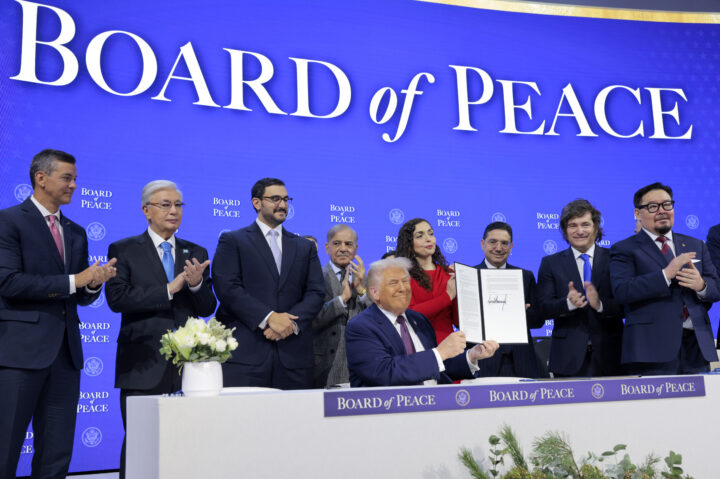
President Donald Trump (C) holds up his signature on the founding charter during a signing ceremony for the “Board of Peace” at the World Economic Forum (WEF) on January 22, 2026 in Davos, Switzerland.


 Add JewishInsider on Google
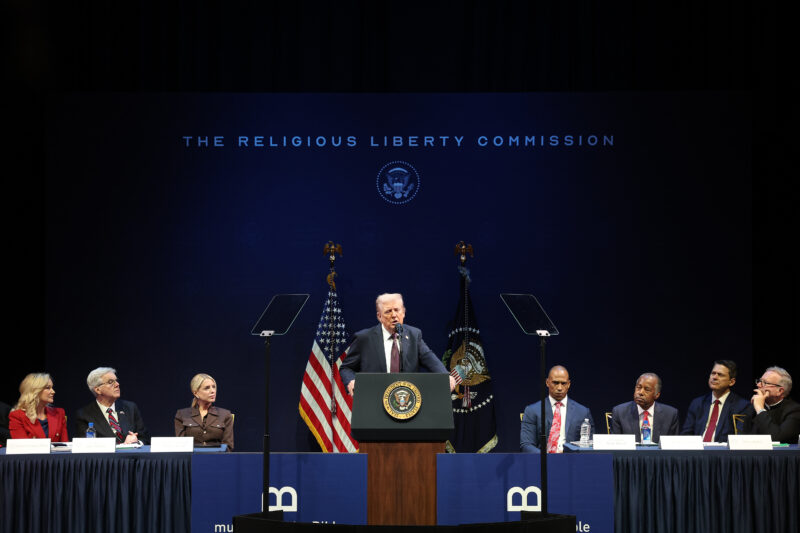
After a splashy debut at the World Economic Forum in Davos last month, President Donald Trump’s Board of Peace will convene for its first meeting on Thursday in Washington.
The new international body now faces a test of its ability to operationalize its goals: Observers will be watching whether the board makes any significant announcements toward its goal of implementing Phase 2 of Trump’s peace plan, which is focused on rebuilding Gaza and securing the enclave.
A source familiar with Thursday’s meeting told Jewish Insider that it is “not just pomp and circumstance,” and that they expect discussion about topics including humanitarian aid and the Palestinian technocratic government in Gaza. “It’s not window dressing at all,” the source said of the board’s work.
Trump has assembled a roster of regional heavy hitters on the Board of Peace, including Saudi Arabia, the United Arab Emirates, Qatar, Turkey, Jordan and Israel. Many European nations, including France, have so far declined the invitation, wary that it intrudes on the United Nations’ authority and that its mandate is not clearly confined to Gaza.
According to a senior Trump administration official, speakers at the event will include Trump, Secretary of State Marco Rubio, Jared Kushner, former U.K. Prime Minister Tony Blair, U.S. Ambassador to the U.N. Mike Waltz, White House Special Envoy Steve Witkoff and Nickolay Mladenov, the former U.N. Middle East envoy now serving as the high representative for Gaza on the Board of Peace. Little has been shared publicly about what the format will be.
Hungarian Prime Minister Viktor Orban, a close ally of Trump, said he plans to attend, as will the leaders of Armenia, Azerbaijan, Indonesia, Vietnam, Cambodia, Pakistan, Kazakhstan and Uzbekistan. Several countries, including Israel, Egypt and Turkey, are sending senior ministers in place of their heads of state. A European Union commissioner is expected to attend Thursday’s meeting as an observer, alongside observers from some other nations who have not joined the board, including South Korea.
“President Trump is proud to welcome representatives from over 40 nations to the Donald J. Trump Institute of Peace on Thursday for a big announcement on Board of Peace actions to establish an enduring peace in the Middle East,” White House principal deputy press secretary Anna Kelly told Jewish Insider, arguing that the board will be “the most consequential international body in history.”
The gathering of Middle East and global leaders will also come against the backdrop of U.S.-Iran nuclear negotiations and speculation that Trump is seriously considering military action against Iran, with the U.S. building up military assets in the region this week.
Trump announced on Sunday that member countries have pledged $5 billion toward rebuilding the war-torn enclave and will commit thousands of personnel to the International Stabilization Force, which has not yet been launched. He did not detail which member nations were making the pledges for funds or troops, though Indonesia said it was readying up to 8,000 personnel to deploy to Gaza by this summer. The estimated cost to rebuild Gaza is $70 billion.
The White House said the media had been too skeptical of Trump’s plans but declined to offer specifics about the source of the $5 billion or how the money would be deployed.
“We’re talking about reconstructing Gaza. I remember when those words came from the president’s lips in the East Room many months ago and all of you in the press were bewildered at how the president could have such an ambitious goal of rebuilding Gaza, which is obviously a place that has been just turmoiled by violence and chaos for many many years,” White House Press Secretary Karoline Leavitt said at a Wednesday press briefing. “But we’re well underway in doing that.”
The key question facing the body is whether it can actually make progress toward addressing the most intractable issue in Gaza: Hamas’ continued control over large parts of the Strip and the terror group’s refusal to disarm.
“What will come out of it besides rhetoric is some financial commitments and troop commitments. But the troop commitments are limited. No one will agree to disarm Hamas,” Elliott Abrams, who served as an Iran envoy in Trump’s first term, told JI. “Reconstruction won’t really begin until Hamas is disarmed and fighting has ended.”
While Trump has repeatedly indicated that disarming Hamas is a top priority, the International Stabilization Force tasked with keeping the peace in Gaza is not expected to take on Hamas militarily. The White House has not laid out a plan for how the ISF will take over control from Hamas, which is thus far unwilling to relinquish governance. It is also not clear how Israel and Hamas will respond to the board’s directives.
“The three core questions that the board is examining are, who’s going to govern Gaza, who is going to provide security for Gaza and then number three, how is Gaza going to be reconstructed?” said Aaron David Miller, a former State Department negotiator. “The board can’t answer those questions. It can provide the resources that could supplement good answers, but those decisions lie in Jerusalem and in Gaza and on the part of Hamas’ external leadership.”
Kushner: ‘I see people criticizing Israel, or Israel criticizing Turkey and Qatar. Just calm down and work together for 30 days’
Mandel NGAN / AFP via Getty Images
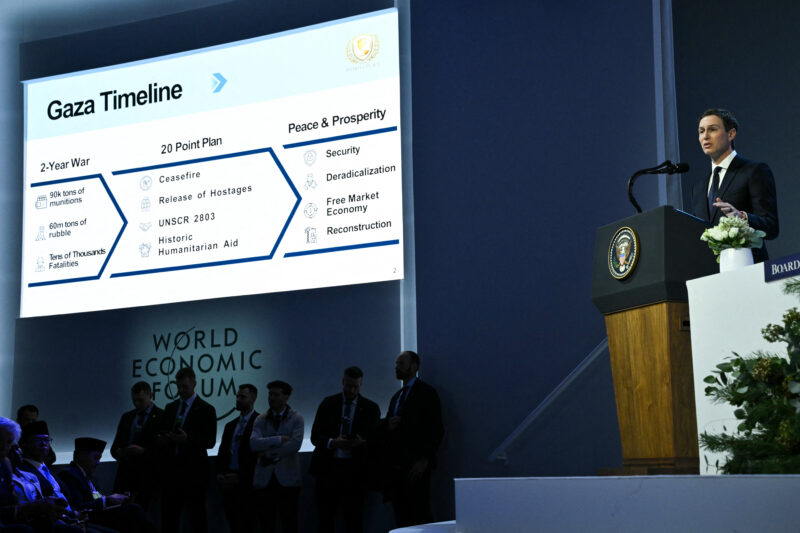
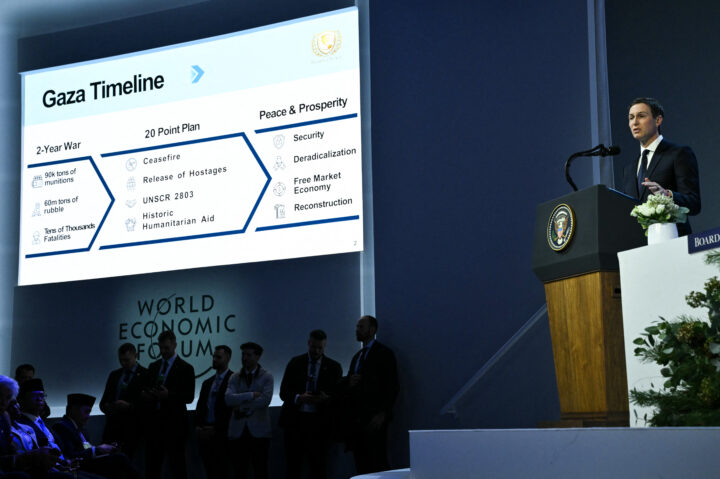
Jared Kushner speaks at the "Board of Peace" meeting during the World Economic Forum (WEF) annual meeting in Davos on January 22, 2026.
Hamas must demilitarize before Gaza can undergo redevelopment, President Donald Trump’s informal advisor Jared Kushner said on Thursday on the sidelines of the World Economic Forum in Davos, Switzerland, as he presented the administration’s plan to disarm the terrorist group and rebuild Gaza.
Kushner was building off of earlier remarks by President Donald Trump at the founding ceremony for his Board of Peace. “We are committed to Gaza being fully demilitarized, properly governed and properly rebuilt. … We’re going to be very successful in Gaza; it’s going to be a great thing to watch,” Trump said at the ceremony.
Hamas, Trump said, “has to give up their weapons, and if they don’t do that, it’s gonna be the end of them.”
Kushner said that the disarmament of Hamas would be a prerequisite to the reconstruction of the enclave. “Without that we cannot rebuild,” he said. “If Hamas does not demilitarize that will be what holds back Gaza and the people of Gaza from achieving their aspirations.”
Kushner presented the administration’s “demilitarization principles” meant to be implemented in the next 100 days. These include the destruction of “heavy weapons, tunnels, military infrastructure, weapons production facilities and munitions.”
According to the plan, Gaza will be governed by a single civilian authority, which will first be the National Committee for the Administration of Gaza (NCAG), the committee of Palestinian technocrats announced last week, followed by the Palestinian Authority, if it undergoes reforms. Any personal weapons in Gaza must be authorized by the NCAG, which will have a monopoly on the use of force, integrating and vetting any internal security and police.
“The end state: only NCAG-sanctioned personnel may carry weapons,” the presentation states.
Reconstruction, according to the plan, will only take place in sectors that are fully disarmed, and those who agree to disarm will be given amnesty and reintegration into or safe passage out of Gaza.
The IDF will gradually withdraw from Gaza based on the successful implementation of the plan, until it fully withdraws to the IDF-controlled security perimeter separating Gaza from Israeli civilians.
The other Board of Peace priorities in Gaza over the next 100 days will be delivering humanitarian aid and rehabilitating essential infrastructure, including water, electricity, sewage, hospitals and bakeries, as well as clearing rubble and building improved temporary housing.
Kushner presented the Trump administration’s vision for a redeveloped Gaza with a map that included a port and a tourism zone along the Mediterranean coast, as well as large residential areas and industrial complexes, while retaining the security perimeter.
Trump spoke in his concluding remarks about the potential of seaside property in Gaza: “This is a great location. See, I’m a real estate person at heart … I said ‘look at this location on the sea, look at this piece of property what it can be … People that are living so poorly can be living so well.’”
The plan includes the construction of a “New Rafah” in the next two to three years, including over 100,000 housing units, and subsequently, a “New Gaza.” Kushner envisioned 100% employment, with 500,000 jobs created and a $10 billion GDP by 2035.
In addition, Kushner projected over $25 billion in investments into the enclave, and said that donor countries will be announced at a separate ceremony in Washington in the coming weeks.
“We’re studying the best practices in the world,” Kushner said. “We want to encourage all the countries to be able to follow these best practices. … If we find what’s working in other countries, we should be copying them.”
Kushner encouraged all countries to put aside their differences to help the plan succeed.
“This deal only happened because … we all worked together to make this happen,” he said. “I see people criticizing Israel, or Israel criticizing Turkey and Qatar. Just calm down and work together for 30 days. … The goal here is peace between Israel and the Palestinian people. Everyone wants to live peacefully, everyone wants to live with dignity. … Let’s focus on the positive story, let’s calm down, turn a new chapter. If we believe peace can be possible, then peace is possible.”
Israeli National Security Minister Itamar Ben-Gvir voiced objections to Qatar and Turkey’s continued involvement on the Gaza Executive Board overseeing the NCAG.
“Turkey and Qatar remain pro-Hamas states that bolstered the Nazi terrorist organization leading up to October 7 and supported it throughout the war; this will not change in 30 days. Hamas must be utterly destroyed — countries that support it will not do so,” he said in a statement following Kushner’s remarks.
Ali Sha’ath, the head of the NCAG, said in a video address shown at the Davos ceremony that the Rafah border crossing would be opened next week. The Board of Peace’s high representative for Gaza, Nickolay Mladenov, also said in a post on X that “an agreement has been reached regarding the preparation for re-opening of the Rafah crossing. Concurrently, we are working with Israel and the National Committee for the Administration of Gaza to expedite the search for the remaining Israeli hostage.”
An Israeli official told Jewish Insider that the matter of the Rafah crossing would be discussed at an Israeli Security Cabinet meeting in the coming days, along with the return of the remains of Ran Gvili, the final Israeli hostage in Gaza.
Former Defense Minister Avigdor Liberman, a member of the opposition, posted on X that “the Rafah crossing is opening, the government of terrorists in suits” — referring to the NCAG — “is already acting in Gaza, and Israel is acting surprised. There are no surprises here, the Oct. 7 government continues to surrender to the Palestinians.”
The president hinted at diplomacy with Iran in his remarks at the ceremony, saying ‘Iran does want to talk, and we'll talk’
Chip Somodevilla/Getty Images
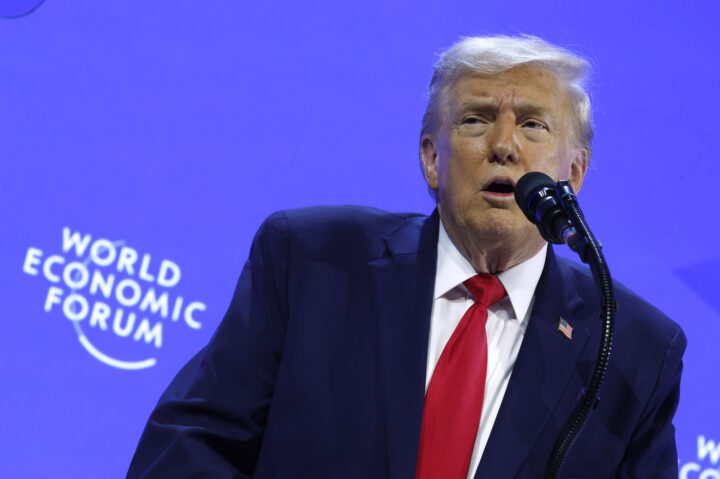
U.S. President Donald Trump gives a speech at the World Economic Forum (WEF) on January 21, 2026 in Davos, Switzerland.
President Donald Trump hosted a signing ceremony on the sidelines of the World Economic Forum in Davos, Switzerland, on Thursday for the founding members of the Board of Peace, his newly formed organization dedicated to world peace and security.
“We’re going to have peace in the world, and boy, wouldn’t that be a great legacy for all of us,” Trump said in his speech launching the board.
The Board of Peace’s “inaugural resolution,” which Trump signed at the ceremony, is to oversee the demilitarization and reconstruction of Gaza.
On Iran, Trump said that the U.S. bombing in June was because “they were two months from having a nuclear weapon, and we can’t let them have that. Iran does want to talk, and we’ll talk.”
In addition to the U.S., 19 countries attended the “massive event,” as a Trump administration source characterized it to Jewish Insider: Bahrain, Morocco, Argentina, Armenia, Azerbaijan, Bulgaria, Hungary, Indonesia, Jordan, Kazakhstan, Kosovo, Pakistan, Paraguay, Qatar, Saudi Arabia, Turkey, United Arab Emirates, Uzbekistan and Mongolia.
Members of Trump’s team in Davos — Chief of Staff Susie Wiles, Secretary of State Marco Rubio, Special Envoy Steve Witkoff, informal advisor Jared Kushner and Josh Gruenbaum, a diplomatic advisor to the board — spent the hours preceding the event working to bring more countries on board.
Some 35 of the 50 invited countries agreed to join the Board of Peace, Reuters reported. Those who did not attend the signing ceremony include Egypt, Vietnam and Belarus and Israel. Israeli President Isaac Herzog was in Davos on Thursday but did not attend because the Board of Peace is under Israeli Prime Minister Benjamin Netanyahu’s remit.
Most Western European countries declined to join the Board of Peace because of its apparent aim to replace the United Nations, as well as Trump’s pressure to turn Greenland over to the U.S. and Russia’s invitation to join.
“Just about every country wants to be a part of” the Board of Peace, Trump said. “We’ll work with many others, including the U.N. … This board has a chance to be one of the most consequential bodies ever created, and it’s my honor to serve as its chairman. … I take it very seriously.”
Though Trump first raised the idea of a Board of Peace as a supervisory body for the Gaza ceasefire reached last year, its charter describes a body concerned with peace worldwide and does not mention Gaza or Israel.
The charter says that the Board of Peace aims to “promote stability, restore dependable and lawful governance, and secure enduring peace in areas affected or threatened by conflict.”
It also makes clear that the board’s expansive mission was borne of disappointment with past efforts by the U.N., with its preamble “declaring that durable peace requires pragmatic judgment, common-sense solutions, and the courage to depart from approaches and institutions that have too often failed … Emphasizing the need for a more nimble and effective international peace-building body.”
Trump said in his remarks on Thursday that “the U.N. has got tremendous potential, and it has not used it,” following a comment earlier this week that the Board of Peace “might” replace the U.N. U.S. diplomats were instructed to say that the Board of Peace is meant to complement the U.N., not replace it, Bloomberg reported.
Trump will be the board’s inaugural chairman, a position that does not have an end date and carries executive power, including to invite and remove members, veto decisions, set the agenda and choose a successor. Membership is free for a three-year term, while permanent membership costs $1 billion.
Italy has yet to join the Board of Peace specifically because it may violate its constitution to join a body led by a single foreign leader, in which it does not have equal standing with other countries.
Rubio, Witkoff, Kushner and former U.K. Prime Minister Tony Blair sit on the Board of Peace’s founding Executive Board, and Gruenbaum and Aryeh Lightstone are its diplomatic advisors.
Trump also said in his remarks that Hamas “has to give up their weapons and if they don’t do that, it’s gonna be the end of them. Many countries say we really want to do it.”
The U.S. is “committed to Gaza being fully demilitarized, properly governed and properly rebuilt,” he added. “We’re going to be very successful in Gaza; it’s going to be a great thing to watch.”
But, the president noted, the regime is ‘shooting people indiscriminately in the streets’
Fabrice COFFRINI / AFP via Getty Images
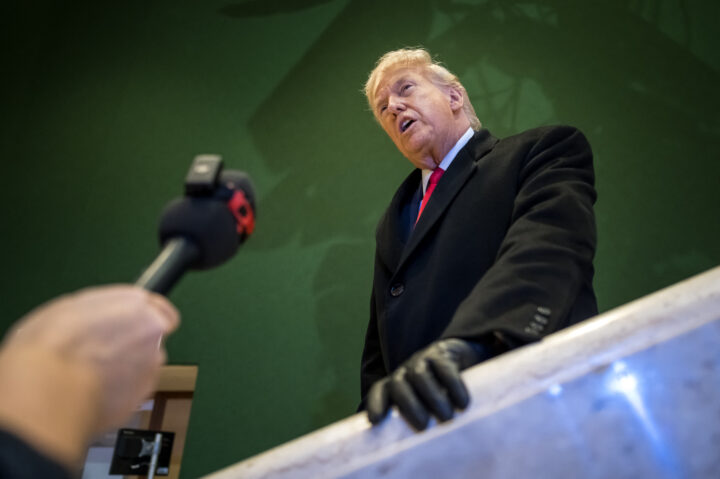
President Donald Trump as he leaves the World Economic Forum (WEF) annual meeting in Davos on January 21, 2026.
President Donald Trump said Wednesday that he hopes no military action will be needed in Iran, but stopped short of ruling it out as the U.S. continues to move military assets to the Middle East.
“We hope there’s not going to be further [military] action,” Trump said during an interview with CNBC on the sidelines of the World Economic Forum in Davos, Switzerland, while alluding to the fact that it still might be a possibility given Tehran’s conduct in suppressing nationwide demonstrations. “But you know, [the regime is] shooting people indiscriminately in the streets.”
The president has previously called the Iranian regime’s killing of protesters a “red line” and vowed to protesters that “help is on its way.” Trump repeated his claim on Wednesday that Iranian authorities had planned to hang 837 protesters last week, but “canceled it” after he warned them not to.
Trump has thus far refrained from authorizing military action against Iran — even as the U.S. has continued to move military assets to the Middle East in preparation for potential escalation, with reports indicating that the Pentagon has relocated more F-15 fighter jets to the region in recent days.
When asked by CNBC’s Joe Kernen whether people should “stay tuned” on Iran, Trump was noncommittal: “I guess — I mean, look, it’s a rough place,” he said.
White House Special Envoy Steve Witkoff, also at Davos, told Bloomberg News that diplomatic engagement remains possible if Tehran changes course.
“Iran needs to change its ways,” Witkoff said. “If they indicate that they’re willing to do that, I think we can diplomatically settle this.” But asked if he believes Iran wants to take the diplomatic path, Witkoff said, “We don’t have that sense yet.”
Still, the president noted that if Tehran were to continue pursuing nuclear capabilities, an attack similar to the U.S. strikes on Iranian nuclear sites last June is “going to happen again.”
“They keep experimenting with nuclear, and, you know, at some point they’re going to get the idea that they can’t do that,” he said.
The anti-hate symbol was worn by World Economic Forum Co-Chairman Larry Fink and Bank of America President Brian Moynihan
Mandel NGAN / AFP via Getty Images
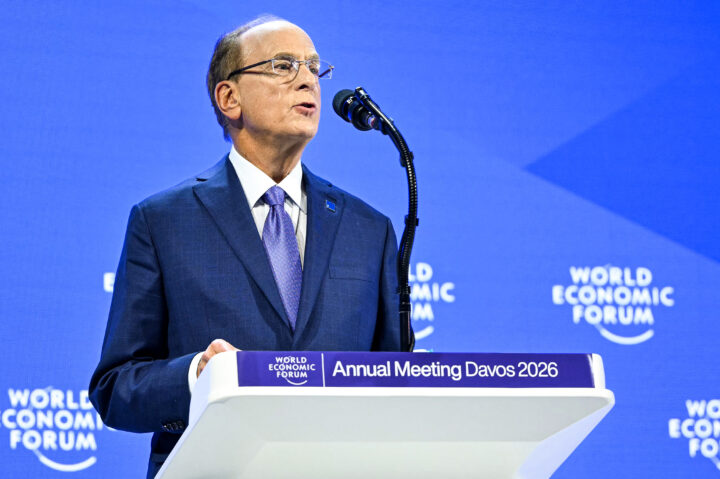
BlackRock chairman and WEF co-chairman Larry Fink speaks before President Donald Trump's address during the World Economic Forum in Davos on January 21, 2026.
Two prominent business leaders were spotted this week at the World Economic Forum in Davos, Switzerland, wearing the blue square pins popularized by Robert Kraft’s foundation that have become a symbol in the fight against antisemitism.
“We are deeply grateful to World Economic Forum Co-Chairman Larry Fink and Bank of America President and CEO Brian Moynihan for wearing the blue square during events in Davos. Their visibility, and their decision to champion this cause on a global stage, sends a powerful message that standing up to antisemitism and hate of all kinds matters in every corner of the world and with every audience,” Adam Katz, president of the Blue Square Alliance Against Hate, told Jewish Insider. The anti-hate group rebranded in October from its previous name, the Foundation to Combat Antisemitism.
Fink, the CEO of BlackRock, wore the pin as he gave opening remarks before President Donald Trump took the Davos stage on Wednesday. Moynihan sported his pin during an appearance from Davos on CNBC’s “Squawk Box” on Tuesday. Bank of America is a corporate partner of the Blue Square Alliance.
“Robert [Kraft] and the team have done a good job [combatting] that anti-hate which was around antisemitism, but it’s the social media piece that people don’t understand. They’re working to identify this very tough stuff,” Moynihan said during the CNBC interview.
Katz told JI that there are more than 5 million blue square pins in circulation worldwide, more than two years after the symbol’s launch in March 2023.
“When anyone wears their blue square, they are joining the fight against hate and becoming part of an alliance committed to building a stronger, more united country and world,” he said.
Speaking at the World Economic Forum, the president said ‘we’re going to know over the next two or three’ days and weeks ‘whether or not they’re going to do it’

Harun Ozalp/Anadolu via Getty Images
President Donald Trump delivers a speech during the World Economic Forum Annual Meeting in Davos, Switzerland, on January 21, 2026.
President Donald Trump issued a stark warning to Hamas on Wednesday, setting a timeline for the terror group’s disarmament and stating that it must deliver on its agreement to demilitarize or face potential military consequences.
“Hamas has agreed to give up their weapons,” Trump said, speaking to a packed room at the World Economic Forum in Davos, Switzerland. “If they don’t do it, they’ll be blown away very quickly.”
The president has made several statements following the initial adoption in October of the Gaza peace plan, insisting that the group disarm or face consequences. During his Davos address, Trump seemed to issue a more concrete timeline for when he expects the administration to determine if Hamas has chosen to comply with the agreement.
“They’ve got to do it, and we’re going to know over the next two or three days, certainly over the next two or three weeks, whether or not they’re going to do it,” said Trump, who noted that disarmament is “not an easy thing” for Hamas, adding that group members are “born with a weapon in their hands.”
The administration is a week into the launch of Phase 2 of Trump’s 20-point Gaza peace plan, which moves from “ceasefire to demilitarization, technocratic governance, and reconstruction,” according to White House Special Envoy Steve Witkoff.
“We have 59 countries that are part of that whole peace deal, and some of those countries aren’t even near the Middle East, and they want to come in and take out Hamas,” said Trump. “They want to come in and they want to do whatever they can.”
Critics have remained skeptical over whether Hamas will comply and relinquish its weapons. The terrorist group has previously insisted that it would refuse to disarm until a Palestinian state is established.
Sen. Lindsey Graham (R-SC), who previously said Hamas is unlikely to disarm without Israeli confrontation, lauded Trump’s statement at Davos in a post on X on Wednesday.
“President Trump rightly put Hamas on a time clock for disarmament,” Graham wrote on X. “This is the right decision at the right time.”
Plus, Israel joins the Board of Peace
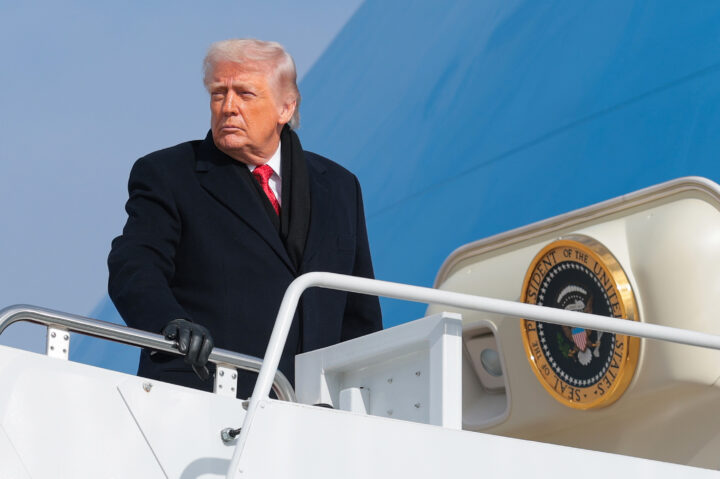
JOINT BASE ANDREWS, MARYLAND - JANUARY 16: U.S. President Donald Trump boards Air Force One on January 16, 2026 in Joint Base Andrews, Maryland. Trump is traveling to Palm Beach, Florida where he will attend a dedication ceremony to rename part of the city's Southern Boulevard before remaining at his Mar-a-Lago property throughout the holiday weekend. (Photo by Anna Moneymaker/Getty Images)
👋 Good Wednesday morning!
In today’s Daily Kickoff, we preview President Donald Trump’s address at the World Economic Forum in Davos, Switzerland, happening later today, and talk to Democrats on Capitol Hill about Pennsylvania Gov. Josh Shapiro’s allegation that the Harris presidential campaign asked him if he’d been an agent of Israel. We look at how J Street is navigating a political environment that is increasingly hostile to Israel, and spotlight Deep33 Ventures as the VC, launched this week, aims to counter China through U.S.-Israel tech collaboration. Also in today’s Daily Kickoff: Noam Bettan, Mark Carney and Rep. Mike Lawler.
Today’s Daily Kickoff was curated by Jewish Insider Executive Editor Melissa Weiss and Israel Editor Tamara Zieve, with assists from Danielle Cohen-Kanik and Marc Rod. Have a tip? Email us here.
What We’re Watching
- President Donald Trump will speak at the World Economic Forum in Davos, Switzerland, this afternoon local time after a delayed arrival resulting from an electrical issue on Air Force One that forced the initial plane to return to Joint Base Andrews after an hour in flight to be swapped out.
- We expect Trump to speak at length about the Board of Peace he is assembling, a day after the president told reporters at the White House that the body could serve as an alternative to the U.N. Earlier today, Israeli Prime Minister Benjamin Netanyahu confirmed that Israel would join the body, after previously criticizing the inclusion of Turkish Foreign Minister Hakan Fidan on the board’s executive committee.
- The president’s address will be preceded by an interview with Palestinian Authority Prime Minister Mohammad Mustafa, and followed by a session focused on the political realignment of the Middle East. Speakers in the latter session include Saudi Foreign Minister Prince Faisal bin Farhan Al Saud, U.K. Foreign Minister Yvette Cooper and International Atomic Energy Agency head Rafael Grossi.
- Later in the day, Sen. Chris Coons (D-DE) is slated to speak at the WEF about the U.S.-China relationship.
- We’re continuing to monitor the situation in the Middle East, as the U.S. deploys an aircraft carrier and fighter jets to the region. Trump issued his harshest warning yet to Iran, vowing in an interview with NewsNation last night to “wipe them off the face of this Earth” if Tehran makes an assassination attempt against him. “Anything ever happens, the whole country is going to get blown up,” Trump said.
- In Washington, the House Foreign Affairs Committee is holding its markup of the Eastern Mediterranean Gateway Act.
What You Should Know
A QUICK WORD WITH JI’S LAHAV HARKOV
When President Donald Trump first raised the idea of establishing a Board of Peace in October, it was as part of his 20-step ceasefire plan for Gaza. The board was meant to oversee a committee of Palestinian technocrats — whose composition was announced last week — and “set the framework and handle the funding for the redevelopment of Gaza … [and] call on best international standards to create modern and efficient governance that serves the people of Gaza and is conducive to attracting investment.”
The following month, the U.N. Security Council passed a resolution supporting the ceasefire plan and “welcom[ing] the establishment of the Board of Peace,” authorizing it to operate in Gaza until the end of 2027.
But the board’s charter describes a body concerned with peace worldwide, not with removing Hamas’ terror threat in Gaza, and in fact, it does not mention Hamas, Gaza or Israel at all. Its expansive, stated role is to “promote stability, restore dependable and lawful governance, and secure enduring peace in areas affected or threatened by conflict.”
Indeed, it appears to be an attempt to compete with the United Nations. Its preamble says: “Declaring that durable peace requires pragmatic judgment, common-sense solutions, and the courage to depart from approaches and institutions that have too often failed … Emphasizing the need for a more nimble and effective international peace-building body.” Asked at a press conference on Wednesday if he intends for the body to replace the U.N., Trump said it “might.” “I wish the United Nations could do more. I wish we didn’t need a Board of Peace,” he said.
QUESTION OF CONCERN
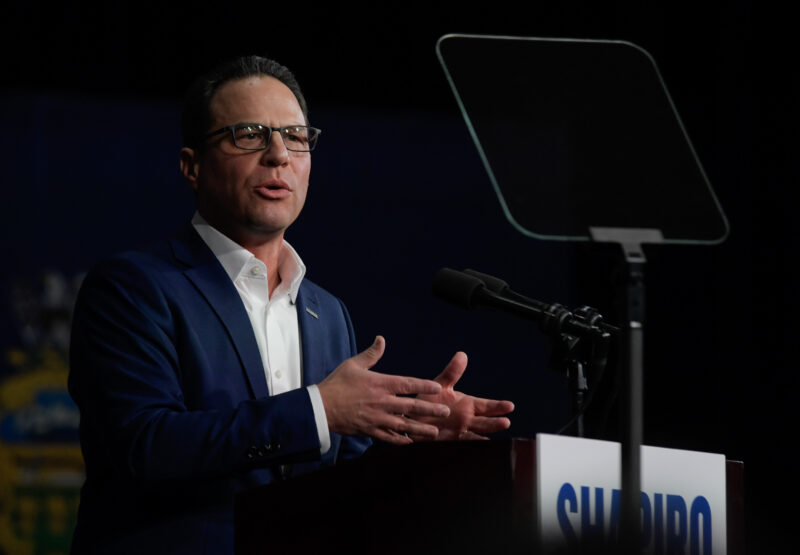
Moderate Dems alarmed by Harris team’s grilling of Shapiro over Israel ties
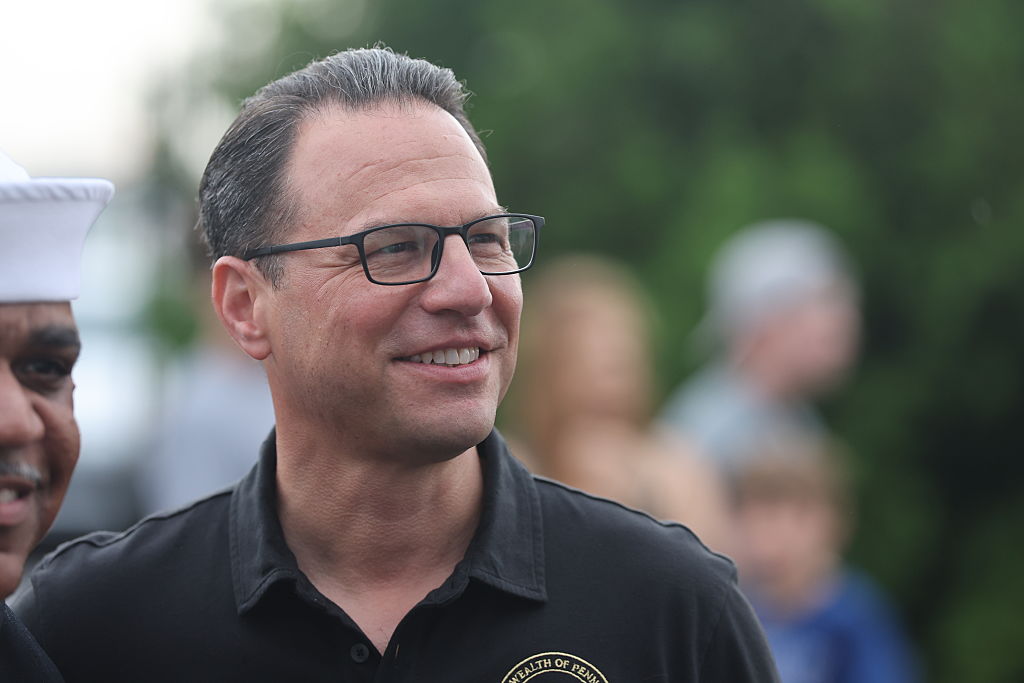
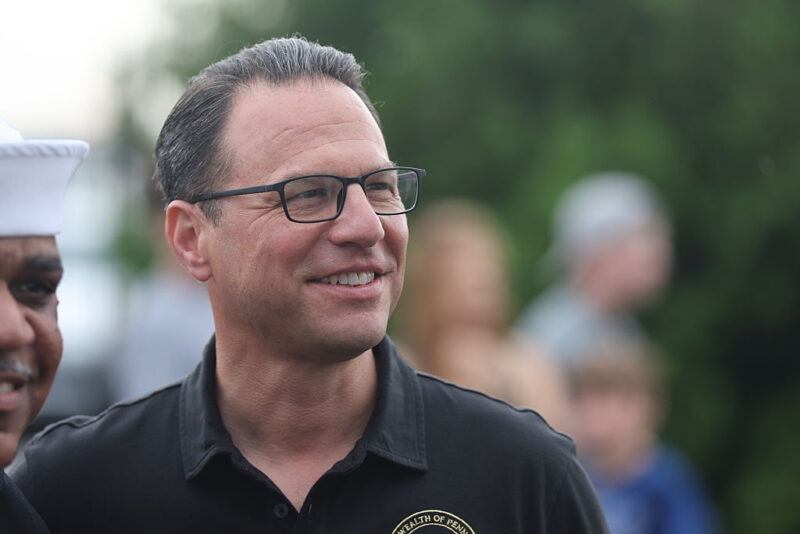
Several moderate House Democrats said they were concerned and frustrated by Pennsylvania Gov. Josh Shapiro’s account, which emerged over the weekend, of being questioned by Vice President Kamala Harris’ presidential campaign, as part of his vetting as her potential running mate, about whether he had ever been an agent of Israel. Shapiro, who volunteered on a kibbutz and briefly on an Israeli army base while in high school, also said that the campaign had pressured him to walk back condemnations of antisemitism on college campuses, and emphasized that he took offense to the scope and persistence of the questioning he faced about Israel, Jewish Insider’s Marc Rod and Emily Jacobs report.
Reactions: “Totally insane,” Rep. Jared Moskowitz (D-FL) told JI. “I don’t know how else to describe insanity. Literally insane.” Rep. Greg Landsman (D-OH) said the questioning was “concerning” and that he was “glad Josh had the courage to say what happened. Hopefully people will appreciate that you shouldn’t do that. … It’s a long-standing antisemitic trope that we’re all agents of the Israeli government, that we’re all working for this global Jewish cabal. And so that’s problematic,” Landsman, who is Jewish, continued.
Bonus: In Shapiro’s new memoir, which comes out next week, he recalls how his turbulent childhood — marked by his mother’s mental health challenges — shaped his approach to family and politics.
‘A new normal’
J Street hopes to capitalize on growing Democratic frustration with Israel

Three months after a ceasefire largely ended the fighting between Israel and Hamas in Gaza, the battle over the future of U.S.-Israel relations still rages in Washington. Both the left and the right face an erosion of support for traditionally pro-Israel positions. Amid the upheaval, the progressive Israel advocacy group J Street sees an opportunity: a chance to solidify Democrats’ shift away from unconditional support for Israel and its security needs. At the start of an election year, interviews with J Street’s top political official and its policy chief make clear that the group is eager to create space for Democrats who have taken a more critical approach to Israel, reflecting and reinforcing a shift toward greater distance in the historically close U.S.-Israel alliance, Jewish Insider’s Gabby Deutch reports.
Shifting tide: “There’s going to be a new normal,” Ilan Goldenberg, J Street’s senior vice president and chief policy officer, told JI in an interview. “There were two years of trauma that, I think, with the return of the hostages and the end of the war, people can finally start processing, but things are not going back.”
SUCCESSION RACE
Brendan Gill emphasizes support for Israel in crowded primary field to replace Sherrill
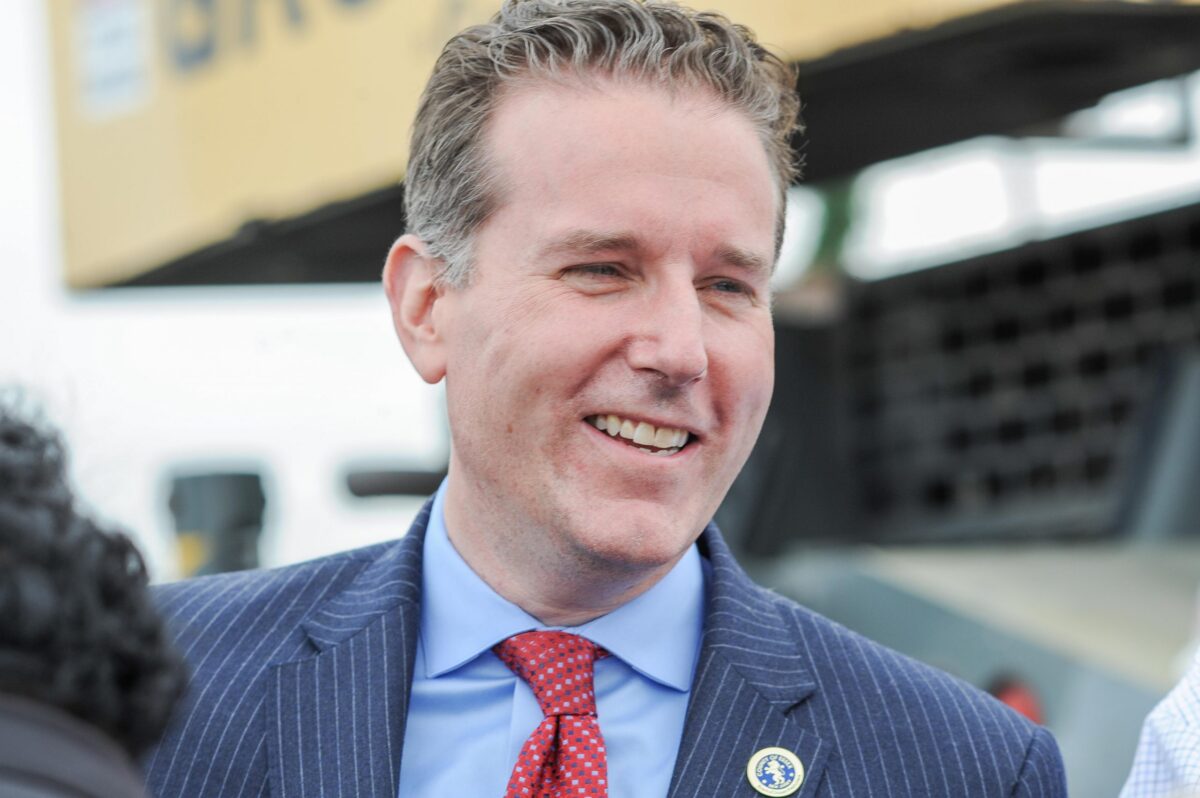
Essex County Commissioner Brendan Gill, one of the leading Democrats running for the vacant 11th Congressional District seat in New Jersey, told Jewish Insider’s Marc Rod he would be a strong supporter of Israel and the continued U.S.-Israel relationship, while also expressing concerns about the current Israeli government.
Background: Gill — a longtime New Jersey political hand who has previously worked as a staffer for or on the campaigns of Sen. Cory Booker (D-NJ), former Sen. Frank Lautenberg (D-NJ), who died in 2013, and former Reps. Steve Rothman (D-NJ) and Bill Pascrell (D-NJ) — said his time working with each of those lawmakers, all strong supporters of Israel, has served as his “North Star” for his policy toward the U.S.-Israel relationship. “I very much believe that we absolutely can respect the ability to disagree with decisions that are made by an elected government that we might not agree with, but still at the same time never waver on Israel’s right to exist, never waver on protecting the strategic partnership in that region of the world that the United States has enjoyed with the only democracy that exists, to continue to aid Israel in ways that are both important to its own protection and, by extension, the protection of our own national interests,” he said.
TAKING AIM
Mike Lawler condemns campaign ad against him as antisemitic

Rep. Mike Lawler (R-NY) condemned as antisemitic an ad running in New York’s suburban 17th Congressional District that targets him for his support for Israel and for receiving support from pro-Israel donors, Jewish Insider’s Marc Rod reports. “This ad is a disgrace,” Lawler said in a statement. “This kind of politics has no place in the Hudson Valley. I am calling on every candidate running in NY-17 to publicly and unequivocally denounce this ad immediately. Silence is an endorsement.”
What it says: The advertisement, paid for by the Institute for Middle East Understanding, attacks Lawler for supporting U.S. aid to Israel, claiming that such aid is depriving Americans of government-funded benefits programs. “Israelis enjoy universal healthcare, while Americans go bankrupt from medical bills,” the ad’s narrator states. “Lawler’s reward? Giant campaign donations from AIPAC and the pro-Netanyahu lobby.”
TEHRAN TALK
House Dems call for steps to restore communications access in Iran, but stay mum on military strikes
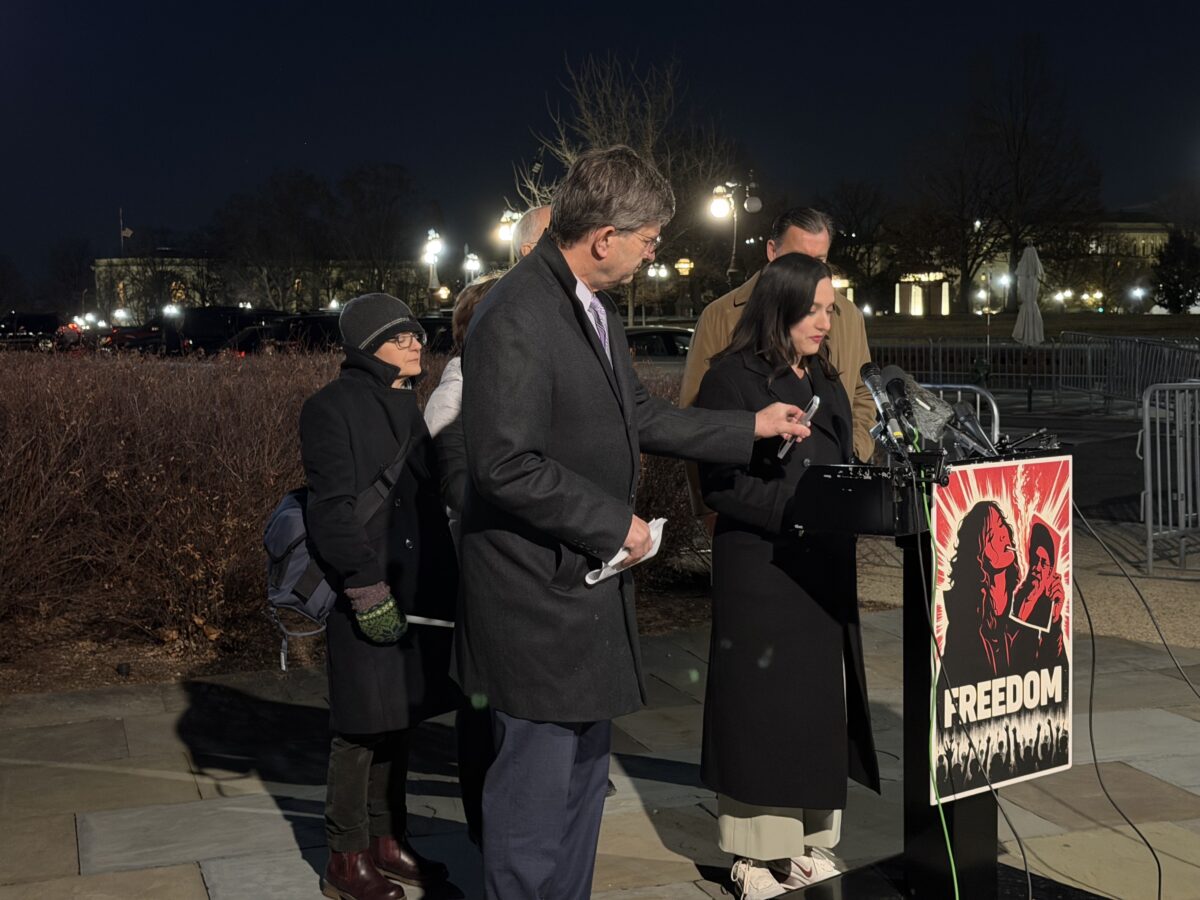
At a press conference outside the Capitol on Tuesday, House Democrats called for action by the U.S. government to ensure free internet access and telecommunications for Iranians amid a crackdown by the Iranian regime, but largely withheld comment on whether the administration should undertake military strikes on the regime in support of the protesters, as President Donald Trump has floated, Jewish Insider’s Marc Rod reports.
Reconnecting: “People cannot reach loved ones, plan and organize or reach unbiased information. They are literally being kept in the dark by their own government, and it could very well be permanent,” Rep. Yassamin Ansari (D-AZ), the daughter of Iranian immigrants and the first Iranian-American Democrat in Congress, said. “It’s why long-standing bipartisan efforts to ensure internet access in Iran cannot be left on the back burner. This access could save lives, and this is all very personal to me.” She thanked colleagues for signing on to a bipartisan resolution expressing support for the Iranian protesters and calling for steps to restore internet access.
Scoop: Reps. Josh Gottheimer (D-NJ) and Andrew Garbarino (R-NY) will reintroduce legislation on Wednesday to address the threat of killer drone strikes by the Iranian regime and other foreign adversaries through increased cooperation between the U.S. and Israel, Jewish Insider has learned.
TECH TOGETHER
Deep33 Ventures aims to counter China in U.S.-Israel tech alliance

A new deep-tech investment firm seeking to help Israeli startups fundraise and collaborate with U.S. companies emerged from stealth mode on Tuesday, announcing the launch of its $150 million fund. Called Deep33 Ventures, the firm will be led by serial entrepreneurs and investors Lior Prosor, who has invested in companies including Via Transportation, Lemonade Insurance and Carbyne, and Michael Broukhim, the co-founder of FabFitFun, who has invested in companies such as SpaceX, Stripe and Hut8, Jewish Insider’s Haley Cohen reports.
‘Allied infrastructure’: The fund, which already secured $100 million in capital commitments from its first group of investors, will focus on deep tech — which includes quantum computing, advanced energy and autonomous systems. “There isn’t a deep tech fund focused on Israel’s ecosystem. One of our biggest differentiators is the overlap of being deep tech and concentrated on Israel,” Broukhim told JI. With offices in Tel Aviv, New York and Los Angeles, the firm aims to create what it calls a U.S.-Israel “allied infrastructure corridor” combining the two countries’ technological strengths to counter China.
Worthy Reads
Pressing For Change: The Atlantic’s Arash Azizi talks to Iranians about potential U.S. military action against the Iranian government and Supreme Leader Ayatollah Ali Khamenei. “Ultimately, Iran’s next chapter will be the outcome not only of what America does or does not do but also of the interactions among regional actors, protesters, and the regime’s web of factions. How these will unfold is all but impossible to predict. But one thing is clear. Until a few years ago, millions of Iranians repeatedly voted in the country’s mostly unfree elections, hoping that regime insiders could pave a path for reform. They wouldn’t have dreamed of demanding change from American bombers or drones, or of asking the U.S. president to please kill the supreme leader for them. Khamenei’s obstinate refusal to effect any meaningful change and his bloody massacre of civilians in droves have brought Iranians to this point.” [TheAtlantic]
Government Without Jews?: In Tablet, former White House official Tevi Troy, looking at the history of Jewish participation in government since the U.S. was established, considers what that participation could look like in the future as both major political parties increasingly welcome antisemitic elements. “While the current attacks on Jews from both the left and the right are by no means unique in the context of Jewish history, they are alien to American political culture — which is what makes this moment frightening. The attempt to mainstream antisemitism on both the left and the right should be properly understood as an attack by extremists in both parties on the existing political culture and on the principles of the American founding. The American tradition is far more closely linked to the Jews and their many contributions to it than it is to the antisemites of the left or the right, whose hatred of the Jews reveals a rejection of that tradition — which they hope to reorder and replace with various European-born ideologies, from communism to fascism to theocracy, that have proven toxic to their political hosts.” [Tablet]
A Spin on Jewish Manhood: In The New York Times, Esther Zuckerman reflects on the Jewishness of the title character in director Josh Safdie’s “Marty Supreme,” a mid-century table tennis phenom whose religion is a critical component of his upbringing and shapes his decision-making as advances in the sport. “The brand of Jewish man who interests Safdie is not a model minority. The director is drawn to brash hustlers who make decisions that get themselves and the people around them into loads of trouble. And yet these characters are written with love and a deep understanding of the evolution of Jewish New York. … Marty Mauser may not achieve the greatness he longs for, but he is a representative of a generation of Jews whose dreams didn’t quite come true but who deserve recognition all the same. That’s the big-picture version of what Safdie and his cohorts are doing with ‘Marty Supreme.’ In the narrative, they dig deeper into the knotty reality of what it would have been like for a 23-year-old Jewish American man in 1952.” [NYTimes]
Word on the Street
Canadian Prime Minister Mark Carney, speaking yesterday at the World Economic Forum in Davos, Switzerland, argued in his speech to attendees that there had been “breaking of the world order, the end of a pleasant fiction and the beginning of a brutal reality where the geopolitics of the great powers is not subject to any constraint”…
Elsewhere at Davos, Sheikh Mohammed bin Abdulrahman Al Thani, Qatar’s prime minister and foreign affairs minister, said on Tuesday that President Donald Trump’s proposed Board of Peace represents the only viable path forward for Gaza, confirming that Doha has been invited to join the initiative, Jewish Insider’s Mathew Shea reports…
In a Wall Street Journal op-ed, Iranian Foreign Minister Abbas Araghchi defends Tehran’s violent crackdown on protests in the country and threatens that Iran will be “firing back with everything we have if we come under renewed attack” by the U.S.; in response, the WSJ’s editorial board, which called Araghchi the “soft face” of the regime, said the diplomat’s threat “betrays Iran’s harsh reality”…
Sen. Peter Welch (D-VT), Rep. Ro Khanna (D-CA) and more than 70 Senate and House colleagues wrote to President Donald Trump urging the U.S. to intervene to stop potential Israeli annexation of the West Bank, and to reimpose sanctions on violent settlers…
Goldman Sachs and the Qatar Investment Authority announced the expansion of their strategic partnership, with the QIA potentially committing up to $25 billion in Goldman Sachs’ asset management arm..
The Supreme Court declined to hear a case brought forth by Agudas Chasidei Chabad, a Brooklyn-based umbrella group representing the Chabad-Lubavitch movement, against Russia over the return of sacred Jewish texts that had been taken by the Nazis and are now held in Russia…
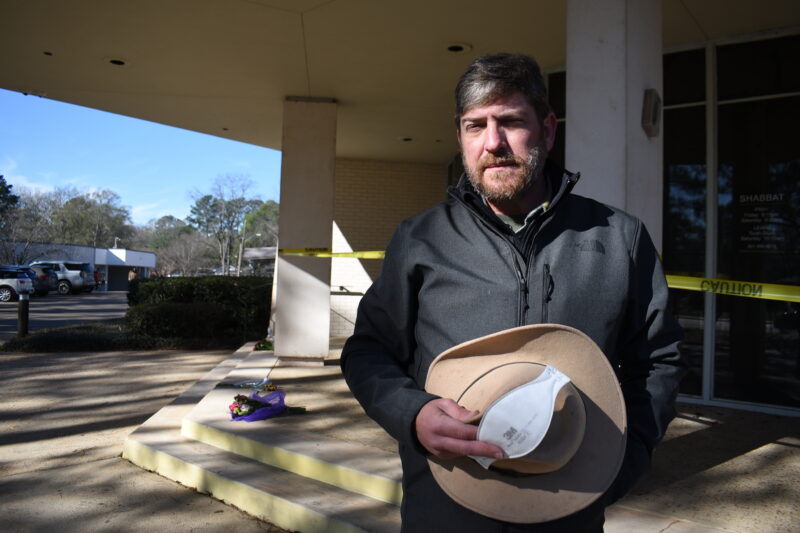
With worshippers at Beth Israel Congregation in Jackson, Miss., still reeling from a Jan. 10 arson attack that severely damaged the historic synagogue, Congress appears poised to provide $300 million for the Nonprofit Security Grant Program for 2026, a small boost from the funding provided in 2024 and 2025, Jewish Insider’s Marc Rod reports…
Miami Beach, Fla., nightclub Vendôme apologized for a now-viral incident in which far-right influencers were seen inside the venue as it played a Kanye West song praising Adolf Hitler; Vendôme said that three staff members that had been involved in the incident were no longer employed there…
Following the Buffalo Bills’ latest postseason loss, Gary Ginsberg laments in The New York Times about his hometown team’s lifelong failure to win a Super Bowl while expressing hope that revitalization efforts in the city could boost the team to a history-making championship win…
Israeli singer Noam Bettan won the season finale of popular Israeli singing competition show “Rising Star,” becoming Israel’s entrant to the 2026 Eurovision Song Contest…
Israel began demolishing the east Jerusalem headquarters of the U.N. Relief and Works Agency, following the passage of a law banning the agency, which works with Palestinians, over what Israel says is its support for terrorism and staffers’ ties to terror groups…
The Kurdish-led Syrian Democratic Forces are facing pressure from Damascus and Washington to agree to integrate into the Syrian government, days after the implementation of a ceasefire between the two…
Jacob Reses, chief of staff for Vice President JD Vance, and the Foundation for American Innovation’s Rachel Altman, got married on Sunday in Rockville, Md….
Literary agent and Holocaust survivor Georges Borchardt, who found a publisher for Elie Wiesel’s Night and represented the estates of such writers as Tennessee Williams and Hannah Arendt, died at 97…
Philadelphia attorney and community activist Daniel Segal died at 79…
Pic of the Day

Israeli Foreign Minister Gideon Sa’ar (left) and Czech Foreign Minister Petr Macinka spoke on Tuesday in Prague during an official visit by Sa’ar to the Czech Republic.
Birthdays
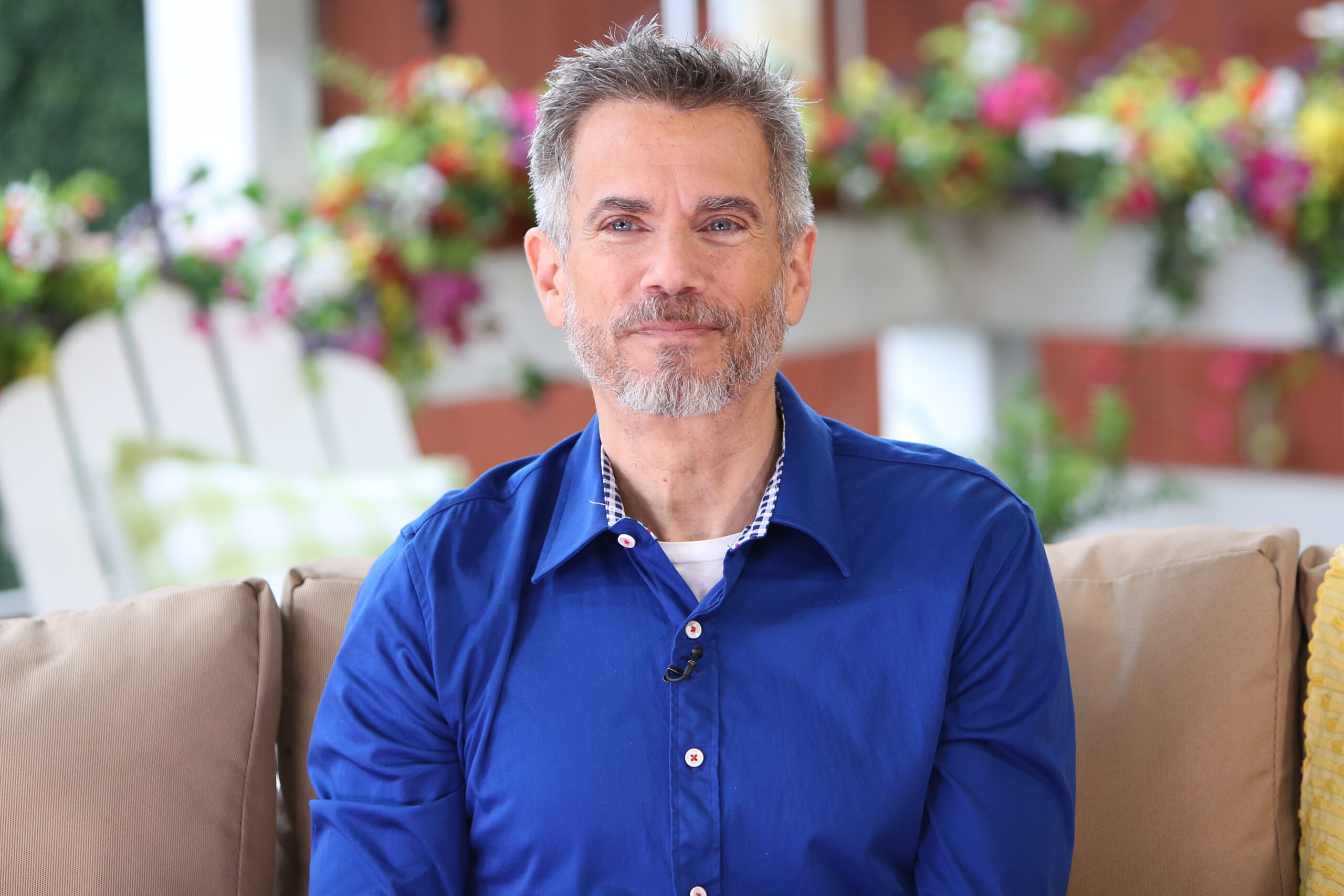
Actor, director and producer, he is the voice of Beast in Disney’s “Beauty and the Beast,” Robby Benson (born as Robin David Segal) turns 70…
Writer specializing in modern Judaism and women’s issues, Blu Greenberg (born Bluma Genauer) turns 90… Philanthropist, co-founder and chair emerita of the Charles and Lynn Schusterman Family Philanthropies, Lynn Schusterman… Owner of the NHL’s Boston Bruins and chairman of Delaware North, a global food service and hospitality company, Jeremy Maurice Jacobs turns 86… Literary critic, feminist, writer on cultural and social issues, Elaine Showalter (born Elaine Cottler) turns 85… Retired Israeli ambassador to Cyprus, New Zealand, Turkmenistan and Estonia, Shemi Tzur turns 81… Israeli visual artist, he taught at Jerusalem’s Bezalel Academy of Arts for 30 years, Zvi Goldstein turns 79… Attorney general of the U.S. during the Obama administration, now a senior counsel at Covington & Burling, Eric H. Holder Jr. turns 75… Past chairman of the Zionist Organization of America and chair of the real estate group at the NY/NJ law firm of Sills Cummis & Gross, Mark Levenson turns 69… CEO of UJA-Federation of New York since 2014, he will retire in June, Eric S. Goldstein turns 66… U.S. senator (R-ND), Kevin Cramer turns 65… Chairman and CEO of Norfolk, Va.-based Harbor Group International, a $21 billion real estate investment firm, Jordan E. Slone turns 64… Executive editor digital at the Washington Monthly, Matthew Cooper… Chief operating officer of OneTable, Andrea Greenblatt… Senior fellow at the USC Annenberg School, she is the former editor-in-chief of both Glamour and Self magazines, Cindi Leive turns 59… CEO at C-SPAN, Sam Feist turns 57… President and CEO of The Harry and Jeanette Weinberg Foundation, Rachel Garbow Monroe… Director, producer and screenwriter of films, best known as the producer or director of the eight films in the “Paranormal Activity” series, Oren Peli turns 56… Christian Zionist, television host and presenter of “The Watchman” sponsored by Christians United for Israel, Erick Stakelbeck turns 50… CEO at Shpait.AI, Shlomo Einhorn… Peruvian model and TV host, she represented her country in Miss Universe 2009, Karen Schwarz turns 45… D.C.-based staff writer for the Los Angeles Times, Jennifer Haberkorn… Israeli actress, screenwriter and filmmaker, Romi Aboulafia turns 42… Vice president, chief of staff and senior counsel at Children’s National Hospital, Jordan Grossman… Samuel Z. Eckstein…
More than 2,500 attendees will arrive in Davos in the coming days for the annual gathering, which begins Monday

Britta Pedersen/picture alliance via Getty Images
Børge Brende, president of the World Economic Forum, speaks in a dpa interview.
The World Economic Forum kicks off in Davos, Switzerland, on Monday, with topics set to address a world that has been much changed since the last gathering a year ago. For one thing, founder Klaus Schwab will no longer be front and center, following his departure as WEF chair last spring; instead, attendees will hear from WEF President and CEO Børge Brende, WEF co-chairs André Hoffmann and Laurence Fink, and Swiss President Guy Parmelin when the first plenary convenes on Tuesday morning.
Marking a shift from the Biden administration, during which only senior White House officials attended the forum, President Donald Trump will travel to Davos, where he is slated to speak on Wednesday afternoon local time. Joining Trump is a delegation that includes White House Special Envoy Steve Witkoff, Treasury Secretary Scott Bessent, Commerce Secretary Howard Lutnick, Energy Secretary Chris Wright and AI and crypto czar David Sacks.
This year’s summit theme, “A Spirit of Dialogue,” will be felt as much on the sidelines as in the official sessions. While at Davos, Trump is expected to chair the first meeting of the Gaza Board of Peace — which is tasked with temporarily governing Gaza after Hamas — and make an additional announcement about the group.
The Trump administration has not yet specified how many members the Board of Peace might include, nor have any individuals been named. However, reports have indicated that Nickolay Mladenov, a former U.N. Middle East envoy, who is expected to run the board’s operations on the ground, is likely to tap people from the private sector and NGOs. Other names that have been floated around as potential members include UK Prime Minister Keir Starmer and Turkish President Recep Erdogan.
The group will ultimately be tasked with overseeing a 15-member Palestinian technocratic governing body in Gaza, led by Ali Shaath, a former deputy minister in the Western-backed Palestinian Authority who oversaw the development of industrial zones, according to a joint statement by Egypt, Qatar and Turkey.
Sens. Chris Coons (D-DE), who this week is leading a delegation to Denmark as the U.S. engages with Copenhagen over Greenland, will travel on to Davos with some of the delegation’s members. He’s slated to participate in two panels on Wednesday — one on global aid, and a second on the U.S.-China relationship.
The legislators will be joined by Govs. Gretchen Whitmer of Michigan, Andy Beshear of Kentucky and Kevin Stitt of Oklahoma, who are speaking on a panel about state governance. Beshear is also slated to speak on another panel focused on middle-class economics.
Israeli President Isaac Herzog will again participate in the forum, this year speaking in conversation with CNN’s Fareed Zakaria on Thursday morning. German Chancellor Friedrich Merz will also speak Thursday morning, days after he made headlines for saying that the Iranian regime is “in its final days and weeks.”
More than a dozen countries — including the U.S., Qatar and Saudi Arabia — will open pavilions in Davos. This will mark Riyadh’s second time opening a pavilion, part of Saudi Crown Prince Mohammed bin Salman’s effort to showcase the Gulf country’s Vision 2030 plan. The Invest Qatar Pavilion will host a series of events over the course of the week, largely focused on finance and innovation.
Israel won’t have a pavilion this year — but efforts are already underway for an Israel House pavilion at next year’s WEF, though the pavilion, unlike some others, won’t be an official pavilion backed by the Israeli government.
Some attendees will depart Davos on Friday following the conclusion of official events, but others will stay for the annual Shabbat dinner, attended by a who’s who of Jewish — and non-Jewish — guests.
“When it comes to Shabbos, it’s at the end of a week of intense meetings and networking and business,” Rabbi Avraham Berkowitz, who for years has been involved in the planning for the annual dinner, told JI in 2023. “So then people come to the last important meal: It’s spiritual, it’s purposeful, it’s Yiddishkeit.”
Jewish Insider Washington reporter Matthew Shea contributed to this report.
Please log in if you already have a subscription, or subscribe to access the latest updates.