









































































A longtime Albany operative has joined forces with local lawmakers for a statewide push against ‘anti-Jewish hate’
Lori Van Buren/Albany Times Union via Getty Images
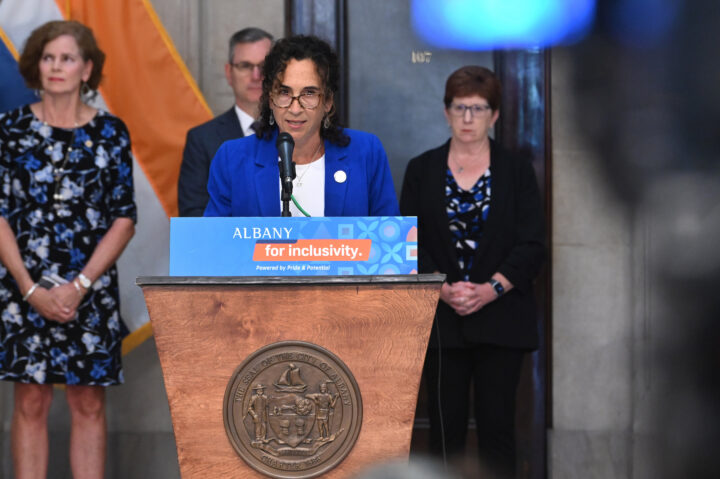
Deborah Zamer, Albany Common Council member, speaks during a press conference at Albany City Hall on Tuesday, Sept. 2, 2025, in Albany, N.Y.


 Add JewishInsider on Google
Three Jewish politicos from New York’s Capital Region — all women, and all Democrats — have launched a new state-level committee dedicated to supporting candidates with liberal social views who also push back on anti-Jewish and anti-Israel forces.
Aleinu-NY PAC, named for the Jewish prayer that translates to “on us,” registered with the New York Board of Elections in late September and officially launched its website last week. It describes itself as “a new nonpartisan political action committee in NYS established to support candidates who stand up against Antisemitism and the scourge in violence against the Jewish community throughout New York.”
Behind the PAC’s inception is veteran Albany lobbyist and consultant Libby Post, along with Albany Common Councilmember Deborah Zamer and Schenectady County Legislator Michelle Ostrelich. A longtime advocate for gay rights and animal welfare, Post told Jewish Insider that the left-wing reaction to the Oct. 7, 2023, Hamas attacks, and the subsequent rise of antisemitic incidents, have placed Judaism at the center of her identity and political concerns for the first time.
“People celebrating Oct. 7 — it’s absolutely disgusting — and not recognizing the fear that has gone through the Jewish community because of the antisemitic, anti-Zionist rhetoric, that’s just turning into violence,” she said in an interview. “I used to say that I was a lesbian who happened to be Jewish. Now I say I’m a Jew who happens to be a lesbian.”
Post said the PAC would consider endorsing candidates “regardless of where they’re running or what party.” But she added that the group would not depart from the values that had defined so much of her political career, and highlighted a section of the website that invokes the halakhic principle of Kavod HaBriyot, often interpreted as universal human dignity.
“We want to help elect candidates who demonstrate their opposition to antisemitism and violence against the community, but we also will be looking at their stands on choice [on abortion] and LGBT rights because that has to do with hate,” she said. “We’re not going to support a candidate who might be great on half what we want them to be great on, but they’re Islamophobic, or they’re anti-choice, or they’re homophobic.”
Post said the PAC had not yet determined how it would define these standards in a candidate questionnaire, and acknowledged that it might rule out support for many Republican candidates or even for conservative Democrats representing the state’s large Orthodox communities.
However, on the question of Israel’s right to exist, the PAC’s standard is already in place and unequivocal.
“Anti-Zionism is a form of anti-Jewish hatred, just like antisemitism. Full stop,” the FAQ section of the webpage states. “Anti-Zionism is a hate movement that uses the lies of ‘genocide,’ ‘apartheid,’ and ‘colonizer’ to incite hostility and violence against the Jewish community.”
Nonetheless, the committee will focus not on foreign policy, but exclusively on domestic rhetoric and the problem of bias attacks.
Post said the PAC had collected $5,000 from around a dozen donors in just one week. But it will not begin interviewing candidates or making endorsements until local elections next year, and will likely hold its first in-person fundraiser in her office near the state Capitol building after the legislature reconvenes in January.
Post said that the “antisemitic spewing from all corners” and the “silence from the left” on Hamas’ sexual assaults during the Oct. 7 attacks had made the PAC’s creation feel necessary.
“I’ve had it. It’s the only way I can explain this,” Post said. “I’m glad my parents aren’t alive to see any of this, because my father fought in [WWII], and we, like so many others, lost family in the Holocaust.”
A new survey by Jewish Women International found that young women experienced major disruption to their dating lives in the aftermath of Oct. 7, with some now seeking out Jewish partners

Getty Images
Rear view of a young couple sitting side by side on a bench in a city park during autumn.
Nearly half (47%) of young Jewish women reported dating less as a result of increased antisemitism and other negative consequences of the Oct. 7, 2023, Hamas terror attacks, according to a new survey by Jewish Women International.
Over one-third (36%) of respondents said they’ve ended existing romantic relationships due to these dynamics, while 18% said they’ve stopped online dating altogether.
Many of the Jewish American women surveyed, who were between the ages of 20 and 34, reported other negative impacts to their romantic relationships including strained conversations (75%), arguments (53%) and decreased contact or connection (39%).
One respondent described ending a relationship over “our differing levels of Zionism” and while another experienced “tension in our relationship” on the “first anniversary of Oct. 7.” One said she “ultimately ended my relationship with my partner because he was always so angry about Gaza but never showed any anger toward antisemites, toward Hamas, or even to an antisemitic gunman who killed two of my peers.”
A vast majority (71%) of respondents said they’d changed what they’re looking for in a dating partner in the aftermath of the attacks, which for several meant seeking out exclusively Jewish partners,
“I decided to only date Jewish to avoid any blatant antisemitism, and also to ensure that there would be common ground,” one wrote. “Before October 7, like, sure, I wasn’t opposed to going on a date with someone who wasn’t Jewish, and exploring that opportunity. And now — not really so much,” another said. “Felt deeper connections to Jews I know and are strangers. Exclusively wanted to date only Jews,” another wrote.
Jewish singles have been grappling with the impact of increasingly heated antisemitic rhetoric on dating apps and among potential romantic interests for years now, as several told Jewish Insider in 2024 that they too had pivoted to seeking a Jewish partner as they waded through politically charged rhetoric on dating profiles.
Even more than their dating lives, survey respondents experienced negative impacts to their mental health (75%) and friendships (74%), with 80% reporting decreased contact in their platonic relationships. For those on college campuses, 68% said their sense of belonging was damaged in the aftermath of Oct. 7, and 63% said the same of their relationships with their classmates.
In professional settings, 39% of respondents said they’d felt pressured to minimize their Jewish identity and 18% said they’d removed Jewish content from their resumes. Several said in written responses that they’d been drawn to work in Jewish advocacy by their experiences.
“JWI has dedicated significant time and resources to a comprehensive national survey of the impact of antisemitism and misogyny on young Jewish women. Based on our findings, young Jewish women feel disenfranchised in the workplace, ostracized in social circles, and compelled to erase their Jewish identities for fear of personal safety,” said Meredith Jacobs, CEO of JWI, who added that the organization will focus its programming on “post-traumatic growth.”
“As the mothers of the next generation of the Jewish diaspora, the support these women receive will directly impact the future of Jewish peoplehood,” Jacobs continued.
The 514 respondents were largely reached through JWI’s networks, including focus groups at the organization’s leadership conference, between Nov. 11-Dec. 22, 2025.
Please log in if you already have a subscription, or subscribe to access the latest updates.
 Continue with Google

 Continue with Apple