














































































Montreal police said the suspect's motive is still under investigation
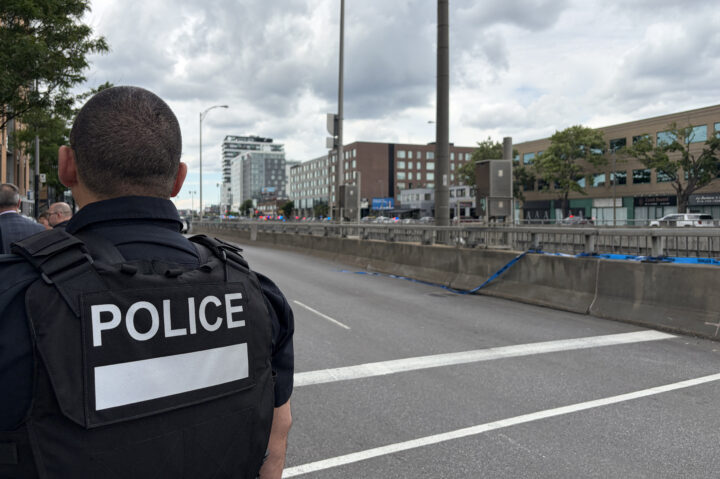
Daphné LEMELIN / AFP via Getty Images
A police officer looks toward the scene of a shooting (near the tall building at L) in Montreal on June 22, 2026, which left three people dead.


 Add JewishInsider on Google
Three people were killed in a shooting attack in Côte-des-Neiges, a heavily Jewish neighborhood in Montreal, Canada. A civilian, a police officer and the suspect were confirmed dead by Montreal police, while one other police officer was seriously injured but in stable condition.
Police urged residents to shelter in place, lock their doors and avoid the area as they responded to the incident and searched the area for additional suspects. In a press conference, Fady Dagher, Montreal’s police chief, said that the motive was still under investigation. He said they had determined there had only been one suspect who shot at them and he had been neutralized.
Tzipi Zeigerman, an Israeli who moved to the neighborhood two years ago, told Jewish Insider she was home when the attack began around noon, and from her window “noticed people running and screaming ‘active shooting.’”
“I heard tons of police cars and helicopters,” said Zeigerman, adding that as of Monday afternoon the streets were still closed and all businesses and schools in the area, including several Jewish institutions, remained on lockdown.
“It’s a tragic moment, it’s a real nightmare, knowing that you get engaged … to protect and serve, and get killed — it’s a dramatic moment for me as a chief, for my troops,” Dagher said, noting that he had visited the troops in hospital. “When we become a police officer, we become a police officer knowing the risk — we never expect this to happen.”
Côte-des-Neiges is home to several historically significant synagogues, including the The Spanish & Portuguese Synagogue, the oldest Jewish congregation in Canada, dating back to 1760.
The shooting comes amid a wave of targeted antisemitic attacks in Canada, which have led local Jewish leaders to raise the alarm on the country’s failure to properly protect the community. The Canadian government eliminated the standalone role of national antisemitism envoy in February.
Three synagogues in the Toronto area were shot at in early March in a span of five days, amid an escalated threat environment as Canada has experienced some of the most severe manifestations of the global surge in antisemitism since the Oct. 7, 2023 terrorist attacks — with higher rates of antisemitic incidents than other countries but lower conviction rates. In another recent incident, Canadian law enforcement arrested three Toronto-area men accused of planning violent kidnappings targeting women and members of the Jewish community. Irwin Cotler, Canada’s former justice minister, told JI in April that if the issue is not addressed quickly, there’s “a ticking bomb here in Canada for what will be the Bondi massacre occurring in Canada,” a reference to the December 2025 mass shooting at a Hanukkah gathering at Bondi Beach in Sydney, Australia, that killed 15 people.
Still, Zeigerman, who said she moved to Canada from Israel to seek a safer life, “felt very safe here — until now.”
Jewish groups urged congressional leaders after the attack to reach a deal to secure funding for the Nonprofit Security Grant Program
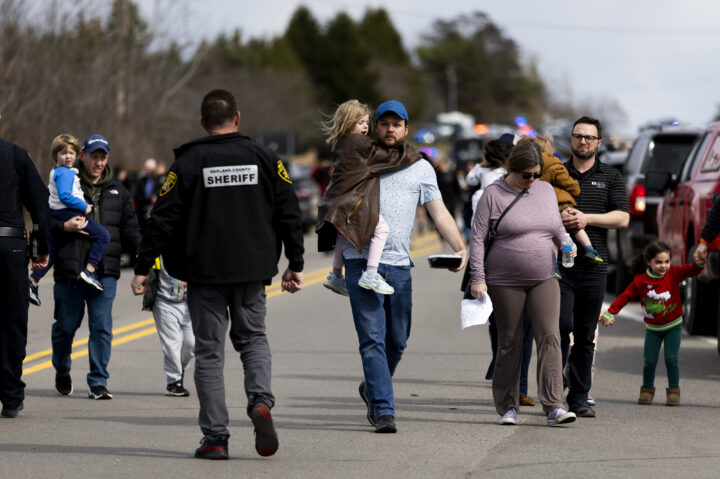
Emily Elconin/Getty Images
Parents carry their children to their cars as enforcement escorts families following an active shooter near Temple Israel on March 12, 2026 in West Bloomfield, Michigan.
The car ramming and shooting attack at Temple Israel in West Bloomfield Township, Mich., on Thursday seems unlikely to break the congressional stalemate over funding for the Department of Homeland Security, which has been in a partial shutdown for weeks.
Among other programs, the Federal Emergency Management Agency and the Nonprofit Security Grant Program fall under the DHS funding bill, which Democrats have sought to renegotiate to implement new restrictions on Immigration and Customs Enforcement, following the deadly shootings of two U.S. citizens in Minneapolis.
The bill, as originally drafted, would have provided $300 million for the NSGP, well below the $1 billion many Jewish community groups have said is necessary and the $500 million that many supporters of the program on the Hill have been advocating for.
“The consequences, impacts of not funding DHS are real, and they’re in an unsustainable position. [It’s] now been 14 days [that Democrats have] had the latest offer from the White House and haven’t responded to it,” Senate Majority Leader John Thune (R-SD) said on Thursday.
Thune also said that Republicans have tried to pass a stopgap funding measure, known as a continuing resolution (CR), to restore funding to DHS while negotiations continue, but Democrats rejected it.
“They’re trying to get up here and blame Republicans, and we’ve tried through a continuing resolution to fund the government to allow for the negotiations to continue, but our offer has been out there. They have yet to respond to it,” Thune continued. “We’re trying to fund everything with a CR to allow for those negotiations to continue, and they consistently block it. So it’s, I’m not sure, but it’s a dangerous game, and people are going to get hurt.”
But Senate Minority Leader Chuck Schumer (D-NY) pointed blame for the lack of NSGP funding toward Republicans, highlighting that they had blocked passage of legislation by Democrats on Thursday to fund and reopen portions of DHS, including FEMA.
“Leader Schumer is an ardent supporter of NSGP funding, and this week, Republicans rejected Democratic efforts to fund the program through FEMA, along with the TSA, CISA, and the Coast Guard,” a spokesperson for Schumer told Jewish Insider. “Democrats continue pushing for common-sense solutions Americans demand: to rein in ICE and make sure no more Americans are killed by unaccountable and masked individuals.”
Schumer had called for $500 million in funding for the program this year.
Multiple Jewish community groups urged lawmakers to move the DHS bill forward in light of Thursday’s attack.
“This latest attack shows the security crisis the Jewish community is facing & the need for more resources for our protection,” Nathan Diament, the executive director of the Orthodox Union Advocacy Center, wrote in a post on X. “The main source of security funding, the Nonprofit Security Grant Program, is bogged down in the DHS funding bill fight[.] Congress needs to act on this now.”
Diament added to JI that lawmakers “need to act — with urgency. We don’t care if the funding comes through a DHS appropriations agreement, the war supplemental or some other legislation — but it’s urgent and must be done.”
A spokesperson for the Jewish Federations of North America told JI, “Our position remains that there are vitally important programs for Jewish communal safety in the Homeland Security bill and that both sides must work to fund them as quickly as possible.”
Sydney Altfield, CEO of the Teach Coalition, which supports Jewish schools, also highlighted the DHS funding gridlock, and urged Congress to support a significant increase in NSGP funding.
“Right now the Nonprofit Security Grant Program, the main funding source protecting institutions like this one, is caught in the middle of a DHS funding fight in Congress. The government’s first responsibility is to protect its citizens,” Altfield said in a statement. “That is why Congress needs to bring NSGP funding levels to $1 billion before the next attack happens. Jewish families have been forced to pay an antisemitism tax for too long.”
Rabbi A.D. Motzen, the national director of government affairs for Agudath Israel of America, wrote on X, “Hopefully Congress will fund [DHS] soon so we can do more to stop these attacks from happening.”
The Anti-Defamation League also urged Congress to boost NSGP funding to $1 billion, without making direct mention of the stalled DHS funding talks.
“Today’s attack in Michigan is a painful reminder that Jewish communities remain targets of violent hate. At a time when threats are rising, at-risk communities must have the resources they need to protect themselves,” ADL CEO Jonathan Greenblatt said. “The Nonprofit Security Grant Program has been a lifeline for synagogues, schools, and community centers seeking to strengthen their security.”
“Yet demand for this lifesaving program continues to far outpace available funding. We urge Congress to significantly increase funding for the Nonprofit Security Grant Program to $1 billion. The safety of American communities must remain a bipartisan priority,” he continued.
In a longer statement issued publicly, JFNA said that the attack at the suburban Detroit synagogue — and the actions of security guards in preventing deaths — highlights the need for additional government support.
“We cannot do it alone. Protecting citizens is the primary responsibility of the government. The Jewish community is forced to spend over $765 million a year to simply protect itself, and there is more the government should do to ensure every vulnerable Jewish institution has the resources to keep safe,” JFNA said in the statement.
“Today’s events prove once again that the investments our community have made in security play a critical role in keeping us safe, even in the face of the intolerable antisemitic violence around us,” the statement continued.
The group has been pushing for $1 billion in funding for the NSGP as part of a six-point plan for protecting the Jewish community, which is facing record levels of antisemitism, which have been exacerbated by the war in Iran.
The Temple Israel attack follows the January firebombing that left a historic Jackson, Miss., synagogue severely damaged.
Please log in if you already have a subscription, or subscribe to access the latest updates.
 Continue with Google

 Continue with Apple