










































































The members say the compressed timeline give states and institutions too little time to complete applications for the 2026 Nonprofit Security Grant Program
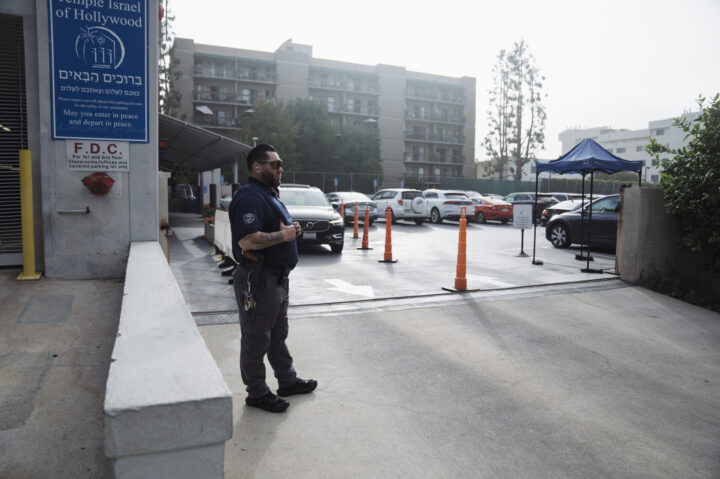
Photo by Eric Thayer/Getty Images)
A security guard stands watch in front of a synagogue on October 9, 2023 in Los Angeles, California.


 Add JewishInsider on Google
A bipartisan group of 58 House members urged the Federal Emergency Management Agency on Thursday to extend the deadline for 2026 Nonprofit Security Grant Program applications, arguing that the current timeline gives states and institutions “insufficient time to complete the application process” and fulfill the program’s goals.
Applications for the program were announced on June 24 and are due to the federal government from state emergency management agencies by July 24. Those state agencies must set their own earlier deadlines for individual institutions to submit applications.
“It is essential that eligible applicants have a fair shot to apply for these funds and fully realize the program’s intended purpose,” the lawmakers, led by Reps. Grace Meng (D-NY) and David Joyce (R-OH), wrote in a letter to acting FEMA Administrator Robert Fenton. “The current timeline imposes significant administrative constraints on both applicants and [state administrative agencies], potentially limiting full and fair participation in this year’s grant cycle.”
The lawmakers argued that organizations would have a short amount of time — potentially just days — to review the program, obtain necessary assessments, develop proposals, gather documents and submit applications. The signatories noted that FEMA has historically provided as many as 80 days from the application announcement to the deadline.
The letter notes that the application period also overlaps state hate crimes grant program application periods in some states, “overburdening” institutions, particularly smaller ones that don’t have large teams to handle grant-writing.
FEMA’s continued delays in releasing 2025 NSGP awards create further issues, the lawmakers explained: “organizations will be applying without knowing their eligibility, creating additional complications since eligibility for this year’s grant is affected by the recipient’s status for last year’s grant.”
The letter urges FEMA to extend the 2026 application deadline, to give state agencies more time to review applications, nonprofits more time to prepare their applications and to guarantee “FEMA receives the strongest possible pool of eligible projects for consideration.”
The Jewish Federations of North America said it organized the letter and was the first to publicize it.
“At a time of rising threats against faith-based communal institutions, Congress has made clear that protecting vulnerable communities is a bipartisan priority,” JFNA CEO Eric Fingerhut said. “Giving state administrative agencies and nonprofit organizations adequate time to complete FEMA’s application process will help ensure these critical security resources reach those NSGP is designed to protect.”
Lauren Wolman, the senior director of government relations and strategy at the Anti-Defamation League, said that “a one-month application window presents significant challenges for the nonprofits that need this funding the most, particularly smaller organizations without dedicated grant writing staff.”
Wolman added, “Extending the deadline would help ensure every eligible organization has a meaningful opportunity to secure the resources they need to protect their communities.”
Rabbi AD Motzen, the national director of government affairs at Agudath Israel of America, said, “Agudath Israel strongly supports the bipartisan Meng Joyce letter and the request for a longer application period. We have heard from nonprofits that are not sure if they were awarded the grant from the previous year and have to make a rushed decision whether or not to apply for this year.”
Nathan Diament, the executive director of the Orthodox Union Advocacy Center, said that the OU also agrees that an extension of the deadline would be “very helpful.”
Separately, 15 Democrats on the House Homeland Security Committee wrote to Homeland Security Secretary Markwayne Mullin and Fenton, raising concerns about the administration’s handling of various FEMA grant programs including NSGP, accusing them of including language in the application materials “that is confusing, impractical, incomplete, and potentially unlawful.”
The Democrats specifically accuse the administration of “deliberately slow processing” of 2025 NSGP applications, noting the continued delay in announcements of 2025 funding and calling for the outstanding grants to be issued “immediately.”
“At-risk nonprofits are forced to navigate overlapping application cycles without knowing if they even need to apply for the FY 2026 NSGP,” the letter reads. “With the FY 2026 application window already open and set to close in less than a month, FEMA’s internal delays and contradictory directives are creating unnecessary burdens for subrecipients.”
It also criticizes the administration for “conflicting instructions on required documentation” and requirements related to immigration and elections imposed on grant recipients. “Imposing these complex mandates on small, volunteer-run, nonprofit organizations, threatens to penalize the very institutions the program is designed to protect,” the Democrats wrote.
Rep. Dan Goldman said that ‘words of condemnation are no longer enough’ and that there has been a ‘systematic failure’ by Congress to address rising antisemitism since Oct. 7
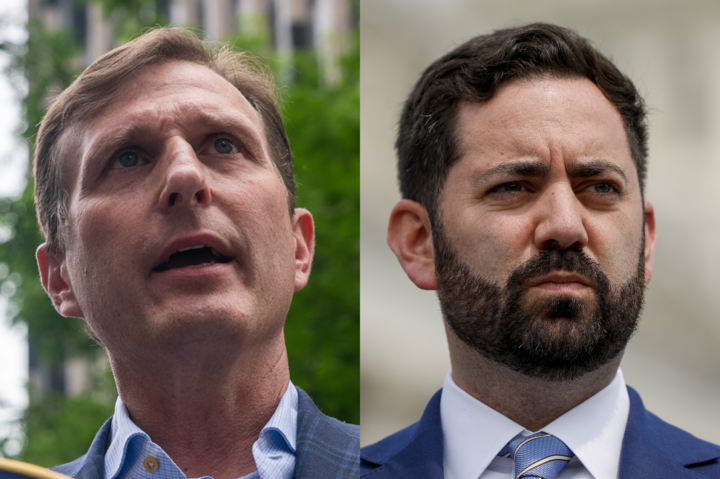
Reps. Dan Goldman (D-NY) and Mike Lawler (R-NY) are leading 28 colleagues in introducing a House version of the Jewish American Security Act, the package of antisemitism-related legislation introduced by Sens. Jacky Rosen (D-NV) and James Lankford (R-OK) last month in the Senate.
The bill includes a proposal for significant increases in security funding, new oversight and administrative measures to address antisemitism on college campuses and new transparency requirements for social media companies relating to antisemitism online.
The legislation is being co-sponsored by Reps. Grace Meng (D-NY), Brian Fitzpatrick (R-PA), Debbie Wasserman Schultz (D-FL), Maria Salazar (R-FL), Jared Moskowitz (D-FL), Rudy Yakym (R-IN), Josh Gottheimer (D-NJ), Marc Veasey (D-TX), Don Bacon (R-NE), Haley Stevens (D-MI), Michael McCaul (R-TX), Nicole Malliotakis (R-NY), Laura Gillen (D-NY), Jeff Van Drew (R-NJ), Jake Auchincloss (D-MA), Ted Lieu (D-CA), Dan Meuser (R-PA), Brad Schneider (D-IL), Tom Barrett (R-MI), Jen Kiggans (R-VA), Greg Landsman (D-OH), David Kustoff (R-TN), Juan Ciscomani (R-AZ), Lois Frankel (D-FL), Tom Suozzi (D-NY), Randy Weber (R-TX), Kristen McDonald Rivet (D-MI) and John Moolenaar (R-MI).
“Words of condemnation are no longer enough,” Goldman said in a statement. “Since the October 7th attacks, there has been a systematic failure in Congress and in our communities to counter the threat posed by surging antisemitism across this country.”
Goldman, a co-chair of the House antisemitism task force, said the bill would change that pattern: “Whether on campus, at synagogues, or online — the Jewish American Security Act will provide the tools necessary to help secure our at-risk communities to practice their faith without fear. American Jews cannot be asked to bear this burden alone. As Americans, we must stand shoulder to shoulder with those under siege by hate.”
Lawler, who is also the lead sponsor of the long-stalled Antisemitism Awareness Act, said in a statement that by providing additional resources for the Nonprofit Security Grant Program, the bill would help safeguard constitutionally protected religious freedom and bolster Jewish institutions against attacks.
“This bill also delivers critical protections for Jewish students on college campuses through stronger Title VI enforcement, requires greater transparency from online platforms on antisemitic content, and establishes key threat assessments,” Lawler said. “We must act decisively so Jewish Americans can feel safe in their schools, synagogues, and online.”
The legislation is supported by a wide range of Jewish groups across the religious and political spectrum.
“[A]ntisemitism remains a serious threat to the safety and security of the American Jewish community. A piecemeal approach to combat this scourge of [antisemitism] is no longer sufficient. The Jewish American Security Act is a serious and comprehensive federal response to this epidemic of hate,” Jonathan Greenblatt, CEO of the Anti-Defamation League, said in a statement. “We are grateful to Congressmen Goldman and Lawler for championing this bill in the House and showing that keeping Jewish Americans safe is a genuine bipartisan priority.”
Eric Fingerhut, the CEO of the Jewish Federations of North America, told Jewish Insider in a brief interview that, given the support in both the House and Senate and the Jewish community, “there’s never really been something like this at this level of comprehensiveness on Jewish security, with all the Jewish organizations working together.”
“People care, but they just don’t realize how bad it’s been. They don’t realize what’s happened in the last year. They don’t understand how Temple Israel was almost a disaster that would have changed the country,” Fingerhut continued. “This is really an important moment and we are all over this. There’s nothing that’s a higher priority.”
He said that if the bill passes, “we really have something that will make a difference for the Jewish community, which has been the target of a serious domestic terror crisis over this last year. So we’re grateful and we’re ready to work.”
American Jewish Committee CEO Ted Deutch said in a statement that Americans should not need security to pray or be afraid to leave their homes and interact in their communities, “yet, that is exactly what Jews in this country are experiencing every day.”
“We are at an inflection point. Surging antisemitism is not just a threat to the Jewish community; it is a crisis for our democracy and the values we cherish as Americans — pluralism, religious freedom, and the promise of equal protection,” Deutch said. “We thank Representatives Goldman and Lawler for their leadership and demonstrating that confronting this hatred is not a political issue, but a moral obligation.”
Amy Spitalnick, the CEO of the Jewish Council for Public Affairs, said that antisemitic violence “demands investments in a sustained, whole-of-government and whole-of-society response.”
“The Jewish American Security Act helps us to meet that need by focusing on tools that we know work,” Spitalnick said. “A truly inclusive American democracy requires Jewish safety — and so too does our safety as Jews depend on protecting our democratic institutions and values and ensuring the safety and rights of each and every community.”
Nathan Diament, the executive director of the Orthodox Union Advocacy Center, said that the organization “strongly supports” the bill and that the “unprecedented wave of antisemitism demands an unprecedented response by our government,” including increasing NSGP funding to $1 billion.
Rabbi Jonah Pesner, the director of the Religious Action Center of Reform Judaism, said that “the need for meaningful steps to bolster security and the fight against hate is vital.”
“The Jewish American Security Act strengthens the government tools and funding that will be available to help us meet this moment and uphold the American commitment to religious freedom,” Pesner said.
William Daroff, the CEO of the Conference of Presidents of Major American Jewish Organizations, praised the bipartisan support for the legislation as well as the broad consensus around it in the Jewish community, urging the bill’s quick passage.
“It is deeply encouraging to see this bill come together with bipartisan, bicameral support at a time when that kind of consensus is all too rare. There is real meaning in Republicans and Democrats joining around the shared responsibility to protect Jewish Americans,” Daroff said.
“It is encouraging to see real consensus across Jewish organizations. Since October 7, engagement is up and coordination is stronger. That unity is both needed and significant.”
Please log in if you already have a subscription, or subscribe to access the latest updates.
 Continue with Google

 Continue with Apple