














































































The vote is postponed until June, after the Memorial Day holiday
Andrew Harnik/Getty Images
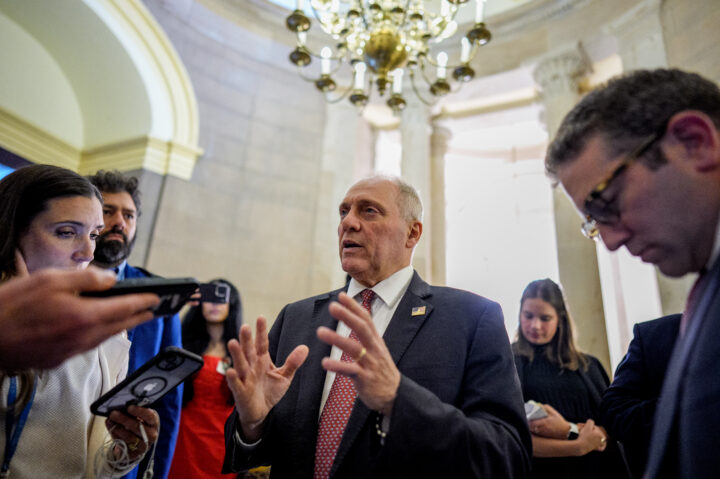
House Majority Leader Steve Scalise (R-LA) speaks to members of the media at the U.S. Capitol Building on May 21, 2026 in Washington, DC.


 Add JewishInsider on Google
House Republicans postponed a vote on a war powers resolution on Iran, which was expected to pass given a series of GOP absences and Rep. Jared Golden’s (D-ME) anticipated flip to support the effort.
The vote now will not take place at least until the beginning of June, after the House’s weeklong Memorial Day recess, but Republicans can’t put the vote off indefinitely given House rules.
The previous war powers resolution failed in a tied vote last week. But eight Republicans — only one of whom was likely to vote for the resolution — were absent for Thursday’s votes, with only two Democrats not present. Only four Republicans and two Democrats were absent for the previous war powers vote.
Democrats said that the margins would have been sufficient to secure passage of the resolution. House Republicans kept the previous vote open for more than 45 minutes — even though it was scheduled to last just five minutes. The delay unfolded as both Republican and Democratic leaders huddled on the House floor, with Democrats repeatedly shouting for the vote to be closed.
House Majority Leader Steve Scalise (R-LA) tacitly acknowledged the attendance issues following the vote.
“Well, we just had some members that weren’t there that wanted to be recorded on it, so we’re going to be giving them that opportunity when we come back,” he told Punchbowl News.
Rep. Brian Fitzpatrick (R-PA), one of the few Republicans who was expected to support the resolution, predicted to Politico that the resolution would pass when it next comes up for a vote.
Democrats have been openly frustrated at the delay. Reps. Hakeem Jeffries (D-NY), Katherine Clark (D-MA) and Pete Aguilar (D-CA), the three top Democrats in the House, accused House Republicans of having “failed this country.”
“The Republican-controlled House continues to behave like a wholly-owned subsidiary of the Trump administration. Republicans cowardly pulled a scheduled vote on a War Powers Resolution — legislation that would have passed with bipartisan support and required the President to end the conflict in the Middle East,” the three said.
They accused Republicans, ahead of Memorial Day weekend, of having “refuse[d] to show up and be accountable to the brave service members that have been recklessly put in harm’s way.”
“The American people will remember in November,” the Democratic leaders said, in reference to the midterms.
The Senate advanced a similar war powers resolution earlier this week through a procedural vote, and is also expected to take a final vote on the measure after the recess, the result of which may also depend on attendance.
Regardless, even if the resolutions pass both chambers, President Donald Trump has the ability to veto them.
Rep. Tom Kean Jr. (R-NJ), whose extended absence from the House for more than two months has gained increasing attention, resurfaced Thursday, contacting reporters and Republican officials after weeks of silence amid an unspecified health condition.
Kean reportedly told National Republican Campaign Committee Chair Rep. Richard Hudson (R-NC) that he would be returning to work in June — potentially securing another “no” vote for Republicans, should he return immediately after the recess, according to reporters who spoke to Hudson.
Jordan Wood, now running to succeed Rep. Jared Golden, said he won’t take money from AIPAC in his newly launched House campaign

Campaign website
Jordan Wood
Jordan Wood, a Maine Democrat who dropped his Senate bid on Wednesday to run for the seat held by retiring Rep. Jared Golden (D-ME), said in a recent podcast interview that he would reject contributions from AIPAC, the pro-Israel advocacy group, joining a growing crop of Democratic candidates who have made similar pledges.
In the conversation with Kaivan Shroff, a Democratic activist, released last week, Wood pointed to what he called “a tremendous amount of distrust right now among Democratic primary voters that the money that AIPAC has put into our political system has affected our priorities when it comes to foreign aid to Israel.”
Graham Platner, a leading far-left candidate in the Democratic Senate primary facing Maine Gov. Janet Mills, has been a particularly hostile critic of AIPAC, which he has made a central focus of his anti-Israel messaging.
In a statement to Jewish Insider, Wood clarified that he does not “take money from AIPAC for the same reason I don’t take money from corporate PACs or lobbyists — because it guarantees voters trust that my policy positions and votes in Congress are not influenced by any campaign contributions.”
A spokesperson for AIPAC, Marshall Wittmann, dismissed that logic. “It’s outrageous to discriminate against pro-Israel Americans,” he said in a sharply worded statement to JI. “Ostracizing and making false accusations about fellow citizens’ democratic engagement to strengthen the U.S.-Israel partnership is contrary to American values and interests.”
“Our six million members will not be deterred by anti-Israel extremists, and their voices will be heard in the 2026 elections,” Wittmann said.
During the podcast interview, Wood stated that, even as he pulls away from AIPAC, “I do also still support aid to Israel,” albeit alongside “conditions on the continuation” of U.S. assistance, including “restrictions on offensive military weapons” to the Jewish state.
Wood, a former congressional staffer who was trailing his rivals in what has increasingly solidified into a two-person Senate race, declared on Wednesday that he was jumping into the open primary to succeed Golden, a moderate Democrat who has represented a GOP-leaning district for three consecutive terms.
The congressman said last week he would not seek reelection, writing he had “grown tired of the increasing incivility and plain nastiness” of American politics and that he and his family had faced “frequent threats” that ultimately contributed to his decision.
Golden, a retired Marine, has been a dependably pro-Israel voice in the House and was endorsed by AIPAC before he announced he was stepping down.
“With Jared not running, it leaves open one of the most competitive House races in the entire country, and so I’m stepping up to take that on,” Wood said on Wednesday.
Matt Dunlap, the Maine state auditor, was already challenging Golden from the left before Wood, who embraced progressive stances as a Senate candidate, said he would enter the race.
The primary field is expected to grow in the coming weeks as other potential candidates are floated, including Troy Jackson, the former president of the Maine Senate currently running for governor, and Kirk Francis, chief of the Penobscot Nation.
The Democratic Congressional Campaign Committee, looking for more-moderate candidates in the field, is still recruiting even with Wood and Dunlap in the race, according to a source familiar with the matter.
Former Maine Gov. Paul LePage is the frontrunner for the Republican nomination in the swing district, which backed President Donald Trump by a double-digit margin in 2024.
Please log in if you already have a subscription, or subscribe to access the latest updates.
 Continue with Google

 Continue with Apple