











































Republicans look like they won’t gain more than several seats in a realistic redistricting scenario — which is far from the insurance they’d need to sustain a tough midterm election performance

RONALDO SCHEMIDT/AFP via Getty Images
Outside view of the Texas State Capitol, in Austin, on November 5, 2025.


 Add JewishInsider on Google
Beware the law of unintended consequences: President Donald Trump’s zeal to aggressively redraw maps in GOP-friendly states is looking like it will bring less of a political advantage to Republicans than originally expected.
Indeed, if the overall political environment remains in the Democrats’ favor — which would be consistent with the historical precedent of the opposition party gaining seats in the first midterm election of a new president — the House is likely to flip back to the Democrats’ control in 2027.
Here’s the lowdown: California’s referendum on redistricting, which passed overwhelmingly on Election Day, will allow Democrats to gain as many as five seats with a new, more-partisan map — with three Republican-held seats (of GOP Reps. Doug LaMalfa, Kevin Kiley and Ken Calvert) all but guaranteed to flip.
That should offset the expected GOP gains in Texas, which started the whole redistricting gamesmanship off with a partisan redraw that guarantees Republicans to pick up at least three Democratic-held seats, with the hope that Republicans can win two additional seats that became more favorable to them.
But there’s a catch with the Texas map. Two of the redrawn districts — the seats of Democratic Reps. Vicente Gonzalez and Henry Cuellar — are in predominantly Hispanic areas along the U.S.-Mexico border that swung dramatically to Trump in 2024, but had a long tradition of voting Democratic before then. If Democrats rebound with Hispanic voters — as happened in New Jersey and Virginia on Election Day — and the national environment remains rough for Republicans, it’s not hard to see the two Democratic incumbents hanging on.
Adding another wrinkle to the GOP’s redistricting plans: A Utah judge rejected the preferred map drawn by Republican state lawmakers, and selected a new map that would guarantee a Democratic district in Salt Lake City. That would automatically flip one seat to the Democrats, given that the state’s current delegation is made up of four Republicans, all in solidly Republican districts.
Republicans managed to secure an additional seat for their party in Missouri — eliminating the solidly Democratic Kansas City-area seat of Rep. Emanuel Cleaver (D-MO), but that’s about it when it comes to automatic pickups.
The GOP’s partisan redraw in North Carolina means they will be favored to win Rep. Don Davis’ (D-NC) seat, but it’s not a fait accompli. And new lines in Ohio give Republicans a better shot to unseat Reps. Marcy Kaptur (D-OH) and Greg Landsman (D-OH) but those Democratic lawmakers will still have a good chance to win reelection.
As the Cook Political Report’s David Wasserman put it, Republicans would only gain between 0-1 seats as the maps stand now, with Florida, Indiana and Virginia the remaining wild cards.
In theory, Republicans could squeeze several additional seats in Florida, but like in Texas, would risk making some Republicans more vulnerable in an overly aggressive gerrymander. Meanwhile, if partisans overcome logistical hurdles in GOP-controlled Indiana and Democratic-controlled Virginia to gain seats, they would balance each other out.
All told, Republicans look like they won’t gain more than several seats in a realistic redistricting scenario — which is far from the insurance they’d need to sustain a tough midterm election performance.
Right now, Democrats only need to flip three seats to win back the House majority. Redistricting won’t be enough for Republicans to hold the line if there’s even a mild headwind at the Democrats’ back next year.
Plus, partisan redistricting endangers pro-Israel lawmakers
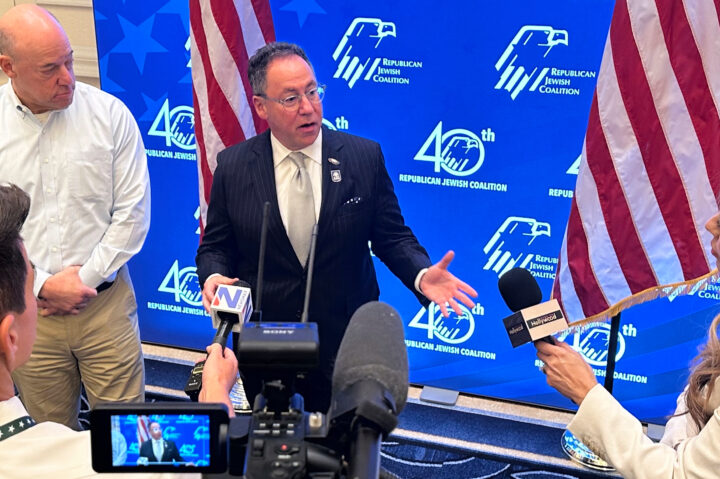
Republican Jewish Coalition CEO Matt Brooks, center, alongside Ari Fleischer, an RJC board member and press secretary to former President George W. Bush, answers questions from members of the news media about confronting antisemitism within the Republican Party, during the coalition's annual conference at the Venetian Resort in Las Vegas, Saturday, Nov. 1, 2025. (AP/Thomas Beaumont)
Good Monday morning!
In today’s Daily Kickoff, we report from the Republican Jewish Coalition’s annual leadership summit in Las Vegas, and look at how mid-decade redistricting efforts in a handful of states could affect pro-Israel legislators. We report on newly obtained audio of Maine Senate candidate Graham Platner expounding on his Israel views, and cover the arrest of Israel’s former military advocate-general, who resigned from her position last week. Also in today’s Daily Kickoff: Michael Eisenberg, Sylvan Adams and Gordon Gee.
Today’s Daily Kickoff was curated by Jewish Insider Executive Editor Melissa Weiss and Israel Editor Tamara Zieve, with assists from Danielle Cohen-Kanik and Marc Rod. Have a tip? Email us here.
What We’re Watching
- The Foundation for Defense of Democracies is hosting a virtual event with former Israeli Defense Minister Benny Gantz on his vision for the future of Israel’s security and relationships around the world.
- The Anti-Defamation League is hosting its annual real estate reception in New York City. This year’s event will honor Feil Organization CFO Eric Lowenstein.
- Elsewhere in New York, Birthright Israel is holding its annual gala tonight. Actor Jonah Platt is slated to emcee the evening’s events, which will honor Lynn Schusterman.
- In Israel, the annual Christian Media Summit kicked off last night in Jerusalem.
What You Should Know
A QUICK WORD WITH JI’S MATTHEW KASSEL
LAS VEGAS — Until last week, the Republican Jewish Coalition’s annual leadership summit was expected to be a triumphant gathering to celebrate President Donald Trump’s accomplishments in the Middle East, chief among them his administration’s recently brokered ceasefire deal between Israel and Hamas, Jewish Insider‘s Matthew Kassel reports.
That all changed after Tucker Carlson hosted the neo-Nazi influencer Nick Fuentes on his podcast for a sympathetic interview, provoking fierce backlash. By the time that Kevin Roberts, the president of the Heritage Foundation, came to Carlson’s defense on Thursday, the RJC recognized its conference would require a thematic update to more forcefully emphasize the urgency of confronting rising antisemitism — and its enablers — within the GOP.
“If there was ever a time for the RJC, this is our time,” Norm Coleman, the organization’s national chairman, said in opening remarks on Friday. “We have been called to this moment to fight the scourge of antisemitism.”
But even as multiple speakers at the three-day summit held at the Venetian Resort — including congressional leaders, conservative activists and media personalities — alluded to antisemitism in their ranks, many talked in broad strokes, didn’t mention Carlson by name or downplayed the issue as confined to the fringes, despite Carlson and Fuentes each commanding a significant number of dedicated followers on the far right.
SPEAKING UP
Lindsey Graham calls Tucker Carlson antisemitism a ‘wake-up call’ for GOP
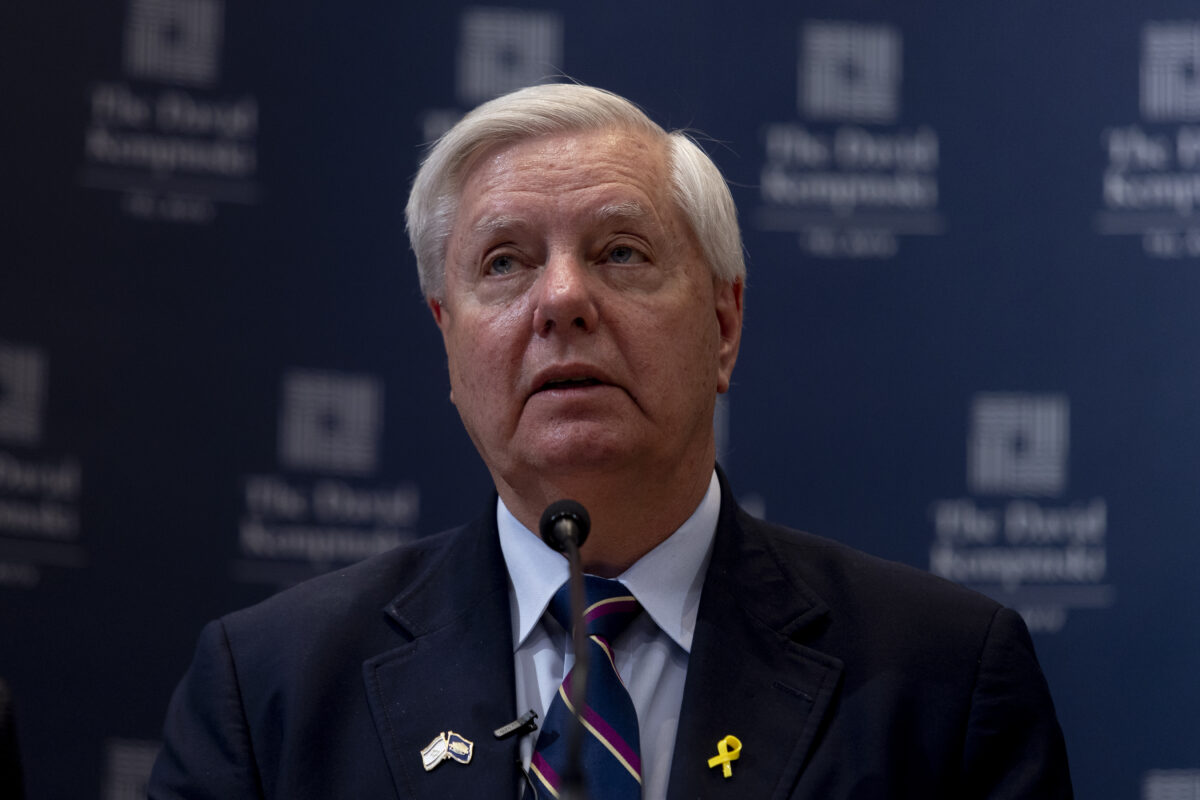
Sen. Lindsey Graham (R-SC) spoke out against Tucker Carlson for giving a friendly platform to Nick Fuentes, the neo-Nazi influencer, on his podcast this week, calling it “a wake-up call” for the Republican Party as it grapples with rising antisemitism within its ranks. “How many times does he have to play footsie with this antisemitic view of the Jewish people and Israel until you figure out that’s what he believes?” Graham said of Carlson in an interview with Jewish Insider’s Matthew Kassel on Friday on the sidelines of the Republican Jewish Coalition’s annual leadership summit at the Venetian Resort.
‘Niche market:’ Graham said that “antisemitism has been with us, and it’ll always be with us, and the goal is to limit it, fight back and contain it. I am confident that if anybody in the Republican world ran for office as a member of Congress, for the Senate or any major elected office and spouted this garbage, it would get creamed,” Graham told JI. “This is a niche market. It won’t sell to a wider audience.”
Drawing a red line: Rep. Randy Fine (R-FL) called Tucker Carlson “the most dangerous antisemite in America” in remarks on Saturday at the conference, in what was an unusually direct rebuke of the far-right commentator who is facing backlash over his recent friendly interview with the neo-Nazi influencer Nick Fuentes, Jewish Insider’s Matthew Kassel reports.
OUT OF BOUNDS
At RJC summit, Ted Cruz slams right-wing embrace of antisemitic figures
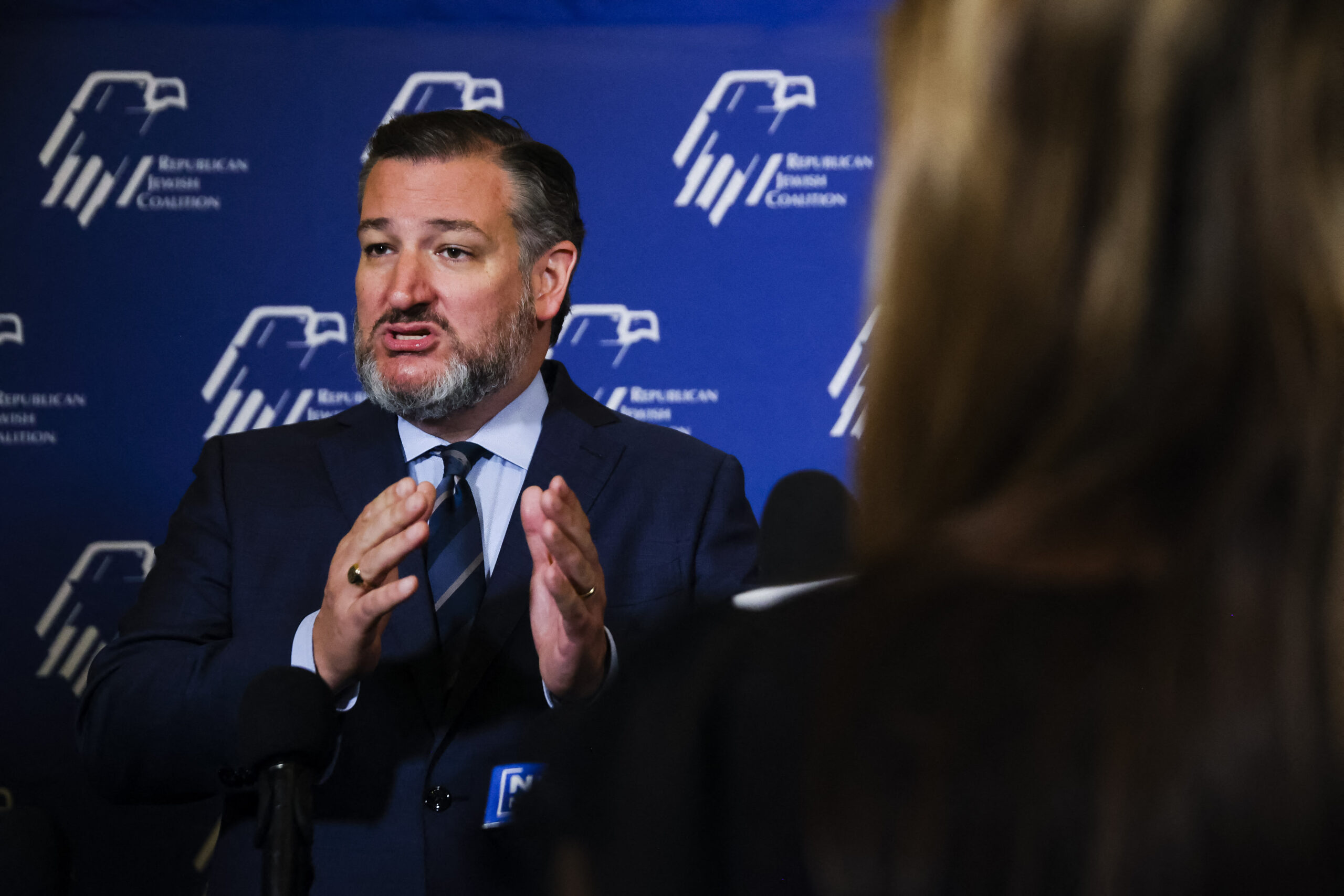
Sen. Ted Cruz (R-TX) criticized Republicans who refuse to disavow prominent antisemites in the conservative movement as “cowards” after the Heritage Foundation and its president, Kevin Roberts, defended Tucker Carlson and his friendly interview with neo-Nazi influencer Nick Fuentes. Cruz warned during a half-hour address at the opening of the Republican Jewish Coalition’s annual summit in Las Vegas on Thursday evening that young Christians were turning away from supporting Israel, something he argued was the result of pro-Israel Christians being maligned by leading voices in the America First movement, Jewish Insider’s Emily Jacobs reports.
Cruz’s comments: The Texas Republican senator did not mention the Heritage Foundation, Roberts, Carlson or Fuentes by name, though he accused anyone who uncritically promotes Adolf Hitler of being “complicit” in spreading virulent antisemitism. Fuentes has praised Hitler on multiple occasions; in his statement, Roberts said he “disagree[s] with” some of Fuentes’ views, “but canceling him is not the answer.” “The last year, we’ve seen three prominent people on the right publicly muse, ‘Gosh, maybe Hitler’s not all that bad.’ No. He is the embodiment of evil, a grotesque bigot. And if you’re confused by that, you’re an imbecile,” Cruz said on Thursday. “Too many people are scared to confront them. I want to ask you, how many elected Republicans do you see standing up and calling this out? How many do you see willing to take on the voices in the anti-Israel right?”
Bonus: Following Roberts’ comments last week, Heritage’s chief of staff, Ryan Neuhaus, was reassigned to serve as a senior advisor, while the think tank’s executive vice president, Derrick Morgan, was moved into the chief of staff role on an interim basis through the end of the year.
PLATNER’S POSITION
Newly surfaced recording of Graham Platner highlights his Israel fixation
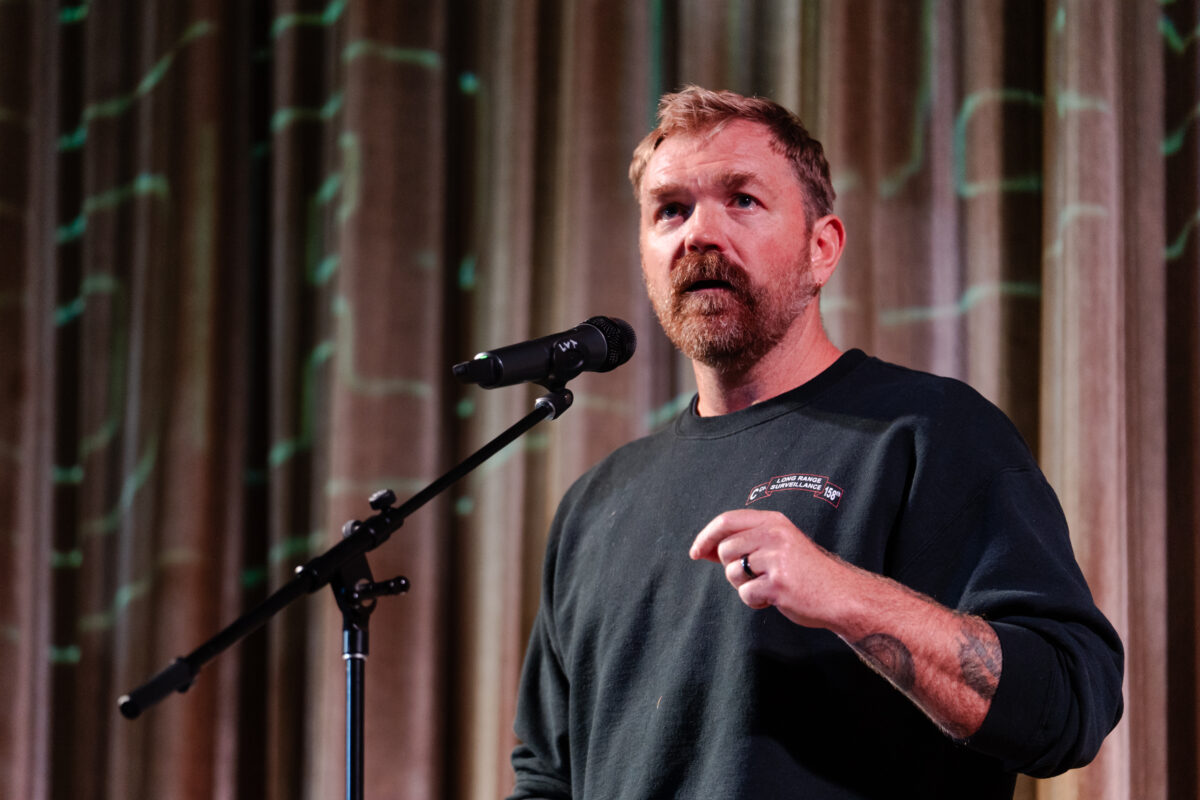
Like many progressives now running for Congress, Graham Platner, a Democratic Senate candidate in Maine, has made opposition to Israel a central part of his messaging. But more so than many candidates, the political newcomer seems particularly invested in engaging on Middle East policy. In a private conversation with attendees of an August fundraiser in Maine, Platner defended his stances on Israel and shared previously undisclosed details about his personal ties to the region, according to audio of the discussion, recently shared with Jewish Insider’s Matthew Kassel.
What he said: While he said he agreed that Hamas is a terrorist organization, Platner claimed that Israeli Prime Minister Benjamin Netanyahu had “publicly stated that” Israel was “funding Hamas to make sure that there was going to be no non-radical leadership within Gaza in order to keep a Palestinian state from happening.” While members of Netanyahu’s coalition have made this argument, the prime minister has never personally made such a claim. New York Times reporting from shortly after the Oct. 7 attacks alleged that the Israeli prime minister had allowed the Qatari government to send money into the Gaza Strip for several years in order to “maintain peace in Gaza.”
Family ties: In the conversation, which took place before controversy ensnared his campaign, Platner noted his stepbrother is Seth Frantzman, an Israeli author, journalist and security analyst who has long worked for for The Jerusalem Post and lives in Jerusalem, saying they are “very close,” according to the audio.
Bonus: Platner’s finance director became the latest campaign departure last week, following the exits last month of Platner’s campaign manager and political director. Ronald Holmes said in a LinkedIn post that he “began to feel that my professional standards as a campaign professional no longer fully aligned with those of the campaign.”
MAPPING MOVES
Partisan redistricting efforts endanger pro-Israel incumbents
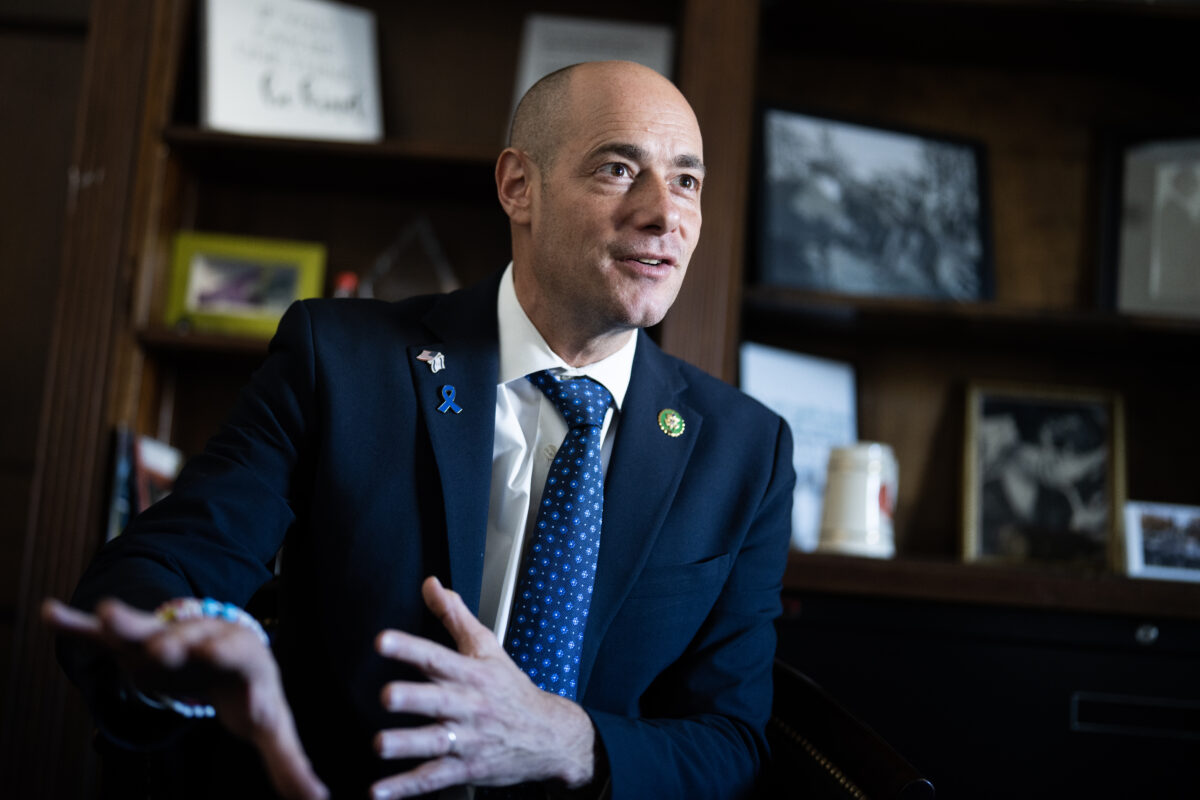
Triggered by President Donald Trump’s efforts to gain a partisan edge in the 2026 midterm elections, a cascade of states is undertaking unusual mid-decade redistricting efforts, in what has become a growing race between Democrats and Republicans to shore up incumbents, knock out lawmakers from the opposing party and create more-winnable seats. On both sides of the aisle, the efforts could endanger a number of vocal pro-Israel incumbents, Jewish Insider’s Marc Rod reports.
Who’s in danger: The districts of Reps. Greg Landsman (D-OH) and Don Davis (D-NC) have been redrawn to be less favorable to the incumbents, and in Florida, Republicans are considering efforts to pack Democratic voters into a smaller number of districts, potentially endangering several pro-Israel incumbents including Reps. Debbie Wasserman Schultz, Jared Moskowitz and Darren Soto. On the Republican side, a series of GOP lawmakers in California with strong records on Israel and antisemitism could be impacted by the redistricting push, including Rep. Ken Calvert — who chairs the Appropriations subcommittee on defense funding — as well as Reps. Darrell Issa, Kevin Kiley, Doug LaMalfa and David Valadao.
LEGAL TROUBLES
Ex-IDF advocate-general arrested over alleged destruction of evidence after being reported missing
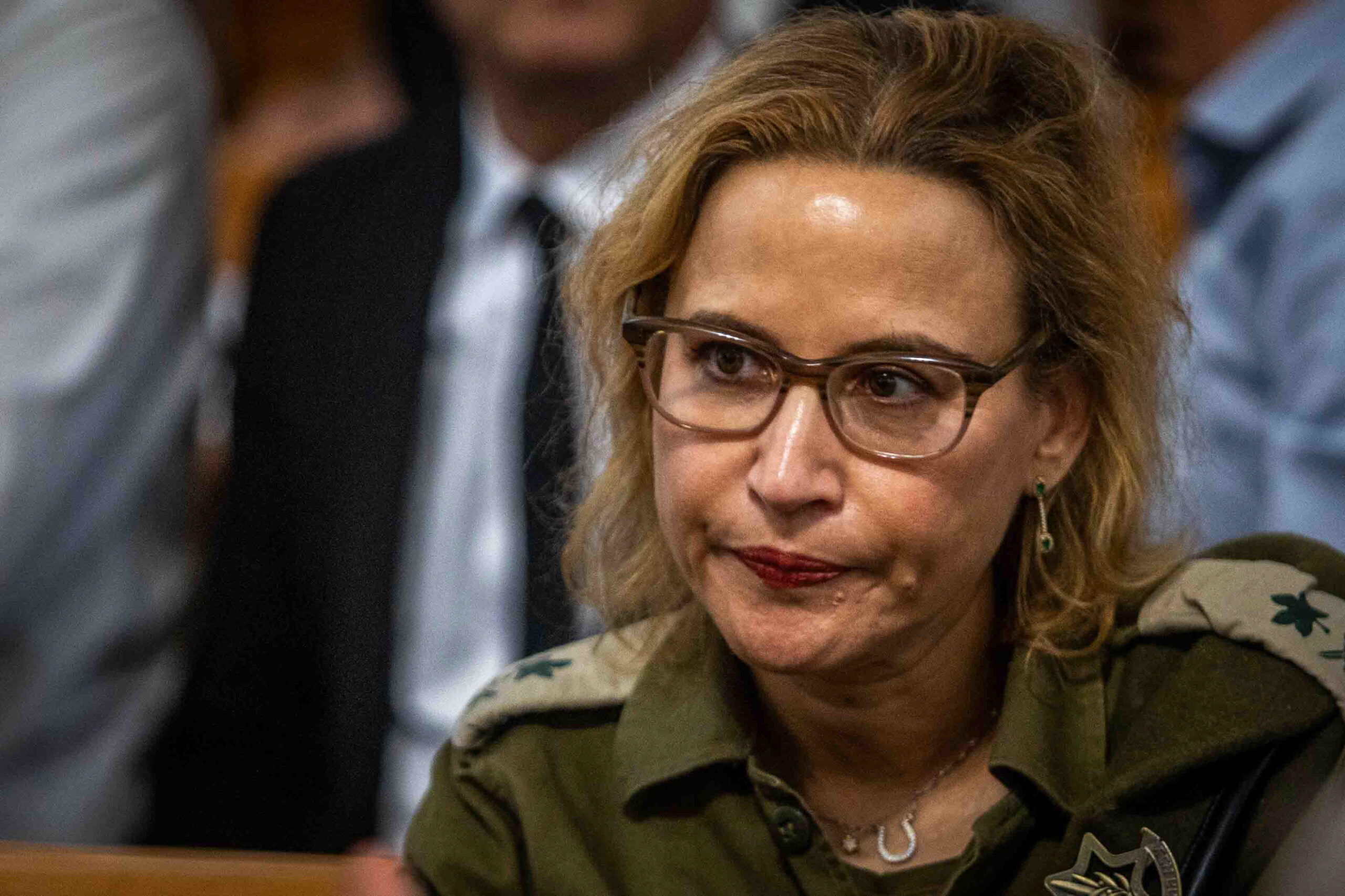
Former IDF Advocate-General Yifat Tomer-Yerushalmi was arrested on Sunday evening, reportedly on grounds of obstruction of an investigation, after disappearing and leaving behind a note raising concerns of a potential suicide. The arrest came two days after she resigned her post following a determination by police that she had leaked sensitive materials showing alleged abuse of a Palestinian detainee at Israel’s Sde Teiman prison to the media, Jewish Insider’s Lahav Harkov reports.
Chain of events: Police found Tomer-Yerushalmi’s car at a beach north of Tel Aviv, hours after relatives reported that she was missing. According to Israeli media, she had left a note to her family telling them, “don’t look back.” The ensuing manhunt involved police, the Israeli Navy, drones with geothermal detection and more. Tomer-Yerushalmi was arrested after police found her safe, but without her phone, which had last been tracked near her car and then turned off. The disappearance of the phone raised police officers’ concern that she had possibly staged a suicide attempt to cover up the destruction of evidence caused by the disposal of her phone, Ynet reported. National Security Minister Itamar Ben-Gvir said on Monday that Tomer-Yerushalmi remains on suicide watch in jail.
UNIVERSITY INSIGHTS
Longtime higher ed leader Gordon Gee says fear, not free speech, is ruling America’s campuses

Gordon Gee has served as president of more American universities than almost anyone, as far as he knows. Most recently he led West Virginia University, from which he retired in July; before that, he oversaw Ohio State, Vanderbilt, Brown and the University of Colorado over a span of 45 years. In an interview with Jewish Insider’s Gabby Deutch last week, Gee, 81, looked back on his career and reflected on the state of academia, noting a growing chasm between what he described as two different kinds of universities: those like Vanderbilt, that have held firm to the principles of institutional neutrality, and those like his alma mater, Columbia University, that have struggled to take an impartial stance in response to campus protests and antisemitism — and that are wary of making significant change.
Fear factor: “The biggest challenge facing university presidents is fear,” said Gee. “I think the university presidents, in many ways, are paralyzed, and a lot of it is brought on by themselves, because of the fact that they allowed themselves to become kind of engaged in this ‘go along, get along’ response, and now all of a sudden, when they discover that they’ve got to take a stand, it’s becoming very difficult for many of them.”
Bonus: In The Atlantic, University of Chicago law professor Aziz Huq suggests that the Trump administration’s recent offer to prioritize federal funding for schools that agree to a series of dictates from the government provides universities that don’t agree to the compact with new opportunities, noting that “[w]ithdrawal from the embrace of the federal government, while painful, also is a chance to confront some latent, long-simmering weaknesses of the existing higher-education model.”
Worthy Reads
Roberts’ Rules of Disorder: The Wall Street Journal’s editorial board weighs in on Heritage Foundation CEO Kevin Roberts’ response to recent antisemitic comments by far-right commentators Tucker Carlson and Nick Fuentes. “Amid criticism on Friday, Mr. Roberts scrambled to list Mr. Fuentes’s odiousness, but his initial contribution was to join in the Jew-baiting. His video framed the issue not as antisemitism, but as Christian freedom of conscience in the face of a hostile attempt to impose loyalty to Israel on Americans. … If conservatives — and Republicans — don’t call out this poison in their own ranks before it corrupts more young minds, the right and America are entering dangerous territory.” [WSJ]
Boycotting The Times: The Atlantic’s Jonathan Chait reflects on a push by anti-Israel figures to refuse to submit future op-eds to The New York Times over the paper’s perceived bias toward Israel. “But the extent to which these writers object to the sword depends on who is wielding it. The letter’s demands come from a coalition of nine groups, three of which have declined to condemn Hamas for the October 7 attack, while six — the U.S. Palestinian Community Network, the Palestinian Feminist Collective, the Palestine Solidarity Working Group, the Palestinian Youth Movement, Pal-Awda, and National Students for Justice in Palestine — rationalized or directly endorsed the massacre.” [TheAtlantic]
Fear of Mamdani: In the Jewish News Syndicate, William Daroff and Betsy Berns Korn, respectively the CEO and chair of the Conference of Presidents of Major American Jewish Organizations, raise concerns about New York City mayoral front-runner Zohran Mamdami over what they describe as his demonstrated “hostility toward the concerns of the Jewish community and contempt for the broader public interest” ahead of tomorrow’s election. “What begins as a debate about policy too often becomes a campaign of hostility toward Jews. In this context, any candidate who fails to condemn terrorists who burned families alive, abducted civilians, and committed rape and other war crimes, as Hamas and other Palestinian terrorists did in southern Israel on Oct. 7, 2023, forfeits the moral right to seek public office.” [JNS]
PA Still Key: In the National Interest, David Makovsky and Shira Efron posit that the Palestinian Authority Security Forces could serve as an “imperfect but plausible” option on the ground in postwar Gaza. “Despite their shortcomings, these forces have over three decades of experience in security coordination with the IDF in the West Bank. … The PA today is like a car without wheels: it cannot drive Gaza out of the post-October 7 morass. But wheels can be added — reforms that build credibility, training that professionalizes the PA’s security forces, and service delivery that tangibly improves daily life for suffering Gazans. With each milestone, the PA gains a larger role, international donors gain confidence, Israel gains a more stable frontier, Gazans gain a path out of limbo, and Palestinians everywhere regain agency that could help establish a political horizon.” [NationalInterest]
Word on the Street
In a wide-ranging CBS “60 Minutes” interview that aired Sunday night, President Donald Trump described the ceasefire between Israel and Hamas as being “very solid”; Trump also said that the U.S. would be “involved” in Israeli Prime Minister Benjamin Netanyahu’s corruption trial, two weeks after the president, speaking at the Knesset, called on Israeli President Isaac Herzog to pardon Netanyahu…
Netanyahu said on Sunday that Israel would “act as necessary” if Lebanon does not move to fully disarm Hezbollah, amid concerns that the Iran-backed terror group is rearming in defiance of the ceasefire inked last year…
Amos Hochstein, who served as a senior official in the Biden administration overseeing the Lebanon portfolio, cautioned that Israel’s muscular approach to Hezbollah in Lebanon could be “counterproductive” and that Beirut is “in a really tough spot” as it works to shore up international support…
Israeli Energy Minister Eli Cohen said his U.S. counterpart, Energy Secretary Chris Wright, canceled a planned trip to Israel following Jerusalem’s decision to hit pause on a $35 billion gas agreement with Egypt that would be the biggest gas deal in Israel’s history…
Video from a May 2024 city council meeting in Hamtramck, Mich., that was recently viewed by local media showed Mayor Amer Ghalib, the Trump administration’s nominee to be U.S. ambassador to Kuwait, voicing support for the council’s passage of a boycott, divestment and sanctions resolution targeting Israel; Ghalib told members of the Senate Foreign Relations Committee that he had not supported the resolution…
The Diocese of Harrisburg, Pa., condemned and apologized for a Halloween float representing a local Catholic school that included a replica of the front gates of Auschwitz with the words “Arbeit Macht Frei”…
The Wall Street Journal spotlights Palantir’s new “Meritocracy Fellowship” in which 22 high school graduates spend four months at the company in lieu of pursuing a traditional college track…
A spokesperson for Zohran Mamdani said that the New York City Democratic mayoral candidate, if elected, would reassess the partnership between the Roosevelt Island campus of Cornell University and Israel’s Technion…
Former U.K. Labour party leader Jeremy Corbyn, who was ousted from the party’s leadership over a series of antisemitism incidents, phone-banked for Mamdani over the weekend…
A London bus driver was suspended after refusing to return a dropped bank card to a visibly Jewish man and hurling antisemitic insults at the passenger for an hour until police arrived…
A French court sentenced four Bulgarian men to prison terms ranging between two and four years over the vandalism last year of Paris’ Holocaust memorial…
The bodies of three Israelis were repatriated to Israel and identified overnight as dual American Israeli citizen Capt. Omer Neutra, Col. Asaf Hamami and Staff Sgt. Oz Daniel; the exchange came a day after Israeli forensics determined that three bodies given to Israel by Hamas on Friday evening did not belong to any of the remaining hostages…
Israel announced a series of tax benefits aimed at luring Israeli high-tech workers abroad back to the country amid an exodus that followed the Oct. 7, 2023, attacks and ensuing war…
Canadian Israeli philanthropist Sylvan Adams committed $100 million to help rebuild the Soroka Medical Center in Beersheva, Israel, which sustained significant damage during the 12-day war between Israel and Iran in June, eJewishPhilanthropy’s Judah Ari Gross reports…
Omani Foreign Minister Badr Albusaidi told attendees at the IISS Manama Dialogue in Bahrain over the weekend that Gulf countries should reverse course on their isolation of Iran and deepen diplomatic, economic and security cooperation with Tehran…
Iranian President Masoud Pezeshkian said that Iran would rebuild its nuclear facilities with “greater strength,” while denying that the country is seeking nuclear weapons…
The New York Times published a belated obituary for World War II partisan fighter and poet Hannah Senesh as part of the paper’s “Overlooked No More” series; Senesh was executed at age 23 after being captured by the Nazis in 1944…
Dutch-Jewish resistance member Selma van de Perre, who forged and delivered documents and helped Jewish families seeking shelter, died at 103…
Pic of the Day

Israeli Prime Minister Benjamin Netanyahu met in Jerusalem over the weekend with Aryeh Lightstone, who is serving as a senior advisor to White House Special Envoy Steve Witkoff; White House senior advisor Josh Gruenbaum and venture capitalist Michael Eisenberg, who is working with the U.S. team overseeing ceasefire efforts.
Birthdays

Winner of the 2013 Nobel Prize in medicine, professor at Yale University, James Rothman turns 75…
Chancellor emeritus of The Jewish Theological Seminary where he also served as a professor of Jewish history, Ismar Schorsch, Ph.D. turns 90… Senior U.S. District Court judge in California, he is the younger brother of retired SCOTUS Justice Stephen Breyer, Judge Charles Breyer turns 84… U.S. senator (D-HI), Mazie K. Hirono turns 78… Resident of Great Barrington, Mass., and a part-time researcher at UC Berkeley, Barbara Zheutlin… Rabbi emeritus at Temple Anshe Sholom in Olympia Fields, Ill., Paul Caplan turns 73… Actress, comedian, writer and television producer, best known for the long-running and award-winning television sitcom “Roseanne,” Roseanne Barr turns 73… Comedian, talk show host, political and sports commentator, Dennis Miller turns 72… Manuscript editor and lecturer, author of books on the stigma of childlessness and on the Balfour Declaration, Elliot Jager turns 71… Award-winning Israeli photographer whose works have appeared in galleries in many countries, Naomi Leshem turns 62… Regional director of development for The Washington Institute for Near East Policy, Jeanne Epstein… Podcaster and clinical professor of marketing at the New York University Stern School of Business, Scott Galloway turns 61… Co-founder and former CEO of Blizzard Entertainment, now CEO of Dreamhaven, Michael Morhaime turns 58… Entrepreneur-in-residence at Loeb Enterprises, he was previously co-chair of the board of the Yeshiva University Museum, Edward Stelzer… VP for federal affairs at CVS Health, she was the White House director of legislative affairs in the last year of the Obama administration, Amy Rosenbaum turns 54… Director of development for States United Democracy Center, Amie Kershner… Partner at political consulting firm GDA Wins, Gabby Adler… Agent at Creative Artists Agency, Rachel Elizabeth Adler… Actress who won three Daytime Emmy Awards for her role on “ABC’s General Hospital,” Julie Berman turns 42… Director of corporate responsibility, communications and engagement at Southern Company Gas, Robin Levy Gray… Senior managing director at Guggenheim Securities, Rowan Morris… General manager of NJ/NY Gotham FC, a women’s soccer team based in Harrison, N.J., Yael Averbuch West turns 39… Former captain in the U.S. Marine Corps, he is a co-founder of D.C.-based Compass Coffee, Michael Haft turns 39… New York state senator, Michelle Hinchey turns 38… Deputy coordinator for global China affairs at the U.S. Department of State, Julian Baird Gewirtz turns 36… Recent MBA graduate at The Wharton School, Ben Kirshner turns 33… Marketing manager at American Express, Caroline Michelman turns 33… Founder and CEO of Noyse Publicity Management, Noy Assraf turns 30… Actress and model, Diana Silvers turns 28… Stu Rosenberg…
Reps. Greg Landsman, Jared Moskowitz and Debbie Wasserman Schultz could be more vulnerable as a result of new maps ahead of next year’s midterms
Tom Williams/CQ-Roll Call, Inc via Getty Images
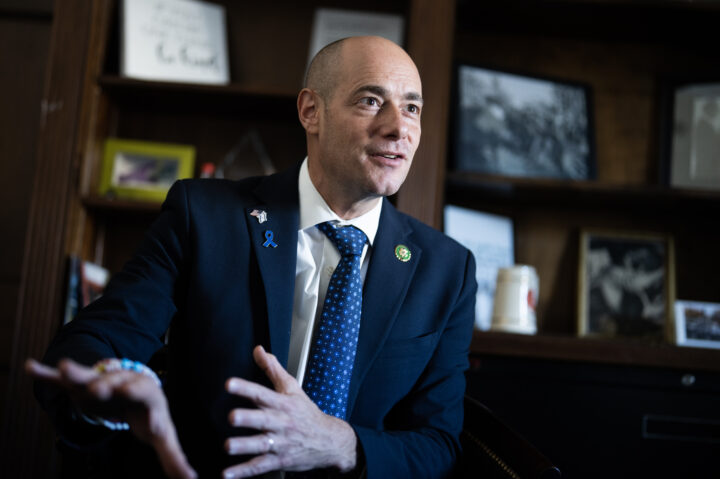
Rep. Greg Landsman (D-OH) is interviewed by CQ-Roll Call, Inc via Getty Images in his Longworth Building office on Friday, November 3, 2023.
Triggered by President Donald Trump’s efforts to gain a partisan edge in the 2026 midterm elections, a cascade of states is undertaking unusual mid-decade redistricting efforts, in what has become a growing race between Democrats and Republicans to shore up incumbents, knock out lawmakers from the opposing party and create more-winnable seats.
On both sides of the aisle, the efforts could endanger a number of vocal pro-Israel incumbents.
In a handful of states that are looking to or have redrawn their congressional maps, some of the Democratic Party’s most prominent pro-Israel moderates could face uphill battles for reelection.
In Ohio, the state’s redistricting commission adopted new maps on Friday that would give Republicans a slight edge in Rep. Greg Landsman’s (D-OH) Cincinnati-area district. Under the old lines, the district was a Democratic-leaning seat that Vice President Kamala Harris won by three points, But under the new lines, Trump would have carried the district by a two-point margin, meaning Landsman will need to win a small number of Republican voters to win reelection.
Given that Landsman, a second-term Jewish Democrat who has been vocal on Middle East policy issues and a strong supporter of Israel, has proven to be a strong campaigner in past elections, the race is likely to remain highly competitive in an environment expected to be favorable to Democrats nationally in next year’s midterms.
The Cook Political Report moved the rating for Landsman’s district from “Likely Democrat” to a toss-up as a result of the redistricting.
In North Carolina, where Republicans have redrawn the state’s maps on several occasions this decade, the latest changes significantly modify the district held by Rep. Don Davis (D-NC) to heavily favor Republicans, further diluting the Democratic voting share in the moderate Democratic lawmaker’s district.
Davis has been among the most committed pro-Israel Democrats, frequently breaking with the majority of his party on the issue.
And in Florida, Republicans are considering efforts to pack Democratic voters into a smaller number of districts, potentially endangering several pro-Israel incumbents including Reps. Debbie Wasserman Schultz (D-FL), Jared Moskowitz (D-FL) and Darren Soto (D-FL). One potential redraw could place Moskowitz and Wasserman Schultz into the same district.
Both Wasserman Schultz and Moskowitz are Jewish and vocal pro-Israel stalwarts representing districts with significant Jewish populations, and Soto’s record is also strong.
A pro-Israel Democratic strategist told JI that “it’s a big problem. The Republicans are trying to say they’re pro-Israel and they’re targeting pro-Israel Democrats left and right. … These guys are stalwart champions and we don’t want to lose them.”
One possible Republican candidate considering a run in a newly drawn South Florida district is Boca Raton Mayor Scott Singer, who has been a strong supporter of Israel.
The strategist said that the redistricting efforts, as well as potential primary challenges to lawmakers such as Rep. Dan Goldman (D-NY), could endanger a series of notable pro-Israel House incumbents, though they also noted that other pro-Israel candidates could be poised to be elected elsewhere in the country.
“I do think it’s probably a little more nuanced because I think there are other people who will show up to replace them,” the strategist continued. “We’re going to win some, we’re going to lose some.”
On the Republican side, a series of GOP lawmakers in California with strong records on Israel and antisemitism could be impacted by the redistricting push, including Rep. Ken Calvert (R-CA) — who chairs the Appropriations subcommittee on defense funding — as well as Reps. Darrell Issa (R-CA), Kevin Kiley (R-CA), Doug LaMalfa (R-CA) and David Valadao (R-CA).
Kiley has been a particularly outspoken voice against campus antisemitism from his perch on the House Education and Workforce Committee.
“[California Gov. Gavin] Newsom’s Prop 50 [redistricting effort] is a desperate partisan power grab that would eliminate five consistently pro-Israel Members of Congress and give more influence to Democrats that spread hate, division, and promote extreme anti-Israel policies,” said Republican Jewish Coalition National Political Director Sam Markstein.
Please log in if you already have a subscription, or subscribe to access the latest updates.
 Continue with Google
 Continue with Apple