














































































Cassidy said the deal leaves Iran stronger and sanctions-free, while senators including Tillis, Cruz and Scott pushed back on Trump's acceptance of Iranian ballistic missiles
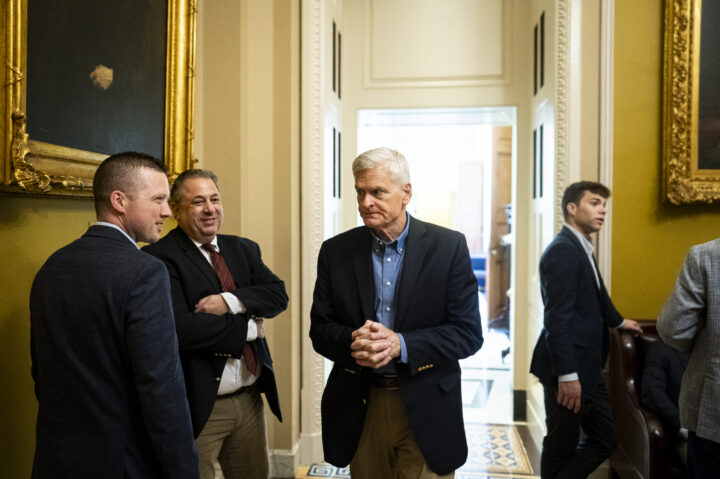
Photo by Al Drago/Getty Images)
Sen. Bill Cassidy (R-LA) departs a meeting with Senate Republicans in the U.S. Capitol on June 28, 2025 in Washington, DC.


 Add JewishInsider on Google
Some Senate Republicans are breaking with President Donald Trump over his handling of Iran, pushing back on the memorandum of understanding’s significant financial relief to the regime and Trump’s comments on Wednesday that he is willing to accept an Iranian ballistic missile program and some level of nuclear enrichment.
“Reagan is rolling over in his grave,” retiring Sen. Bill Cassidy (R-LA) said on X. “Iran’s nuclear ambitions were not curbed, and they have learned that threatening the Strait of Hormuz works and will undoubtedly leverage it in the future. Now, Iran gets to build brand-new infrastructure under this deal.”
Cassidy recently voted in favor of war powers resolutions that aimed to prevent further combat operations in Iran. He’s retiring after being defeated by a Trump-backed primary challenger.
“Before the war, the Strait [of Hormuz] was open, Iran was being crushed by sanctions and 13 service members were still alive,” Cassidy said. “Now, 13 Americans are dead, families have paid billions at the pump, sanctions will be lifted, and the bombing has stopped. This is the worst foreign policy blunder in decades.”
He subsequently explained to reporters: “Iran went from having sanctions and now is having no sanctions. Hundreds of billions of dollars [are] being paid to it. Our allies are weaker. Our opponent is stronger. You say the strait’s open — the strait was open four months ago.”
Asked whether he thought the deal was worse than the Obama-era Joint Comprehensive Plan of Action, Cassidy responded, “I didn’t like the JCPOA the first time. I don’t like it the second time.”
While Cassidy was perhaps the most strident critic, numerous Republican senators also expressed their disagreement with Trump’s comments, the deal, or both.
Given that eliminating Iran’s nuclear enrichment and ballistic missile capacity were stated objectives of the war, “$100 billion and 13 lives later, I’ll need to understand that rationalization,” Sen. Thom Tillis (R-NC) told Jewish Insider of Trump’s comments.
He added later that the $300 billion reconstruction fund laid out in the MOU is “concerning,” though he called the deal preliminary and said he needed to see more details.
“I need to see it taken as a whole. I can’t be against it because I need to see the net. I need to see, have we accomplished what the president set out to accomplish?” Tillis continued. “If you remember, we were going to obliterate their military, we were going to take all of the uranium or any weapons grade uranium out of the country — we’re equivocating on that now. I just need to see what the new deal is now.”
He said that, given the costs of the war, “there needs to be some accountability for Iran. We can’t just walk out because we’re getting a bit skittish over the economic consequences of going to war to begin with.”
While Trump argued that Iran should be able to have ballistic missiles because others in the region do as well, Sen. Rick Scott (R-FL) said that the difference is that other countries in the region aren’t American adversaries.
“I would be fine [with them having missiles] if they didn’t want to kill Americans. I don’t care if Saudi Arabia has them, or if Israel has them because they don’t want to kill us,” Scott told JI. “But if somebody wants to kill me, I don’t want them to have a ballistic missile.”
Asked about the financial benefits Iran is set to receive under the deal, Scott said that he does not want any U.S. funding to support Iran, and that Iran should be paying the U.S. reparations instead.
“I’m not spending a dime for Iran. I want them to pay us for what we had to do,” Scott continued.
Sen. Ted Cruz (R-TX) warned against giving Iran a financial windfall, though he placed blame for the situation on those around the president, rather than Trump himself.
“History teaches that giving billions of dollars to theocratic lunatics who want to murder us is not a good idea,” Cruz said. “I think the President is receiving some very poor advice on this deal.”
Cruz said on his podcast that “if this deal is giving them $300 billion, that’s a mistake. I hope that is not the case.” But he also said that it is “absurd” to compare it to the JCPOA in light of the U.S. military action against Iran’s nuclear program.
“What I’m urging the president, what I’m saying to him, is don’t give away the victory. I don’t believe he’s doing so, I hope he’s not doing so, I hope his administration is not doing so,” Cruz said. “We have defeated their military, don’t suddenly come in with massive buckets of cash to let them rebuild and become a threat to America again.”
He added on X that the fact that Biden Iran Envoy Rob Malley supported the deal “may be the most serious criticism that can possibly be leveled against it.”
Sen. Pete Ricketts (R-NE) said that “it’s a bad idea to allow Iran to have a ballistic missile program,” though he said he was waiting to see what the text of the deal says on the issue of enrichment. Sen. Mike Rounds (R-SD) told JI, “I don’t feel the same way” as Trump on the missile and enrichment issues.
Sen. Lindsey Graham (R-SC), one of the most vocal supporters of the Iran war on Capitol Hill, offered his support for the MOU in a lengthy X post following a conversation with special envoy Steve Witkoff.
“It is my opinion that signing the MOU will be beneficial to the United States, in as much as the Strait of Hormuz will begin to open, and the hostilities with Iran will stop,” Graham said. “Whether or not the United States can reach an acceptable, verifiable deal with Iran regarding its nuclear program and other issues is yet to be determined, but I see little downside to trying.”
He added that the MOU would also be worthwhile as an “essential step” toward enabling the normalization of relations between Saudi Arabia and Israel, restoring economic stability and ending the war.
Despite that, Graham still broke with Trump on his comments on Iranian nuclear enrichment.
“I’m not OK with nuclear enrichment at all,” Graham said.
Sen. Josh Hawley (R-MO), who has been one of the most vocal GOP advocates for bringing the war to a close, said that he’s “glad the strait is reopening” and “glad that their nuclear program is under rubble and presumably will stay that way.”
“I don’t really want to give them any money,” Hawley continued. “I discourage that. I would not want to do that. But, let’s see what happens and I wish the VP all the best of luck.”
Sen. Roger Wicker (R-MS), the chairman of the Senate Armed Services Committee, told JI he would continue to withhold comment on Iran, the same response he’s been offering to reporters on the deal throughout the week.
On the Democratic side, Sen. Richard Blumenthal (D-CT) said that the deal constituted “unconditional surrender … by us, not by Iran,” referencing Trump’s demands earlier in the war.
“There seems to be no objective of this war that has been accomplished and in fact has emboldened Iran internally and strengthened their standing in the world community,” Blumenthal continued. “They’ve taken the best punch we could give them and they seem bolder than ever.”
He said that the financial benefits Iran is set to receive under the MOU “will enable them to support their malign proxies in the region, causing more instability and bloodshed.”
Blumenthal said that Iran’s objectives of “death to America and death to Israel … will only be advanced by this huge amount of money and additional freedom they have to sell their oil with lifting sanctions.”
Economic ties and broader European alliances are likely to preserve the bilateral relationship, even as the expected prime minister-elect moves to rejoin the ICC and potentially pivot back towards the EU
Min. of Foreign Affairs of Pakistan / Handout /Anadolu via Getty Images
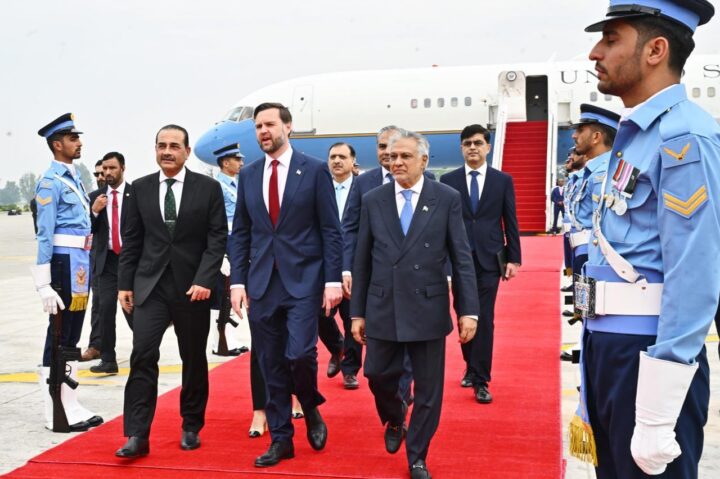
Vice President JD Vance (C) is welcomed by Ishak Dar (R), Pakistan Foreign Minister, and Asim Munir (L), Chief of Army Staff of Pakistan, as the US delegation arrive in Islamabad, capital of Pakistan, for high-stakes talks with Iran to end the Middle East conflict amid the ongoing two-week ceasefire on April 11, 2026.
Senate Republicans maintained the position on Monday that Iran should never be allowed to possess nuclear enrichment capacity, following reports that the administration had proposed a 20-year pause in enrichment — rather than a permanent end to Iran’s enrichment capacity — as part of peace talks in Islamabad over the weekend.
Last year, during diplomatic talks with the regime prior to the U.S. strikes on the Iranian nuclear program, all but one Senate Republican signed a letter arguing that Iran should never have enrichment capacity, a position echoed by a vast majority of House Republicans. The New York Times reported Monday that Iran agreed to halt enrichment for just five years.
Sen. Lindsey Graham (R-SC), who has been a vocal proponent of the war in Iran but has also defended the Trump administration’s diplomatic efforts, said on X that a 20-year pause to Iranian enrichment would not be sufficient.
“If this reporting is accurate, the idea that we would agree to a moratorium on enrichment rather than a ban on enrichment would be a mistake in my view,” Graham said on X. “Would we agree to a moratorium for al Qaeda to enrich? No. The only difference between al Qaeda and the Iranian regime is that one is a Sunni terrorist organization and the other is a Shia terrorist state.”
He said that Iran cannot be trusted and that the U.S. must hold firm to a standard of zero enrichment.
Sen. Pete Ricketts (R-NE), a co-lead of the letter last year, told Jewish Insider that he hadn’t seen the reports about the administration’s negotiating position and declined to comment on it specifically, but said more broadly that he does not believe that Iran has any legitimate need for enrichment.
“There’s no civilian reason for Iran to have an enrichment program,” Ricketts said. “They’re getting their uranium right now for their civilian program from Russia, and the fact that they have admitted they’ve enriched uranium to near bomb-grade potential demonstrates that this is for nuclear weapon production, not civilian use.”
Sen. John Cornyn (R-TX) said that Iran can’t be trusted to “stick with anything they agree to, so you have to understand that going into it.”
“But I agree with the president: no enrichment, no nuclear weapons and open up the Strait of Hormuz.”
Sen. Ted Budd (R-NC) said that “the preference is no enrichment.”
“Iran can never be allowed to have a nuclear weapon. Bottom line, end of story,” Budd said. “The 20-year pause — is that a strategic component to a greater negotiation? I can understand that. … Do they have civilian nuclear power as part of that? Can they be trusted with this current regime? I don’t think so. But again, I’m going to give a lot of leeway to the administration who wants to end nuclear capability for Iran.”
Sen. Rick Scott (R-FL) also said he has not seen the reports, but that “it should be a forever” prohibition on Iranian nuclear enrichment.
Sen. Roger Wicker (R-MS), the chairman of the Senate Armed Services Committee, said that Republicans are set to discuss on Tuesday the best way to approve a supplemental funding request for the war and the proper size of the supplemental package.
Sen. Tommy Tuberville (R-AL) told reporters that he thinks the Iran war funding should be folded into the upcoming reconciliation package — focused on immigration and border security matters — while others maintain it should be a stand-alone bill. Including the Iran funding could make passing the reconciliation package in the House more difficult.
Wicker said, “it’s a matter of vote-counting, largely.”
There are also some apparent disagreements between Republicans about what should happen if the war extends past the 60-day timeline for unilateral executive military action laid out in the War Powers Act.
Sen. John Kennedy (R-LA) said that the War Powers Act deadline may be unconstitutional or unenforceable, but said “there’s nobody walking around here in the Senate going, ‘How many days do we have left?’ Nobody’s paying attention.”
But Sen. James Lankford (R-OK) told reporters, “I’m sure we’ll have some sort of a vote or a statement at that [60-day] point.”
Other Republican senators are taking a firmer stance, rejecting any war operations beyond 60 days without congressional approval.
“Here in America, constitutional limits are in place to temper the president from unilateral authority. I support the president’s actions taken in defense of American lives and interests,” Sen. John Curtis (R-UT) said in a recent op-ed. “However, I will not support ongoing military action beyond a 60-day window without congressional approval.”
And Curtis said he would not support any supplemental funding for the war without congressional authorization.
Please log in if you already have a subscription, or subscribe to access the latest updates.
 Continue with Google

 Continue with Apple