










































































The Pax Silica initiative is designed to help allies reduce their dependence on China
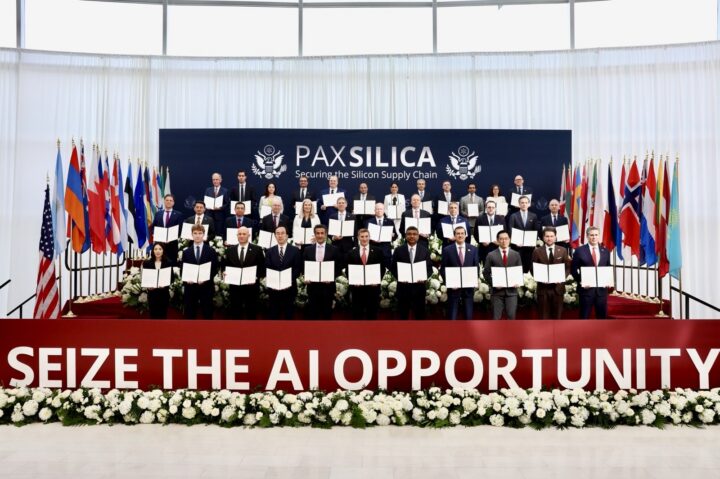
Nine new parties signed on to Pax Silica during the Pax Silica Summit at the U.S. Institute of Peace in Washington, June 25, 2026
Under Secretary of State for Economic Affairs Jacob Helberg/X


 Add JewishInsider on Google
The State Department announced on Thursday that nine new parties had signed on to Pax Silica, the U.S.-led initiative uniting American allies with the aim of developing global supply chains for artificial intelligence and the production of semiconductors, chips, critical minerals and energy sources to reduce global dependence on China.
The announcement came from Jacob Helberg, the under secretary of state for economic affairs and the architect of the project, during the Pax Silica Summit at the U.S. Institute of Peace in Washington, which brought together artificial intelligence and tech companies, prominent investors, senior business executives and top officials from at least two dozen countries seeking partnerships and investment opportunities with fellow signatories of the alliance.
Helberg told attendees that the European Commission, the Netherlands, Germany and Greece had officially joined the alliance and that Argentina, Chile, Costa Rica, Kazakhstan and Panama would sign on this week, bringing the total number of signatories to 22.
Helberg also suggested Italy would soon join the alliance and said that 35 countries had signed on to a global AI opportunity declaration that the U.S. had spearheaded as part of the initiative.
Among those in attendance for the opening of the two-day summit were American Israeli venture capitalist Michael Eisenberg, U.S. Ambassador to India Sergio Gor, Indian Information Technology Minister Ashwini Vaishnaw and former Italian Ambassador to the U.S. Armando Varricchio.
The summit also was the setting for the “first trilateral economic dialogue” between the U.S., Israel and the UAE, Helberg said., where he was joined by Israel’s National AI Directorate head, Brig.-Gen. (Res.) Erez Eskel, and United Arab Emirates Minister of State Saeed Bin Mubarak Al Hajeri.
Helberg posted a photo of the three men standing in front of their respective countries’ flags to X and said, “In President Trump’s first term, the Abraham Accords showed peace builds prosperity. In his second term, under Secretary Rubio leadership, Pax Silica is showing shared supply chains builds shared economic security.”
It came more than seven months after the State Department launched Pax Silica with the goal of boosting diplomatic ties between U.S. allies by encouraging the partnerships that create shared economic incentives. Israel was one of the founding nations of Pax Silica when the U.S. launched the initiative last December alongside Australia, Japan, Singapore and South Korea. The United Arab Emirates and Qatar joined the alliance in January.
Helberg used his remarks on Thursday to encourage U.S. allies to embrace collective efforts to address shared challenges on AI and energy.
“Governments everywhere are asking many of the same questions,” Helberg said. “How do we build trusted AI ecosystems? How do we secure resilient supply chains? How do we ensure our citizens share in the prosperity that AI can create?”
“No country can answer those questions alone,” he continued.
The undersecretary of state touted to Jewish Insider in February Israel and Qatar’s participation in the expanding alliance, despite the deeply hostile relationship between the two countries, as proof that bypassing traditional security agreements and instead encouraging increased economic cooperation through U.S.-led frameworks can create pathways to diplomacy.
“This is the first time that Israel and Qatar have been brought under the same framework and signed the same document to actually agree that shared supply chains are more important than shared ideologies,” Helberg told JI at the time.
He told the Financial Times this week that Israel and the UAE’s successful use of American technology in building out their respective tech sectors served as evidence that the U.S. was not using the initiative to solely promote its own interests. “These countries punch far above their weight, so that should be a really strong counterexample to folks,” he said.
Helberg posted on X on Thursday that the U.S., Israel and the UAE held a first trilateral economic dialogue on the margins of the summit. “In President Trump’s first term, the Abraham Accords showed peace builds prosperity,” he said. “In his second term, under Secretary Rubio leadership, Pax Silica is showing shared supply chains builds shared economic security.”
Helberg unveiled several new ventures on the first day of the summit, including the Pax Silica Artificial Intelligence Assistance Project, which he described as a service “for Pax partners that ship high-value AI supply chain products through Panama,” and PaxPass, an application he said was aimed at streamlining the movement of “the critical goods that power the AI economy,” along with a $50 million commitment from the U.S. to finance the platform. He also revealed plans for the U.S. and Kazakhstan to jointly establish an economic security zone in the Central Asian country to protect mineral security.
He announced the establishment of The Foundry School, a workforce development initiative partnering the State Department with Stanford University to “equip entrepreneurs, engineers and advanced manufacturing leaders across the Pax Silica economies.” Helberg said the State Department would also sign a memorandum of understanding with Stanford to “develop a first-of-its-kind curriculum for institutions across Pax Silica economies to adopt and teach.”
“Our hope is that this is only the first of a handful of such zones across the Pax Silica network, creating a connected ecosystem where investment, innovation and trusted production reinforce one another across partner countries,” Helberg told attendees.
For the Trump administration’s under secretary of state for economic affairs, the Pax Silica initiative takes on additional meaning as ‘the first time that Israel and Qatar have been brought under the same framework’
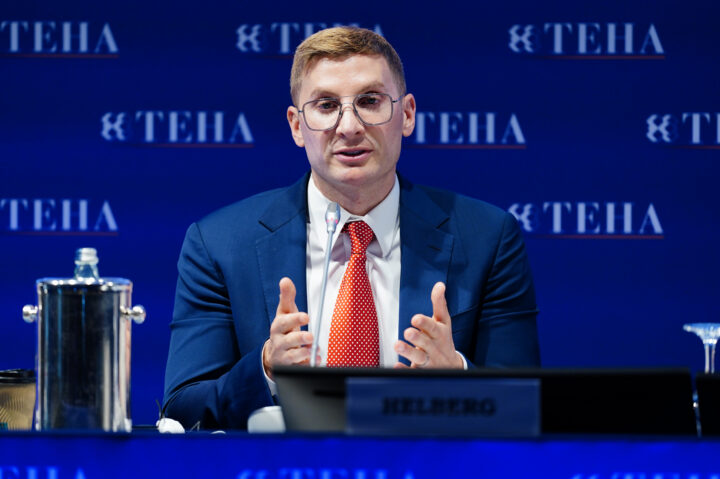
Pier Marco Tacca/Getty Images
Jacob Helberg, advisor to the White House Council of Economic Advisers and U.S. Under Secretary of State designate for Economic Growth, Energy, and the Environment, attends the 51st Edition of TEHA 'Cernobbio Forum Takes Place In Italy on September 05, 2025 in Como, Italy.
That Qatar and Israel both signed onto a U.S.-led initiative to improve and strengthen AI supply chains does not mean the two nations — both of whom foster a deep reserve of hostility for each other, particularly in a Middle East transformed by the Oct. 7 attacks and two years of war in Gaza — are on the pathway toward closer ties, let alone diplomatic normalization.
But for Jacob Helberg, the under secretary of state for economic affairs who has taken a wonky but driven approach to economic diplomacy, it still counts for something. Helberg recently returned from a trip to Israel, Saudi Arabia, the United Arab Emirates and Qatar. He presided over a series of signing ceremonies for Pax Silica, an effort by the Trump State Department to bring American partners together to develop AI supply chains that rely less intensively on China.
“My trip to the Middle East was actually incredibly significant, because this is the first time that Israel and Qatar have been brought under the same framework and signed the same document to actually agree that shared supply chains are more important than shared ideologies,” Helberg told Jewish Insider in an interview last week.
Helberg is enmeshed in the specifics of AI architecture, mineral refining, semiconductor production and technology manufacturing. There is also a bigger pitch, particularly when it comes to the Middle East: that economic cooperation — driven by companies working across national borders to grow their bottom line — can also be a boon for diplomacy.
“Our goal has been the expansion of the Abraham Accords, and the president’s been very, very clear and vocal about that,” said Helberg, a China hawk who is leading the Pax Silica initiative. “When people do business together, when people focus on shared goals, you inherently create, identify and focus on things that people agree on. It’s certainly my hope that this will pave the way for peace and economic integration of the region.”
Helberg’s nomination to a senior role at the State Department marks the culmination of a political evolution that took him from being a major donor to former President Joe Biden in 2020 to giving more than $1 million to President Donald Trump’s 2024 campaign. He told JI in 2024 that his shifting political identity was owed in part to what he viewed as the Democratic Party’s shift to the left, including on Israel. Helberg grew up in Paris, the grandson of Holocaust survivors on his father’s side and Tunisian Jews who left the country for France on his mother’s side.
Helberg’s husband, Keith Rabois, is a venture capitalist who hosted a fundraiser featuring Vice President JD Vance in Florida last week.
On Helberg’s recent trip to the Middle East, he said he witnessed collaboration between Israel and the UAE that endured over the course of the war.
“There is nascent collaboration between the UAE and Israel on the tech side,” he said. “That has actually been a really interesting observation that I’ve seen in the Middle East … how pragmatic and apolitical people can be on the business side of the ledger, and very comfortable compartmentalizing politics.”
While Israel has in some ways become more isolated on the diplomatic stage since its response to the Oct. 7 attacks, Helberg said the war in Gaza revealed the strength of Israel’s tech ecosystem. The country’s defense capabilities have only contributed to that image, he noted.
“Israel, obviously, is a country that has always punched way above its weight technologically. They are respected in all corners of the world for having an incredibly innovative technology ecosystem,” said Helberg, who previously worked at Palantir and Google. “Since Oct. 7 and the unfolding of the war, the world has really witnessed just how incredible Israel’s capabilities are, both for military technologies as well as for cybersecurity.”
Please log in if you already have a subscription, or subscribe to access the latest updates.
 Continue with Google

 Continue with Apple