














































































The hedge fund manager and GOP donor said Emanuel ‘did an extraordinary job’ as Democratic mayor of Chicago
Patrick T. Fallon / AFP via Getty Images
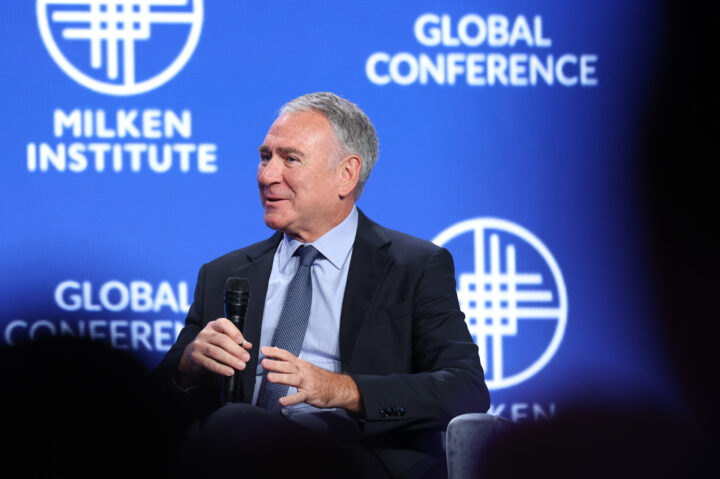
Ken Griffin, founder and CEO of multinational hedge fund Citadel, speaks during the 29th annual Milken Institute Global Conference at the Beverly Hilton in Beverly Hills, California on May 5, 2026.


 Add JewishInsider on Google
Citadel CEO Ken Griffin praised Rahm Emanuel’s tenure as former mayor of Chicago while attacking Illinois Gov. JB Pritzker for his handling of crime and education issues — two Democrats seen as potential presidential contenders — during a panel at the annual Milken Institute Global Conference on Tuesday.
The billionaire hedge fund magnate and major Republican donor has held a longstanding feud with Pritzker over his state’s economic, crime and education policies to the point that he moved his firm’s headquarters from Chicago to Miami, Florida.
Griffin said his acrimonious relationship with New York City Mayor Zohran Mamdani was “triggering of the trauma I went through in Chicago.” Citadel has a major presence in New York City, but Griffin has threatened not to proceed with a major planned development in Manhattan due to Mamdani’s use of Griffin’s property there to promote a tax on luxury second homes.
“Chicago went through a renaissance during most of my 30 years there,” Griffin said on Tuesday. “Under the leadership of JB Pritzker, [former Chicago Mayor] Lori Lightfoot and the current mayor [Brandon Johnson], it has just evolved into a state that has lost its way. … This is really a story of the progressive left. I mean, when Rahm Emanuel was there, I think he did an extraordinary job of helping to deal with the issues that we had in our public schools and that we had with crime on the streets.”
Griffin touted the work he did with the Emanuel administration to get the city to “use digital technology to forecast what crime could occur.”
“I helped to fund this work, and we would actually pre-position police officers in these crime hotspots. We brought murder rates down in one of the most difficult neighborhoods by 50% in less than two years. That’s lives saved. That’s both political leadership, thought leadership and execution from our police department,” he said.
“We saw that JB Pritzkers and Lori Lightfoots of the world dismantle these gains that we were making that we’re really improving the lives of people who depend upon good government to make their lives better.”
Griffin said violent crime was “the biggest problem” that caused him to leave the state, telling Eisen that “I had a colleague stabbed outside the door of our building. I had a colleague’s house burned down by an arsonist. I could just go on for the next 10 minutes about muggings, about bullets flying through people’s cars.”
“It became impossible to recruit people to Illinois, because of the question they posed: ‘I love the job, I love the people, but will my family be safe here?’” he continued. “You couldn’t look somebody in the eyes and go, ‘Your family will be safe here.’ You couldn’t. The best you could do is, ‘I hope they will be.’”
The Citadel chief executive said his team’s conversations with Mamdani’s City Hall have “made clear … that we need to double down on our bet in Miami.”
“We want to be in a state that embraces business, that embraces education, that embraces personal freedom and liberty and that embraces people having an opportunity to live the American dream,” Griffin said. “It’s a dream of earned success, not a dream of redistributive handouts that lead people dependent on government for their lives and their livelihoods in a way that takes away community and honor.”
On the U.S. war with Iran, Griffin backed the rationale for the war while criticizing the Trump administration for not being transparent enough with the American public.
“I applaud the president for having the willingness to actually try to ensure a nuclear-free Middle East,” Griffin said. “I don’t think he has made that case strongly for the American people, but we should all sleep better knowing that he has set back the Iranians and their nuclear ambitions for years, if not decades, over the course of his time as president.”
Asked by Eisen about the lack of broad support domestically for the war, Griffin reiterated his view that the president has not made a “strong enough” case to the public for launching the war, but continued to defend its mission.
“A nuclear Iran would put into question the safety and security of the people of our nation,” Griffin said. “I think that they have made many good decisions here, but they have encountered something that they did not anticipate, which is a military capacity by Iran and a commitment to the preservation of the regime that is completely different to what they saw in Venezuela. In some sense, the extraordinary success of Venezuela almost certainly led all of us to believe that we could have some remarkable success in Iran,” he added, referencing the U.S. mission to oust former dictator Nicholas Maduro.
Griffin also noted that the Iranian military had not yet “been defeated,” counter to Trump’s claims, which Griffin described as a “stalemate situation” that was causing energy prices to rise. He said that the U.S. is “largely shielded from that” from a holistic standpoint, but that individual consumers are not.
Eisen, who has been moderating panels at the Milken Institute conference, said the rise in anti-Jewish hate has been the ‘sideline conversation’ all week
Daniel Zuchnik/Sportico via Getty Images
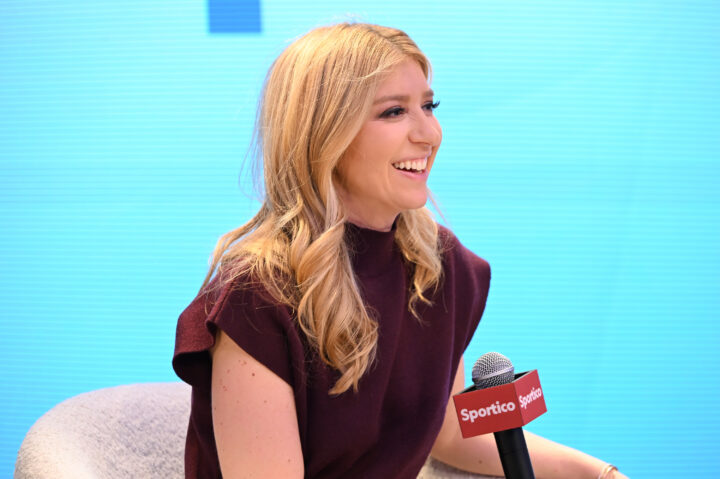
Sara Eisen at Sportico Invest in Sports New York 2025 at Nasdaq HQ on Nov. 4, 2025 in New York.
LOS ANGELES — CNBC anchor Sara Eisen is a fixture at the annual Milken Institute Global Conference in Los Angeles, where she moderates marquee events, such as a one-on-one interview on Tuesday with Ken Griffin, CEO of the hedge fund Citadel.
But the real reason that Eisen — along with scores of billionaire investors and business executives — comes to Beverly Hills for the exclusive annual gathering is for the conversations happening far from the main stages. And much of the conversation Eisen is hearing this week, she told Jewish Insider, has to do with the dramatic rise in antisemitism in recent years.
“To a large extent, I reflect a lot of what the sources that I speak to [say]. That’s investors, and it’s business leaders, and it’s private equity leaders,” Eisen said in an interview during the conference, after she wrapped up moderating a conversation with the CEO of Carlyle, the co-president of Morgan Stanley, the chairman and CEO of State Street and the CEO of the California Public Employees’ Retirement System.
“A lot of these people, Jewish and non-Jewish, talk to me about it. They know about my background. They know my perspective. They see what’s happening in the political world. They see what’s happening in geopolitics,” she continued. “This is the sideline conversation.”
The issue isn’t new for Eisen. Her grandfather was a Holocaust survivor, and he talked openly about his experiences. “I have always been someone with a really strong Jewish identity,” she said. But something began to change for her after the Oct. 7, 2023, Hamas attacks in Israel, and it seeped into her professional work.
“I think for a lot of us, after Oct. 7, it was a wake-up call that we need to speak out more about these issues. I try to use my platform to bring awareness and education to issues like antisemitism, because I care about it,” said Eisen.
During a guest appearance on “The View” in March, she criticized former Trump administration official Joe Kent, who resigned from his position as director of the National Counterterrorism Center in March, for blaming Washington’s war with Iran on Israel.
“It is a very old-school, antisemitic trope to blame the Jews and to blame Israel. It’s as old as time,” Eisen said on “The View.” “It is a classic case of quintessential antisemitism, and by the way it is a dangerous time to do that because the Jews are under attack, and we’re fortifying our synagogues and our schools.”
In an April interview with Sen. Elizabeth Warren (D-MA), Eisen pressed Warren on her support for Maine Senate candidate Graham Platner, despite the fact that the Democrat had a tattoo of a Nazi symbol and praised military tactics used by Hamas. “I’m just curious why you think he’s your ‘kind of man,’” Eisen said, referencing Warren’s description of Platner at a recent campaign event.
Warren defended Platner, noting that he apologized for the tattoo and his history of insensitive remarks. Eisen drilled down on Platner’s praise of Hamas tactics: “You guys want to be the party of inclusivity, right?”
“I want to be the party that stands up for hard-working people,” was Warren’s response. “I want us to be the party that actually delivers on lowering costs and that expands opportunities, and that’s what Graham Platner wants to do, and I’m there to stand with him and to help in that fight.”
Eisen is known as a no-nonsense TV anchor with an occasional snarky streak and an aptitude for finance and economic trends. She covers the news, and lately, she sees antisemitism in the headlines — and feels a particular obligation to cover it.
“I think that the world’s changed,” Eisen said. “There is now this raging outburst of antisemitism, and it’s a societal issue, and I have a background and a perspective on it. And I think it feeds directly into stories we’re doing about the economy and society and geopolitics.”
Reporters, Eisen argued, should not pretend they do not have backgrounds that affect the issues they cover. For her, that means talking about being Jewish, and spotlighting the rise in antisemitism. It stands out at a time when questions like the ones she asked Warren are not necessarily echoed by other top reporters at national outlets.
“As journalists, we’re also people. We have families, we have religions, we have backgrounds, we have history. I try not to inject those opinions, but I do think perspective matters,” she said. “Nobody wants to be interviewed by robots.”
The result is even more social media vitriol than she has always received as a prominent media figure. Only now, it’s antisemitic.
“I feel the heat, and that’s definitely a calculated risk, and it’s unfortunate and it’s unpleasant,” said Eisen. “But I also feel like if, if we’re not asking these questions and we’re not speaking up about these issues, then then nobody will. So we need to.”
Please log in if you already have a subscription, or subscribe to access the latest updates.
 Continue with Google

 Continue with Apple