














































































While an anti-Israel activist was defeated in the Senate primary, another prominent candidate who attacked AIPAC won her hotly contested congressional primary
(Joseph Prezioso/Getty Images)
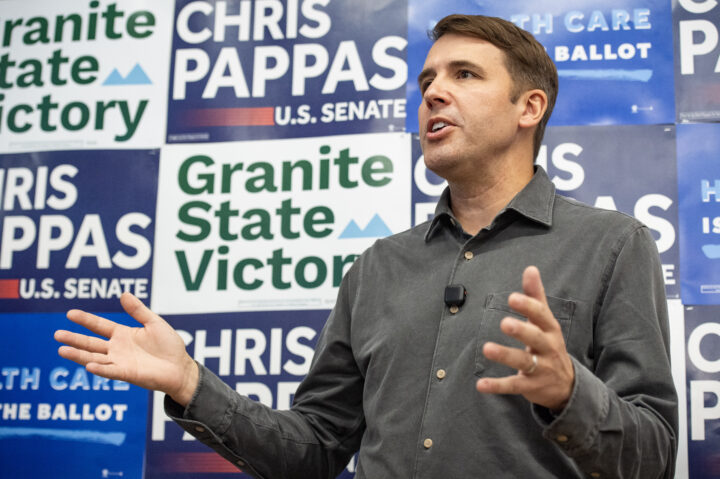
New Hampshire Democratic Senate candidate, U.S. Rep. Chris Pappas (D-NH) speaks to supporters as he attends a canvass launch rally as he campaigns for office on September 6, 2026 in Manchester, New Hampshire.


 Add JewishInsider on Google
Tuesday night’s Democratic primaries in New Hampshire delivered mixed results for candidates who made attacks on Israel a centerpiece of their closing arguments.
Rep. Chris Pappas (D-NH) trounced progressive activist Karishma Manzur by nearly a 2-to-1 margin (65%-33%) in the Senate primary, after Manzur attacked Pappas for his stance on Israel and called him a “shill for AIPAC” as a central message of her campaign.
Pappas is now facing a competitive general election against former Sen. John Sununu (R-NH), who is running to rejoin the Senate after nearly two decades out of office. Sununu is expected to be a formidable challenger who holds a narrow lead over Pappas in recent public polling.
The Cook Political Report rates the race as “Lean Democratic.” A longtime New Hampshire pollster told JI last week that Sununu is the underdog but is a strong and experienced candidate, and has a well-known and popular family name in the state, with a record of support from moderates and independents whom Pappas has previously worked to attract.
Pappas will likely be buoyed, however, by the strong national environment for Democrats, while Sununu will need to hold together a coalition of moderates skeptical of President Donald Trump and MAGA diehards in the GOP base.
Meanwhile, Stefany Shaheen, the daughter of Sen. Jeanne Shaheen (D-NH), narrowly beat military veteran and second-time candidate Maura Sullivan. Shaheen closed out the race with claims that AIPAC, which did not endorse and was not involved in either race, had been bundling contributions for Sullivan.
Shaheen’s advantage is partly attributable to her family name — but Sullivan came close to overcoming that advantage despite starting the race trailing Shaheen by double digits.
Shaheen went on air in the closing days of the race with ads accusing Sullivan of being “bankrolled” by AIPAC, and leaned into her opposition to Israel in interviews. Sullivan hit back in her own ad saying she doesn’t take any money from AIPAC.
Under pressure from the left in the wake of the war in Gaza, both Pappas and Sullivan recalibrated their stances on Israel during their primary races. Pappas, a pro-Israel moderate for most of his time in the House, backed away from his previous relationship with AIPAC and called for a “reset” of the U.S.-Israel relationship while voting “present” on an amendment to strip aid from Israel.
Democratic Majority for Israel and the Jewish Democratic Council of America congratulated Pappas on his victory.
Sullivan, who rejected efforts to cut aid to Israel earlier in the race, came around to supporting the suspension of at least some weapons sales to Israel.
The pro-Israel moderate has been recalibrating his foreign policy views under pressure from a far-left anti-Israel opponent
Tom Williams/CQ-Roll Call, Inc via Getty Images
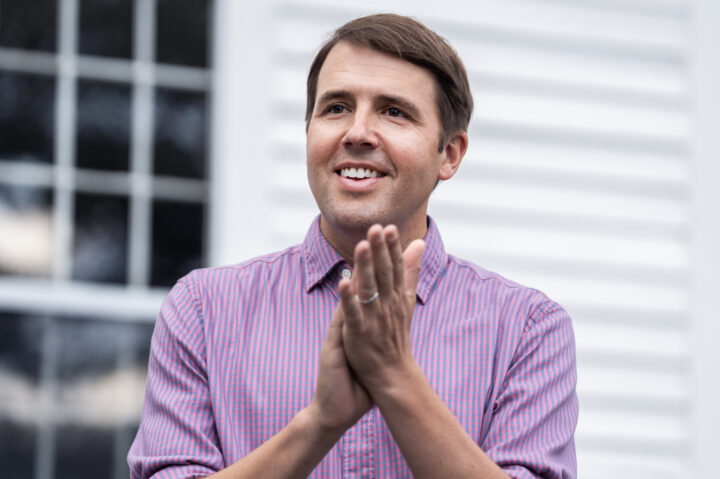
Rep. Chris Pappas (D-NH), Democratic candidate for U.S. Senate, talks with voters on August 16, 2026.
Moderate Rep. Chris Pappas (D-NH) remains favored to win the New Hampshire Democratic Senate primary, but the race is shaping up to be more competitive than expected, both in the Democratic primary and in the general election.
In the primary, Pappas’ progressive challenger, Karishma Manzur, has been gaining ground against him, and leveling attacks related to Pappas’ past support from AIPAC and backing of the U.S.-Israel relationship. Pappas has subtly recalibrated his foreign policy views during the primary.
An Aug. 20-24 poll by the University of New Hampshire showed Pappas’ lead had shrunk to 13 percentage points — though other surveys have shown Pappas with a more significant lead, including a mid-August St. Anselm poll that put him up 31 points and an internal campaign poll that showed him with a 56-point lead.
Pappas has been a pro-Israel moderate in the House, though he voted “present” on the recent amendment by Rep. Thomas Massie (R-KY) to cut off U.S. aid to Israel and, with most Democrats, against a college campus anti-Boycott, Divestment and Sanctions bill. He was endorsed by AIPAC in his House races, but the group has not yet made any endorsements in the Senate race.
Manzur, who accuses Israel of genocide, has made attacks on Pappas for past support from AIPAC a central element of her campaign, going after him for “tak[ing] money from corporate PACs, super PACs, AIPAC, foreign lobbyists” (foreign political donations are illegal) while stating she only takes donations from “regular American folks,” a comment that the New Hampshire Jewish Federation has described as offensive.
She has also accused Pappas of taking a “payoff” from AIPAC in exchange for voting “against humanitarian aid to starving children.”
Her campaign has rented a billboard in Pappas’ home city attacking him over his ties to AIPAC.
Manzur, in a statement to Jewish Insider on Friday, said that Pappas was “unwilling to answer a simple question about AIPAC’s endorsement” and accused him of “hypocrisy.”
“Pappas is a shill for AIPAC and corporations supporting the war machine, so it’s no surprise that special interests are pouring in millions to buy this seat,” she said. That’s exactly why I’m surging in the polls: people are sick and tired of business-as-usual politicians like Pappas who serve their wealthy donors instead of the people they represent. Granite Staters deserve leaders with honesty, integrity, and accountability. I am honest, un-bought, and the people’s candidate, fighting every day to improve people’s lives. That’s why I will win this primary.”
Pappas, for his part, has toned down his past support for the Jewish state, saying after the vote on the Massie amendment, “I cannot support this amendment as written, but also cannot support the disproportionate, extreme policies of the Netanyahu government” and calling for a “reset” of the U.S.-Israel relationship.
Despite appearing at an AIPAC summit earlier this year, and recording a video in front of an AIPAC backdrop expressing support for the U.S.-Israel relationship, he has more recently downplayed that appearance as a meeting with local constituents, rather than with AIPAC as an organization.
Asked recently on CNN about his past support from AIPAC, he downplayed his relationship with the group, saying, “I appreciate the support I have from individuals out there” and said he’s working to change campaign finance laws, as well as emphasized his criticisms of the Israeli government and efforts to push for a two-state solution.
Andrew Smith, the director of the University of New Hampshire Survey Center, attributed Manzur’s growing share of the vote to left-wing energy in the party. New Hampshire Democrats, he explained, have traditionally put forward “people who are kind of middle of the road, not flashy, somewhat boring as candidates … who [aren’t] going to be the most dynamic campaigners,” including Pappas.
“That I think is the biggest problem that Pappas has right now. He’s seen as part of that old guard of the Democratic Party here, even though he’s pretty young,” he continued. “He’s not really, I think, reflecting the energy and anger that you’re seeing from the progressive left of the party.”
That said, he predicted that Pappas is still favored to be the nominee, given the strong support he receives from older voters. Younger voters, who are Manzur’s base, are less likely to turn out on Election Day.
General election polling is also pointing to a competitive race for Pappas in November. A UNH poll in late August showed former Sen. John Sununu (R-NH), the likely GOP nominee, with a narrow lead over Pappas, a result matched by a GOP-sponsored Fabrizio, Lee & Associates poll last week. The nonpartisan elections handicapper Inside Elections shifted the race to a toss-up on Thursday.
A St. Anselm College poll in mid-August had shown Pappas with a seven-point lead over Sununu.
Smith said that Pappas, assuming he’s the nominee, would face a competitive race in the general election, despite the environment otherwise favoring Democrats. Sununu’s family name is well-known throughout the state, he was popular during his time in office and his brother Chris Sununu was a popular recent governor, Smith explained.
“He’s getting more support from more moderate voters and more independent voters who either don’t know Pappas or maybe they are just looking for somebody different,” Smith said. “Sununu is maybe the underdog, but … he knows how to run,” is very sharp and is a strong debater.
Sununu’s biggest challenge will be to distance himself enough from President Donald Trump to win over moderate voters without angering Trump voters in the GOP base.
Please log in if you already have a subscription, or subscribe to access the latest updates.
 Continue with Google

 Continue with Apple