













































































Now that shifting American politics is pushing the president to distance himself from Israel’s preferred policies, Netanyahu is stuck without his trump card

SAUL LOEB/AFP via Getty Images
President Donald Trump shakes hands with Israeli Prime Minister Benjamin Netanyahu during a meeting in the Oval Office of the White House in Washington, DC, on April 7, 2025.


 Add JewishInsider on Google
Domestic politics isn’t always the best lens through which to evaluate foreign policy decisions.
But in assessing why President Donald Trump has gone to significant lengths to prevent Israeli Prime Minister Benjamin Netanyahu from striking back against Iran’s attacks, and why Netanyahu went ahead with the first wave of military strikes before standing down, it’s instructive to understand how the domestic politics in the U.S. and Israel are diverging.
The joint U.S.-Israel military operation against Iran, which began on Feb. 28 and has evolved into a very tenuous ceasefire since April 8, has not achieved many of the military goals outlined by both sides. Iran’s extremist leadership is still in place, it still maintains its nuclear ambitions and retains its nuclear material, and its ballistic missile stockpiles, while damaged, still remain.
On the Lebanese front, Hezbollah continues to threaten Israel’s north and not abide by any of the diplomatic agreements recently negotiated between Israel and the Lebanese government.
As a result of the limited achievements so far, public support for renewing military action against Iran has been low among the American public, and the overall operation is receiving lukewarm backing from Republicans.
Over two-thirds of voters in a recent Economist/YouGov poll said the U.S. “should make a deal to end the war in Iran as quickly as possible,” with just 11% disagreeing. Over half of Republicans shared the same sentiment of ending the war, with just 21% opposing.
Support for the war itself was much higher among Republicans than Democrats or independents, but still less than typical partisan support for Trump’s actions, with 67% of GOP voters backing the war in Iran and 20% opposing. (Among all voters, just 28% said they supported the war against Iran, with 60% opposing.)
These polling numbers explain why Trump, ever cognizant of public opinion especially in the run-up to a consequential midterm election, is trying to avoid reengaging with Iran militarily — even as he desperately seeks for some diplomatic off-ramp that Iran isn’t giving him.
In fact, it’s Trump’s very transparent desperation for a deal with Iran — and apparent unwillingness to go back to war —that’s emboldening Iran to continue its rejectionism to the point where it launched ballistic missiles at Israel over the weekend, feeling confident Trump would constrain Israel from any sustained response (which he did).
Only in Trump’s mind is a ceasefire with active fighting still a ceasefire. But he’s hoping he can maintain that illusion long enough to prevent him from losing more ground politically. Gas prices and reopening the Strait of Hormuz are bigger priorities at the moment to him than Israel’s national security.
Meanwhile, in Israel, the public is pushing Netanyahu to continue taking the fight to Hezbollah, whose drones and rockets have made the northern part of the country virtually uninhabitable. And Israelis are increasingly frustrated, despite Trump’s popularity in the country, over how Netanyahu is being restrained from responding against Iran because of American political pressure.
A clear majority of Israelis (59%) in a May poll from the Institute of National Security Studies believed Israel should intensify its fighting against Hezbollah in Lebanon. The pollster also found, a month earlier, that 61% of Israelis opposed the initial American-led ceasefire.
Netanyahu, in an election year, is in a no-win situation where he’s tasked with maintaining solid support from Trump, given their perceived strong relationship has been at the center of his reelection messaging. But now that shifting American politics is pushing the president to distance himself from Israel’s preferred policies, Netanyahu is stuck without his trump card.
This is where Netanyahu’s bet on Trump — and trust in the personal relationship he’s built with him — is looking a bit shaky right now. Support for Israel runs widely in Republican circles (and deeply among Jewish Republicans and evangelicals), but some of the backing is a partisan reflection of the president’s own stalwart support of the Jewish state.
If Trump, for his own political self-interest, decided to change course in his Middle East policy, it’s likely many of his voters would follow to the beat of his drum. And that would leave Israel without much backing within the Democratic Party, and support within the GOP subject to Trump’s own personal whims.
That’s a pretty precarious place for Netanyahu to be in — just several months before his own big election.
This year is being treated inside the Beltway as the most high-profile WHCD weekend in at least a decade, the result of Trump’s decision to participate in this year’s dinner after boycotting it for his entire presidency
Tasos Katopodis/Getty Images
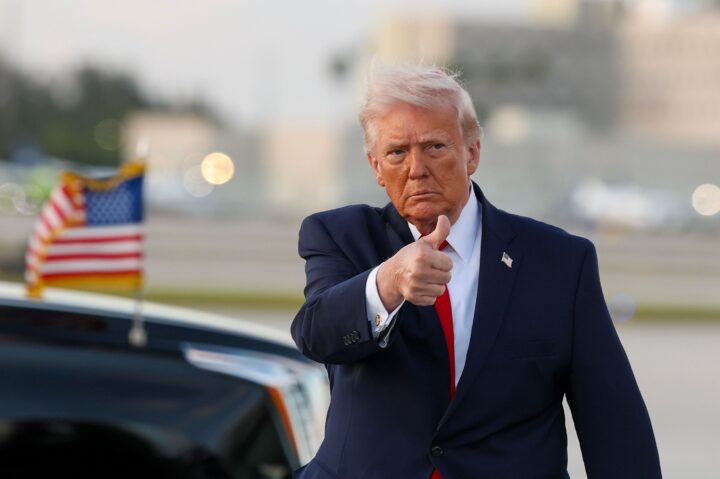
U.S. President Donald Trump waves to the media after walking off of Air Force One at Miami International Airport on April 11, 2026 in Miami, Florida.
A who’s who of the leading names in media, tech and global and domestic politics are flocking to the nation’s capital for the scores of exclusive parties surrounding the annual White House Correspondents’ Dinner this Saturday — where President Donald Trump will make his first-ever appearance as president and deliver a roast of the political press corps.
The correspondents’ dinner, and the parties thrown in its honor, have always generated enough fanfare to maintain its status as the biggest weekend of the social calendar in Washington. This year, however, is being treated inside the Beltway as the most high-profile WHCD weekend in at least a decade, the result of Trump’s decision to participate in this year’s dinner after boycotting it for his entire presidency.
In addition to Trump’s roast, guests will be entertained by Oz Pearlman, a famed mentalist known for his mind-reading tricks. Pearlman, who is Jewish and was born in Israel, marks a shift from the traditional entertainment choice at the dinner, which is usually a monologue delivered by a comedian. Those comedians’ jokes about Trump were a factor in why the president has skipped previous dinners, and the White House Correspondents’ Association canceled its planned entertainer last year over backlash to her past comments.
The dinner could make for some awkward moments: one of the WHCA’s award winners this year is a team from The Wall Street Journal, for reporting on Trump’s ties to disgraced financier Jeffrey Epstein — an article that led Trump to sue the Journal. And that’s not to mention Trump’s routine hostility toward and criticisms of the media more broadly. It is unclear if the president will be present for the award ceremony.
Celebrities have historically flocked to Washington for WHCD weekend, though the number of famous names willing to appear for the dinner or other events dwindled during the first Trump administration. That trend began to reverse during the Biden administration, though it picked up again last year when Trump returned to office.
Nicki Minaj, the rap superstar who has become an advocate for the Trump administration, will be attending the dinner as a guest of the Washington Times. No other media organizations have announced celebrity guests for their respective tables at the dinner.
Regardless of a diminished turnout of famous faces, this weekend will be jam-packed with nonstop events, and it has already begun.
Trump’s announcement in early March that he would attend Saturday’s dinner — leading many senior administration officials to also make plans to attend the festivities and Donald Trump Jr. to organize an ultra-exclusive event at his Executive Branch Club in Georgetown on Friday night — prompted an avalanche of interest from major companies, U.S. officials, foreign diplomats and dignitaries, top corporate powerbrokers and domestic political firms.
Boeing, Meta and Amazon swiftly organized intimate, invite-only gatherings for this weekend or became lead sponsors for events being hosted by D.C.-area embassies, media outlets, political operatives and high-profile consulting groups. Foreign ambassadors stationed in the U.S. and others looking to connect with the president’s circle or the broader Washington political orbit began calling in favors to get on the guest lists for all of the weekend’s events, making invitations all-the-more difficult to secure for those who have attended in the last decade.
The parties start early on Friday with Axios Live’s annual WHCD weekend kickoff brunch at 9:00 a.m., followed by MS NOW’s brunch at 11:00 a.m. and Punchbowl News’ WHCD weekend kickoff gathering the publication’s townhouse in Capitol Hill at noon.
Meghan McCain’s “Renegade Women’s Cocktail Party” at The Graham in Georgetown starts at 4 p.m. while YouTube’s official WHCD party at Floreria Atlantico in Georgetown and the Motion Picture Association’s reception at the Downtown headquarters begin at 5:30.
Later that night, Semafor is hosting a “house party” at the private residence of its founder, Justin B. Smith, starting at 8 p.m.; Creative Artists Agency’s annual Friday evening party, sponsored by Vanity Fair, will take place this year at 7:30 p.m. at the Belgian ambassador’s residence near Georgetown; and United Talent Agency will host their annual “Celebration of American Journalists” at 9:00 p.m. at Osteria Mozza in Georgetown.
The Qataris are once again hosting a Friday evening correspondents bash with Washingtonian magazine, which starts at 8 p.m. at the Georgetown Four Seasons, which Qatari Ambassador Meshal Al Thani is slated to attend. At 7 p.m., doors will open for the Daily Mail’s party with Brunswick Review Business Magazine at the British ambassador’s residence.
Saturday’s festivities start at 11 a.m. with the annual White House Correspondents’ garden brunch, hosted by Tammy Haddad at the Beall-Washington House in Georgetown. Ahead of the dinner, Puck is hosting a “penthouse pre-party” on the rooftop of The Hepburn, located next to the Washington Hilton. At the Hilton, where the dinner is taking place, The Wall Street Journal and ABC News have their respective annual pre-dinner receptions at 5:30 p.m. The Washington Post has a cocktail reception at the Hilton starting at 6 p.m., the same time that Politico’s pre-dinner event with CBS News — featuring new CBS News honcho Bari Weiss — takes place just down the hall.
Alongside the dinner, Substack is hosting its “New Media Party” at 8 p.m. at the Renwick Gallery, located blocks from the White House; afterward, MS NOW and NBC News have dueling parties starting at 11:30 p.m., with the former hosting theirs at Dupont Underground in Dupont Circle and the latter hosting theirs at the French ambassador’s residence in Kalorama. Time’s WHCD afterparty at the Swiss ambassador’s residence in Woodley Park begins at 11 p.m.
On Sunday, NOTUS and Politico are hosting a brunch at the home of Robert Allbritton starting at 11:00 a.m., and CNN’s “WHCD Weekend Finale” brunch reception starts at 12:30 p.m.
Please log in if you already have a subscription, or subscribe to access the latest updates.
 Continue with Google

 Continue with Apple