














































































Rep. Mike Lawler: ‘Iran and its Houthi proxies have now simultaneously put pressure on two of the world’s most important maritime checkpoints’
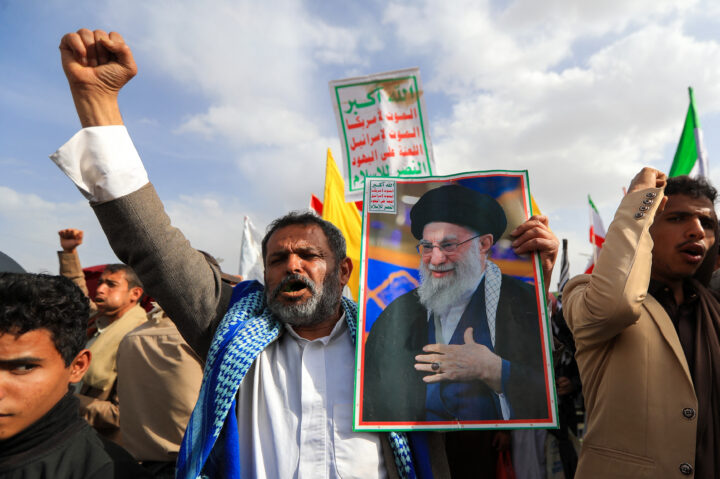
Photo by Mohammed HUWAIS / AFP via Getty Images
A Yemeni supporter of the Iran-backed Houthi movement holds a portrait of Iran's slain supreme leader, Ayatollah Ali Khamenei, during a protest against U.S. strikes on Iran in Sanaa on July 10, 2026.


 Add JewishInsider on Google
Middle East experts urged members of Congress on Tuesday to empower the Yemeni government and resume diplomatic efforts to constrain the Houthis in Yemen, warning that the Trump administration’s bombing campaign against the Houthis and the subsequent ceasefire have failed to deter the group from targeting commercial shipping in the Red Sea.
At a House Foreign Affairs Committee Middle East subcommittee hearing on the threats posed by the Houthis to U.S. interests in the Red Sea, Nadwa Al-Dawsari, an associate fellow at the Middle East Institute, and Allison Minor, the director of the Project for Middle East Integration at the Atlantic Council, testified that the Trump administration’s approach to containing the Iran-backed terror group had not sufficiently weakened or deterred it.
“The United States does not have an ambassador appointed to Yemen, to Saudi Arabia or to the UAE, the countries that are most important to resolving the conflict,” Minor said. “We have career diplomats in place as chargé d’affaires, but unfortunately, it’s not sufficient.”
Asked who is filling that void by Rep. Bill Keating (D-MA), Minor replied: “You have caretaker career diplomatic staff in place. I think there are a handful of envoys this administration has appointed for a series of global conflicts. I don’t think they have the bandwidth currently for Yemen.”
Lawmakers from both parties expressed concern over the negative impact on the economy caused by the Houthis’ repeated disruptions to commercial shipping in the Red Sea, with several connecting the campaign with Iran’s closure of the Strait of Hormuz. (Most recently, the Houthis have been attacking targets in Saudi Arabia, including ships, airports and oil facilities.)
“[The Houthis] have targeted American forces, attacked our partners and threatened commercial vessels transiting one of the world’s most important waterways,” Rep. Mike Lawler (R-NY), who chairs the subcommittee, said.
“Iran transformed a local armed movement into a terrorist organization capable of threatening Americans and disrupting international commerce. … This becomes even more dangerous in Yemen when the Red Sea and the Strait of Hormuz are involved. Iran and its Houthi proxies have now simultaneously put pressure on two of the world’s most important maritime checkpoints.”
Pressed on what Congress could do to protect freedom of navigation and commercial shipping in the Red Sea, Minor warned that, “until we have a durable resolution to this threat, we will continue to see a disruption to commerce that has immediate impacts on global energy markets and long-term consequences for freedom of navigation globally.”
Minor also agreed with Keating’s suggestion that “the closure and the limitation on the Strait [of Hormuz] has given the Houthis even more leverage than before.”
Minor and Al-Dawsari concurred that the Trump administration has failed to develop a durable Yemen policy or provide enough support to the Yemeni government to counter Houthi influence and territorial control.
Both witnesses criticized the ongoing ceasefire between the U.S. and the Houthis as strategically unproductive, pointing to the terrorist group’s increased recruiting numbers and continued attacks on commercial shipping. The two urged the Trump administration to not treat the ceasefire as a long-term strategy.
Al-Dawsari and Minor also rejected the notion that prior U.S. military operations had significantly diminished the Houthis’ ability or willingness to fight.
“U.S. military pressure has imposed real costs on the Houthis, but airstrikes alone will not eliminate the threat,” Al-Dawsari said. “The Houthis have not been degraded.”
“Air strikes have disrupted Houthi operations and … undermined some of their capabilities, but the Houthis have proven that they are able to regenerate some of these capabilities,” she continued. “The Houthis have not engaged in peace negotiations in good faith. They used that time to rebuild their capabilities, recruit more fighters and prepare for the next war.”
Minor argued that, “U.S. airstrikes and Israeli strikes all failed to eliminate Houthi capabilities or alter their strategy. … Each time the Houthis have come under attack from U.S. or Israeli strikes, they have used this to fuel their recruitment.”
Neither witness supported the idea of a U.S. military operation targeting the Houthis involving
ground troops, and both agreed that the Trump administration should fill the vacant U.S. special envoy for Yemen post and surge humanitarian assistance.
But Al-Dawsari and Minor diverged on how to achieve a lasting solution that eliminates the group’s fighting capacity and ensures the Yemeni government can maintain control of the country.
Minor argued that the Trump administration needs to address the lack of a broader American diplomatic apparatus in the region while pursuing a “viable negotiated settlement that can contain Houthi threats while addressing the governance issues that have been fueling this Houthi threat for over a decade.” While Minor did not rule out the viability of military force completely, she urged the U.S. to stop “vacillating between costly U.S. military intervention and disengagement.”
Al-Dawsari, meanwhile, encouraged the Trump administration to partner with Saudi Arabia on a broader effort to provide intelligence and military training, as well as any other assistance, “to support the Yemeni government militarily, politically and economically.” She also urged lawmakers to continue supporting the Houthis’ Foreign Terrorist Organization (FTO) designation.
“The most important source of leverage is territory,” Al-Dawsari said. “The United States needs to do the one thing that it hasn’t done yet: support the Yemeni government to take territory from the Houthis.”
“This is not the United States’ war, and it shouldn’t be,” she argued. “We need to provide [the government] with the necessary military and economic and political support in order to be able to take on the Houthis on their own long-term. That’s the only way to do it. There is no other substitute.”
The president said at a lengthy press conference: ‘I can tell you they're negotiating, we think, in good faith. We're going to find out’
Tom Williams/CQ-Roll Call, Inc via Getty Images
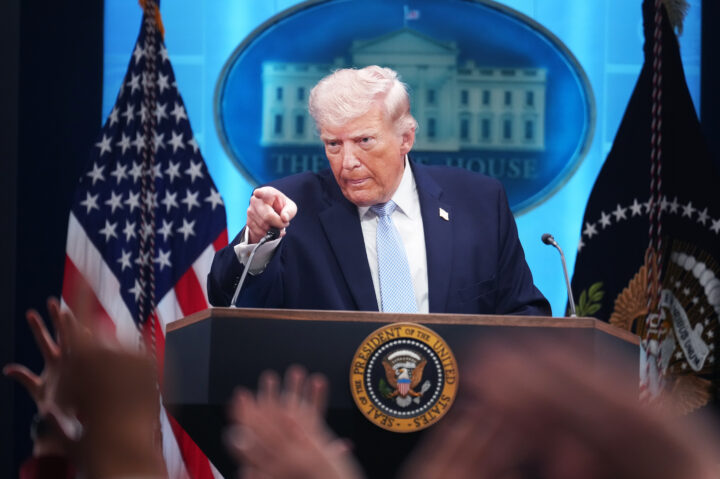
President Donald Trump conducts a news conference in the White House briefing room about the war in Iran on Monday, April 6, 2026.
President Donald Trump doubled down on his threats to escalate the war in Iran on Monday if Iranian leaders do not agree to a broad ceasefire deal that includes reopening the Strait of Hormuz by his Tuesday evening deadline, threatening that the U.S. would target every bridge and power plant still standing in the country.
Trump took a hawkish posture while speaking to reporters at the White House alongside senior U.S. defense officials about the ongoing war and diplomatic efforts to bring it to a close, warning that the U.S. has a plan to take out Iran’s entire transportation and energy infrastructure within “four hours” if Iran did not make a deal.
“I can tell you they’re negotiating, we think, in good faith. We’re going to find out. … After [8 p.m. ET on Tuesday], they’re going to have no bridges. They’re going to have no power plants. Stone ages,” Trump said, referring to the deadline he set for Iran to agree to his terms, which has now been postponed three times.
The president said he extended the deadline from Monday to Tuesday at 8 p.m. ET because he “thought it was inappropriate” to demand a response “the day after Easter.” The comment came hours after telling reporters at the annual White House Easter Egg Roll that the Tuesday deadline was final and unlikely to have any additional extensions.
“The entire country can be taken out in one night and that night might be tomorrow night,” Trump said from the briefing room. “We have a plan, because of the power of our military, [where] every bridge in Iran will be decimated by 12 o’clock tomorrow night, where every power plant in Iran will be out of business, burning, exploding and never to be used again. I mean complete demolition by 12 o’clock, and it’ll happen over a period of four hours if we want it to.”
“We don’t want that to happen. We may even get involved with helping them rebuild their nation. If that’s the case, the last thing we want to do is start with power plants, which are among the most expensive things, and bridges,” he continued. “So do I want to do that? No. Do I want to destroy their infrastructure? No. It will take them 100 years to rebuild. Right now, if we left today, it would take them 20 years to rebuild their country and it would never be as good as it was. The only way they’re going to be able to rebuild their country is to utilize the genius of the United States of America.”
Defense Secretary Pete Hegseth, who took part in the press conference alongside Trump, told reporters on Monday that, “per the president’s direction, today will be the largest volume which strikes since day one of this operation. Tomorrow, even more than today, and then Iran has a choice. Choose wisely, because this president does not play around.”
Trump repeatedly reiterated his commitment to ensuring that Iran can never obtain a nuclear weapon — after saying the country’s nuclear program was “obliterated” last June — and said that any agreement between Iran and the U.S. would need to adhere to his terms, including the reopening of the Strait of Hormuz. “We have to have a deal that’s acceptable to me, and part of that deal is going to be [that] we want free traffic of oil and everything,” the president said.
“They’re not going to have a nuclear weapon,” Trump said of Iran, arguing that his actions were an insurance policy for the U.S. “if somebody that takes my place someday is weak and ineffective, which possibly that will happen, because we had numerous presidents that were weak, ineffective and afraid of Iran.”
The president described the Iranians as “very good bulls*** artists, that’s why for 47 years they’ve been bulls***ing other presidents,” while defending his decision to take military action against the regime.
“I think that 47 years of this stuff is long enough. They’re at the weakest point they’ve ever been,” Trump said, despite Iran’s continued missile strikes across the Gulf and in Israel. “In fact, the biggest problem we have in our negotiations is that they can’t communicate. … They have no method of communication. So we’re communicating like they used to communicate 2,000 years ago with children bringing a note back and forth.”
Please log in if you already have a subscription, or subscribe to access the latest updates.
 Continue with Google

 Continue with Apple