




































































The strikes reportedly targeted air-defense systems, radars and drone command-and-control units in southern Iran

ATTA KENARE / AFP via Getty Images
Explosions erupt following strikes at Tehran Oil Refinery in Tehran on March 7, 2026.


 Add JewishInsider on Google
CENTCOM announced on Wednesday evening that it had begun launching additional “self-defense” strikes against multiple targets in Iran, after initially renewing its attacks on Tuesday. A U.S. official told Axios the latest targets included air-defense systems, radars and drone command-and-control units in southern Iran.
The strikes came hours after President Donald Trump met with his national security team to discuss military options, and as Defense Secretary Pete Hegseth told reporters that CENTCOM would be “busy tonight” with “bombs dropping on key facilities in Iran.”
The military action came as Qatari mediators were reportedly meeting with officials in Tehran in an effort to revive negotiations and close remaining gaps between the U.S. and Iran.
Earlier in the day, Trump raised the possibility of targeting Iranian power plants and bridges, expressing frustration that Tehran is, in his view, stringing the U.S. along in diplomatic discussions. The strikes ultimately focused on military targets, according to a U.S. official.
Hegseth said the numerous recent violations were expected as the U.S. launched its mission to escort ships through the Strait of Hormuz
Chip Somodevilla/Getty Images
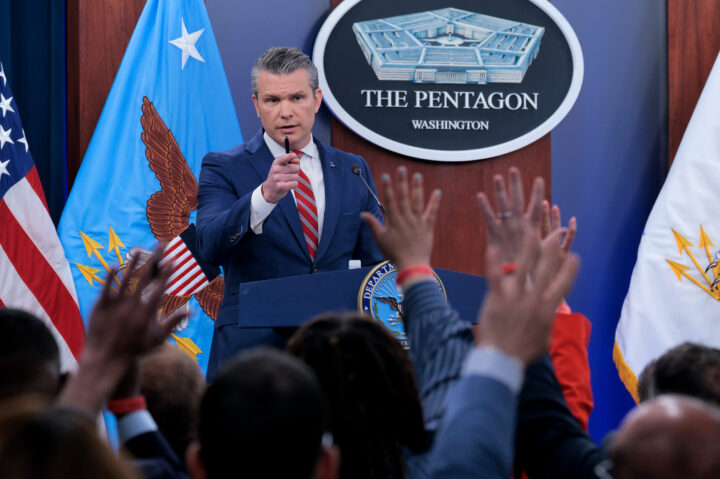
Secretary of Defense Pete Hegseth calls on reporters during a press briefing at the Pentagon on May 05, 2026 in Arlington, Virginia.
Defense Secretary Pete Hegseth said on Tuesday that the ceasefire between the U.S. and Iran was still in effect, despite numerous ceasefire violations by both sides in recent days.
“No, the ceasefire is not over,” Hegseth said during a press briefing at the Pentagon alongside Chairman of the Joint Chiefs of Staff Gen. Dan Caine. “Ultimately, this is a separate and distinct project,” Hegseth said of the new U.S. mission to escort commercial shipping vessels through the Strait of Hormuz, “and we expected there would be some churn at the beginning, which happened, and we said we would defend and defend aggressively, and we absolutely have.”
“Iran knows that, and ultimately, the president is going to make a decision whether anything were to escalate into a violation of a ceasefire. But certainly, we would urge Iran to be prudent in the actions that they take, to keep that underneath this threshold,” the defense secretary continued.
President Donald Trump announced on Sunday that U.S. forces would ensure the Strait of Hormuz is reopened to commercial traffic by escorting vessels and deflecting missile and drone attacks from Iran. Referring to the operation as “Project Freedom,” Trump warned on Monday that Iran would be “blown off the face of the earth” if the regime attempted to interfere.
Hegseth continued, “This is about the straits. This is about freedom of navigation. This is about international waterways. This is about free flow of commerce, all the things that happened before and that only Iran is contesting. So right now, the ceasefire certainly holds, but we’re going to be watching very, very closely.”
Caine said similarly that even though Iran has fired on commercial vessels nine times, seized two container ships and attacked U.S. forces more than 10 times since the ceasefire began, that is all “below the threshold of restarting major combat operations.”
Hegseth was pressed by reporters whether Trump was considering seeking congressional authorization to continue military operations in Iran, as many lawmakers believe the president has run out the 60-day clock for a war launched without congressional approval.
“Our view is … that ultimately, with the ceasefire, the [60-day] clock stops. If it were to restart, that would be the president’s decision. That option is always there, and Iran knows that, and that’s why their choices on freedom are important,” Hegseth said. “The president retains the opportunity and the capabilities — more capabilities than we have at the start of this — to restart major combat operations if necessary.”
Asked about alleged assertions by Israeli Prime Minister Benjamin Netanyahu and Mossad Director David Barnea that Israel would not abide by or participate in the ceasefires in Iran or Lebanon, Hegseth rejected claims that Israel was forcing the American president’s hand.
“I will say those questions are based on the false premise that somehow President Trump is being pulled in by Prime Minister Netanyahu to any of these actions,” Hegseth told reporters. “President Trump has led at every step of this based on his view of American interests and America First, and we’re grateful that Israelis have been very capable partners at many steps of this.”
“They may have some objectives at times that are slightly different than ours, but there’s only one hand on the wheel ultimately directing this, whether it’s Project Freedom or previously Operation Epic Fury, and it’s President Trump,’ he continued. “So we’re grateful for their input, their insights, the existential nature of the threat they face from an Iranian bomb, the capabilities that they can bring to that, but ultimately the coordination will happen with the leadership of President Trump.”
John Phelan was on Capitol Hill meeting with the leaders of the Armed Services Committee minutes before the Pentagon announced his dismissal on social media — a move that caught even Senate Majority Leader Thune off guard

Tasos Katopodis/Getty Images
Secretary of War Pete Hegseth and Secretary of the Navy John Phelan stand together as U.S. President Donald Trump announced the creation of the “Trump-class” battleship during a statement to the media at Trump’s Mar-a-Lago estate on December 22, 2025 in Palm Beach, Florida.
Defense Secretary Pete Hegseth did not give advance notice to senior Republican senators before announcing on Wednesday that he was firing Navy Secretary John Phelan and had already tapped his replacement, causing surprise and confusion on Capitol Hill.
“I found out about it the way everybody else did,” Senate Majority Leader John Thune (R-SD) told Jewish Insider of the Pentagon’s announcement on social media of Phelan’s dismissal.
Reached for comment, the Pentagon referred JI to Pentagon spokesperson Sean Parnell’s statement on X — the first public announcement of the news.
“Secretary of the Navy John C. Phelan is departing the administration, effective immediately. On behalf of the Secretary of War and Deputy Secretary of War, we are grateful to Secretary Phelan for his service to the Department and the United States Navy,” Parnell said on X. “We wish him well in his future endeavors.”
After taking part in White House meetings earlier Wednesday, Phelan was on Capitol Hill in the afternoon for a pair of pre-scheduled meetings, the first with Sen. Roger Wicker (R-MS), the chairman of the Senate Armed Services Committee, and the second immediately after with Sen. Jack Reed (D-RI), the committee’s ranking member. Phelan’s departure was posted to the Pentagon’s social media pages minutes after Phelan walked out of Reed’s office, a source familiar with the matter told JI.
A GOP senator on the committee who spoke to Reed and Wicker after the Pentagon announced Phelan’s immediate dismissal told JI that the topic of Phelan’s future in his role did not come up in either meeting, and that none of the three men was expecting such a move.
“This was a total surprise to Senate Republican leadership, to the two leaders of the Armed Services Committee and, clearly, to the secretary of the Navy himself,” the senator said.
Senators on the committee privately expressed concern to JI over Phelan’s firing, which comes amid as the U.S. is maintaining a naval blockade of Iranian ports and has begun boarding Iranian-linked tankers around the world, with three U.S. aircraft carriers on station or en route to the Middle East.
“I mean, I’m sure there are going to be some questions asked about the reasons, etc.,” Thune told JI. “But hopefully the authorizing committee will get a briefing and be informed about some of these decisions.”
Prior to his role at the Defense Department, Phelan ran an investment firm and was a major fundraiser for President Donald Trump’s presidential campaign. Phelan and other administration officials had reportedly been clashing over how best to grow the U.S. shipbuilding industry, a longtime challenge, though Phelan has heralded his own close relationship with Trump.
Hegseth’s term has also been marked by ongoing friction with other senior officials in the department, including Army Secretary Daniel Driscoll, and the firings of multiple top officials. Hegseth fired Army chief of staff Gen. Randy George earlier in April.
Phelan is being replaced by Under Secretary of the Navy Hung Cao, a former House and Senate candidate in Virginia.
Please log in if you already have a subscription, or subscribe to access the latest updates.
 Continue with Google

 Continue with Apple