














































































In a statement, the caucus said the speaker selection ‘sent Jewish students a clear message that they were not welcome’
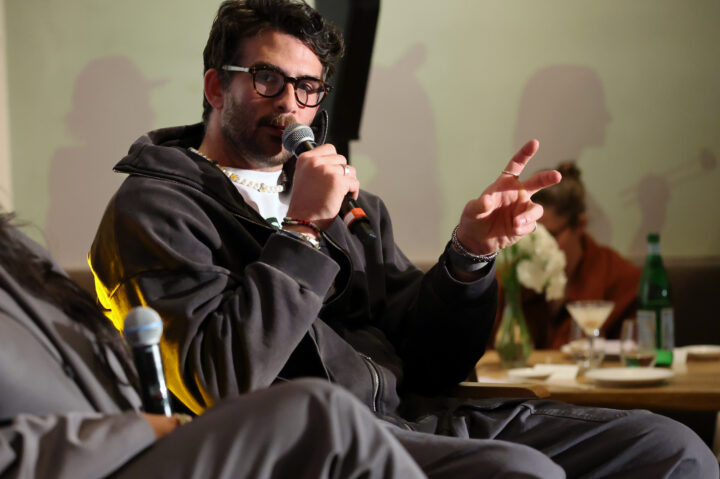
Amy Sussman/The Hollywood Reporter via Getty Images
Hasan Piker speaks during The Hollywood Reporter Creators A-List Dinner presented by Facebook at Matsuhisa on October 15, 2025 in Beverly Hills, California.


 Add JewishInsider on Google
The College Democrats of America’s decision to platform far-left, antisemitic influencer Hasan Piker at its recent conference was “a direct threat to Jewish safety and inclusion,” the group’s Jewish Caucus said on Tuesday.
Piker, who has a long-standing history of antisemitic rhetoric — including justifying Hamas’ Oct. 7, 2023, terrorist attacks, calling Orthodox Jews “inbred” and asserting that America deserved 9/11 — was announced on Friday as the convention’s “surprise speaker,” just hours before it began. CDA is the official collegiate arm and student outreach branch of the Democratic National Committee
In his speech on Saturday, Piker distanced himself from the mainstream wing of the Democratic Party, condemning “Democrats who compromise, who conciliate and who betray us,” to loud applause. “No more to the Democrats who collaborate and cooperate with the fascists, who will fund ICE, who will fund Israel … we don’t need those Democrats anymore,” Piker said.
“The normalization of Piker and his rhetoric in CDA-sanctioned programming is a direct threat to Jewish safety and inclusion within the College Democrats community,” the CDA Jewish Caucus said in a statement. “Elevating Piker at this convention sent Jewish students a clear message that they were not welcome.”
“The same standard CDA would rightly apply to bigotry on the right must also be applied within our organization,” the statement continued.
According to the caucus, attendees were prevented from conducting a walkout during Piker’s appearance by national board members, who cited security concerns. Delegates from at least one state were advised not to post photos with Piker on official accounts to avoid further controversy, the caucus said.
The caucus called on CDA’s national leadership to issue a formal apology for platforming Piker and for restricting members from exiting the room. The group also urged the CDA to commit to ongoing dialogue with all caucuses, including the Jewish Caucus, regarding future programming.
J Street U, the student organizing arm of J Street, was a sponsor of the convention, though the group told Jewish Insider it had no role in speaker selection.
Neither the CDA nor the DNC responded to requests for comment about their decision to invite Piker.
IDF spokesman says Israel thwarted an Iranian plan for a larger missile attack on the largest city in southern Israel

IDF
The site of an Iranian ballistic missile strike in Beersheba, Israel, June 20th, 2025.
An Iranian missile struck Beersheba, the largest city in southern Israel, for the second consecutive day on Friday, hours after President Donald Trump said he would decide in the next two weeks whether to join Israel in striking the Islamic Republic.
The IDF unsuccessfully attempted to intercept the surface-to-surface missile from Iran, which injured seven and left a crater at the blast site and damage to buildings in the area of Beersheba’s HiTech Park.
One of the sites reportedly damaged was Microsoft’s office in Beersheba, which the Islamic Revolutionary Guard Corps claimed worked in “close collaboration with the Israeli military” and was “part of the system supporting aggression, not merely a civilian entity.”
Beersheba Mayor Rubik Danilovich said, “There is extensive damage, but people acted according to Home Front Command instructions” — to enter safe rooms and shelters — “and saved themselves. Our challenge is to collect the residents and find them solutions. We prepared for this.”
Some of the residents wounded by the blast were evacuated to Soroka Medical Center, the hospital in the city where an entire wing was destroyed by a missile a day prior. That wing was older and, unlike other areas of the hospital complex, not reinforced to protect from attacks.
Hours before the strike on Beersheba, the IDF shot down an Iranian drone near the Dead Sea.
But in most parts of the country, Israelis had their first quiet night in a week, with no sirens interrupting the sleep of residents of central or northern Israel.
White House Press Secretary Karoline Leavitt said on Thursday that President Trump would take up to two weeks to decide if the U.S. will join Israel’s operation against Iran. Key components of Iran’s nuclear program are in a facility in Fordow built under a mountain, and experts said Israel does not have the capability to destroy it from the air, while the U.S. has Massive Ordinance Penetrators and B-2 heavy stealth bombers, which are thought to be have the capacity to destroy it.
“I have a message directly from the president, and I quote, ‘Based on the fact that there’s a substantial chance of negotiations that may or may not take place with Iran in the near future, I will make my decision whether or not to go within the next two weeks,'” she said at a White House briefing.
“He’s been very clear,” Leavitt stated. “Iran went for 60 days when he gave them that 60-day warning without coming to the table. On day 61, Israel took action against Iran. And as I just told you from the president directly, he will make a decision within two weeks.”
Israel struck the Lavizan area of Tehran late Thursday night. Earlier this week, opposition news outlet Iran International reported that Iranian Supreme Leader Ali Khamenei was underground with his family in Lavizan.
In the early hours of Friday morning, the IDF struck Rasht, a town near the Caspian Sea in northern Iran, and the location of a technological park. The IDF sent residents an evacuation notice before the strike, saying that it plans to “attack military infrastructure” in the area.
Over 60 IAF aircraft attacked dozens of targets in Iran overnight, including “an essential component for nuclear weapons,” IDF Spokesperson Effie Defrin said in his daily briefing on Friday.
Defrin said that Iran had planned a larger attack on Beersheba on Friday morning but Israel thwarted that plan, destroying three primed launchers. “Prior to launch, we detected the deployment of three launchers that were ready to fire, as seen on the screen, and we neutralized them,” Defrin said.
Israeli aircraft struck production sites for missiles and missile components, as well as radar installations and a weapons research and development center in Tehran, the IDF Spokesperson’s office said.
Asked about reports that the IDF is running low on interceptors, Defrin explained that the more missile launchers Israel strikes in Iran, the fewer interceptors it will need in Israel.
The International Atomic Energy Agency reported on Thursday that Israel caused severe damage to Iran’s heavy water reactor in Khondab, used for research. IAEA Director Rafael Grossi said he did not expect any radiological consequences.
Please log in if you already have a subscription, or subscribe to access the latest updates.
 Continue with Google

 Continue with Apple