














































































The app, built by a Jewish founder drawing on his upbringing, lets users block distracting apps for one day of the weekend

Clara Margais/picture alliance via Getty Images
A person looks out to sea on a windy day on Mallorca's Es Carnatge beach in Palma.


 Add JewishInsider on Google
A new app called Sabbath is selling an ancient pitch to a modern, phone-addicted crowd: lock technology away for one sacred day a week.
The app, launched earlier this month by Dig Wells — the makers of the reading app Matter and the habit tracker Halo — is designed to help users unplug from sundown to sundown on either Saturday or Sunday. Users pick the apps they wish to block at no cost, while a paid tier adds custom weekday blocks, such as a daily 5-7 p.m. family time or an hour for morning meditation.
Founder Ben Springwater told Jewish Insider the app draws inspiration from Shabbat. “I’m Jewish and I grew up celebrating Shabbat with my family,” he said. His family didn’t keep a strict Sabbath — they drove and used electronics — but Friday night dinner and prayers was “a cornerstone of my life growing up” and “a way to anchor the week,” he recalled. Springwater has since built a similar Shabbat practice with his wife and two young children.
“I have a startup, I work hard and I’m always online. I’m on X a lot. I’ve increasingly been feeling like I need a way to introduce some boundaries and a little bit of rest and recovery into my life,” Springwater told JI.
He said that notion drew him to the idea of observing Shabbat beyond a Friday night meal —- though he wasn’t ready to go full in.
“I like having my phone with me on the weekends and being able to communicate with my friends,” said Springwater. “I don’t want to create impositions that don’t allow me to enjoy the day. But I don’t want to be checking X when I’m out at the park with my family. The rule that I created for myself was no X and no work apps, the ones I compulsively want to turn to.”
Already, there were several popular apps on the market that have built businesses around tracking screentime and helping people block distracting social media. There are also physical devices, such as Brick, that disable apps of a user’s choosing.
“We didn’t want to just add another stone to the pile, but I had gone on my own journey with the Sabbath and saw there was something very simple, powerful and easy about this ancient system of taking one day of rest. So what if we created an app totally oriented around that practice?” said Springwater.
The name Sabbath “popped to mind immediately,” he told JI. “We did talk about how explicitly we want to make this app about religion. Where we came was that we want to connect with the religious tradition. There should be religious undertones but we don’t want to make it denominational.”
The Sabbath app — which Springwater calls “Shabbat with training wheels” — offers an accessible experience for everyone from culturally observant Jews to wellness enthusiasts who may miss the Jewish reference.
“It helps someone who is Sabbath-curious but can’t make that big of a commitment,” said Springwater. “It’s trying to make a bigger tent, get more people to experience some of the benefits and virtues of what Shabbat offers.”
Springwater’s idea has received support even from Jews who already keep Shabbat.
“The world of technology continues to evolve and change at breakneck speeds,” said Rabbi Mordechai Lightstone, the director of Tech Tribe, a New York-based affiliate of Chabad Young Professionals that serves as a gathering place for Jews working in the tech sector. “Even while the trajectory it propels us into continues to remain unknown, I firmly believe that as a society we are capable of using tech — be it social media, AI or whatever else comes our way — for positive and uplifting purposes.”
“But to do that, it’s critical that we align our own internal system with positive and redemptive forces,” Lightstone told JI. “Taking a break from the digital distractions that surround us, as Ben’s App Sabbath encourages, is a key step towards recentering our inner algorithm around the core values that we need to properly channel technology: Community, family, study and meaningful spiritual connection — to very literally touch grass.”
The launch of the Sabbath app arrives just as observing a weekly day of rest — whether Jewish or Christian — has recently gained viral popularity.
Facing terminal stage 4 pancreatic cancer, former U.S. Senator and University of Florida President Ben Sasse shared in recent interviews that he regrets not better honoring the Christian Sabbath. Supermodel Karlie Kloss, who converted to Judaism before marrying businessman Joshua Kushner, shared on a recent podcast that she does not drive or touch her phone on Shabbat. Outside of the religious sphere, tech entrepreneur and longevity biohacker Bryan Johnson frequently posts on X about digital minimalism, advocating for multi-day phone and social media fasts to improve health.
Springwater said the role of his app is not to offer community or shape how people spend their time, but it does include a feature where users can add “friends,” the equivalent of Facebook connections, in order to create some accountability and mutual support.
If a user wants to check Instagram while using Sabbath, they open the app and press “pause,” which requires them to type in a reason. “It introduces this friction so you can’t just open it in the heat of the moment, but you can still do it. There’s a balancing act, you don’t want to make it so impossible because in some cases someone might have to circumvent it,” said Springwater.
“The reason that you type in to end your Sabbath is then visible to your ‘friends’ on [the app]. At the end of Sabbath, you can see if someone had a perfect Sabbath or if they took two breaks. The social features are for accountability and support but they don’t facilitate some sense of community on the Sabbath,” he said.
Springwater said that while fighting antisemitism by building cultural bridges was not the original goal for his app, that idea has grown on him since its launch.
“One of the things that is so hopeful to me about the Sabbath is how crosscutting and universal it is. I’ve observed that a lot of different types of figures across the religious and cultural spectrum have been resonating with this idea. You can come at it with a very explicitly religious value system or a more secular value system, but you can find common cause in what this practice has to offer,” he said.
“There are very few things that so many different types of people can agree on and think is a good thing and all get behind,” continued Springwater. “The World Cup was one of them — it feels like the practice of Sabbath is another.”
The Well — named for the biblical story of Eliezer finding Isaac’s wife, Rebecca — combines the best of matchmakers and technology, founder Erica Schwartz told JI
Liri Agami
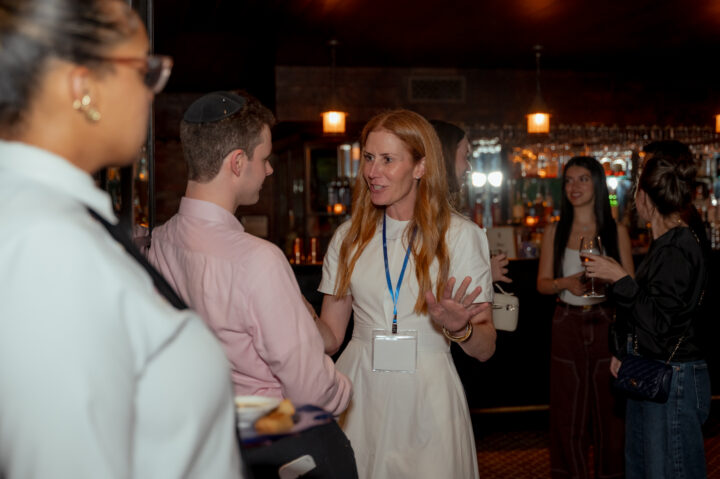
Erica Schwartz mingles with prospective users of The Well at the app's launch event on July 278, 2028, in Manhattan.
When the biblical Abraham sought a wife for his son Isaac, he dispatched his trusted servant to the city of Nahor in Mesopotamia. The servant, Eliezer, stopped at a well and prayed for a sign: the right woman would offer water not just to him, but to his camels as well. Rebecca did exactly that — and became Isaac’s match.
That story now has a modern namesake. A new dating app called The Well, slated to launch in the coming weeks, exclusively matches Jewish day school alumni. It’s aiming to fill a void for the very affiliated Jews searching for their bashert but tired of swiping.
“As I started to watch the way the world — at least in my Modern Orthodox circle — was meeting or not meeting each other, something felt very broken to me,” Erica Schwartz, the app’s founder, told Jewish Insider on Tu B’Av, the Jewish holiday of love, which began at sundown on Tuesday.
“Back in my day, we’d go to a synagogue and you’d meet and mingle outside and somebody might give you a call. Now everything is through a matchmaker and people aren’t meeting in person so everything is moving to more formal apps or shidduch résumés.”
Schwartz graduated from the Modern Orthodox Ramaz School on Manhattan’s Upper East Side, where she now serves as board chair. She also sent all six of her children to Jewish day schools. She said the aforementioned methods of dating were not “speaking to what I look at as this large middle niche I’m putting under the banner of the day school crowd, where they have a Jewish background and identity so they’re not a random Jew out there on a dating site, and they’re also not the ultra-Orthodox dater who is going to, through a matchmaker, go on six dates and then get married.”
“In that middle camp are all these day school graduates who are looking to meet somebody,” continued Schwartz. “It seems like such a natural place of overlap and connection, they just need to become aware of each other. That’s what The Well is trying to do — build a niche area of Jewish dating.”
Unlike mainstream dating apps — including other Jewish ones — known for endless swiping, The Well features no swiping at all, which makes it feel more personal, said Schwartz. She describes the platform as “human intuition and wisdom working in tandem with technology.”
The Well enters a crowded field of established Jewish dating apps — swipe-based JSwipe, application-only Lox Club and older-skewing JDate. But it’s betting that its swipe-free, day-school-verified niche can reach daters that those other platforms don’t.
Users, who must be in their 20s and 30s, begin by filling out a profile form. The first thing they’re asked to note is the day school they attended and year of graduation. Day school graduates of all backgrounds — from pluralistic to yeshiva — are welcome to join, but users must submit two names of people who can vouch that they attended that school. “That’s our current verification system. We need to see how that works and are prepared to tighten it a bit,” said Schwartz.
The profile form then prompts users to speak with a chatbot named Elli — a nod to Eliezer from the biblical story.
Elli is trained to ask follow-up questions in nuanced ways and pick up the user’s personality, said Schwartz. It asks users to describe their religious beliefs, share their profession and include key dating details like height preference or college alma mater.
Users also have the option to fill out the form manually, but Schwartz said taking advantage of Elli is preferred.
The Well also offers a small, vetted cohort of matchmakers if users wish to open their profile to them. Daters can also book an individual phone session with a matchmaker for $180, but otherwise the app is entirely free of charge.
A team of about a dozen advisors and matchmakers has been involved since the app’s inception, including two Modern Orthodox rabbis: Rabbi Elie Weinstock, senior rabbi of the Jewish Center of Atlantic Beach on Long Island, and Rabbi Daniel Kraus, director of community education at Congregation Kehilath Jeshurun in Manhattan.
“The future of Jewish dating isn’t choosing between technology and people,” Kraus told JI. “It’s combining the best of both. There are many excellent dating apps today. But no single platform can serve every community equally well. Every week I meet remarkable young adults who are ready to build Jewish homes, yet many still struggle to meet the right person. The challenge isn’t a lack of commitment. It’s creating meaningful opportunities for the right introductions.”
“The Well’s model is especially compelling because it pairs the scale and intelligence of technology with the wisdom, intuition and personal touch of experienced shadchanim [matchmakers],” continued Kraus. “Technology broadens the possibilities. People bring the judgment that no algorithm can fully replicate.”
The name itself, said Kraus, is “deeply rooted in Jewish tradition.”
“Throughout Tanach, wells are places where lives change,” he said. “Rivkah, Rachel and Tzipporah each met their future spouse at a well. While the platform is new, the mission is timeless: to help more young Jews find one another and build the next generation of Jewish families.”
The Well features two levels of profiles: public and private. The private one is only seen by Elli or a matchmaker. There’s also a dashboard where matchmakers can discuss the profiles of their clients so they can make suggestions in addition to the ones Elli makes.
Names are drawn for users every Monday and Thursday — the days biblical Jews traditionally went to the market — and they have a certain amount of time to respond; they can say “pass” or can choose to start a conversation. They can also share someone’s profile with another user in their “village,” which is the equivalent of Facebook friends.
“Some of that we’re fine tuning to make sure we’re not infringing on privacy,” said Schwartz, adding that the platform uses vanishing pictures to ensure profiles aren’t screenshotted and sent around.
Since dating apps first launched in the 2010s, they have instantly put hundreds of profiles at users’ fingertips, making them the favored method for nearly half of Americans looking for love, according to a Forbes Health survey. But apps that claim credit for matches made five or ten years ago now face user burnout, with many people saying they prefer to meet in person rather than swipe through an endless pool of potential mates. Seventy-eight percent of users report dating app burnout, according to another Forbes survey conducted last year.
Addressing this, Schwartz said The Well also features an events section of the app that will advertise social gatherings for this demographic across the country. She described that as a “crucial” component.
Before officially going live, The Well hosted an invitation-only launch event Tuesday night at the swanky Bowery Hotel on Manhattan’s Lower East Side, timed to coincide with Tu B’Av, drawing some 200 young professionals eager to mingle and learn about the app.
“What makes The Well stand out is that it rejects the culture of infinite swiping and disposable connections,” Erez Kahan, a 35-year-old who works as a relationship manager in the family office space and attended the launch event, told JI. “Instead, by thoughtfully introducing just a couple of carefully considered matches each week, it encourages people to slow down, be present and give each connection the attention it deserves. It’s a refreshingly human approach — one that values individualized care, quality over quantity and genuine intention over endless choice.”
Kahan, a graduate of The Frisch School, a Modern Orthodox school in New Jersey, said he’s particularly drawn to the symbolism behind The Well’s name — something he expressed hope to experience through the app: “A chance meeting at a well became something guided by purpose rather than endless searching.”
We’ve built an app to bring you the latest news as we report it out, and it’s now available for you to download.
You’ll find the Daily Kickoff each morning and our reporting throughout the day — the same journalism you already read, now in an app built for your phone.
Open it and read. The Daily Kickoff and our reporting are free.
Want more? A paid subscription opens up the rest: What We’re Watching, our live briefing that updates throughout the day as stories develop; the Daily Overtime, our end-of-day briefing; exclusive election coverage; audio of our reporting; and the Weekly Print. If you’d like to become a paying subscriber, find out more at JewishInsider.com/Subscribe.
Download the app in the App Store or Google Play. Don’t wait for tomorrow’s Daily Kickoff to find out what happened today.
Please log in if you already have a subscription, or subscribe to access the latest updates.
 Continue with Google

 Continue with Apple