






































































American Priorities’ spending has aided two Democratic Socialists of America-backed House hopefuls while drawing scrutiny over contributions from GOP donors and AI investors
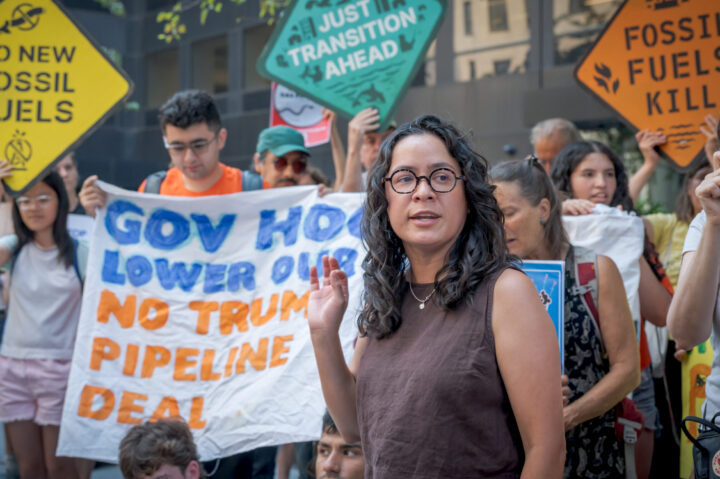
Erik McGregor/LightRocket via Getty Images
NY Assemblymember Claire Valdez


 Add JewishInsider on Google
American Priorities, a new super PAC created as a progressive counterweight to pro-Israel spending in Democratic primaries, has drawn scrutiny in recent weeks for accepting contributions from donors who have given to Republicans — even as its allies on the far left have accused AIPAC, a chief rival, of serving as a Trojan horse to advance GOP-linked interests in safe blue districts.
Meanwhile, filings show that the anti-Israel group has received $250,000 from a tech executive whose firm is developing AI data centers in New York State. That money has boosted two democratic socialist House candidates in New York City who oppose efforts to expand data centers.
Claire Valdez, a state assemblymember running to succeed retiring Rep. Nydia Velazquez (D-NY), and Darializa Avila Chevalier, an anti-Israel activist who is challenging Rep. Adriano Espaillat (D-NY), have benefited from over $2 million in estimated support from American Priorities in the final stretch of their closely contested primaries set for next Tuesday.
But the source of the group’s spending has not neatly aligned with the values its preferred candidates have promoted during their campaigns, underscoring the degree to which American Priorities has become a liability as well as a financial lifeline while emerging as a dominant player in the midterms.
Both Valdez and Avila Chevalier, for instance, have advocated for a federal moratorium on AI data center construction — despite the significant contribution to American Priorities from Nazar Khan, the co-founder of TeraWulf, a bitcoin mining company pivoting to AI infrastructure development. The firm is now pressing to move forward with proposed construction of an AI data center in New York’s Finger Lakes region, which has faced local opposition from residents questioning its environmental impact.
TeraWulf is also in the process of expanding another data center in western New York that “is expected to rank among the largest” facilities of its kind in North America, according to a February press release.
Khan did not respond to a request for comment from Jewish Insider, nor did campaign representatives for Valdez or Avila Chevalier.
Brad Lander, the former New York City comptroller mounting a challenge to Rep. Dan Goldman (D-NY), has also said he favors an AI data center moratorium. American Priorities has indicated that it would spend on his behalf as part of a multimillion-dollar pledge to elevate Mayor Zohran Mamdani’s endorsed slate of far-left House candidates, but it has yet to do so as it has focused on Valdez and Avila Chevalier, who are also backed by the Democratic Socialists of America.
The anti-Israel group has helped elevate a range of House candidates on the left this election cycle. But its aggressive spending in New York City has stoked backlash, particularly in light of its small handful of donors who have also given to far-right Republicans such as former Rep. Marjorie Taylor Greene (R-GA) and recently ousted Rep. Thomas Massie (R-KY).
For his part, Espaillat, a veteran incumbent backed by AIPAC, has accused Avila Chevalier of accepting support from “a millionaire in Texas” who “funded [Texas Gov.] Greg Abbott,” a reference to Hussein Mahrouq, who has contributed $525,000 to American Priorities in recent months.
Avila Chevalier, who vows to ban super PAC money from elections on her campaign website, has denied knowledge of American Priorities’ spending, though she has not discouraged the group from engaging in her primary.
“I control my campaign and the money that my campaign receives,” Avila Chevalier, whose past inflammatory social media posts have featured in attack ads from pro-Espaillat groups, said recently.
Meanwhile, Brooklyn Borough President Antonio Reynoso and City Councilmember Julie Won, who are both facing Valdez in the primary in the 7th District, teamed up in a joint statement last week to accuse their opponent of reneging on her pledge to reject super PAC spending.
“Claire has turned what should have been a race about our records and vision for the people of Brooklyn and Queens into a Super PAC-driven negative election,” Reynoso and Won wrote.
Valdez, who has sought to highlight small-dollar donations, has cautiously justified the super PAC investments as a response to heavy spending from the AI and crypto industries as well as AIPAC. “The way that some people are countering that is by also spending money,” she said last week.
Earlier this week, Valdez drew criticism for falsely speculating that AIPAC was behind a newly formed super PAC, Real Fight NYC, that is spending to boost Reynoso’s campaign. But AIPAC’s super PAC, United Democracy Project, said it had no involvement, while the American Federation of Teachers took credit for a large donation.
While AIPAC has been a regular source of attacks from Valdez and Avila Chevalier, the group’s super PAC has not been directly involved in their primaries.
A top donor to American Priorities PAC, which has backed far-left Democratic candidates, has donated to Marjorie Taylor Greene, Thomas Massie and Greg Abbott

Drew Angerer/Getty Images
Rep. Marjorie Taylor Greene (R-GA) departs a closed-door GOP caucus meeting at the U.S. Capitol January 10, 2023 in Washington, DC.
A recently launched super PAC positioning itself as a progressive counterweight to AIPAC’s involvement in Democratic primary elections has accepted financial contributions from a number of individuals who have also donated to Republicans, campaign filings show.
The financial support for American Priorities PAC, created in February, has come even as AIPAC and its super PAC have faced backlash from critics on the left who accuse it of meddling in Democratic primaries as a sort of front group for GOP-funded attacks against anti-Israel candidates in safely blue districts.
AIPAC’s super PAC, United Democracy Project, has taken far more from GOP-linked donors than its new rival, American Priorities — now funded largely by a handful of deep-pocketed contributors. UDP supports both Democrats and Republicans.
But American Priorities, which has thus far only supported Democrats and pledged to spend at least $10 million during the midterms, has not acknowledged that the source of some of its funding is from donors who have at the same time given to GOP candidates and groups — and more extensively than previously reported.
A spokesperson for American Priorities did not respond to a request for comment about whether the group is comfortable with such financial support and how it views the donations in relation to AIPAC’s own pro-Israel fundraising.
American Priorities, which has raised $5.4 million thus far, has sought to mimic AIPAC’s playbook of spending aggressively in progressive congressional districts to elect its preferred primary candidates. The new group is investing significantly in New Jersey’s 12th District race on Tuesday on behalf of Adam Hamawy — a plastic surgeon who opposes all U.S. aid to Israel and whose past ties to a convicted terrorist mastermind as well as a now-shuttered al-Qaida-linked group in Bosnia have drawn scrutiny in the final weeks of the election.
The super PAC has vowed to spend around $2 million by the end of the crowded primary — where Hamawy has been surging — and it recently reached $500,000 in another race in California boosting Randy Villegas, a progressive critic of Israel running for a red-leaning seat held by Rep. David Valadao (R-CA), who is endorsed by AIPAC.
Those investments have been fueled, most notably, by at least $525,000 from Hussein Mahrouq, a Texas businessman who has backed far-right Republicans including the recently ousted Rep. Thomas Massie (R-KY) and former Rep. Marjorie Taylor Greene (R-GA), both of whom have been accused of using antisemitic tropes about Jews and Israel.
In 2024, Mahrouq, one of the top contributors to American Priorities, also gave $100,000 to boost Texas Republican Gov. Greg Abbott and donated $25,000 to Republican Lt. Gov. Dan Patrick, state filings show.
Meanwhile, American Priorities accepted a $5,000 contribution from Omar Khawaja, a personal injury lawyer in Houston, who in March donated to a super PAC supporting hard-right Texas Attorney General Ken Paxton, who won last week’s GOP primary run-off in the state’s closely watched Senate race. Khawaja has also contributed to a Republican House candidate in Texas as well as Massie, who is among the most vocal critics of Israel in the GOP congressional caucus, according to filings.
Moiz Ali, an entrepreneur and investor in Texas who gave $150,000 to American Priorities in March, also donated to Massie last fall — shortly before he drew a challenger, Ed Gallrein, who defeated the libertarian congressman earlier this month with the backing of President Donald Trump. AIPAC also spent heavily against Massie, a top target of the group this cycle.
Another American Priorities donor, Nadeem Baig, a gastroenterologist in New Jersey who gave $50,000, has previously contributed to former Sen. Ben Sasse (R-NE), former Rep. Leonard Lance (R-NJ) and Rep. Darin LaHood (R-IL), all of whom have been known as staunch supporters of Israel. LaHood is backed by AIPAC, while Lance served as a co-chair of the House Republican Israel Caucus before he was unseated in 2018.
In a statement shared with Jewish Insider by a spokesperson for Mahrouq, he called himself “an independent businessman, not affiliated with any political party,” and said that his “support has always been guided by what I believe is in the best interest of the United States, its economic strength, security and long-term prosperity.”
“I have supported individuals and organizations across the political spectrum when their positions align with those priorities,” he continued. “My focus is not partisan politics, but rather promoting policies that strengthen America, encourage opportunity, and serve the interests of American citizens. I believe decisions affecting our country should be made based on what is best for the United States, independent of pressure from any foreign government, foreign interest group or partisan agenda.”
Mahrouq was the only American Priorities donor reached for comment by JI who shared a response.
The contributions to Massie and Greene in particular suggest anti-Israel sentiment can transcend partisan boundaries, in the way pro-Israel advocacy has been seen as a bipartisan effort connecting Democrats and Republicans.
Still, American Priorities has only backed Democrats, while AIPAC has championed bipartisan advocacy — even as it has stirred controversy over its engagement in Democratic races that show the group is navigating mounting hostility toward Israel from candidates and elected officials.
American Priorities is led by Hannah Fertig, a strategist with ties to Sen. Bernie Sanders (I-VT) and the far-left group Justice Democrats, which also gave to the super PAC and is likewise backing Hamawy in his primary on Tuesday. “We want our foreign policy views to reflect where the Democratic base has moved, particularly on Gaza, and on unconditional U.S. military to Israel,” Fertig told Semafor in March following the group’s launch. “We’re seeing this as a generational inflection point, and we launched because there’s a huge gap in the progressive spending ecosystem.”
Please log in if you already have a subscription, or subscribe to access the latest updates.
 Continue with Google

 Continue with Apple