














































































Jewish organizations across the political spectrum question whether the deal will curb Iran’s nuclear program or its support for regional proxies
Tom Williams/CQ-Roll Call, Inc via Getty Images
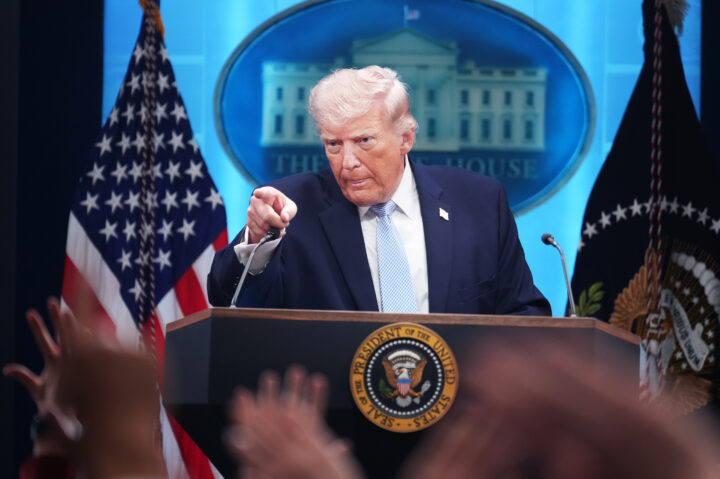
President Donald Trump conducts a news conference in the White House briefing room about the war in Iran on Monday, April 6, 2026.


 Add JewishInsider on Google
As details begin to emerge about the Trump administration’s agreement with Iran to end the war and lift the U.S. blockade of the Strait of Hormuz, some mainstream Jewish organizations are treating the deal as a preliminary step — focusing on the 60-day negotiating period ahead, while others are expressing skepticism about the contours of the agreement.
AIPAC, in a statement that came late Monday afternoon after many other organizations had already spoken out, framed the current MOU as a preliminary step, focusing more on the upcoming negotiations, while emphasizing the need for more details about how the current deal affects Israel.
“The announced MOU kicks off a new 60-day window for talks. We look forward to learning the full details of the framework for these negotiations, including whether the deal preserves the sovereign right of our democratic ally Israel to respond to the security threats it confronts,” AIPAC said in a statement.
The group also emphasized that “Congress will play a critical role in working with the administration throughout these negotiations and in reviewing the ultimate agreement.”
It said any deal should require the removal of all enriched uranium from Iran, the dismantling of its enrichment capacity and should address Iran’s missile and drone programs and end its support for terrorist proxies.
The American Jewish Committee also did not take a definitive position on the current agreement, saying on X that the organization “await[s] developments about the reported 60-day ceasefire agreement” but emphasized the need to continue to focus on Iran’s long-running threats.
The AJC said that any ultimate deal with Iran at the conclusion of the upcoming 60-day negotiating period should ensure Iran cannot obtain a nuclear weapon, rebuild its ballistic missile program, continue to support terror proxies, threaten U.S. allies and partners or hold the Strait of Hormuz hostage.
“AJC also strongly supports the legitimate aspirations of the Iranian people for greater freedom, opportunity and dignity, and hopes that those aspirations are eventually realized,” the statement continued. “As the contours of this and future agreements become more clear, we will continue to engage with our partners in the U.S., the Middle East, and around the world to make this vision a reality.”
Other groups offered a more directly negative reaction to the emerging details of the MOU.
The Zionist Organization of America, which has been strongly supportive of Trump administration policies and President Donald Trump himself, praised the president for carrying out military operations against Iran but said that “the pending deal with Iran is concerning.”
“The deal appears to be an ‘agreement to negotiate’ — which enables the Iranian regime to obtain massive oil revenue and time to build up its military and terror arsenals, while leaving the genocidal Iranian regime and its nuclear and missile stockpiles in place, and positioning the Iranian regime to continue and strengthen its 47-year war to destroy the U.S., Israel, and the West,” ZOA National President Mort Klein said. “[T]he little that we know is deeply problematic.”
Klein said it “makes no sense” for the U.S. to let up on its blockade of Iran unless Iran fully gives up its nuclear program and missile stockpile. He also expressed concerns that the deal will allow Hezbollah to regroup and rearm, and that Trump demanded that Israel stand down against Hezbollah.
“Pressuring Israel to not respond to threats of annihilation and attacks on her people is not, as the president called it, a ‘Great Deal [that] will bring Peace and Security to the whole Region,’” Klein said.
“Disturbingly, the interim Iran deal does not appear to be even close to the U.S.-Israel war goals of eliminating the existential dangers of Iran’s nuclear program and ballistic missiles, ending the Iranian regime’s support for its terror proxies, and helping the Iranian people overturn the brutal, genocidal Iranian regime,” he continued.
Democratic groups are also skeptical.
Democratic Majority for Israel CEO Brian Romick criticized the administration’s “incoherent and erratic strategy” and said that “there are concerning details about what is and isn’t in this deal.” Romick called on the administration to lean on “experienced negotiators and technical experts” in the next phases of talks, “rather than relying on friends, family, and donors.”
He said that any deal must permanently end Iran’s nuclear program, constrain its ballistic missiles, address Iran’s support for terrorism and ensure that the Islamic Revolutionary Guard Corps and Iran’s terrorist proxies do not receive additional support as a result of sanctions relief or the unfreezing of assets, and that it must be thoroughly vetted by Congress.
“Despite this tentative deal, the reality is Israel still faces constant threats from Iranian-backed terrorist groups like Hamas and Hezbollah. President Trump must not limit or interfere with our ally’s ability to defend itself from very real threats along its border,” Romick continued.
The Jewish Democratic Council of America’s CEO Halie Soifer took an even more strident tone.
“Donald Trump’s deal with Iran isn’t a deal at all. At best, it’s a statement of intention — a ‘concept of a plan’ — lacking details. At worst, it’s an admission of defeat by the United States,” Soifer said, describing it as a weaker deal than the 2015 Joint Comprehensive Plan of Action.
She argued that the “reckless war” gave Iran a “chokehold” on the U.S. and global economy that it will continue to exercise in the future, gave Iran a stronger hand in nuclear negotiations, solidified the current regime, harmed the Iranian people and gained the U.S. nothing.
“Today, Iran is unquestionably further from regime change — and this Iranian regime is stronger — than before the war,” Soifer said. “Trump repeatedly berated the Obama administration for offering sanctions relief and unfreezing Iranian assets as part of the JCPOA. The amount of financial benefit Iran received from the JCPOA will be dwarfed by the amount of money going to Iran following Trump’s defeat.”
Soifer also criticized Trump for sidelining and ignoring Israel throughout the talks.
J Street has thus far been an outlier in expressing support for the deal.
The group’s president, Jeremy Ben-Ami, said J Street “welcomes” the announcement, while also criticizing the war effort as a whole.
“The lesson is the same one many experts and former security officials have warned about for years: There is no sustainable military solution to the challenge posed by Iran’s nuclear diplomacy,” Ben-Ami said. “Durable constraints on Iran’s nuclear activities can only be achieved through pragmatic and sustained diplomacy.”
Ben-Ami argued that the deal would be largely similar to the JCPOA, adding, “We urge lawmakers to support this agreement to end the fighting and push to ensure future diplomatic efforts address the security threats presented by Iran.”
The Republican Jewish Coalition has not issued a full statement of its own on the deal, but has indicated support thus far, sharing on its X account two Truth Social posts from Trump about the Strait of Hormuz being reopened and the lifting of the U.S. blockade. RJC did not immediately respond to a request for comment.
Sen. Josh Hawley to JI: ‘We need to be really clear, and I say that not only as a conservative, but also as a Christian. There is no place for antisemitic hatred, tropes, any of that stuff’
Kayla Bartkowski/Getty Images
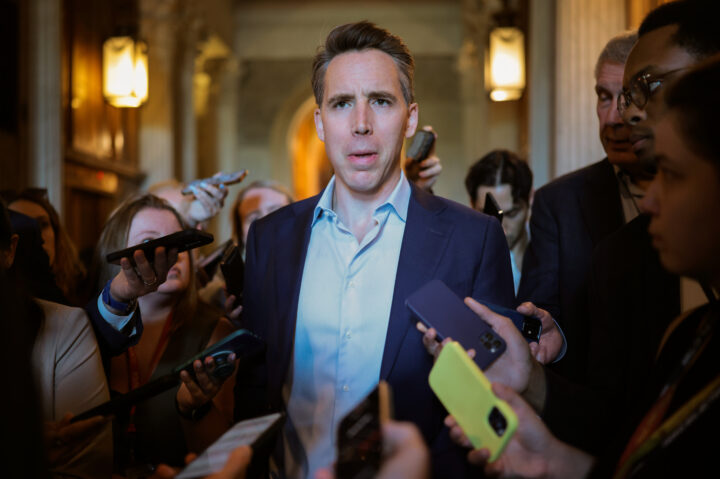
Sen. Josh Hawley (R-MO) speaks to the press on June 2, 2025 in Washington.
Sen. Josh Hawley (R-MO) warned on Monday against the mainstreaming of antisemitic figures within the conservative movement in response to Tucker Carlson’s platforming of neo-Nazi influencer Nick Fuentes.
Hawley, an ally of the national conservative movement who has advocated for the Trump administration to take an aggressive approach to combating campus antisemitism, made the comments while speaking to Jewish Insider about the controversy surrounding Fuentes’ appearance on Carlson’s podcast late last week.
“I just think on the substance of what he says, I mean, it’s antisemitic. Let’s just call it for what it is, let’s not sugarcoat it,” Hawley said of Fuentes.
“That’s not who we are as Republicans, as conservatives. Listen, this is America. He can have whatever views he wants. But the question for us as conservatives is: Are those views going to define who we are? And I think we need to say, ‘No, they’re not. No. Just no, no, no,’” he continued. “We need to be really clear, and I say that not only as a conservative, but also as a Christian. There is no place for antisemitic hatred, tropes, any of that stuff. I just think we’ve gotta say that stuff.”
The Missouri senator drew a parallel between the antisemitism seen at universities across the country since Hamas’ Oct. 7, 2023, attacks on Israel and Fuentes’ views.
“Do we really want to be part of what we’ve seen happen on college campuses, for instance, in this country in the last two or three years? Conservatives have been decrying that,” Hawley said. “Are we now to believe that, oh, actually, we have no problem with that? And that all of the things they were saying about Jews and Jewish Americans, that was fine? That’s not my view. I wasn’t fine with it then, I’m not fine with it now.”
“I thought it was morally repulsive then, I think it’s morally repulsive now. I’m not going to change my opinion on that. I want to be really clear: that’s above all a moral issue,” he added.
Hawley was not the only Republican senator to voice their objections to a GOP embrace of Fuentes or the avowed antisemite’s appearance on Carlson’s program.
The fallout now involves the Heritage Foundation, the result of its president, Kevin Roberts, coming to Carlson’s defense in a video last Thursday that called out the “venomous coalition attacking” Carlson and warned that “their attempt to cancel him will fail.” Roberts has since clarified that he and Heritage do not support Fuentes’ antisemitic views, though he refused to disavow him, and is facing growing calls to walk back his comments.
Sen. James Lankford (R-OK), the co-chair of the Senate antisemitism task force, told JI that he was “a little surprised that Heritage jumped out in support of [Carlson] and Nick Fuentes to say, ‘Hey, we want them in our camp’ after the statements that were made.”
“Heritage could have just sat back and not said anything, but instead, they chose to jump out on their side,” Lankford continued. “I don’t get that.”
He, like Hawley and other Republican lawmakers, warned that the right faces a similar crisis of antisemitism as is roiling the left if conservatives do not proactively confront and shun antisemites in their midst.
“The left has seen an implosion of their party based on antisemitism rising in their party. I don’t want to see the same thing on the right,” Lankford said. “To say the least, I want to make it very, very clear we are not the party of antisemitism. We’re not the party that believes Hitler was a good guy and that Winston Churchill was the bad guy. We’re not the party that blames media issues on the Jews and all these weird tropes that are out there. That’s not who we are, that’s not what we stand for, nor what we should stand for.”
He said that he does not understand the impulse to “allow it to be a big tent and allow antisemitism in our party. If there are [antisemites] that are there, we should call it out and say that’s wrong.”
“What I’ve tried to be very clear on is [that] the ‘New Right’ is now quoting an old wrong. It’s wrong,” Lankford continued.
Sen. Rick Scott (R-FL) offered a similar message.
“The Democrat Party — we already have a party that’s for antisemitism [and] is against Israel,” Scott told JI. “The Republican Party [is going to] stand for Israel and we’re going to stand against antisemitism. I don’t think there’s any question.”
Rabbi Yaakov Menken, the executive vice president of the Coalition for Jewish Values, told JI that Roberts’ message “was the most tone-deaf comment, in both its content and its timing, that I’ve ever heard from a major Washington organization on any political side.”
Menken resigned from Heritage’s Project Esther, the group’s antisemitism initiative, last week in response to Roberts’ video message defending Carlson. Along with Menken and CJV, several other groups have also publicly disaffiliated from Heritage’s antisemitism task force, including the National Jewish Advocacy Center, the Zionist Organization of America and Young Jewish Conservatives.
Amid political divisions over funding for the office, Jewish groups called on Congress to ‘provide the highest possible funding’ in 2025

Jemal Countess/Getty Images for JDRF
Committee chair Sen. Patty Murray (D-WA) and Senator Susan Collins (R-ME) greet witnesses and delegates from the 2023 JDRF Children's Congress prior to the Senate Appropriations Committee hearing on July 11, 2023, in Washington, D.C.
In a letter sent to key members of the Senate and House Appropriations Committees on Friday, a coalition of 23 Jewish groups, spanning a range of political and denominational positions, urged Congress to “provide the highest possible funding” in 2025 for the Department of Education’s Office of Civil Rights.
The widespread support for funding for the office, known as OCR, is notable given political divisions over the issue on Capitol Hill. Democrats critical of Republicans’ approach to combating antisemitism on campuses have emphasized calls for increased funding for the office. Some Republicans, meanwhile, have downplayed the need for additional funding for the office, often arguing that it has the resources it needs but must better prioritize antisemitism cases.
But calls for increased funding span the political spectrum. In the 2024 funding process, a bipartisan group of 51 lawmakers urged Congress to provide funding in excess of the administration’s budget request for OCR.
House Republicans sought to cut funding to OCR, the office responsible for investigating complaints of antisemitism on campuses, for 2024. Education Secretary Miguel Cardona has said the office’s staff are severely overstretched, with each staffer working 50 cases in light of a post-Oct. 7 surge in complaints.
OCR received $140 million for 2024, the same funding it received in 2023, falling $37.6 million below the administration’s request. The administration requested $162 million for OCR for 2025.
“It is Congress’s responsibility to ensure that OCR has the resources it needs to conduct immediate and robust investigations into these complaints. OCR cannot protect the rights, safety and wellbeing of students if it does not have adequate resources to appropriately investigate and respond to its increased caseload,” the letter reads.
The signatories include the Anti-Defamation League, Alpha Epsilon Phi Sorority, Alpha Epsilon Pi, American Jewish Committee, B’nai B’rith International, Combat Antisemitism Movement, Conference of Presidents of Major American Jewish Organizations, Hadassah, Hillel International, Jewish Council for Public Affairs, Jewish Federations of North America, Jewish Grad Organization, Jewish on Campus, Olami, National Council of Jewish Women, Rabbinical Assembly, Sigma Alpha Mu Fraternity, Sigma Delta Tau, StandWithUs, Union for Reform Judaism, Orthodox Union, Zeta Beta Tau Fraternity and Zionist Organization of America.
They include liberal, nonpartisan and conservative-leaning Jewish groups, as well as groups representing the Reform, Conservative and Orthodox denominations.
The groups, the letter states, “reflect the depth and breadth of American Jewish life [and] are united in asking your urgent support to combat growing antisemitism on university campuses.”
The letter highlights data showing that cases of antisemitism on college campuses have “skyrocketed” since Oct. 7, and that OCR is facing “a surge in reported cases” alongside a reported 10% reduction in full-time staff.
Please log in if you already have a subscription, or subscribe to access the latest updates.
 Continue with Google

 Continue with Apple