














































































GOP New York governor hopeful blasts Mamdani as ‘antisemitic’ and ‘anti-Christian’ but praises NYPD Commissioner Tisch

(Anna Connors - Pool/Getty Images)
New York Democratic gubernatorial candidate, current Gov. Governor Kathy Hochul and Republican gubernatorial candidate Bruce Blakeman face off in the only scheduled debate ahead of the November New York gubernatorial election at the Spectrum News NY1 studios on October 13, 2026 in New York City.


 Add JewishInsider on Google
Nassau County Executive Bruce Blakeman, the Republican candidate for New York governor, declined to back away from warnings he made at a weekend event in Brooklyn with Hasidic leaders about the threat of mass arson and sexual assault to their communities — but he specified that he expected the violence would come from anti-Israel protesters.
The New York Times first reported that Blakeman, himself Jewish, had suggested in a private meeting in Williamsburg on Sunday that New York City Mayor Zohran Mamdani would not intervene “if there is rioting here, if they’re burning down the yeshivas and your shuls, and burning down your house and raping your women.”
Pressed about the comments in a televised debate with Gov. Kathy Hochul on Tuesday, Blakeman did not deny making them, and clarified that the people he warned of were demonstrators of the sort that occupied colleges and other public spaces following Hamas’ attacks on Israel on Oct. 7, 2023, and the ensuing war in Gaza.
Bruce Blakeman blasted Mamdani as an "antisemite," and defended his comments that the mayor would not intervene "if there is rioting here, if they’re burning down the yeshivas and your shuls, and burning down your house and raping your women." Read more: https://t.co/EnsIDN1HrL https://t.co/ruVzsOyeiG
— Jewish Insider (@jewishinsider) October 14, 2026
“‘They’ are the professional protesters that took over Columbia University, that blocked our bridges and our roadways with the lawlessness that took place,” said Blakeman, asserting that Hochul had failed to adequately protect Jewish students.
But despite pointing to the campus activists who took part in the high-profile encampments, Blakeman also explicitly evoked the Crown Heights riots of 1991. The notorious racial clash saw numerous incidents of Black-on-Jewish violence after a vehicle in the motorcade of Lubavitcher Rebbe Menachem Mendel Schneerson struck two Black children, killing one.
Blakeman reiterated longstanding complaints that late former Mayor David Dinkins failed to adequately respond to the looting, murders, assaults and property damage.
“I’m talking about political leaders getting involved in law enforcement when they shouldn’t be, what happened under David Dinkins when he waited three days before he stopped the rioting in Crown Heights,” the Republican added.
Blakeman called Mamdani “antisemitic” and “anti-Christian,” and blasted Hochul for maintaining a close political relationship with the mayor.
Hochul, for her part, repeatedly hit Blakeman for rallying with President Donald Trump last week — and accused him of insulting the NYPD and New York City Police Commissioner Jessica Tisch. Hochul has been an advocate for the police chief, a member of one of New York’s most prominent Jewish families, since Tisch’s time in the administration of former Mayor Eric Adams.
“He had a secret meeting where he basically said that NYPD, under the leadership of Jessica Tisch, would not respond to this neighborhood if there are women being raped and people being murdered and riots in the street,” Hochul said. “He would not trust them to show up. I stand with the men and women in blue every day of the week. I know how hard they work. They put their lives on the line. And I support the leadership of Jessica Tisch.”
Blakeman himself quickly added that he was not referring to Tisch, and even lauded the mayor’s decision to retain her over the objections from the far left.
“I have a lot of confidence in Jessica Tisch — matter of fact, if there’s a compliment I could give to Zohran Mamdani, it’s in keeping her as the police commissioner,” Blakeman said.
The exchange took place after several days of demands from the DSA and top Mamdani allies that the mayor fire Tisch over the NYPD’s response to anti-Immigration and Customs Enforcement protests after a federal agent shot a man in Manhattan. Mamdani has so far rebuffed all such demands.
Former Boca Raton Mayor Scott Singer traveled with a delegation of U.S. mayors to Qatar where he met with the minister of municipality

Obtained by JI
Scott Singer in Qatar in 2024.
Former Boca Raton Mayor Scott Singer, the Republican candidate running against Rep. Jared Moskowitz (D-FL) in South Florida, traveled to Qatar in 2024.
Singer and Moskowitz have been battling over which one of them is the stronger and more reliable supporter of Israel, in a district with a substantial Jewish population that could be up for grabs in the midterm election.
Singer argues that Moskowitz is overpowered by the anti-Israel wing of the Democratic Party, while Moskowitz argues that he’ll be a more important voice as a prominent pro-Israel Democrat than Singer would be in the GOP.
According to the Gulf Times, Singer met and was photographed with Qatari’s minister of municipality, Abdullah bin Hamad bin Abdullah Al Attiyah, during a visit to the World Economic Forum with other mayors from around the U.S. The trip was first resurfaced by The Floridian.
“Scott Singer joined other mayors in a delegation for the World Economic Forum, at the same time a congressional delegation was there, meeting with our military at Al Udeid Air Base, the then-US ambassador, and other representatives from government and business,” Singer campaign spokesperson Michael Stwarka said in a statement to Jewish Insider. “He gained a better understanding of the complex relationship between our nation and Qatar, and their potential for influence in our educational system.
According to the the Gulf Times, the group “discussed avenues of cooperation between the Ministry of Municipality and the US cities in areas of shared interest, in addition to means of promoting them between the two sides, particularly smart cities and upgrading infrastructure, municipal services, agriculture, food security and waste management.”
Qatar has come under significant scrutiny in the Jewish and pro-Israel community since Hamas’ Oct. 7, 2023, attacks on Israel, given its support for and hosting of Hamas leadership. The kingdom has also been accused of stoking antisemitism on college campuses through its substantial financial support for U.S. colleges and universities.
Stwarka — the Singer spokesperson — said that, when elected, Singer “will introduce legislation that bans federal funding going to any educational institution that receives foreign funds from any foreign nation. … Scott will always be a steadfast supporter of our closest ally Israel and continues to be a strong voice against antisemitism.”
Moskowitz has been a vocal critic of Qatar, calling for accountability for the country’s support for Hamas.
It was not immediately clear who paid for the trip.
Another member of the mayors group photographed alongside Singer is Dearborn, Mich., Mayor Abdullah Hammoud, who has been accused of cultivating a hostile environment for Christian and Jewish residents of the city.
In one notable incident, Hammoud harangued a Christian pastor who spoke at a city council meeting against naming a street in honor of a local publisher who had expressed support for terrorist groups, with Hammoud telling the pastor he was Islamophobic and “not welcome” in the city, adding, “The day you move out of the city will be the day I launch a parade celebrating the fact that you moved out of the city.”
“Scott Singer does not share all the views of all who attended,” Stwarka said in the statement to JI.
While Republicans are now rejoicing over their narrow win, it otherwise largely demonstrated how Democratic leaders effectively sacrificed the seat to the GOP rather than elevate an extremist member of their own party
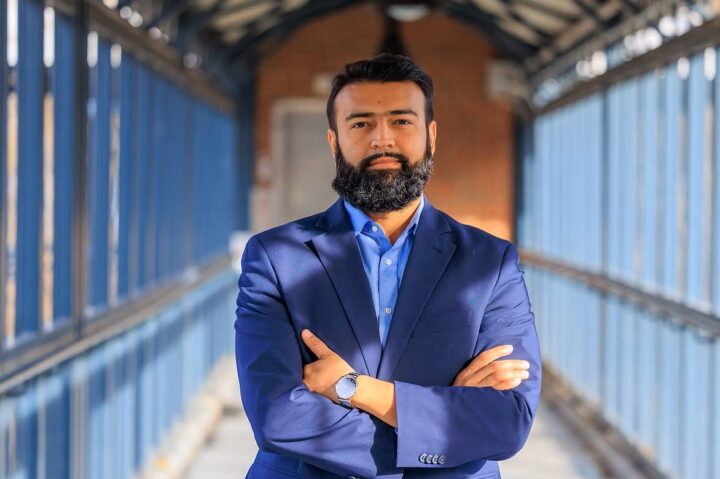
Muhammed Casim's campaign page
Muhammed Casim
In a low-profile electoral upset that defied the difficult national political environment facing the GOP, a Republican candidate declared victory this week in a down-ballot race for a seat on the Prince William Board of County Supervisors in Virginia — for the first time in nearly 40 years.
But while Republicans are now rejoicing over their narrow win, it otherwise largely demonstrated how Democratic leaders effectively sacrificed the seat to the GOP rather than elevate an extremist member of their own party who had claimed the nomination.
The result underscored the extent to which local Democrats had swiftly mobilized to oppose their own nominee, Muhammed Casim, who faced backlash over a series of recently uncovered past social media comments in which he used racist, misogynistic and antisemitic language. The posts, written more than a decade ago, used the n-word as well as demeaning rhetoric targeting women. He also accused Israel of genocide and promoted a conspiratorial post about U.S. financial assistance to the Jewish state, among other extreme comments.
More broadly, the outcome is an atypical example of how the Democratic Party worked to meaningfully confront extremism within its own ranks, even if its efforts came at the expense of an easily winnable local seat that instead flipped to Republicans for the first time in decades.
Casim apologized for his comments but refused bipartisan calls to drop out of the race, which had motivated a Democratic challenger to launch a write-in campaign that ultimately helped siphon votes away from his embattled bid. He lost to Republican Jeannie LaCroix by a margin of 258 votes. Write-in candidates pulled in 744 votes — a relatively sizable total that appeared to have made a difference in the closely contested race.
“Opposing antisemitism, racism or misogyny isn’t a partisan position,” Marc Broklawski, a Jewish vice chair of the Virginia Democratic Party, told Jewish Insider on Wednesday. “It’s a floor, not a ceiling, and the least we should expect from any party, official candidate or voter. When Democrats hold that floor even when it’s costly, that’s something to be proud of. When we don’t, voters notice that too.”
Casim’s campaign did not respond to a request for comment on Wednesday.
Though some prominent Democrats have sought to reject radicalism in their party, many Jewish party activists have begun to express a growing sense of unease about whether their longtime political home will remain welcoming, amid rising hostility toward Israel that has frequently crossed into antisemitism while producing alliances with controversial figures.
This week, for instance, leading Jewish groups spoke out against New York City Mayor Zohran Mamdani’s decision to host Mahmoud Khalil, the campus anti-Israel activist facing deportation who had justified Hamas’ terror attacks, for dinner at his official residence, while Democratic officials largely stayed silent.
Likewise, a mounting number of Senate Democrats have endorsed Graham Platner in his insurgent bid for Senate in Maine, brushing aside concerns about a recently covered Nazi tattoo whose provenance he has struggled to explain as well as associations with antisemitic conspiracy theorists that have continued to raise alarms among many Jewish party members.
And in Virginia, Jewish Democrats have denounced an anti-Israel state legislator, Sam Rasoul, who has called Zionism “evil” and a “supremacist ideology,” even as high-ranking state party officials have been reluctant to weigh in on his incendiary commentary.
By contrast, several Jewish activists and party strategists said they were encouraged that most Democratic leaders had enforced red lines in the Virginia supervisor election. Even if the party had been forced to endure a short-term hit in losing the seat, they suggested, it was healthy to set standards — particularly in a time of rising extremism on both sides of the aisle.
“Virginia Democratic leaders were clearly repulsed by Muhammed Casim’s racist, misogynistic and antisemitic social media posts,” Sara Forman, a Jewish party strategist who previously worked in the state, told JI. “Their actions, including calling Casim out publicly, should send a strong signal nationally that the entirety of the Democratic Party has not capitulated to the leftist narrative entirely.”
Such opposition was not unanimous, however, as the local party accepted Casim’s apology and said it would stand behind his campaign. “There’s a lesson in there about the integrity of voters and the lack of integrity — and therefore weakened legacy — among some Dem leaders,” Shannon Watts, a gun control activist who has also criticized Platner, wrote in an X post on Wednesday.
“Leadership means speaking out clearly and consistently against antisemitism, racism, misogyny, and not only when it is easy, but especially when it is not — and from whomever,” Eileen Filler-Corn, a Jewish Democrat and former speaker of Virginia’s House of Delegates, told JI. “These values should unite us. We can disagree on policy and politics, but standing against hate and discrimination in all forms should never be up for debate. Our credibility with voters depends on our willingness to apply that standard fairly and without hesitation.”
Still, with most Democratic elected officials in the county refusing to support Casim after his posts had surfaced near the end of the race, nonpartisan Jewish leaders and members of both parties voiced satisfaction regarding the strong show of resistance.
“We think it is imperative that both parties call out the fringe and hateful elements in their own parties, so we’re certainly glad to see the Democratic Party do it in this instance — especially when it was hard and cost them a seat,” Vicki Fishman, the director of Virginia government and community relations at the Jewish Community Relations Council of Greater Washington, told JI. “It’s an important lesson for everybody that hate is hate, and when you see the ugly rhetoric in your own house for what it is, it’s important to call it out.”
Gary Katz, a Jewish Republican activist in nearby Loudoun County, said he was “encouraged by the outcome” of Tuesday’s race, “where principled voices within the Democratic Party chose to reject a nominee whose past comments reflected racism, misogyny and antisemitism — even at the risk of losing the seat to a Republican.”
He said the dynamic “mirrors efforts we’ve seen in the GOP, such as in Fairfax County, to keep hateful elements from gaining leadership roles,” referring to a recent election where Republicans beat back an extreme candidate for county chair who had spread antisemitic conspiracy theories.
“It’s a reminder that combating the rising scourge of antisemitism requires people of good conscience in both parties to prioritize our shared values over partisan wins,” Katz told JI on Wednesday. “We need more of this vigilance to ensure that extreme fringes on either side never hold power, and that we support responsible leadership, even when we disagree politically, rather than those who align with us but betray our core principles.”
Please log in if you already have a subscription, or subscribe to access the latest updates.
 Continue with Google

 Continue with Apple