










































































The retiring liberal Democrat also pointed out the contingent of anti-Israel lawmakers in the caucus
Andrew Harnik/Getty Images
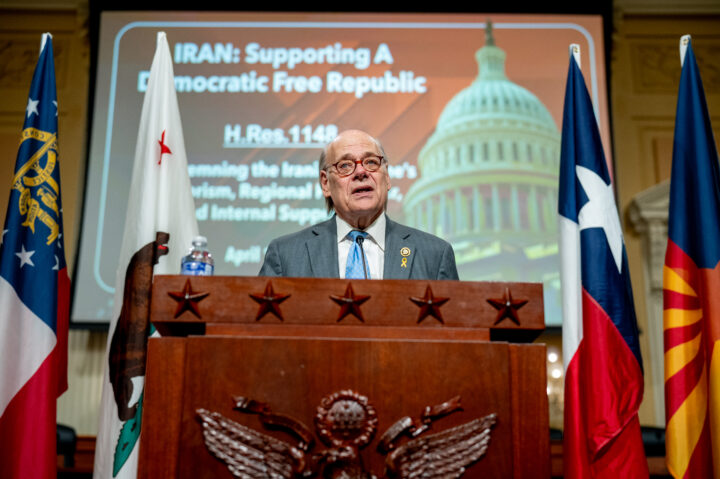
U.S. Rep. Steve Cohen (D-TN) speaks during a Congressional briefing on Iran held by the Organization of Iranian American Communities on Capitol Hill on April 16, 2024 in Washington, DC.


 Add JewishInsider on Google
Rep. Steve Cohen (D-TN) told CNN he left the Congressional Progressive Caucus last year — and decided not to run for reelection this year — in part because of the rise in socialist leadership in the caucus.
“I just found it to be not the same caucus I joined in 2007. It had become more the socialist caucus, and most of the leadership was socialist Democrats,” Cohen, a longtime progressive, said in an interview with the outlet. “I didn’t feel comfortable in it.”
The Democrat said there’s now a growing contingent of anti-Israel Democrats as well within the Congressional Progressive Caucus, which he said was not present when he first came to the Hill.
“There certainly were not people who were so anti-Israel when I started, and there are within the progressive caucus now,” Cohen said.
The chairman of the Congressional Progressive Caucus is Rep. Greg Casar (D-TX), who won his seat in 2022 on an anti-Israel platform. The caucus’ vice-chair is Rep. Ilhan Omar (D-MN), who has long been one of the most outspoken detractors of Israel in Congress and has been subject to censures over allegations of antisemitism.
Cohen, who announced his retirement after Tennessee Republicans carved up his congressional district, predicted that he would have faced antisemitic attacks over his stance on Israel if he had run for reelection.
Before redistricting, Cohen was facing a challenge from far-left state Sen. Justin Pearson, who was campaigning on an anti-Israel platform.
“I foresaw it getting really nasty and antisemitism getting into it,” Cohen said.
Cohen also told CNN that Rep. Rashida Tlaib (D-MI) had not spoken to him since he voted to censure her for sharing a video that included the slogan “from the river to the sea” and after she accused former President Joe Biden of supporting genocide.
Cohen voiced his frustration with the redistricting process at a recent ADL event, blaming the ‘mamzers in the Tennessee General Assembly,’ using the Hebrew word for bastard
Andrew Harnik/Getty Images
U.S. Rep. Steve Cohen (D-TN) speaks during a Congressional briefing on Iran held by the Organization of Iranian American Communities on Capitol Hill on April 16, 2024 in Washington, DC.
Rep. Steve Cohen (D-TN) will retire from the House after 20 years, following a redistricting push by Tennessee Republicans that carved up his Memphis district, ending his re-election campaign, Cohen announced on Friday.
Cohen, 76, was the first Jewish person to represent Tennessee in Congress, and long stood out as a white, Jewish lawmaker representing a majority-Black district in the South, a rare profile in Congress. Prior to the redistricting move, which was fueled by a recent Supreme Court decision allowing states to eliminate some majority-minority districts, Cohen faced a challenge from far-left state Rep. Justin Pearson.
The longtime congressman voiced his frustration with the redistricting process, finalized just a week ago, at an Anti-Defamation League event in Washington, D.C. earlier this week.
“I was the first Jewish congressman elected in Tennessee. Served 20 years in Congress, and I was redistricted out of my seat, which was a majority African American seat, by the mamzers in the Tennessee General Assembly,” Cohen said, using the Hebrew word for bastard. “And there are a whole bunch of ‘em.”
He went on to recount the prejudice he faced earlier in his career as a Jewish candidate.
“In 1994, I ran for governor. I went to a little radio station in Dixon, Tenn. One-person radio station. Gravel road. Came in, talked to the man for a while and he said, ‘Son, you Jewish?’ I said, ‘Yes sir.’ He said, ‘Goooood luck!’” Cohen continued. “It ain’t changed a lot since then. Be careful. There’s a lot of mamzers out there. They don’t know us, but they don’t like us.”
Cohen told reporters in an emotional press conference on Friday that the decision to drop out of the race was “by far the most difficult moment I’ve had as an elected official.” He said he had considered running for one of the newly drawn districts, but that none of the seats were similar to his current Memphis-based district.
He said that if state courts block the redistricting process until 2028, he would run again in his current seat.
Cohen said that the new maps were drawn specifically to defeat him, the only Democratic member of the state’s delegation and that he did not feel he could properly represent the far-flung, GOP-friendly areas now incorporated into Memphis-area seats.
The veteran lawmaker has long been a voice on Capitol Hill against antisemitism and in support of Israel, though he took some stances more critical of Israel during the war in Gaza, including signing a letter accusing Israel of violating U.S. arms sales law. He told Jewish Insider he had considered but resisted pressure to back cutting off weapons sales to the Jewish state.
Cohen reiterated in his press conference on Friday that he was confident that he would be able to fend off the challenge from Pearson under the original district lines — as he has beaten numerous Black challengers over his time in office.
Cohen joins several other prominent Jewish and non-Jewish Democrats strongly supportive of Israel whose political futures have been thrown into question by the ongoing mid-decade redistricting wave across the country.
Fellow Jewish Reps. Debbie Wasserman Schultz (D-FL) and Jared Moskowitz (D-FL) are also facing uncertain re-election campaigns after Republicans redrew the Florida Congressional map in a more partisan manner.
Please log in if you already have a subscription, or subscribe to access the latest updates.
 Continue with Google

 Continue with Apple