














































































The former Chicago mayor said the relationship between the countries ‘needs a solid dose of honesty’

Alex Wong/Getty Images
Rahm Emanuel testifies during a confirmation hearing before Senate Foreign Relations Committee at Dirksen Senate Office Building on Capitol Hill October 20, 2021, in Washington, D.C.


 Add JewishInsider on Google
Rahm Emanuel, the former Chicago mayor and prospective presidential candidate, is slated to discuss the future of U.S.-Israel relations at Tel Aviv University on July 8, according to an announcement on Monday from the school.
Emanuel, who has long held a close connection to the Jewish state, has recently drawn headlines over his calls to immediately end U.S. military aid to Israel, which he had played a key role in securing as a chief of staff to former President Barack Obama from 2009-2010.
“I’ve been having frank and honest conversations about Israel’s future throughout my public life,” Emanuel, who most recently served as U.S. ambassador to Japan in the Biden administration, said in a statement about the discussion, billed as “An Honest Conversation: The U.S.-Israel Relationship — Where It Stands Today and The Road Ahead.”
“Today, Israel is more militarily secure yet more politically isolated than it’s ever been,” he added. “As friends and allies, we need a candid conversation about where the relationship stands, what’s changed and what’s next. We find ourselves in a pivotal moment in our relationship and in the region. The U.S.-Israel relationship is strongest when it’s honest, and right now it needs a solid dose of honesty.”
The event will be moderated by Yoav Fromer, founding director of Tel Aviv University’s Center for the Study of the United States, and professor Yael Sternhell, who leads the school’s American studies program.
“We are delighted to host Ambassador Emanuel at Tel Aviv University and discuss both the challenges facing the U.S.-Israel relationship and the opportunities for the United States to play a constructive role in ensuring Israel’s long-term security and prosperity,” Fromer said in a statement. “Tel Aviv University has long been committed to the study, teaching, and research of the United States in order to enhance the special bonds between the two nations and promote wider public understanding of America among Israelis. An honest dialogue with Ambassador Emanuel will undoubtedly advance this important cause.”
Emanuel, a moderate Jewish Democrat who is seeking to challenge party orthodoxies on a range of issues as he positions himself for a potential presidential bid in 2028, has been reluctant to address his personal evolution on Israel in depth.
In a recent interview with Jewish Insider, however, Emanuel indicated that he is now advocating for a fundamental reassessment of the U.S.-Israel alliance, in contrast with more supportive rhetoric he had long espoused.
The United States, he told JI, should continue to stand with Israel only if its efforts in the region help contribute to peace. “Every risk you will take, the State of Israel takes, for peace, then America will stand by you,” he explained. “We understand there’s risks. We have stood by Israel through thick and thin.”
“But when one friend in that relationship abandoned something that’s contrary to our interests and contrary, in my view, also to Israel’s interests,” he added, it is reasonable, he suggested, to rethink that relationship.
‘There’s going to be a new normal,’ the progressive Israel advocacy group told JI, as it endorses candidates who call Israel’s actions in Gaza a genocide
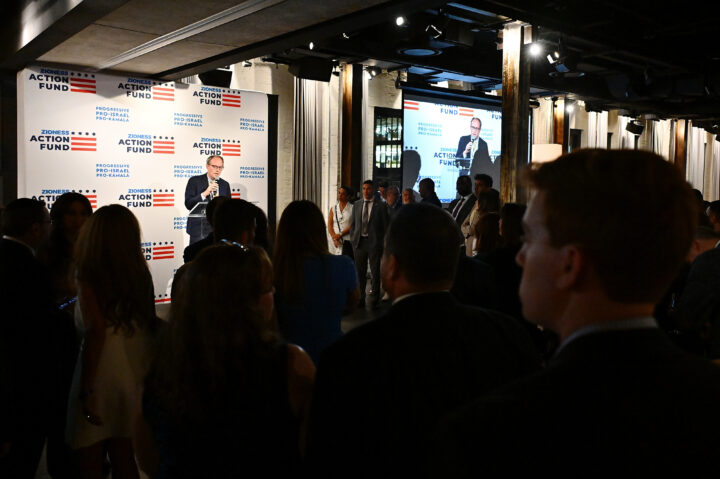
Daniel Boczarski/Getty Images for Zioness Action Fund
Ilan Goldenberg speaks onstage during the Zioness Action Fund DNC Kickoff Party on August 20, 2024 in Chicago, Illinois.
Three months after a ceasefire largely ended the fighting between Israel and Hamas in Gaza, the battle over the future of U.S.-Israel relations still rages in Washington. Both the left and the right face an erosion of support for traditionally pro-Israel positions. Amid the upheaval, the progressive Israel advocacy group J Street sees an opportunity: a chance to solidify Democrats’ shift away from unconditional support for Israel and its security needs.
J Street is betting that the shift within the Democratic Party reflecting a chillier relationship with the Jewish state — wrought by two years of war in Gaza — is here to stay. At the start of an election year, interviews with J Street’s top political official and its policy chief make clear that the group is eager to create space for Democrats who have taken a more critical approach to Israel, reflecting and reinforcing a shift toward greater distance in the historically close U.S.-Israel alliance.
“There’s going to be a new normal,” Ilan Goldenberg, J Street’s senior vice president and chief policy officer, told Jewish Insider in an interview. “There were two years of trauma that, I think, with the return of the hostages and the end of the war, people can finally start processing, but things are not going back.”
Following the Oct. 7, 2023, Hamas attacks, public opinion, particularly on the left, began to shift against Israel during its aggressive war against Hamas in Gaza. That change was reflected in increased calls from congressional Democrats to place conditions on American security assistance to Israel, a position that a decade ago was largely a fringe idea.
AIPAC has, at least publicly, written off the shift as “noise,” noting that American security assistance to Israel remains intact. Earlier this month, Congress voted to approve a State Department funding package that included the expected $3.3 billion in military aid to Israel.
But J Street’s influence in the Democratic Party is growing. House Minority Leader Hakeem Jeffries (D-NY) accepted an endorsement from J Street for the first time last year. The group now counts every member of House Democratic leadership among its endorsees. (Jeffries has also been endorsed by AIPAC.)
Even though the Gaza war is largely over, J Street doesn’t expect the Democratic Party to return to its historic pro-Israel posture. Instead, the group wants to see a permanent shift in how Washington supports Israel militarily, even if its endorsees hold a range of views on that question.
“We’re not looking for complete ideological fealty from our endorsees. We just don’t ask for that,” J Street’s vice president of political and digital strategy, Tali deGroot, told JI. “We want to see candidates affirm that U.S. aid to Israel should conform to U.S. law, that Israel’s use of our aid should comply with international law and that our aid to Israel shouldn’t be viewed as a blank check.”
Israel is nearing the end of a 10-year security agreement with the U.S. that provides it $3.3 billion in annual foreign military financing (FMF), along with $500 million for cooperative missile-defense programs, though the funding needs to be approved by Congress every year. That memorandum of understanding expires in 2028, and the question hanging over the next MOU is, if the Trump administration comes to a similar agreement with Israel, whether the political will still exist in Congress to appropriate it over another decade.
Israeli Prime Minister Benjamin Netanyahu surprised even some of his closest backers by telling President Donald Trump last month that he wants to wind down U.S. FMF to Israel as part of a bid to increase Israeli self-sufficiency. Sen. Lindsey Graham (R-SC), a staunch pro-Israel advocate, said he intends to work with Netanyahu to achieve that goal. It’s a rare position where Netanyahu and Graham now find themselves aligned with a J Street policy position.
“I agree with Bibi Netanyahu and Lindsey Graham. It’s time to wind down the FMF piece of this,” Goldenberg said. “It doesn’t mean we don’t sell Israel weapons. It doesn’t mean we don’t cooperate on joint research together on things like Iron Dome.”
The “exceptional” way that the U.S. treats Israel — particularly Israel being the largest recipient of U.S. FMF — “actually is bad for Israel in that it draws all this extra attention to the relationship,” said Goldenberg. Instead, he argued that the U.S. should “put the relationship on normal grounds,” meaning withdrawing unconditional support.
“When [other allies] do things we disagree with, we don’t go along with that, and don’t necessarily give them weapons for that, or necessarily sit in international institutions and defend them when we disagree with their policies,” Goldenberg said.
J Street’s influence in electoral politics is relatively limited. The group’s war chest does not come close to that of rival AIPAC. Save for a handful of races, J Street largely does not play in primaries, although the group is planning to roll out a super PAC this year that is “pretty large,” at least by “J Street standards,” according to deGroot. On top of that, J Street’s policy priorities almost certainly stand no chance of getting adopted during the Trump administration.
And while large Jewish groups like the Jewish Federations of North America and the Anti-Defamation League have deepened their support for Israel since the Oct. 7 attacks, J Street has continued to test the boundaries of just how critical one can be towards the Jewish state while remaining in the Zionist camp. J Street President Jeremy Ben-Ami said in August that he would no longer push back when people claim that Israel’s actions in Gaza amounted to genocide. “I simply won’t defend the indefensible,” he wrote. And J Street has endorsed candidates who use the term genocide, like Sen. Bernie Sanders (I-VT).
“That’s up to the candidates of how they’re going to say it,” deGroot said regarding the word “genocide.” “We’re looking for broad values alignment, and if they are extremely concerned about the situation for Palestinians in Gaza, so are we.”
Please log in if you already have a subscription, or subscribe to access the latest updates.
 Continue with Google

 Continue with Apple