














































































Brandeis Center CEO Ken Marcus: ‘For months, we have been demanding answers about billions of dollars in foreign funding flowing into American universities without adequate transparency or accountability’
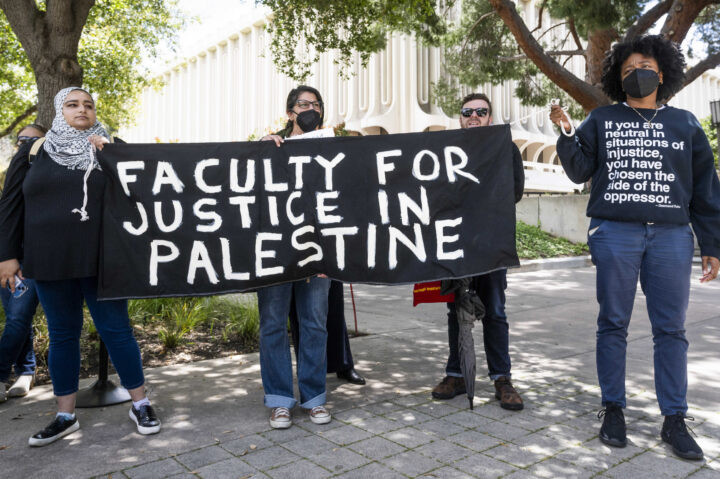
(Paul Bersebach/MediaNews Group/Orange County Register via Getty Images)
Several hundred people demonstrate at the University of California, Irvine in Irvine, CA on Thursday, April 25, 2024.


 Add JewishInsider on Google
The Louis D. Brandeis Center for Human Rights Under Law and Foundation for Defense of Democracies filed an amicus brief on Friday urging a federal judge to allow the Department of Education to proceed with the disclosure of data on foreign funding to college campuses, which is currently being blocked by a temporary restraining order.
The Association of American Universities, which filed the lawsuit to block the report, has argued that the release of such information would compromise donors’ expectation of anonymity and potentially compromise their safety in their home countries, a concern that District Court Judge Tanya Chutkan cited in granting the temporary restraining order.
The Department of Education, which itself delayed the release of the data six times since July, has said it only intends to release the names of organizations, rather than individual donors.
“For months, we have been demanding answers about billions of dollars in foreign funding flowing into American universities without adequate transparency or accountability. After six delays, the public was finally about to get those answers, until universities went to court to keep them hidden,” Kenneth L. Marcus, the chairman and CEO of the Brandeis Center, said in a statement.
“Without the identities of the foreign governments, state-controlled entities and other institutions behind these billions of dollars, students, parents and taxpayers cannot fully understand who may be seeking to influence American higher education — including whether foreign funding is contributing to the antisemitism and harassment Jewish students are experiencing on campus,” Marcus continued.
In the brief, FDD emphasized the national security implications of foreign donations from countries like China and Qatar. “Public identification of institutional counterparties is important to this work because it enables independent scrutiny of foreign funding relationships and institutional affiliations that cannot be assessed through country-level disclosures alone,” the brief states.
In an interview, Paul Eckles, a Brandeis Center attorney who worked on the brief, emphasized that the donations in question are not from individuals, but are million or billion-dollar donations from countries like Qatar and China, which often come with conditions attached.
“The public deserves to know who these foreign actors are, that are making these donations and what kind of conditions and influence they’re trying to obtain at these universities,” Eckles said. “It raises questions of, why are the universities fighting this? What don’t they want the public to see?”
He said that the AAU’s claims that their objections are connected to ensuring the privacy of altruistic political dissidents are misleading. “The whole purpose of the statute is to provide a basis for public oversight,” he continued.
Eckles also noted that the Brandeis Center has an active Freedom of Information Act request seeking the information in question, and argued that there is “no legal basis for the government to withhold disclosing this information” in response to that FOIA request.
The AAU is set to file a reply brief on Oct. 20, with a hearing on the case set for Oct. 21.
Please log in if you already have a subscription, or subscribe to access the latest updates.
 Continue with Google

 Continue with Apple