














































































The administration notified lawmakers last year that it is moving toward a nuclear deal with Riyadh, potentially lacking safeguards around Saudi enrichment
Valerie Plesch/Bloomberg via Getty Images
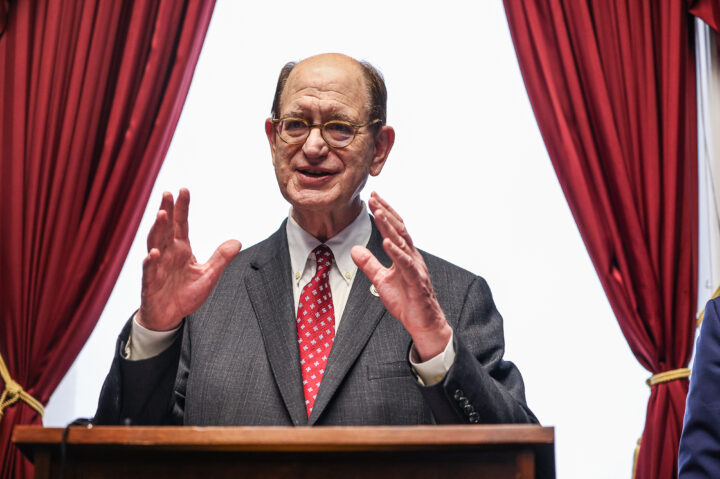
Rep. Brad Sherman, a Democrat from California, during a news conference.


 Add JewishInsider on Google
Rep. Brad Sherman (D-CA) said Tuesday that he’s pushing for legislation to require an affirmative congressional vote prior to the U.S. reaching any nuclear deal with Saudi Arabia, following a notification from the administration to Congress indicating that it is moving toward a deal that could allow Riyadh to enrich uranium for civilian purposes.
Sherman has been a longtime opponent of nuclear cooperation with Riyadh, warning that a Saudi civilian nuclear program would be the first step toward a nuclear weapon that could one day be turned against Israel. The White House announced plans for a nuclear cooperation agreement with Saudi Arabia in November during a Washington visit by Saudi Crown Prince Mohammed bin Salman.
Such a deal had previously been coupled with Saudi normalization with Israel, as had advanced weapons sales to the kingdom, but the Trump administration has de-linked those initiatives.
Sherman said during a hearing of the House Foreign Affairs Committee on Tuesday that the administration notified some House Republicans in November of plans to forge a nuclear deal with Saudi Arabia.
The notification procedures, which do not include specific terms of a potential deal, suggest that that Saudi Arabia will not be required to agree to more intrusive International Atomic Energy Agency inspections (known as the “additional protocol” to the Nuclear Nonproliferation Treaty) or “gold standard” safeguards — which would require Saudi Arabia to agree not to enrich or reprocess nuclear material — used for the U.S. nuclear cooperation agreement with the United Arab Emirates.
Those “gold standard” safeguards, which would make it more difficult for Saudi Arabia to repurpose a civilian nuclear program for military purposes, have been a baseline expectation for some lawmakers in earlier rounds of nuclear talks with Saudi Arabia.
The text of the congressional notification was shared with and published by the Arms Control Association earlier this month. While the notification does not specifically state that the agreement will allow for Saudi enrichment, it includes language stating that the deal will employ “additional safeguards and verification measures to the most proliferation-sensitive areas of potential nuclear cooperation … (enrichment, conversion, fuel fabrication, and reprocessing).”
Sherman said that the administration had failed to properly notify congressional Democrats of its plans, as required under law, and that no Democrat on the committee was aware of the report before February.
“We’ve got to look at whether we want a nuclear cooperation agreement with Saudi Arabia that does not have the safeguards that we negotiated with the UAE,” Sherman said.
He said he’s collecting support for a bill he originally introduced in 2019 with Secretary of State Marco Rubio, then a senator, to require the affirmative support of Congress for any nuclear deal with Saudi Arabia.
“I think Sen. Rubio was wise, perhaps sometimes wiser than Secretary Rubio, and I hope that all members will join me in that effort,” Sherman said.
The Virginia senator can force a vote on the legislation, which would bar U.S. military action against Iran unless directly authorized by Congress

Drew Angerer/Getty Images
Sen. Tim Kaine (D-VA) speaks to reporters on his way to a classified all-Senate briefing.
Sen. Tim Kaine (D-VA) introduced a war powers resolution on Monday that aims to block the U.S. from taking military action against Iran in support of Israel’s ongoing operation against the regime.
The resolution would bar military action against Iran unless directly authorized by a congressional vote, or in order to defend the United States from an “imminent attack.”
The legislation comes as Israeli leaders are reportedly pushing the United States to support Israel’s military operations, particularly to target the deeply entrenched nuclear site at Fordow that Israel is believed to lack the capabilities to destroy on its own.
War powers resolutions are privileged under congressional procedures, meaning that Kaine can force a vote on the legislation. Kaine told Jewish Insider on Monday that the resolution could be called up, at earliest, late next week, depending on other timing issues.
Rep. Thomas Massie (R-KY) announced that he plans to introduce a similar war powers resolution in the House.
“The question of whether United States forces should be engaged in hostilities against Iran should be answered following a full briefing to Congress and the American public of the issues at stake, a public debate in Congress, and a congressional vote as contemplated by the Constitution,” the resolution reads.
Kaine warned in a statement that the Israeli-Iranian conflict “could quickly pull the United States into another endless conflict.”
“It is not in our national security interest to get into a war with Iran unless that war is absolutely necessary to defend the United States,” Kaine said. “The American people have no interest in sending servicemembers to fight another forever war in the Middle East. This resolution will ensure that if we decide to place our nation’s men and women in uniform into harm’s way, we will have a debate and vote on it in Congress.”
President Donald Trump has indicated that the U.S. does not intend to get directly involved in the conflict.
Lawmakers, led by Kaine, pursued similar efforts during Trump’s first administration following the killing of Quds Force leader Gen. Qassem Soleimani. That legislation passed Congress in 2020 with the support of then-Sen. Lamar Alexander (R-TN), as well as Sens. Todd Young (R-IN), Mike Lee (R-UT), Lisa Murkowski (R-AK), Susan Collins (R-ME), Rand Paul (R-KY), Bill Cassidy (R-LA) and Jerry Moran (R-KS), but was vetoed by Trump.
Sens. Bernie Sanders (I-VT), Peter Welch (D-VT), Elizabeth Warren (D-MA), Jeff Merkley (D-OR) Chris Van Hollen (D-MD), Ed Markey (D-MA), Tammy Baldwin (D-WI) and Tina Smith (D-MN) introduced a separate bill on Monday to block funding for any use of force against Iran except if authorized by Congress or in self-defense.
Please log in if you already have a subscription, or subscribe to access the latest updates.
 Continue with Google

 Continue with Apple