










































































‘No good options’: Israel considers high-stakes Gaza occupation plan
Netanyahu, Zamir and Katz held a three-hour meeting on Tuesday, which was reportedly very tense due to disagreement over the plan
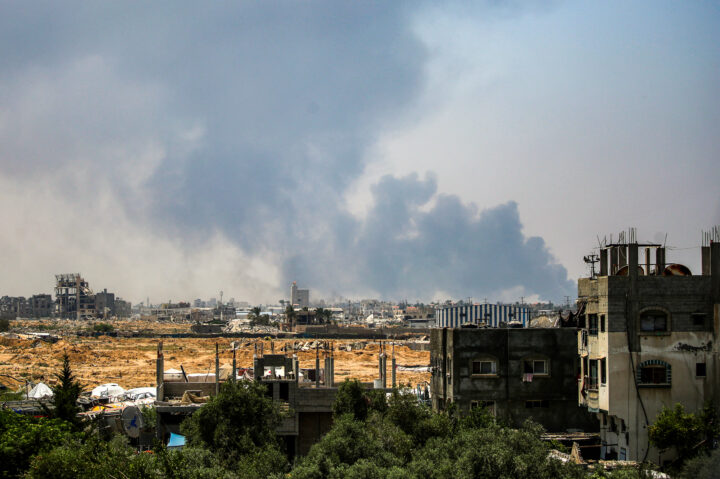
EYAD BABA/AFP via Getty Images
Smoke billows from Israeli bombardment as pictured from Deir el-Balah in the central Gaza Strip on July 21, 2025.


 Add JewishInsider on Google
Israel’s Security Cabinet is set to vote this week on occupying the remaining parts of Gaza that it does not currently control, after Hamas refused last month’s ceasefire and hostage deal proposal and did not return to negotiations.
Israeli Prime Minister Benjamin Netanyahu, IDF Chief of Staff Lt.-Gen. Eyal Zamir and Defense Minister Israel Katz held a three-hour meeting on Tuesday, which was reportedly very tense due to disagreement over the plan, though Zamir ultimately said he will follow through with the government’s decision.
Zamir argued that the IDF should surround the areas in Gaza in which it currently does not have a presence, including Gaza City and towns in the center of Gaza in which hostages are believed to be held. Entering those areas, Zamir warned, would endanger the lives of the 20 hostages who are thought to be alive. Hamas has threatened to kill hostages if the IDF approaches, as it had executed six hostages a year ago.
Beyond the fraught issue of the hostages, there is the matter of what “occupation” means.
Broadly, the war in Gaza was initially conducted via raids in which the IDF would warn civilians to leave a given area, enter, destroy terrorist infrastructure and combat terrorists, and eventually leave to move to a different part of Gaza, letting the population return. Hamas terrorists would also end up returning to those areas, leading the IDF to have to enter some of the same places repeatedly.
In March, Israel embarked on Operation Gideon’s Chariots, in which Israel entered Gaza from its perimeter on all sides, and moved inwards, capturing territory and maintaining control of it, in contrast to its previous strategy. That operation has, in effect, resulted in Israel controlling 75% of Gaza.
The remaining 25% is what Israel would move to control under the plan Netanyahu supports.
Brig.-Gen. (res.) Yossi Kuperwasser, head of the Jerusalem Institute for Strategy and Security and the former head of research for IDF intelligence, told the Misgav Mideast Horizons podcast this week that the commonly used 75%-25% formulation is “a misrepresentation.”
“Almost all the population of Gaza is in areas controlled by Hamas, which allows Hamas to keep its grip over the population, and this is the source of its power … It’s not about the percentage of the area, it’s about who controls the population,” he said.
While “occupation” is the correct military term for what Israel would be doing by taking control of territory, the connotation of the word in the Israeli context tends to be the West Bank, which Israel has controlled since 1967 and where over half a million Jewish citizens of Israel live.
Some Cabinet ministers have advocated for allowing Israelis to move to Gaza, where 21 Israeli settlements were forcibly evacuated in 2005; Netanyahu has repeatedly rejected such a plan.
What senior Israeli officials have long said is that, while Israel seeks to have other countries and some Palestinians administer Gaza, they will not do so until it’s clear that Hamas has been ousted. As such, Israel may have to take control for some time until other arrangements are made.
Kuperwasser said that while Netanyahu’s decision may be risky, Zamir’s preference of surrounding the remaining 25% of Gaza is more of the same.
“In Gaza, there are no good options,” he said. “The option of continuing what we have done for the last 22 months is not a good option, because it didn’t put enough pressure on Hamas to release the hostages and accept the idea that they should give up their arms. The option of succumbing to Hamas demands … is a very bad idea, too. And taking over Gaza is also a bad idea, because you end up being responsible for the population of Gaza and there is going to be a lot of criticism around the globe … you cannot guarantee that you are going to get the hostages alive.”
Kuperwasser argued that the only way at this point for Israel to move towards freeing the hostages and removing Hamas from power is if Hamas is “convinced that we are about to take over Gaza by force and remove them from power by force … So we have to make this decision, and yes, it comes with a price.”
Starting on the new strategy may be enough to convince Hamas to reach a deal, Kuperwasser said, but in order to get to that point, he argued, Israel has to prepare to actually occupy Gaza.
“We have to convince Hamas that we are serious, that we are really preparing for this eventuality,” including for civil administration of Gaza, he said.
More Stories

Fashion Faux Pas?
Anna Wintour mingles with Qatari royal who glorified Hamas’ slain leader

exclusive
Schumer, Senate Democrats introduce resolution condemning Fuentes, Carlson

BARAKA'S BACKING
In progressive pivot, N.J. congressional candidate Brian Varela secures Newark Mayor Ras Baraka’s endorsement

BISS' BACKTRACK
Daniel Biss reversed position on aid to Israel after launching congressional campaign

MEDIA MOMENT
White House taps Hamas-sympathetic Drop Site News in press corps rotation

MAKING IT OFFICIAL
Trump signs executive order pledging to designate chapters of Muslim Brotherhood as terrorist orgs
Please log in if you already have a subscription, or subscribe to access the latest updates.