





























































2026 defense bill includes unconditional repeal of Syria sanctions, Iraq war authorizations
The Caesar sanctions repeal comes in spite of hesitation from some lawmakers on Capitol Hill, who argued that the sanctions should remain on the books

Kevin Carter/Getty Images
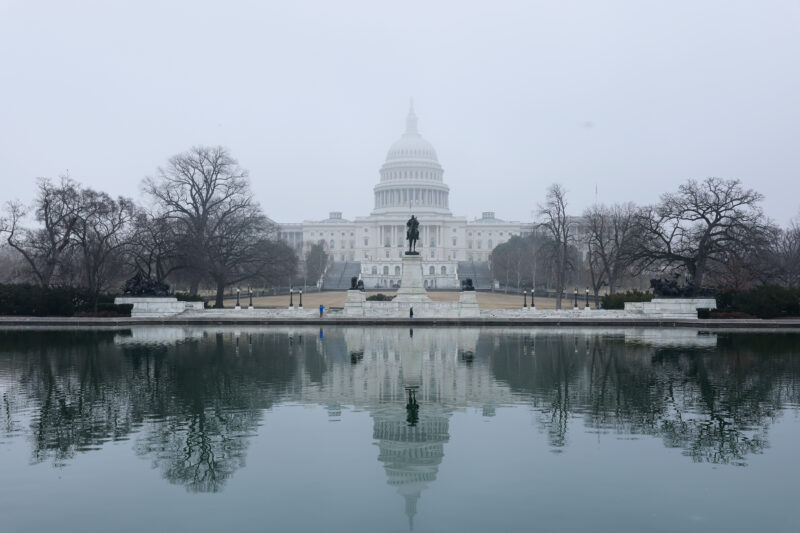
U.S. Capitol Building on January 18, 2025 in Washington, DC.


 Add JewishInsider on Google
The final version of the 2026 National Defense Authorization Act negotiated by Senate and House leaders includes a full and unconditional repeal of U.S. sanctions on Syria under the Caesar Civilian Protection Act, as well as a repeal of the war authorizations that allowed for the Iraq war and the first Gulf War.
The Caesar sanctions repeal comes in spite of hesitation from some lawmakers on Capitol Hill, who argued that the sanctions should remain on the books, with relief contingent on the Syrian government meeting various benchmarks. Supporters of full sanctions relief have argued that it’s necessary in order to put Syria on a more predictable and stable financial footing and provide confidence to foreign investors to support reconstruction projects.
Rep. Brian Mast (R-FL), the chairman of the House Foreign Affairs Committee, who had been skeptical of the prospect of unconditional repeal, ultimately decided to provide his approval to include it in the bill.
The legislation requires the administration to report to Congress twice per year to certify whether the Syrian government is complying with a range of U.S. priorities, including cooperating with counter-ISIS efforts, removing foreign fighters from the Syrian government, protecting minority rights, non-aggression toward Israel, integrating the Kurdish-led Syrian Democratic forces, complying with U.S. sanctions, prosecuting human rights abusers and combating narcotics production.
It includes a nonbinding provision that “the president may consider whether to impose targeted sanctions on individuals under existing authorities” if these conditions are not met for two reporting periods, but includes no binding snapback provisions mandating the reimposition of sanctions.
The repeal of the Iraq war authorization has been a longtime priority for lawmakers on both sides of the aisle, but others have argued that a more deliberative approach is needed to ensure that the U.S. maintains its ability to target Iranian proxies or terrorist groups in Iraq.
Largely outside of Middle East policy, the legislation contains a number of provisions seemingly aimed at countering isolationist pushes from within the administration, including provisions to ensure that U.S. aid to Ukraine continues and that the U.S. does not significantly draw down its troop presence in Europe or South Korea.
It also includes a provision seemingly aimed at responding to senators’ public concerns about a lack of transparency and communication by Under Secretary of Defense for Policy Elbridge Colby, mandating that he personally brief Congress twice next year about the national defense strategy.
Overall, the bill proposes a defense budget $8 billion above the Trump administration’s 2026 request — though any actual funding allocations will have to be approved separately through the still-pending appropriations process.
Within the Middle East domain, the NDAA authorizes annual funding for joint missile-defense programs with Israel, including Iron Dome, David’s Sling and Arrow, guaranteed under the memorandum of understanding with Israel that lasts through 2028.
The explanatory report accompanying the bill requires the administration to brief Congress on Israel’s current Arrow stockpiles — systems that saw heavy use during Iran’s ballistic missile attacks on Israel earlier this year — including potential obstacles to increasing Arrow production capacity and inventory and the possibility of creating “fully redundant Arrow production capacity in the United States.”
Addressing existing regional air- and missile-defense cooperation programs, the report directs the administration to brief Congress on progress toward an integrated air and missile architecture, as well as lessons learned during the past two years of war in the Middle East and the impacts of existing cooperation efforts during that time.
It also requires the Pentagon to brief Congress on any delays in providing aircraft or air-launched munitions to Israel and the “feasibility and advisability” of providing Israel with American systems to fill those gaps in the interim.
The NDAA proposes increasing funding for joint U.S.-Israel anti-tunnelling programs to $80 million, a $30 million increase. The report requires the administration to study potential steps to secure the border between Egypt and Gaza to cut down on smuggling into the enclave via tunnels, drones and the Mediterranean Sea.
The legislation also expands existing U.S.-Israel cooperative programs countering airborne drone threats to include other unmanned systems, including sea- and land-based drones, and proposes funding of $70 million, a $15 million increase.
It extends both the counter-tunnel and counter-drone programs through 2028.
The bill also proposes providing $35 million for a new program to pursue military applications of emerging technologies such as AI, quantum computing and cybersecurity in cooperation with allies like Israel.
The legislation also directs the administration to create a U.S.-Israel Defense Industrial Base Working Group to expand defense production cooperation with Israel, and study the possibility of integrating Israel into the National Technology and Industrial Base, alongside other key U.S. allies.
The explanatory report directs the Defense Department to consider creating a “regional outreach center” of the Defense Innovation Unit in Israel; the House draft of the NDAA had included a requirement that the Pentagon establish such an office.The DIU is a relatively new Pentagon unit with offices around the U.S. that works to allow the military to more quickly adopt emerging commercial technologies.
In an effort to address international boycotts and other punitive measures against Israel, the NDAA requires the administration to continually assess the impact of arms embargoes, sanctions and other restrictions imposed on Israel and the ways the U.S. might be able to mitigate those impacts.
The explanatory report instructs the Pentagon to avoid participating in international arms exhibitions that exclude Israeli companies.
But the final NDAA does not include a provision from the House draft of the bill instructing the administration to engage with top allies to ensure they do not enforce International Criminal Court arrest warrants against the U.S. or Israel.
The report states that the U.S. should engage in “regular military exercises of increasing complexity” with Israel, to include “other regional partners as well when feasible,” and requires the administration to report to Congress on such exercises.
In an effort to address growing cooperation among Iran, China, Russia and North Korea, the legislation instructs the administration to establish a whole-of-government effort to respond to such alliances, including establishing working groups in several Cabinet agencies, charged with providing recommendations to the administration and Congress.
The NDAA expands existing required reports on Iran’s nuclear capabilities, mandating the administration provide additional information to Congress about Iran’s support to its terrorist proxies, its nuclear advancements and its production of new weapons systems like single-use drones.
It further requires prompt notification to Congress if the intelligence community finds that Iran has made the decision to produce a nuclear weapon from its stockpiles of highly enriched uranium.
The bill also includes a new authority permitting the U.S. to quickly send weapons seized in transit from Iran to the Houthis to U.S. allies, potentially including Israel and Ukraine.
The NDAA instructs the administration to create a strategy for expanding U.S. security partnerships with Jordan and Lebanon, including working to ensure the disarmament of Hezbollah. It requires the Defense Department to set out benchmarks for cutting off support to the Lebanese Armed Forces if they fail to make progress in or are unwilling to disarm Hezbollah.
The legislation also includes a provision to withhold 25% of U.S. security assistance to Iraq until the administration certifies that the Iraqi government is taking steps to weaken Iran-aligned militia groups in Iraq and remove members of Iran-aligned groups operating as part of the Iraqi security forces, though the secretary of defense can waive those conditions.
And it requires the administration to declassify all documents related to the Iranian proxy attack on the U.S.’ Tower 22 Facility in Jordan in January 2024, which killed three U.S. service members.
Matching an executive order from the Trump administration, the legislation codifies a new designation and sanctions regime for countries engaging in wrongful detention of U.S. citizens, with a requirement that the State Department report to Congress on whether Iran should be so designated.
In addition to the Caesar Act repeal, other Syria-related provisions in the bill require the administration to report to Congress on the possibility and security concerns involved in reopening the U.S. embassy in Damascus, the U.S.’ force posture in Syria and any planned changes to U.S. forces in the country.
It does not include a more stringent provision from the Senate version of the bill requiring the Pentagon to certify that drawing down U.S. forces in Syria would not compromise U.S. priorities.
The NDAA also provides continued authorization for the U.S. to assist vetted Syrian groups in combating terrorism in the country.
The bill additionally mandates that the Defense Department report to Congress on the possibility of expanding the Comprehensive Security Integration and Prosperity Agreement — an economic and security pact with Bahrain — to include other countries.
And it requires the administration to develop a plan to counter foreign efforts to “continue or expand” the civil war in Sudan.
The legislation does not include a House-proposed provision extending through 2029 the authorization — currently set to lapse on Jan. 1, 2027 — for the U.S. weapons stockpile in Israel, which Israel can tap into in emergencies.
It also excludes House provisions that aimed to tackle Hezbollah’s operations in South America and to encourage defections by senior Iranian officials. A House provision awarding medals to those servicemembers involved in the U.S. strikes on Iranian nuclear facilities in June was not included either.
Other provisions from the House draft of the bill relating to antisemitism, including prohibiting Department of Defense funding for schools that failed to take action against antisemitic demonstrations, and requiring reports on antisemitism in the Pentagon and transnational antisemitic extremism, were also excluded.
More Stories

UNSEALED
Newly released memos reveal State Dept. concerns about basis for student deportations
Daily Kickoff
Saudi-U.S. nuclear negotiations draw lawmaker scrutiny

LAW AND ORDER
Former Columbia law dean says Jewish students treated differently on campus

Fashion Faux Pas?
Anna Wintour mingles with Qatari royal who glorified Hamas’ slain leader
RAISING RED FLAGS
Israel eyeing upcoming Iran-U.S. talks with deep skepticism
NORTHERN FRONT
Israel expands strikes in Lebanon after major Hezbollah barrage
Please log in if you already have a subscription, or subscribe to access the latest updates.
 Continue with Google
 Continue with Apple