







































To mark the second anniversary of the Oct. 7 attacks in Israel, the Jewish Insider team asked leading thinkers and practitioners to reflect on how that day has changed the world. Here, we look at how Oct. 7 changed higher education

JOSEPH PREZIOSO/AFP via Getty Images
Tents and signs fill Harvard Yard in the pro-Palestinian encampment at Harvard University in Cambridge, Massachusetts, on May 5, 2024.


 Add JewishInsider on Google
The former civil rights official says he’s confident the education secretary will pursue strong and enforceable agreements with Harvard and other schools to combat antisemitism on campus

Ken Marcus, the founder of the Louis D. Brandeis Center for Human Rights Under Law, said on Wednesday that he had faith in Education Secretary Linda McMahon to ensure that any settlements the Trump administration were to make with Harvard University or other schools would ensure concrete reforms to address campus antisemitism.
Marcus, one of the nation’s leading antisemitism experts who served as assistant secretary of education for civil rights in President Donald Trump’s first administration, made the comments while speaking to Jewish Insider on the sidelines of the Federalist Society and the Defense of Freedom Institute’s annual Education Law & Policy Conference, where he and McMahon both made appearances.
“There have been a lot of concerns expressed about whether the federal government is going to be letting universities off too easily on soft deals. It is my perception that Sec. McMahon is resolved to make sure that any settlement agreements are strong and effective. I believe that she is willing to fight for that, and that should be a source of significant confidence,” Marcus told JI.
Marcus was responding to a question about the ongoing dispute between different factions within the Trump administration over the effectiveness of the ongoing negotiations and settlements with universities, most notably Harvard. Officials have split themselves into two camps, with one side pushing only for deals that secure substantial changes to school policies to address civil rights issues and the other seeking large payouts to appease President Donald Trump, who has said he wants Harvard to pay at least $500 million to restore its more than $2 billion in federal funds.
McMahon said during her Wednesday morning appearance that it was not the Trump administration’s objective to end up in prolonged legal battles with Harvard or other universities and revealed she was hopeful about reaching a settlement that delivers meaningful reforms to the elite campus. She also expressed confidence in the government’s case.
“Sec. McMahon was right to remind us that the same judge who ruled against the federal government in the Harvard case had also ruled in favor of Harvard in the affirmative action case,” Marcus told JI.
“The judge was overruled before and may well be overruled again. That case turns in part on some very technical issues involving sovereign immunity under the Tucker Act and whether the Court of Federal Claims is the exclusive court with jurisdiction over procurement issues, so we’ll see where it goes on appeal, but I certainly fully understand why the Trump administration would appeal this and feel some degree of confidence,” he continued, referring to the federal law that allows individuals to sue the U.S. government.
Marcus spoke to JI ahead of his appearance on a panel entitled, “Federal Efforts to Combat Antisemitism: Restoring Campus Civil Rights or Infringing on Academic Freedom?”
The discussion was moderated by Florida Supreme Court Chief Justice Carlos Muniz and featured Marcus; Sarah Perry, vice president and legal fellow with Defending Education; Ilya Somin, law professor at George Mason University’s Antonin Scalia Law School; and Tyler Coward, lead counsel for government affairs at the Foundation for Individual Rights and Expression (FIRE).
While the group respectfully disagreed over some proposed solutions, such as codifying the International Holocaust Remembrance Alliance’s working definition of antisemitism on the state or federal level, they also found several areas of common ground.
Perry, Marcus and Coward each said they support the federal government amending Title VI to add religion to the categories of protected groups. “Title VII of the Civil Rights Act of 1964 does something that Title VI does not, which is including religious protections,” Perry said.
All four agreed that enforcement of current policies on the books, rather than relying on legislators to amend the law, was necessary.
“If we enforce the policies that are on the book, we actually don’t have to address defining antisemitism, because we already have these neutral policies that are on the books. Then we can avoid some of those things [such as disputes over the IHRA definition],” Coward said. “Because I think the actual actions we’re trying to stop are the … conduct of running Jewish students off campus, that kind of stuff, as opposed to defining that more broadly.”
Plus, Iron Beam laser system ready for action

Paul Sancya/Pool/Getty Images
Sen. Elissa Slotkin (D-MI) rehearses the Democratic response to President Donald Trump's address to a joint session of Congress.
Good Wednesday afternoon.
This P.M. briefing is reserved for our premium subscribers like you — offering a forward-focused read on what we’re tracking now and what’s coming next.
I’m Danielle Cohen-Kanik, U.S. editor at Jewish Insider and curator, along with assists from my colleagues, of the Daily Overtime briefing. Please don’t hesitate to share your thoughts and feedback by replying to this email.
📡On Our Radar
Notable developments and interesting tidbits we’re tracking
In a moment of Democratic soul-searching, Sen. Elissa Slotkin (D-MI) said in remarks at a security briefing hosted by Jewish groups on Capitol Hill today that she’s grown concerned with left-wing animus towards the Jewish community.
“We’re used to the right-wing side. What is new and what I think has so many in the Jewish community on our heels is that new left-wing antisemitism and how to approach it. How do we counteract it? How do we protect against it? How do we educate?” she said.
“And certainly, we’re watching, on many college campuses, a lot of young people who actually maybe didn’t grow up with the Jewish community at all, get to campus and maybe repeat what they’re hearing, sometimes not even understanding or knowing. I would just say that one of our responsibilities as Jewish leaders and Jewish activists is to try and really parse through how to deal with antisemitism on the left, since antisemitism on the right isn’t good, but it’s more of a well-known threat,” Slotkin continued…
On the other side of the aisle, House Speaker Mike Johnson (R-LA) told a group of pro-Israel leaders in a private meeting today that he’s attempting to push back on the isolationist wing of the GOP in the House and in his candidate recruiting efforts, but that the party is likely bound for a major debate on the issue after President Donald Trump leaves office, attendees told Jewish Insider’s Marc Rod…
Sen. Bernie Sanders (I-VT) and Rep. Becca Balint (D-VT) separately accused Israel of committing genocide in Gaza today, the first Jewish lawmakers to do so…
British Prime Minister Keir Starmer delayed his announcement to recognize a Palestinian state until this weekend, after Trump has departed from his state visit to London…
On the campus beat, Education Secretary Linda McMahon said this morning at the Federalist Society and the Defense of Freedom Institute’s annual Education Law & Policy Conference that the Trump administration is hopeful in reaching a settlement with Harvard and seeing changes in its approach to antisemitism implemented on the elite campus without a protracted legal battle.
“Harvard has already started to put in place some of the things we wanted them to do. They reassessed their Middle East policies. They actually fired a couple of their professors. They are looking at having safe measures on campus, and so without even admitting any guilt in any way, they have started to change their policies, and that is the ultimate goal of our investigation, of making sure that things are proper on campus,” McMahon said.
A federal court recently ruled in favor of Harvard in its First Amendment lawsuit against the Trump administration; McMahon said they intend to appeal…
Engaged in its own negotiations with the Trump administration over hundreds of millions of dollars in frozen federal funding, regents of the University of California met today in San Francisco; this month, UC Berkeley notified 160 people connected to allegations of antisemitism that it had given their information to the federal government as part of the investigation into the school, sparking community uproar at the meeting…
The New York Times spotlights the upcoming governors’ races in New Jersey and Virginia, considered predictive for the 2026 midterms. Yesterday, the Democratic National Committee announced it was doubling its support of Rep. Mikie Sherrill (D-NJ) in the Garden State to a total of $3 million, the most it’s ever contributed to a New Jersey gubernatorial election, in a sign of tightening polls in the Democratic state…
Meanwhile in New York, The Gothamist reports on growing tensions between Democratic New York City mayoral nominee Zohran Mamdani and City Comptroller Brad Lander, just months after they cross-endorsed each other in the primary race.
Lander is reportedly insinuating behind closed doors that he’ll be appointed first deputy mayor, the mayor’s right hand, should Mamdani win the election, while Mamdani is said to have told him to back off and insists no personnel decisions have been made…
Billionaire pro-Israel philanthropist Ronald Lauder injected $750,000 to the Fix the City PAC, which is backing former New York Gov. Andrew Cuomo in his bid to defeat Mamdani as an independent, despite Cuomo’s recent turn away from his full-throated support of Israel…
The Israeli Ministry of Defense announced today that it has completed the development of the Iron Beam laser missile interception system, which will be operational by the end of the year. Each laser interception costs less than $5, while Iron Dome interceptions cost around $40,000-$50,000 each…
The Senate Foreign Relations Committee voted to advance several nominees out of committee for consideration of the full Senate, including Sergio Gor for ambassador to India, Mike Waltz for U.S. ambassador to the U.N., Michel Issa for ambassador to Lebanon and Richard Buchan for ambassador to Morocco…
Top EU diplomat Kaja Kallas announced plans today for the EU to impose tariffs on Israel and sanction Israeli National Security Minister Itamar Ben-Gvir and Finance Minister Bezalel Smotrich, following on European Commission President Ursula von der Leyen’s call last week for the EU to suspend free trade measures with Israel.
The tariffs on Israeli imports, which currently receive preferential access to the EU under existing free trade initiatives, would require a majority of EU countries’ support, while the sanctions would have to be unanimous, neither of which currently has the requisite support from European capitals to pass. While Kallas’ proposals are more limited than some European leaders have called for, the move is another sign of the increasing demand for action against Israel in Brussels…
⏩ Tomorrow’s Agenda, Today
An early look at tomorrow’s storylines and schedule to keep you a step ahead
Keep an eye on Jewish Insider tomorrow morning for a rundown of what to expect from the reimposition of U.N. Security Council snapback sanctions on Iran.
Tomorrow morning, the Senate Committee on Health, Education, Labor and Pensions will hold a hearing on the state of K-12 education.
The Atlantic Festival begins in New York City tomorrow, opening with a session including former Vice President Mike Pence and former National Security Advisor H.R. McMaster.
In the evening, the Israeli Embassy will host its Rosh Hashanah reception in Washington.
United Hatzalah will hold its 2025 Los Angeles gala with honorary guest Gal Gadot. Israeli Eurovision performer Yuval Raphael will receive United Hatzalah’s Hero Award and American venture capitalist Shaun Maguire, fresh off a visit to Israel, will receive its Am Israel award.
Stories You May Have Missed
KARP’S CALL
Palantir’s Alex Karp says Jews need to ‘leave their comfort zone’ to defend community

The Palantir CEO was honored at the American Friends of Lubavitch (Chabad) annual Lamplighter Awards in Washington, D.C.
scoop
Fifty Senate Republicans call on European foreign ministers to hold firm on snapback, enforce Iran sanctions

‘The regime has abused diplomatic processes for years to avoid penalties. Sanctions relief should only be negotiated after snapback is fully implemented,’ the lawmakers wrote
McMahon said Harvard has already started to make changes requested by the federal government ‘and that is the ultimate goal of our investigation’
Zach Miller Photography
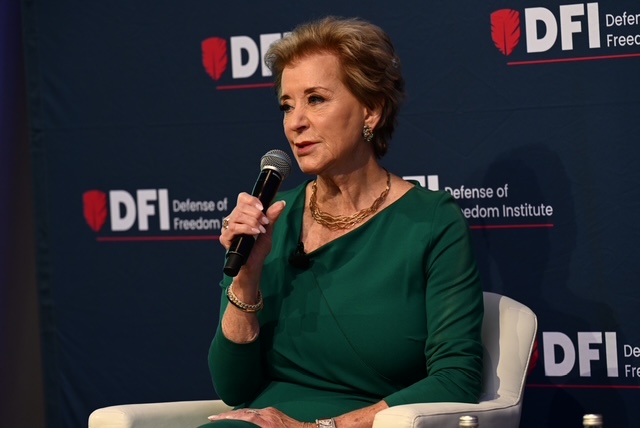
Education Secretary Linda McMahon speaks at the Federalist Society and the Defense of Freedom Institute’s annual Education Law & Policy Conference on Sept. 17, 2025.
Education Secretary Linda McMahon said on Wednesday that the Trump administration’s goal is not to engage in a prolonged legal battle with Harvard University and expressed hope that the federal government would be able to reach a settlement that delivers meaningful reforms to the elite campus.
McMahon made the comments while appearing at the Federalist Society and the Defense of Freedom Institute’s annual Education Law & Policy Conference on Wednesday morning, after being asked during a moderated conversation with Washington Examiner news editor Marisa Schultz where negotiations between Harvard and the administration stand.
“I’m certainly hopeful on the settlement. I have spoken to Alan Garber, their very good president, at the very beginning of this. I haven’t spoken to him since, but I do think that with the idea that Harvard has already started to take certain measures to change what they were doing, I certainly hope that there will be an agreement,” McMahon said. “It’s not our goal to have to go to court to make people abide by the law, to make universities abide by the law.”
Getting specific, the education secretary explained that, “Harvard has already started to put in place some of the things we wanted them to do. They reassessed their Middle East policies. They actually fired a couple of their professors. They are looking at having safe measures on campus, and so without even admitting any guilt in any way, they have started to change their policies, and that is the ultimate goal of our investigation, of making sure that things are proper on campus.”
Asked by Schultz about the ongoing negotiations with the University of California, Los Angeles and other schools, and how the settlements fit into the Trump administration’s “big picture mission for elite universities and colleges in America,” McMahon said that their “goal is really not to be punitive necessarily, but to have universities, I think, return to what we all believe that universities started out to be.”
“It’s not to be punitive. That’s really not the goal. The goal is to make them change their policies and practices, and if they are not in compliance with the law, then surely we’re going to insist they are, or they won’t receive federal funding,” she said.
The education secretary said she believed it was in the best interest of all parties to reach settlements rather than risk upending the more than $2 billion in research grants that Harvard receives from the federal government. “The federal funding for Harvard, not only for students who attend, for their tuition, but also the amazing amount of research funding — they get over $2 billion, almost $3 billion — is very significant to those scientists and professors who were there, who have grants and who are working on their own projects,” McMahon said.
“They can take that grant money and go somewhere else, if it’s a grant directly to them, so I think it’s in Harvard’s interest to continue to negotiate. I think it’s in all of our interests for Harvard and for all of the other universities that we are sending letters to, that we are investigating, and there are others. Hopefully there will be these settlements with all of them, because basically, we just want them to do right,” she explained.
McMahon made a similar remark about the importance of protecting research grants while discussing the administration’s settlement with Columbia University reached over the summer, which followed a protracted legal battle.
“We eventually reached an agreement with Columbia,” McMahon said. “They will pay a fine back to the United States government. Their funding will be released again, and it’s primarily research funding. I believe our universities do some of the most incredible research in the country. We want them to be able to do that, but they have to abide by the law. They have to abide by Title VI, they have to abide by Title IX. They have to be worthy to receive the funds that they are receiving from the United States government.”
The comments mark the first time McMahon has publicly shared her thoughts on what outcome she would like to see from the federal government’s negotiations with Harvard University amid an ongoing dispute between different factions within the Trump administration over the effectiveness of the ongoing negotiations and settlements with universities.
While some officials are focused on any deal that would secure strong reforms to address antisemitism and other civil rights issues, others are looking for securing large payouts to appease President Donald Trump.
“There’s growing dissatisfaction with the White House letting universities buy their way out of accountability with no meaningful change. It’s clear they’ve been totally out-negotiated,” one source familiar with the negotiations told JI earlier this month of the situation.
Trump said late last month that he expected Harvard to pay at least $500 million to restore its more than $2 billion in federal funding. “We want nothing less than $500 million from Harvard. Don’t negotiate, Linda. They’ve been very bad. Don’t negotiate,” Trump said while addressing McMahon at a Cabinet meeting. (McMahon acknowledged Trump’s remarks in the moment but did not respond further.)
Pressed on Wednesday about Trump’s comments and the fact that a federal judge in Boston blocked the administration’s freeze on Harvard’s research grants earlier this month, McMahon noted that they plan to appeal the ruling and said the government was in a strong position in its fight against the university.
“We’re still in the throes of negotiating with Harvard. They filed a lawsuit, they won the first round, and one of the things they were claiming was that the steps that we were asking of them would violate First Amendment rights, and that’s just not true. I think that we have a really good case against Harvard,” McMahon said.
Plus, Gillibrand cautions Dems over anti-Israel rhetoric
Michael Brochstein/SOPA Images/LightRocket via Getty Images
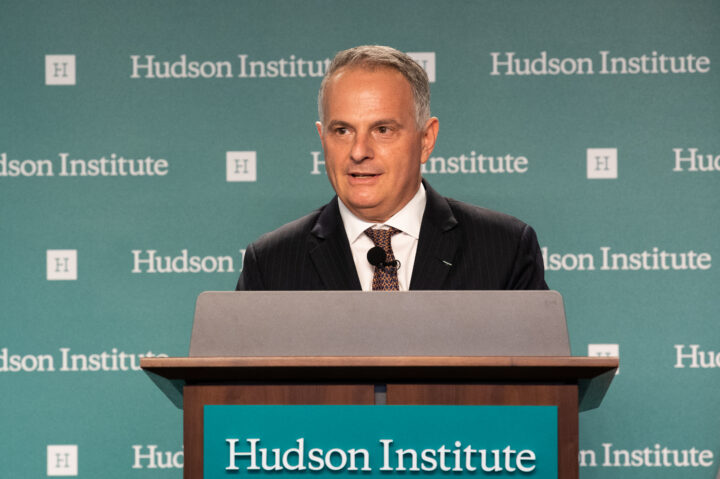
Kenneth Weinstein, President and Chief Executive Officer of Hudson Institute, speaking at the Hudson Institute in Washington, DC.
Good Monday afternoon.
This P.M. briefing is reserved for our premium subscribers like you — offering a forward-focused read on what we’re tracking now and what’s coming next.
I’m Danielle Cohen-Kanik, U.S. editor at Jewish Insider and curator, along with assists from my colleagues, of the Daily Overtime briefing. Please don’t hesitate to share your thoughts and feedback by replying to this email.
📡On Our Radar
Notable developments and interesting tidbits we’re tracking
We’re watching developments in ceasefire and hostage-release negotiations after President Donald Trump called for Hamas to accept the latest U.S.-sponsored deal over the weekend, which would see all the hostages, living and dead, released on the first day of the ceasefire.
Middle East envoy Steve Witkoff and former Trump Mideast advisor Jared Kushner met with Israeli Minister for Strategic Affairs Ron Dermer in Miami today to discuss developments in Gaza, Axios’ Barak Ravid reports.
Hamas had claimed it was ready to “immediately sit at the negotiating table” in response to Trump’s statement, but sources for the terror group told a Saudi newspaper today that a complete hostage release would not be possible immediately, claiming a ceasefire would have to go into effect first to reach all the bodies…
In other national security news, The New York Times spotlights the race between defense firms to develop technologies for a future “Golden Dome” missile-defense system.
“Companies chosen for Golden Dome are likely to become the new cornerstones of U.S. defense, military officials involved in the project said,” and firms including Palantir and Anduril as well as innovative startups have been in discussions with the Trump administration, the Times reports.
Mark Montgomery, senior director of the Center for Cyber and Technology Innovation at the Foundation for Defense of Democracies, said, “There are more than 100 companies out there with a sensor, satellite or other devices they want to sell to Golden Dome. This is the Wild West, and this is a massive opportunity for whoever is selected”…
Diplomatic tensions are rising between Israel and Spain after Spanish Prime Minister Pedro Sanchez announced today that his country would be formalizing an existing de facto arms embargo against Israel and banning anyone who has participated in “genocide” in Gaza from entering Spain as well as ships carrying fuel for the IDF from Spanish ports.
“This is not self-defense, it’s not even an attack — it’s the extermination of a defenseless people,” Sanchez said of Israel’s war in Gaza.
In response, Israeli Foreign Minister Gideon Sa’ar announced that Israel had banned two anti-Israel Spanish ministers from entering the country; Spain then summoned its ambassador in Tel Aviv, all shortly after a young Spanish immigrant to Israel was killed in this morning’s terror attack on a bus stop in Jerusalem…
The U.K. has come to a different conclusion about Israel’s actions in Gaza, according to a letter sent last week by former Foreign Secretary David Lammy before he was replaced in a reshuffling of Prime Minister Keir Starmer’s Cabinet.
Lammy wrote to the chair of the U.K.’s international development committee that the Foreign Office had found in an assessment that Israel was not committing a genocide as it was missing “intent” to do so. It’s the first time the U.K. has said so explicitly, previously holding that the matter of genocide was up to international courts to determine, just weeks before the country is expected to recognize a Palestinian state…
Former Hudson Institute CEO and President Kenneth Weinstein will serve as CBS News’ ombudsman, a new role that oversees editorial concerns from employees and viewers, Paramount announced Monday. Alongside reports that Paramount is expected to purchase Bari Weiss’ Free Press and bring her into an editorial role at CBS, the moves mark a new era for the network that has been accused of systemic anti-Israel bias…
Embracing their anti-Israel bona fides, hundreds of actors, filmmakers and film industry workers recently signed a pledge to boycott Israel, which says it was inspired by filmmakers who refused to screen their films in apartheid South Africa.
The signatories, including Hollywood stars such as Alyssa Milano, Mark Ruffalo, Anna Shaffer, Ayo Edebiri, Cynthia Nixon, Hannah Einbinder and Ilana Glazer, promised “not to screen films, appear at or otherwise work with Israeli film institutions — including festivals, cinemas, broadcasters and production companies — that are implicated in genocide and apartheid against the Palestinian people”…
Sen. Kirsten Gillibrand (D-NY) said in comments to Jewish leaders in New York City today that some of her fellow Democratic lawmakers are inadvertently fueling antisemitism through the rhetoric and slogans they use, Jewish Insider’s Marc Rod reports.
“When they say words like ‘river to the sea,’ whey they say words like ‘globalize the intifada,’ it means end Israel. It means destroy Jews,” Gillibrand said. Intifada, she continued, is “not a social movement. It’s terrorism, it’s destruction, it’s death.”
The New York senator had previously offered strong condemnation of NYC Democratic mayoral nominee Zohran Mamdani for his refusal to condemn the “globalize the intifada” slogan and has not endorsed his bid for mayor…
Mamdani’s opponent, New York City Mayor Eric Adams, meanwhile, officially dropped the ballot line “EndAntiSemitism,” running only on the “Safe & Affordable” line, after the New York City Board of Elections said he couldn’t run on both. Adams’ campaign spokesperson said he intends to pursue legal options over the issue…
Graham Platner, an anti-Israel Democratic Senate candidate in Maine, wrote in a high school op-ed shortly after 9/11, during the Second Intifada in Israel, that the media provides an “incomplete story” of terrorist acts and writes “incomplete coverage” of the Israeli-Palestinian conflict “where a sometimes-oppressive Israeli state can be, and often is, portrayed as a victim.”
Platner and his co-authors argued in the article in a local Maine outlet, unearthed by the Free Beacon, that ending terrorist acts would be “best achieved by understanding the circumstances under which they were committed”…
⏩ Tomorrow’s Agenda, Today
An early look at tomorrow’s storylines and schedule to keep you a step ahead
Keep an eye on Jewish Insider tomorrow morning for an interview with former Obama speechwriter Sarah Hurwitz, whose new book As A Jew: Reclaiming Our Story From Those Who Blame, Shame, and Try to Erase Us, comes out Tuesday.
It’s a busy week in Washington, where the 2025 MEAD Summit will kick off tomorrow. The high-profile but elusive gathering will bring together top American and U.S. security officials, diplomats, lawmakers, philanthropists, CEOs and journalists. If you’re attending, make sure to say hello to JI’s Josh Kraushaar and Gabby Deutch!
The Iran Conference, hosted by the National Union for Democracy in Iran, will also begin in Washington tomorrow for analysts, policymakers and activists to discuss Iran policy, just two months after U.S. and Israeli strikes decimated Tehran’s nuclear and military infrastructure.
On the Hill, the House Education and Workforce Committee’s Subcommittee on Health, Employment, Labor and Pensions will hold a hearing on “unmasking union antisemitism.”
Virginia’s 11th Congressional District is holding its special election tomorrow to fill the seat of the late Rep. Gerry Connolly (D-VA). James Walkinshaw, Connolly’s longtime former aide, is the heavy favorite to win. Read JI’s interview with Walkinshaw here.
Looking to New York City, The MirYam Institute will hold an international security benefit briefing tomorrow featuring former Israeli Prime Minister Naftali Bennett; nearby, the Soufan Center will begin its Global Summit on Terrorism and Political Violence, meant to honor the memory of 9/11 victims and address emerging global threats.
The Florida Holocaust Museum is reopening tomorrow with a ribbon-cutting ceremony after an extensive period of renovation.
Abroad, the U.S. Embassy in Jerusalem will host its belated July 4 party tomorrow, and the Hili Forum will convene its last day in Abu Dhabi, United Arab Emirates, covering trade, tech and governance. DSEI U.K., a large defense trade show, is starting up in London, where protests are expected against the dozens of Israeli firms that are participating.
Stories You May Have Missed
CANDIDATE CRITIQUE
Lawler challenger Peter Chatzky says Israel violating U.S. arms sales laws
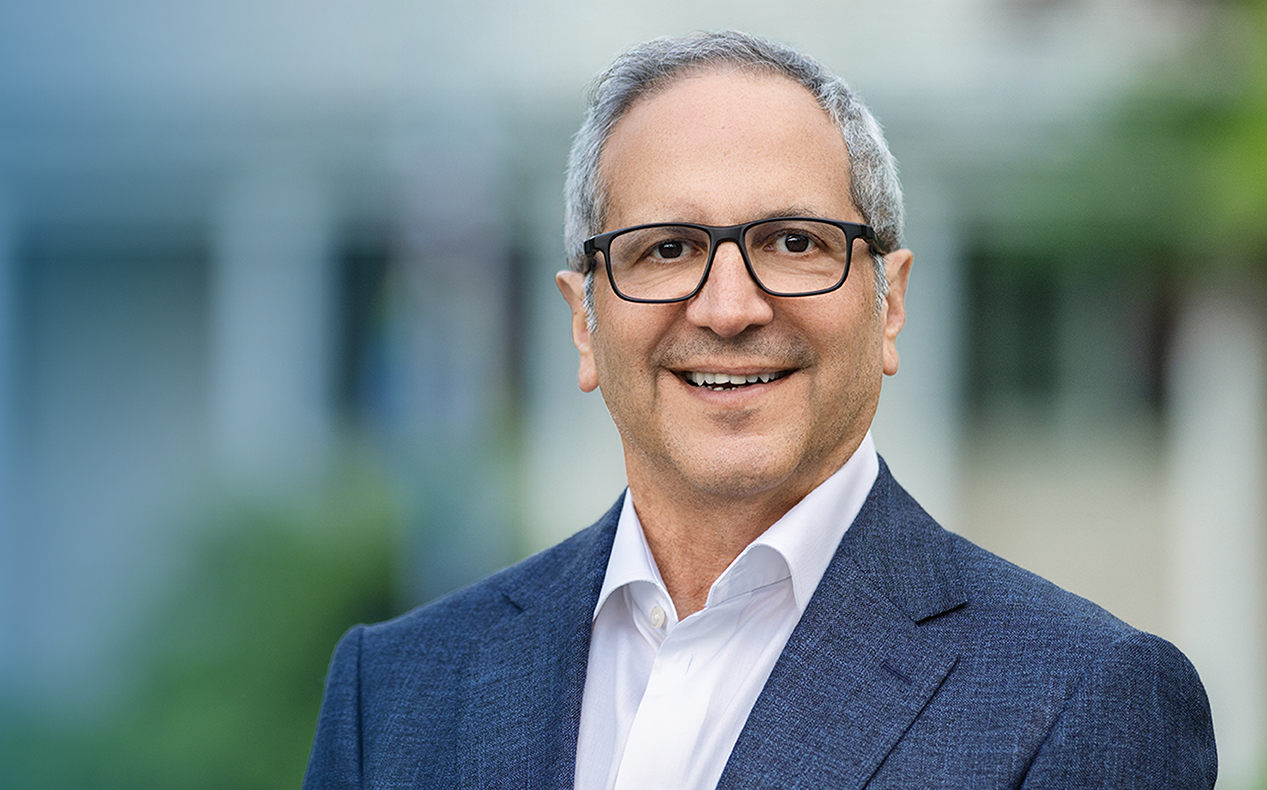
The Democratic candidate also said he does not believe that far-left NYC mayoral candidate Zohran Mamdani is ‘taking actions I would claim to be antisemitic’
ACROSS THE POND
U.K. Cabinet shake-up not likely to change British position on Israel, experts say
On Sunday, British Jews marched to protest against rising antisemitism in the country
Plus, United resumes Washington, Chicago routes to TLV
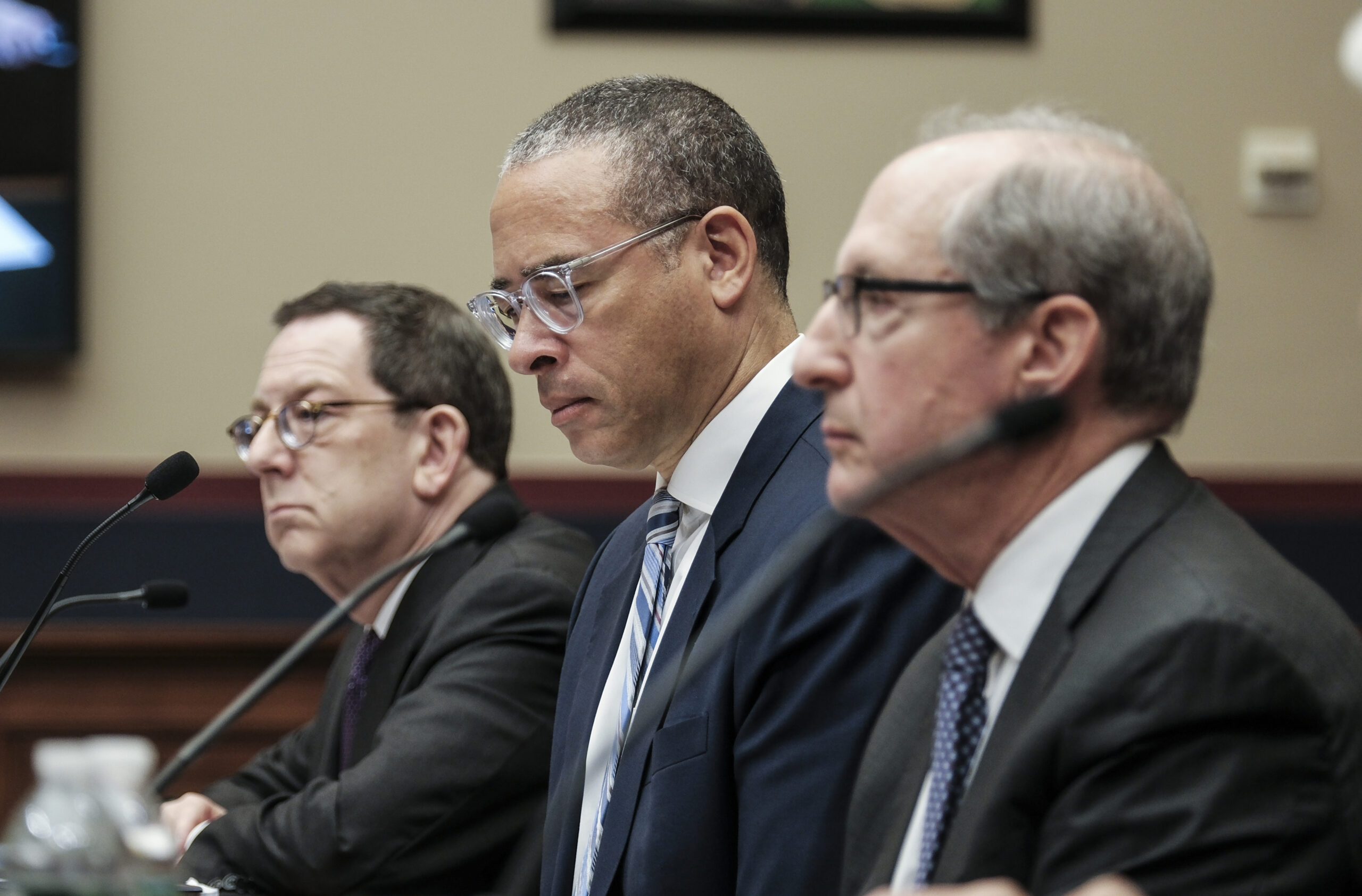
Michael A. McCoy/Getty Images
(L-R) Mr. Michael Schill, President, Northwestern University, Dr. Jonathan Holloway, President, Rutgers University and Mr. Frederick Lawrence testify at a hearing called "Calling for Accountability: Stopping Antisemitic College Chaos" before the House Committee on Education and the Workforce on Capitol Hill on May 23, 2024, in Washington, D.C.
Good Thursday afternoon.
This P.M. briefing is reserved for our premium subscribers like you — offering a forward-focused read on what we’re tracking now and what’s coming next.
I’m Danielle Cohen-Kanik, U.S. editor at Jewish Insider and curator, along with assists from my colleagues, of the Daily Overtime briefing. Please don’t hesitate to share your thoughts and feedback by replying to this email.
📡On Our Radar
Notable developments and interesting tidbits we’re tracking
Kicking off the new school year, embattled Northwestern University President Michael Schill announced today he is stepping down as president, remaining in an interim role until his successor is chosen.
Schill’s tenure coincided with a period of antisemitic turmoil on the Chicago-area campus and he was accused of handling the issue poorly, leading some lawmakers to call for his resignation.
A brief recap of Schill’s troubled tenure: He acceded to several demands of an anti-Israel encampment on campus in the spring of 2024, drawing condemnation from Jewish leaders and leading several Jewish members of Northwestern’s antisemitism advisory committee to step down. He then defended the move in a heated House Education and Workforce Committee hearing as being in the interest of Jewish students and was recalled by the committee this spring due to his alleged failure to live up to his own commitments from the previous hearing.
Committee Chairman Tim Walberg (R-MI) said in a statement today that “President Schill will leave behind a legacy of not only failing to deter antisemitism on campus but worsening it. … Northwestern’s next president must take prompt and effective action to protect Jewish students.”
In his resignation announcement, Schill said that “from the very beginning of my tenure, Northwestern faced serious and often painful challenges. … I was always guided by enduring values of our University: protecting students, fostering academic excellence, and defending faculty, academic freedom, due process and the integrity of the institution”…
Columbia University, meanwhile, hired Jonathon Kahn as its senior associate dean of community and culture, a new position created to “build and lead initiatives that cultivate curiosity, civic purpose and meaningful dialogue” and “reimagine what a liberal arts and sciences education can be in the next century,” Jewish Insider’s Haley Cohen reports.
Kahn signed a 2021 letter supporting the Palestinian “indigenous resistance movement” and rejecting “the fiction of a ‘two-sided conflict,’” accusing Israel of carrying out “settler colonialism, apartheid, and ethnic cleansing”…
Secretary of State Marco Rubio called an Israeli proposal by far-right Finance Minister Bezalel Smotrich to annex parts of the West Bank “wholly predictable” in response to European countries’ planned recognition of a Palestinian state.
Rubio said, “We told all these countries. We said, if you guys do this recognition stuff — it’s all fake, it’s not even real — if you do it, you’re going to create big problems. There’s going to be a response from Israel … and it may even trigger these sorts of actions that you’ve seen, or at least these attempts at these actions. So we’re watching it closely.”
Rubio, who was asked about the issue today at a press conference in Quito, Ecuador, continued, “What you’re seeing with the West Bank and the annexation, that’s not a final thing. That’s something that’s being discussed among some elements of Israeli politics. I’m not going to opine on that today.”
“And by the way, let me tell you something. The minute, the day that the French announced their [intent to recognize a Palestinian state], Hamas walked away from the negotiating table. … We also warned that that would happen, and it did. Sometimes, these guys don’t listen,” Rubio said.
The issue of West Bank annexation was due to be discussed in a high-level meeting convened by Israeli Prime Minister Benjamin Netanyahu today but was reportedly removed from the agenda after the UAE warned such a move would be a “red line” for regional normalization…
Israeli officials told The Wall Street Journal that Mossad Director David Barnea and Foreign Minister Gideon Sa’ar have joined IDF Chief of Staff Eyal Zamir in expressing hesitation to Netanyahu over the IDF’s plan to expand its offensive into Gaza City. They have also argued in favor of reaching a partial hostage-release deal with Hamas as an alternative to the comprehensive deal Israel is currently seeking…
A viral accusation that the IDF killed an 8-year-old Palestinian boy at a Gaza Humanitarian Foundation aid site in May was proven false when the boy was found to be alive and safely extracted from the Gaza Strip. The claim had been made by Anthony Aguilar, a former GHF contractor and Green Beret, who repeated the story on far-right and far-left media outlets.
Johnnie Moore, head of the GHF, said in a statement today, “When this lie was brazenly, cravenly shared from the press to the halls of Congress, our team set out to find this little boy — whatever it took.” He attributed the success to “veterans who never stopped working to find him and bring him to safety in the most complex environment imaginable”…
A report by the U.N.’s International Atomic Energy Agency, obtained by the Associated Press, found that, as of one day before Israel’s strikes on Iran’s nuclear facilities began, Iran had escalated its nuclear enrichment and increased its stockpile of near weapons-grade enriched uranium to where it could soon produce at least one atomic bomb…
On the Hill, Sen. Tom Cotton (R-AR) asked the FBI to investigate the Palestinian Youth Movement as a “threat to U.S. national security” after one of its leader, Aisha Nizar, called for Palestinian activists to “disrupt” the supply chain for F-35 fighter jets at the recent People’s Conference for Palestine in Michigan…
Rep. Buddy Carter (R-GA), who is running for Senate in Georgia, filed a resolution today to censure Rep. Rashida Tlaib (D-MI) for “promoting and cheering on terrorism and antisemitism” at the same conference…
Semafor’s David Weigel reports from this year’s National Conservatism conference, which is winding down in Washington today and featured a host of high-level right-wing personalities from Trump administration officials to lawmakers and influencers.
Conference speakers and attendees were jubilant over what they view as conservative successes in President Donald Trump’s second term, but there was one “possible future sore point that conference organizer Yoram Hazony acknowledged openly: Israel.”
“Hazony was upset by the ‘depth of the slander of Jews as a people’ that he saw in corners of the online right. The Israel critics in their fold could make the nationalist ‘revolution consume itself,’ he added, and risk everything,” Weigel wrote…
In long anticipated news, United Airlines announced today it’s restarting direct flights to Tel Aviv from Chicago O’Hare and Washington Dulles in early November…
⏩ Tomorrow’s Agenda, Today
An early look at tomorrow’s storylines and schedule to keep you a step ahead
Keep an eye on Jewish Insider tomorrow morning for reporting on a new cross-faith initiative to address antisemitism led by Robert Kraft’s Foundation to Combat Antisemitism.
This weekend, Sen. Bernie Sanders (I-VT) will be campaigning with New York City Democratic mayoral nominee Zohran Mamdani in the next installment of Sanders’ Fighting Oligarchy tour, after an appearance in Maine last weekend with anti-Israel Democratic Senate candidate Graham Platner.
We’ll be back in your inbox with the Daily Overtime on Monday. Shabbat shalom!
Stories You May Have Missed
ENVOY INTERVIEW
Amb. Leiter: Nature of U.S.-Israel aid may change in coming years
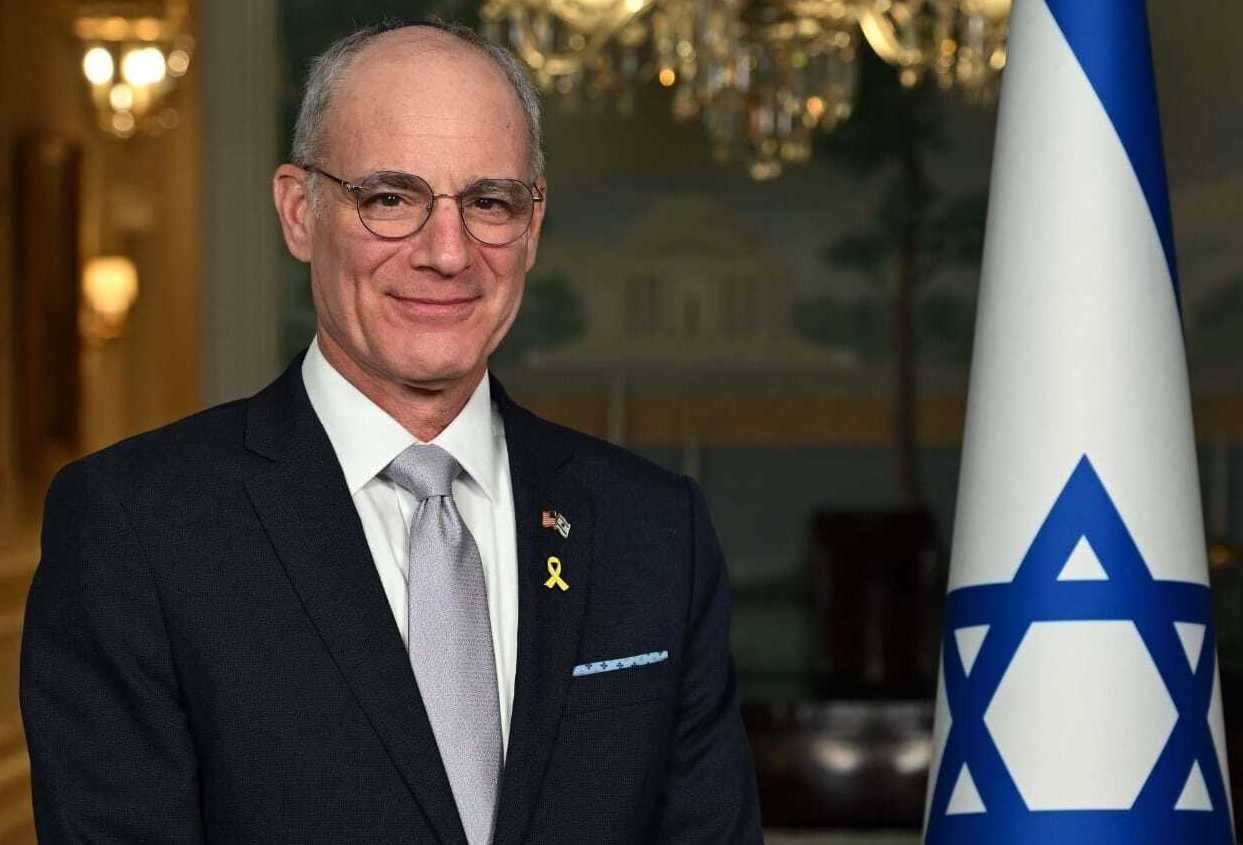
‘It’s a very partisan atmosphere in Washington right now. Strong support for Israel in the [Trump] administration almost drives the Democratic opposition into opposing very close support for Israel,’ the ambassador said
EYE ON ANKARA
Lawmakers take aim at Turkey in 2026 defense bill

House lawmakers introduce series of amendments seeking to place further restrictions on U.S. aid on Ankara over its support for Hamas and hostility toward Israel
Plus, former Sen. Sununu considers a New Hampshire comeback
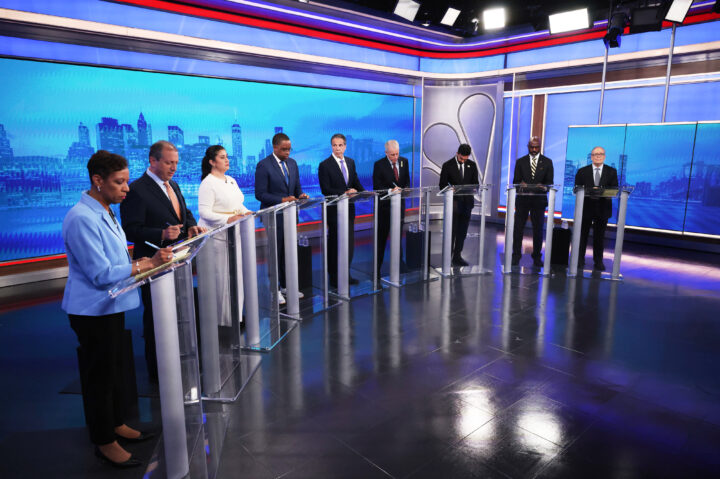
Yuki Iwamura/AP Photo/Bloomberg via Getty Images
Adrienne Adams, New York City mayoral candidate, from left, Brad Lander, New York City mayoral candidate, Jessica Ramos, New York City mayoral candidate, Zellnor Myrie, New York City mayoral candidate, Andrew Cuomo, New York City mayoral candidate, Whitney Tilson, New York City mayoral candidate, Zohran Mamdani, New York City mayoral candidate, Michael Blake, New York City mayoral candidate, and Scott Stringer, New York City mayoral candidate, during a mayoral Democratic primary debate in New York, US, on Wednesday, June 4, 2025.
Good Wednesday afternoon.
This P.M. briefing is reserved for our premium subscribers like you — offering a forward-focused read on what we’re tracking now and what’s coming next.
I’m Danielle Cohen-Kanik, U.S. editor at Jewish Insider and curator, along with assists from my colleagues, of the Daily Overtime briefing. Please don’t hesitate to share your thoughts and feedback by replying to this email.
📡On Our Radar
Notable developments and interesting tidbits we’re tracking
Advisors to President Donald Trump have discussed giving New York City Mayor Eric Adams and Republican mayoral candidate Curtis Sliwa positions in the president’s administration, sources tell The New York Times, in order to consolidate New York City voters behind former Gov. Andrew Cuomo, running as an independent, as a bid to block far-left Democratic mayoral nominee Zohran Mamdani’s path to Gracie Mansion.
Adams has already been offered a position at the U.S. Department of Housing and Urban Development, Politico reports.
Cuomo told a group of donors last month that he anticipated Trump would get involved in the race and help bolster his prospects…
Turning internationally, Trump appeared to support Israel’s desire for a comprehensive deal to end the war in Gaza, as he posted this morning on Truth Social, “Tell Hamas to IMMEDIATELY give back all 20 Hostages (Not 2 or 5 or 7!), and things will change rapidly. IT WILL END!”
The figure of 20 hostages likely refers to the hostages thought to still be alive; there are a total of 50 hostages being held in Gaza…
U.S. Ambassador to Israel Mike Huckabee held a closed-door briefing for members of the House Foreign Affairs Committee this morning on issues including the hostages and developments in the West Bank, lawmakers told Jewish Insider.
“Given the insistence on the part of the French and other Europeans to recognize a Palestinian state, I thought it was important for my colleagues to have a greater understanding of what we’re actually talking about with respect to Judea and Samaria, or the West Bank, and how it is actually governed post-Oslo,” Rep. Mike Lawler (R-NY), who organized the briefing, said.
Asked whether the group had discussed a potential declaration of Israeli sovereignty in that area, Lawler responded, “No, we had a broad discussion on the entirety of the situation there”…
On the campaign trail, former Sen. John Sununu (R-NH) is considering a bid for Senate to replace retiring Sen. Jeanne Shaheen (D-NH), telling a local outlet he will make a decision by the end of the month.
Sununu would be a formidable candidate in the race, given his name recognition and family connections. (His brother, Chris, served as the state’s popular governor from 2017-2025, and his dad was both the state’s former governor and former President George H.W. Bush’s chief of staff.)
But in a year that’s shaping up to be favorable for Democrats, Sununu would face a challenging race against Rep. Chris Pappas (D-NH), the expected Democratic nominee with a history of winning tough races in a swing district. Pappas launched his candidacy in April shortly after Shaheen announced her retirement…
In academic news, a federal judge ruled today that the Trump administration broke the law in freezing billions of dollars of Harvard’s research funding.
The government had argued that Harvard was no longer deserving of the funds due to antisemitism on campus, but Judge Allison Burroughs wrote, “We must fight against antisemitism, but we equally need to protect our rights, including our right to free speech, and neither goal should nor needs to be sacrificed on the altar of the other … Harvard is currently, even if belatedly, taking steps it needs to take to combat antisemitism and seems willing to do even more if need be.”
The ruling strengthens Harvard’s position in settlement talks with the administration, which were expected to result in a $500 million fine for the university…
After the International Association of Genocide Scholars adopted a resolution accusing Israel of committing genocide, pro-Israel activists made a mockery of the organization by registering to become members online, highlighting that anyone could join the respected academic and professional organization by paying a nominal fee, not necessarily by having recognized expertise.
IAGS took down its member profiles on its website and shut down its X account after the issue was made public…
Yair Rosenberg chronicles the rise of Hitler apologists among far-right media personalities, including Tucker Carlson and Candace Owens, in The Atlantic, highlighting several guests on Carlson’s podcast who have sought to recast Hitler’s actions as misunderstood.
“Carlson and his fellow travelers on the far right correctly identify the Second World War as a pivot point in America’s understanding of itself and its attitude toward its Jewish citizens. The country learned hard lessons from the Nazi Holocaust about the catastrophic consequences of conspiratorial prejudice. Today, a growing constituency on the right wants the nation to unlearn them,” Rosenberg writes…
In a move exciting political junkies and congressional watchers around the nation, C-SPAN announced it will be coming to YouTube TV and Hulu this fall…
⏩ Tomorrow’s Agenda, Today
An early look at tomorrow’s storylines and schedule to keep you a step ahead
Keep an eye on Jewish Insider tomorrow morning for an interview with Israeli Ambassador to the U.S. Yechiel Leiter on the future of U.S. aid to Israel and reporting on a leading Democratic candidate for Senate in Iowa’s support for conditions on Israel’s fight against terror.
Tomorrow, Israeli President Isaac Herzog is set to meet with Pope Leo XIV at the Vatican (after a brief diplomatic kerfuffle over who initiated the meeting) to discuss the hostages and the war in Gaza. Herzog was meant to meet with the pope’s predecessor, Pope Francis, before his death.
Stories You May Have Missed
SUCCESSION IN MANHATTAN
Nadler’s handpicked successor drawing scrutiny over Mamdani endorsement
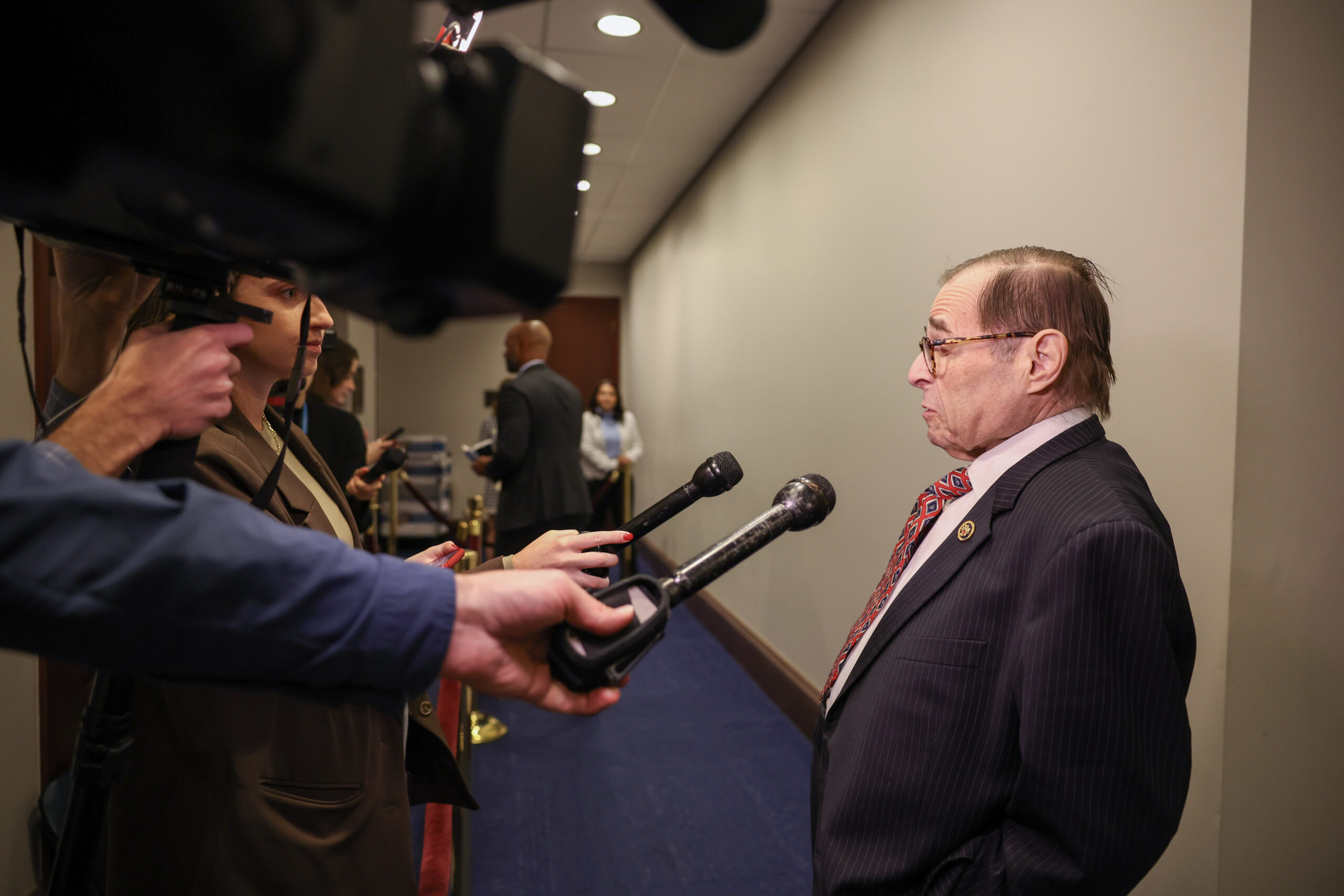
Like the retiring congressman, New York Assemblyman Micah Lasher endorsed the anti-Israel mayoral nominee
MILITARY MUSCLE
China uses WWII memory to project power in military parade and international diplomacy

The parade was an example of how Beijing has used WWII not only to encourage nationalism, but to project power internationally, from Jerusalem to Taipei and beyond
Plus, Platner doubles down on anti-Israel fixation

Mostafa Alkharouf/Anadolu via Getty Images
A general view of Jerusalem on June 13, 2025.
Good Tuesday afternoon.
This P.M. briefing is reserved for our premium subscribers like you — offering a forward-focused read on what we’re tracking now and what’s coming next.
I’m Danielle Cohen-Kanik, U.S. editor at Jewish Insider and curator, along with assists from my colleagues, of the Daily Overtime briefing. Please don’t hesitate to share your thoughts and feedback by replying to this email.
📡On Our Radar
Notable developments and interesting tidbits we’re tracking
Maine Democratic Senate candidate Graham Platner is unusually focused on anti-Israel attacks in his bid to unseat Sen. Susan Collins (R-ME), Jewish Insider‘s Marc Rod reports. Every one of Platner’s active ads on Facebook and Instagram, as well as many of his written advertisements, include a repudiation of AIPAC and around half accuse Israel of genocide…
In another Senate race to keep an eye on, Rep. Ashley Hinson (R-IA) hinted she’ll be running to replace Sen. Joni Ernst (R-IA), who this afternoon officially announced her retirement from the Senate at the end of her current term. Hinson said she would be President Donald Trump’s “strongest ally in the Senate” and “will have an announcement soon”…
Meanwhile in Foggy Bottom, a State Department cable sent to U.S. embassies on Aug. 18 indicated the department has suspended approvals for almost all Palestinians seeking to enter the U.S. on visitor visas, The New York Times reports, shortly before the department revoked visas for Palestinian Authority officials ahead of the U.N. General Assembly meeting in New York this month. The suspension could prevent Palestinians from entering the country for medical treatment, attendance at American universities, business travel and more…
French President Emmanuel Macron and Saudi Crown Prince Mohammed bin Salman announced today that they will co-chair another conference on the two-state solution on Sept. 22 on the sidelines of the UNGA, where several European countries are expected to announce their recognition of a Palestinian state.
Macron called the U.S.’ decision to revoke the visas of PA officials “unacceptable” and said it must be reversed.
Palestinian Vice President Hussein al-Sheikh sent a letter to Secretary of State Marco Rubio similarly asking him to reconsider the revocation of PA President Mahmoud Abbas’ visa to attend the UNGA, arguing it was made on “false pretenses,” according to Axios…
U.S. Ambassador to Israel Mike Huckabee recently told Israeli officials the Trump administration is concerned about the security implications of a potential economic collapse of the Palestinian Authority in the West Bank. “If the Palestinian economy completely collapses, it will not be a victory for anyone. … Desperate people do desperate things,” Huckabee told Israel’s Channel 12…
Rubio is expected to visit Israel the week of Sept. 14 where he will reportedly attend the Sept. 15 inauguration ceremony for the “Pilgrimage Road” at the City of David archeological site, a recently discovered path that led to the Temple Mount during the Second Temple Period. (Read JI’s coverage of the Pilgrimage Road excavation here)…
Also making the long flight, several high-profile venture capitalists, including Palantir co-founders Peter Thiel and Joe Lonsdale as well as Elad Gil and Keith Rabois, were in Israel this past weekend where they attended the wedding of VC investor Zach Frenkel. Some of the attendees reportedly met with Israeli Prime Minister Benjamin Netanyahu while in town…
Michael Velchik, the Department of Justice’s lawyer defending the Trump administration in its battle against Harvard in federal court, called Hitler’s Mein Kampf his favorite book and wrote a paper from the dictator’s perspective during his time as a Harvard undergraduate, which “so unnerved the instructor that he was asked to redo the assignment,” The Boston Globe reports. Velchik said in court in July that Harvard no longer deserved federal funding based on its “wanton” and “deliberate indifference to antisemitism”…
Robert Satloff, executive director of The Washington Institute for Near East Policy, called the International Association of Genocide Scholars’ declaration that Israel is committing genocide in Gaza “one of the most egregious examples of the dereliction of scholarly responsibility in recent history.”
The IAGS resolution, approved by less than a third of its members over the weekend, “reflects not one iota of original or independent research,” Satloff wrote, instead relying on findings from the U.N., Special Rapporteur Francesca Albanese and anti-Israel human rights organizations…
⏩ Tomorrow’s Agenda, Today
An early look at tomorrow’s storylines and schedule to keep you a step ahead
Keep an eye on Jewish Insider tomorrow morning for reporting on China’s shifting rhetoric on Israel amid its aggressive posturing on the international stage, as well as an interview with Rep. George Latimer (D-NY) about his recent trip to Israel with a delegation of freshman Democratic members.
We’re tracking the many potential candidates who may join the race to succeed Rep. Jerry Nadler (D-NY), after he announced his retirement last night.
Though Nadler is expected to support his former aide, state Assemblyman Micah Lasher, as his successor, politicos speculate other contenders for the Manhattan district could include high-profile New Yorkers from Rep. Dan Goldman (D-NY), who represents a neighboring district, to Lina Khan, the former commissioner of the Federal Trade Commission.
Liam Elkind, a 26-year-old Jewish nonprofit leader who launched his bid in July to unseat Nadler in a generational challenge, is also still in the race. Stay tuned to JI for coverage as the field develops.
Tonight, the House Appropriations Committee‘s Labor, Health and Human Services, Education and Related Programs Subcommittee will vote on a funding bill for the Department of Education that includes sweeping new provisions restricting federal funding for universities that fail to address antisemitism but also cuts funding for the Office for Civil Rights.
Also tonight, the Senate will begin the process of finalizing the 2026 National Defense Authorization Act, which may include votes on several amendments relating to Middle East defense programs in the coming days.
Tomorrow, the House Foreign Affairs Committee is holding a members-only virtual briefing with Huckabee focused on the West Bank.
Stories You May Have Missed
MOU MINEFIELD
Negotiations for next U.S.-Israel aid deal faces uphill battle with changing political tides

The next U.S.-Israel memorandum of understanding will need to be secured in a political environment much more hostile to Israel than 10 years ago
WISDOM CARRIED FORWARD
New Humash features Rabbi Sacks’ posthumously published translations
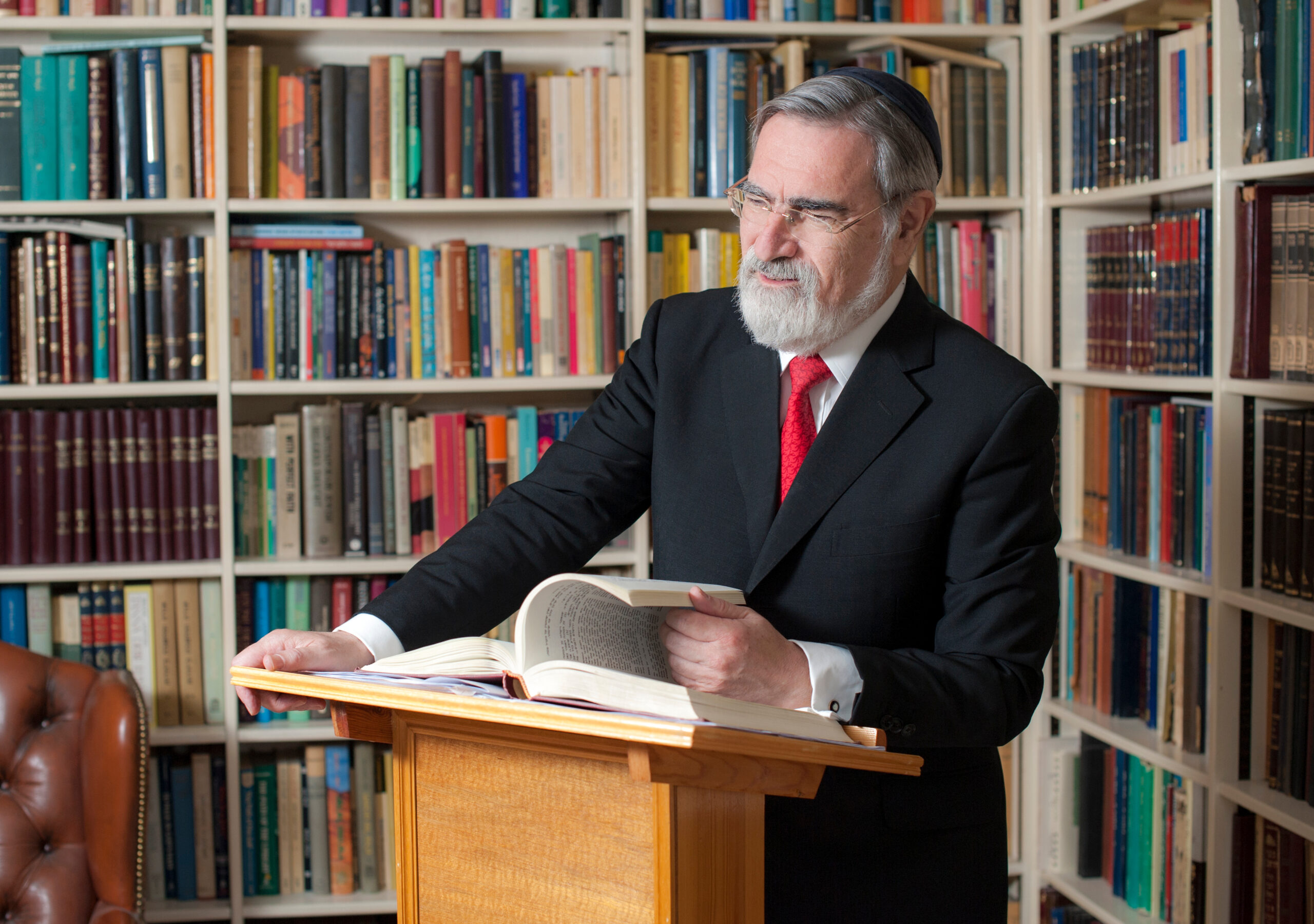
English translation, commentary by former U.K. chief rabbi seeks to ‘make Torah relevant to us today’
Chabad’s building at Harvard is located off campus, on private property in Cambridge, Mass.
JOSEPH PREZIOSO/AFP via Getty Images
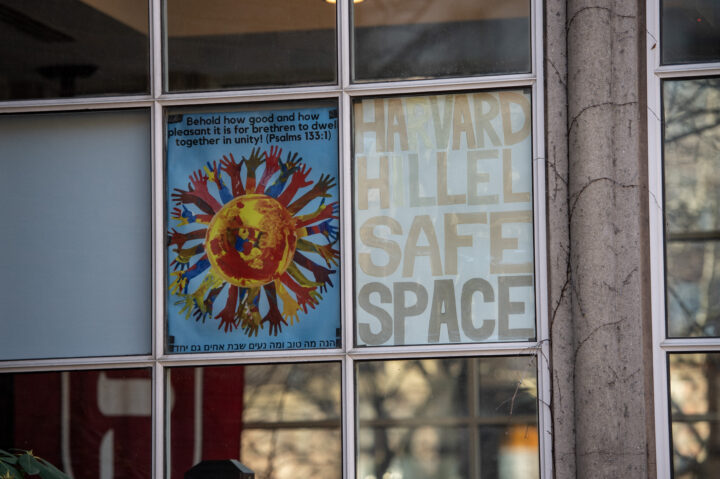
A sign calls the building a safe space at the jewish student organization HILLEL society's building at Harvard University in Cambridge, Massachusetts on December 12, 2023.
Harvard University’s recent decision to cover security costs for Harvard Hillel was celebrated by many Jewish students as a way to alleviate growing security costs amid a surge in campus antisemitism. But for others, it raised questions about why the agreement did not extend to other Jewish groups affiliated with the school, such as Harvard Chabad.
“Of course, there is a sense that there should be a responsibility” to cover Chabad’s security as well, Harvard Chabad Rabbi Hirschy Zarchi told Jewish Insider, although he said that he has never directly asked the administration to do so.
Alex Bernat, Harvard Chabad’s outgoing undergraduate student president who graduated in the spring, said it’s “crucial” that Chabad receive the same funding. “If you want to make claims about protecting the Jewish community, you have to protect the whole Jewish community,” he told JI.
“As an incoming student planning to be active in Chabad, I’m concerned that only funding security for Hillel overlooks the safety needs of the entire Jewish community,” Stella Hiltzik, who is slated to begin her freshman year at Harvard in the fall, told JI. “In today’s climate, all Jewish spaces deserve equal protection.”
While Hillel owns its building structure, that building sits on university property. It also contains a Harvard dining facility and other spaces that are accessible to all students, faculty and staff using Harvard’s ID swipe system. Chabad’s building is located on private property in a Cambridge, Mass. neighborhood. The latter has been guarded by armed security — funded by donors — every day since the Oct. 7, 2023 terrorist attacks and subsequent rise of antisemitism on college campuses.
A Harvard spokesperson declined to comment to JI regarding the reason Hillel received university-funded security, but Chabad didn’t.
Since Oct. 7, Harvard Chabad has been a centerpoint of campus security concerns. In a December 2023 speech made on campus during a Hanukkah menorah lighting, Zarchi described an atmosphere of fear for Jewish students and for his own family, who he said had been advised by Harvard’s police department to obtain private security after Harvard Chabad became the first university to screen IDF footage from the Hamas terror attacks in Israel. “Twenty-six years I gave my life to this community. I’ve never felt more alone,” Zarchi said at the time.
On July 31, following years of lobbying by Harvard Hillel officials and advocates, Harvard agreed to cover all security costs for the university’s Hillel through the rest of Harvard President Alan Garber’s tenure, which is set to conclude at the end of the 2026-27 academic year. The move comes as Harvard faces billions of dollars in federal funding cuts from the Trump administration over its alleged failure to address antisemitism on campus.
“By taking on responsibility for security at Hillel, Harvard University is making a powerful statement: Harvard is committed to the safety of Jewish students,” Rabbi Jason Rubenstein, executive director of Harvard Hillel, told JI when the announcement was made.
Zarchi called it “misleading” to claim that the university is protecting Jewish students broadly if Chabad is not included. Since last week’s announcement, Zarchi said he has received “floods” of calls and emails from students, parents and alumni who are “deeply concerned” about the university limiting security funding to Hillel. Chabad, according to Zarchi, is attended by nearly 500 students per week.
“It’s this public misrepresentation and abandonment of the safety of so many that we need to address,” said Zarchi.
“All Jewish students at Harvard, whether it’s Chabad or Hillel, should have safety and security.”
The agreement comes as the school is preparing to reach a settlement with the federal government over its handling of antisemitism

Zhu Ziyu/VCG via Getty Images
A glimpse into the Harvard University campus on May 24, 2025 in Cambridge, Massachusetts.
Harvard University, in a move long sought-after by advocates for Jewish college students, agreed on Thursday to cover all security costs for the university’s Hillel ahead of the upcoming academic year, Jewish Insider has learned.
“By taking on responsibility for security at Hillel, Harvard University is making a powerful statement: Harvard is committed to the safety of Jewish students,” Rabbi Jason Rubenstein, executive director of Harvard Hillel, told JI.
Security costs “represent a significant part of our annual budget,” Rubenstein said, declining to provide figures. The agreement is slated to run through the rest of Harvard President Alan Garber’s tenure, which is set to conclude at the end of the 2026-27 academic year.
“We should take this moment to appreciate the efficacy of Hillel’s advocacy and President Garber’s principled leadership. While more work remains to be done, tangible results like these are encouraging signs of the will and capacity for real and significant institutional change at Harvard,” Rubenstein continued, noting that advocacy efforts for Harvard to take on Hillel’s security have been in the works for several years, predating the Oct. 7, 2023, terrorist attacks.
Harvard has faced billions of dollars in federal funding cuts for research from the Trump administration over its alleged failure to address antisemitism on campus. The university’s decision to fund Hillel security comes as it has signaled a willingness to settle with the government to restore its funds, The New York Times reported this week — a deal which could see the school agree to the Trump administration’s demand for as much as $500 million to end its clash.
The Ivy League school has made several recent attempts to appeal to the Jewish community as it gears up for a settlement. On Monday, the university expanded its ties to Israel, announcing a new undergraduate study abroad program with Ben-Gurion University of the Negev and a postdoctoral fellowship for Israeli scientists at Harvard Medical School.
“Harvard University’s commitment to the safety and well-being of members of our Jewish community is paramount,” a Harvard spokesperson told JI. “Recent tragic events in communities across the country are evidence of the growth in antisemitism and further Harvard’s resolve in our efforts to combat antisemitism on our campus.”
The university did not respond to a follow-up inquiry from JI asking why Chabad is not receiving security funding as well. Harvard Hillel’s dining facility and other spaces are generally more easily accessible, with Harvard students, faculty and staff being able to enter by swiping their university ID.
The decision for universities to take on Hillel security costs has been in flux in recent years. Yale University, for example, announced in December 2023 — as a response to Oct. 7 and subsequent rise of antisemitism on campus — that it would expand a pilot program launched the year prior and fully fund the cost of day-to-day security service for the Slifka Center, the university’s Hillel, for at least three years.
Adam Lehman, president and CEO of Hillel International, called for “other universities to follow Harvard’s example in this decision.”
“Harvard’s decision to fund these essential security measures reflects the understanding that Jewish students, like all students, deserve to be safe and welcome on campus,” Lehman told JI.
Columbia’s Hillel director said that the university is on track for a large incoming class of Jewish freshmen next year
CHARLY TRIBALLEAU/AFP via Getty Images
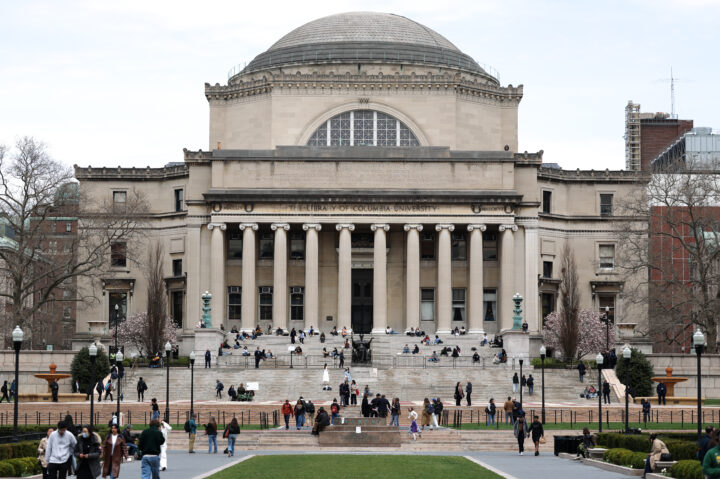
Students are seen on the campus of Columbia University on April 14, 2025, in New York City.
Earlier this year at a symposium in New York City, Jewish scholars gathered to analyze the recent surge of antisemitism on college campuses and debate whether Jewish students still belong at the country’s elite bastions of higher education.
“I certainly don’t think that we should abandon great citadels of learning or be chased out of them, although to be there takes fortitude that I don’t think should be asked of every student,” Rabbi David Wolpe, a former visiting scholar at Harvard University Divinity School, said during the event’s opening address. “So I’m going to give a selective answer: it depends who.”
Over the next two months, college freshmen will embark on new chapters at universities around the country. Many Jewish students have found appeal in other top schools, such as Vanderbilt in Nashville, Tenn., and Washington University in St. Louis, where administrators were quick to enforce university rules amid rising antisemitism in the aftermath of the Oct. 7, 2023, terrorist attacks, and therefore avoided much of the chaos that played out on other campuses.
But some Jewish students are still seeking admission to the country’s most prestigious schools.
Who are these students making the choice to display the fortitude that Wolpe referenced by attending Columbia and Harvard —- two Ivy League campuses that have been beset by nearly two years of controversy over anti-Israel encampments and classroom disruptions, physical assaults of Jewish students and battles with the federal government, including potential loss of accreditation — over an alleged failure to address antisemitism?
Leah Kreisler, a recent graduate of Winston Churchill High School in Potomac, Md., decided in ninth grade that she wanted to attend Columbia. Kreisler plans to enroll in Columbia’s dual-degree program with the Jewish Theological Seminary and will begin next year, following a gap year in Israel.
Recent events have only reinforced Kreisler’s dream of attending the storied institution. “Columbia has always had a politically charged environment and I honestly think that fits a part of who I am,” she told Jewish Insider. “I like having those kinds of discussions and engaging with people I disagree with. That spirit drew me to the school.”
She’s also hopeful that by the time she arrives at Columbia for the 2026-27 school year, “things will get figured out.” The university is in talks with the federal government to restore the institution’s federal funding, which was slashed in March due to the antisemitic demonstrations that have roiled the campus since Oct. 7.
Still, Kreisler admitted she’s “a little bit scared” to face antisemitism, which she hasn’t directly encountered in her tight-knit D.C. suburb with a sizable Jewish community. “There will probably be people in the streets doing antisemitic things,” she said, noting that she often gets “weird looks from Jewish members of the community” when she shares her plans to attend Columbia.
Laura Hosid runs a private business in Potomac guiding high school students through the college admissions process. She works with many students like Kreisler who are “often willing to overlook [antisemitism] at schools like Harvard and Columbia, if they can get in,” Hosid, who is Jewish, told JI.
“At slightly less selective schools, though, it’s more of a factor,” she said. “Students are willing to look away if there’s too much anti-Israel stuff.”
“Jewish life at Columbia is Dickens-esque: the best of times and the worst of times,” said a Jewish Columbia alum who requested to remain anonymous. “There are real challenges, but at the same time, you can go to Columbia Hillel, the Kraft Center for Jewish Life, and access the most interesting people in the world. Bob Kraft shows up for events,” he said, referencing the billionaire owner of the New England Patriots for whom the center is named.
“I’m certainly not discouraging students if they are interested in schools like Columbia and Harvard,” Hosid continued. “I’m just making sure that they are well aware of what’s going on there and how it compares to what the climate is like at other schools.”
A Jewish Columbia alum who requested to remain anonymous told JI that he still sees his alma mater as “an amazing New York City school with an incredible alumni network.” So he was supportive when his daughter, an incoming Columbia freshman, committed to the university.
“Jewish life at Columbia is Dickens-esque: the best of times and the worst of times,” he said. “There are real challenges, but at the same time, you can go to Columbia Hillel, the Kraft Center for Jewish Life, and access the most interesting people in the world. Bob Kraft shows up for events,” he said, referencing the billionaire owner of the New England Patriots for whom the center is named.
In 1967, Columbia’s student body was 40% Jewish, according to a Jewish Telegraphic Agency report at the time. But even as Jewish enrollment at Columbia has declined since then, it still has one of the highest percentages of Jewish undergraduates in the Ivy League, at an estimated 22%. “The numbers for this year’s incoming class are quite strong,” Brian Cohen, executive director of Columbia Hillel, told JI.
Cohen said that the center’s “top priority is to make sure that every Jewish student feels seen and supported and part of a vibrant Jewish community from the moment they arrive at Columbia University.”
“Everything we hear anecdotally is that the number of applications of Jewishly involved students to Harvard were stable — if not increased — from last year to this year,” said Rabbi Jason Rubenstein, the director of Harvard Hillel.
That’s been Hillel’s goal for years — even before antisemitism reached record highs on campus. But Cohen noted that for the past two academic years, “everything is ramped up.”
“We want to make sure that when we meet students and families face-to-face they already have some idea of who we are and the relationship isn’t starting from square one,” he said, outlining two priorities. “One is that students understand that they are entering into this thriving, diverse Jewish community on campus. [The second is] that, should any problems arise during their time at Columbia, they have trusted resources to go to that are easily accessible and can help support them in navigating the various university processes.”
Rabbi Jason Rubenstein, the director of Harvard Hillel, is similarly spending the summer preparing for a new class of Jewish students. He’s hearing less concern around antisemitism from incoming students and their parents compared to last year. “I think that’s a combination of all of us adjusting our baselines and knowing what we’re getting into, and that last year was calmer on campus than the year before.”
Like Columbia, Harvard has had billions of dollars in federal grants and contracts frozen by the Trump administration. The university filed suit against the government in April, claiming that the cuts violate the First Amendment. A 300-page antisemitism report released by the university in April described “severe problems” that Harvard’s Jewish students have faced in the classroom, on social media and through campus protests.
“Everything we hear anecdotally is that the number of applications of Jewishly involved students to Harvard were stable — if not increased — from last year to this year,” Rubenstein said. Ramaz, a Modern Orthodox Jewish day school in Manhattan, for instance, admitted five students to Harvard the past admissions cycle, with four planning to attend. “That’s the highest in living memory,” Rubenstein said.
One of the Ramaz graduates starting at Harvard this fall is Stella Hiltzik, who grew up hearing “incredible stories” from her mother’s time on the Boston campus. “But it wasn’t until I visited Harvard last year that I decided that was the place I wanted to be,” Hiltzik, whose major is undecided, told JI. She was drawn to Harvard “even despite all of the crazy things happening on campus” after seeing “how supportive, warm and comforting Jewish life on campus is — especially the Chabad. It feels like a sense of home,” Hiltzik said.
“Despite everything going on, when I say I’m going to Harvard, most people are proud of me and supportive,” Hiltzik continued. “But there are some people who ask me, ‘What are you thinking?’ For me, it’s honestly a cool conversation to have, because I get to tell them how I’m excited to be a Jewish voice on campus during these hard times.”
“Despite everything that has happened at Columbia,” Leah Kreisler, a recent graduate of Winston Churchill High School in Potomac, Md., said, “I don’t think that the solution to antisemitism is to remove ourselves from these institutions. That’s been my mentality throughout the college [application] process.”
“Jewish students are not being dissuaded,” Rubenstein said. “Which is a great thing because some people are chanting ‘Zionists are not welcome here’ and the one thing they most want is Jewish students to not come here.”
Students like Hiltzik and Kreisler offer a quiet rebuke to the billionaire alums of the Ivies who have begun to withhold their considerable donations. One Israeli venture capitalist went as far as to try to lure Jewish students attending Ivy League schools to transfer to universities in Israel.
“Despite everything that has happened at Columbia,” Kreisler said, “I don’t think that the solution to antisemitism is to remove ourselves from these institutions. That’s been my mentality throughout the college [application] process.”
“People shouldn’t be afraid to go to any of these schools,” echoed Hiltzik. “At the end of the day, you’re going to get a good education and you’re going to show everyone how cool it is to be a proud Jew. I feel, in a sense, that this is my version of fighting for my people.”
Many Jewish students are concerned about research cuts and a ban on international students, but others note that antisemitism has been on the decline since Trump’s crackdown
Zhu Ziyu/VCG via Getty Images
A glimpse into the Harvard University campus on May 24, 2025 in Cambridge, Massachusetts.
As Israeli students departed from Harvard University last month to begin summer break, the usual sense of relief and excitement at having completed another academic year was replaced by fear and uncertainty for many.
Amid the Trump administration’s battle with Harvard — which recently escalated to stripping the university of its ability to enroll foreign students entirely — “see you in the fall” was replaced with “I hope to see you in the fall” among international students exchanging goodbyes.
Harvard currently hosts more than 10,000 international students, according to university data. 160 of them are from Israel. On May 22, the White House issued a policy directive meant to completely cut off the university’s ability to admit international students, the first instance of the government doing so. A federal judge has since temporarily blocked President Donald Trump from implementing the policy, although the matter will work its way through the courts. If the White House is successful, international students must transfer schools or lose their visa.
Jewish students and faculty who conduct biomedical research at Harvard also face grim prospects, after Trump revoked billions of dollars in federal funds to the university.
“Jewish faculty may have grants, as well, that are being cut or canceled,” said Dr. Richard Schwartzstein, a professor at Harvard Medical School who has worked to raise awareness about antisemitism in medicine, and to incorporate lessons on antisemitism into the school’s anti-racism curriculum. “That has been disconcerting for everyone, because most of us don’t believe that biomedical research has much to do with the issues that the Trump administration seems to be concerned about. It seems to be merely used as a punishment.”
Rabbi Jason Rubenstein, executive director of Harvard Hillel, told Jewish Insider that “morale is low” among Jewish students planning a career in scientific and medical research, and among Jewish students from abroad.
“Those are major parts of the Harvard Jewish community, and they are really suffering and concerned about their future,” said Rubenstein.
At the same time, many Jewish students on campus expressed relief that the antisemitism and anti-Israel activism that was all too common in the aftermath of the Oct. 7, 2023 Hamas attacks had declined significantly in the previous school year.
Last year, for instance, hundreds of students and faculty members walked out of the school’s main commencement ceremony in solidarity with 13 anti-Israel student protesters who were denied degrees as a result of their involvement in the school’s illegal encampment that spring.
But last week, Harvard’s 374th Commencement appeared to run smoothly, with just a few subdued reminders of the campus chaos that has been wrought by Israel’s war with Hamas.
Harvard’s president, Alan Garber — booed at last year’s ceremony over his decision to not allow the demonstrators to graduate — received a standing ovation this year. A banner reading “There Are No Universities Left in Gaza” was briefly unfurled on the steps of the main library before being confiscated by campus police, the Harvard Crimson reported. Another, reading “Harvard Divest From Genocide in Gaza,” was dropped from a window of Sever Hall and taken down minutes later.
Alex Friedman, who just finished his second year at Harvard Law School, said he left Cambridge last month feeling “cautiously optimistic” about the direction in which the university is moving.
“Harvard is moving very quickly and aggressively to eliminate certain sources of anti-Israel bias on campus,” said Jesse Fried, a law school professor at Harvard. “If the Trump administration were not breathing down their neck, I believe progress would have been much slower.”
“There’s no question that campus was definitely quieter this year than in the previous year. That year was extraordinary, the outburst of antisemitism and anti-Israel activity on campus,” Friedman told JI last week. “The magnitude and consistency were definitely not the same. That, of course, doesn’t mean that the underlying issues have been solved. Antisemitism at Harvard has been a problem for decades, and it’s not going away overnight.”
Jesse Fried, a law school professor at Harvard, attributed to the change to a combination of “natural loss of energy” as students got bored of the topic, and “students’ sense that, ‘Okay, I could get into trouble.’”
Changes on campus were implemented at the beginning of the 2024-2025 school year, when Joe Biden was still president, Fried said, noting that Harvard’s progress in addressing antisemitism and students’ anti-Israel bias was not only a result of pressure from Trump. But once Trump came into office and began threatening Harvard — and then implementing policies that directly targeted the Ivy League university — change happened more quickly, Fried observed.
“Harvard is moving very quickly and aggressively to eliminate certain sources of anti-Israel bias on campus,” Fried said. “If the Trump administration were not breathing down their neck, I believe progress would have been much slower.”
Last month, under pressure from Trump, Harvard released a long-delayed report on campus antisemitism, which found that the university had “severe problems” in its handling of the issue. In March, before any funding had been revoked, Harvard paused a controversial partnership with a Palestinian university and let go leaders of its Center for Middle Eastern Studies.
Harvard’s Jewish community is “split” on how Trump is handling the problem, Fried said, although Trump’s revocation of federal research funding and his threat to bar international students from the university have upset many in the Jewish community.
“There might be some people who are supportive of what Trump is doing, because they see it as a necessary evil: ‘You have to do this in order to fix Harvard,’” said Fried. “But most of the Jewish community is appalled by what he’s doing and the tactics he’s using.”
Rubenstein echoed that the Jewish community has mixed reactions to Trump’s crackdowns. “Federal engagement has been helpful when it’s focused, measured and proportionate,” he said. “The threat of federal funding cuts was important in facilitating different actions throughout the university. For example, Harvard’s counsel was explicit that it wanted to settle the Title VI [of the Civil Rights Act of 1964] lawsuits before Trump’s inauguration.”
Before the government’s actions against Harvard escalated, aspects of the crackdown appeared to address antisemitism that had been pervasive on campus even before the Oct. 7 attacks, according to Rubenstein.
“Every time there’s an action taken by the Trump administration, an immediate email is sent discussing how Harvard will respond and offering support to students,” said Alex Friedman, who just finished his second year at Harvard Law School. “People are focusing on, ‘Oh, Harvard’s doing great. They’re really standing up,’ and understandably so. But this also shows that Harvard could have done that 18 months ago, after Oct. 7, when they were faced with what was happening on campus and what they were facing in the world, and yet they chose not to.”
“I’ve heard from faculty that they always felt Harvard has been one settlement away from the antisemitism policy we wanted,” Rubenstein said, “so they are grateful for the settlement [in January] which led to the adoption of the International Holocaust Remembrance Alliance’s working definition of antisemitism” as part of a resolution to two Title VI lawsuits.
Even as Harvard has made progress in tackling antisemitism, the university’s blundering response in the aftermath of the Oct. 7 attacks still stings for many Jewish Harvard affiliates, particularly when viewed in comparison to the urgency with which Harvard has responded to Trump’s policies.
“Every time there’s an action taken by the Trump administration, an immediate email is sent discussing how Harvard will respond and offering support to students,” said Friedman, the Harvard Law student. “People are focusing on, ‘Oh, Harvard’s doing great. They’re really standing up,’ and understandably so. But this also shows that Harvard could have done that 18 months ago, after Oct. 7, when they were faced with what was happening on campus and what they were facing in the world, and yet they chose not to.”
Looking ahead to the fall, Jewish leaders at Harvard expressed hope that their focus can return to strengthening Jewish life.
Rabbi Hirschy Zarchi, who leads the campus Chabad, said he intends to stay away from the “politics of the moment” and instead “focus on building and nurturing Jewish life and community … [which] we expect to continue to grow from strength-to-strength.”
Rubenstein expects “the disproportionate focus on Israel will really dissipate on campus when there’s peace in Israel, the hostages are returned, please God, and Hamas is no longer a threat in the Gaza Strip.”
Still, he predicts “several years of work and ongoing vigilance from the Jewish community, as antisemitism is ascendant in many corners where we didn’t used to think we had to combat it.”
And campus Jewish leaders are cautiously optimistic that the work won’t fall as heavily on them.
“What we hear consistently from Jewish students is by far the most important thing for their experience of being Jewish in college is the vibrancy of their Jewish community — the Shabbat dinners, friendship, trust, song, laughter. That need is not going anywhere,” Rubenstein said.
“That need is only growing, and in many ways we’ve lost track of it over the past year as we’ve turned attention to governance of the university, faculty politics and disciplinary procedures,” he continued. “That’s important, but our community needs to recommit to resources for the lives of Jewish students.”
Over 150 Israeli students at Harvard will be impacted by the move; they must transfer schools or lose their visas

Scott Eisen/Getty Images
An entrance gate on Harvard Yard at the Harvard University campus on June 29, 2023 in Cambridge, Massachusetts.
The Trump administration on Thursday stripped Harvard University of its ability to enroll foreign students, citing Harvard’s collaboration with the Chinese Communist Party, in what the Department of Homeland Security described as an act of accountability for the university “fostering violence, antisemitism and pro-terrorist conduct from students on its campus.”
The move is an escalation in President Donald Trump’s battle with Harvard, just one front in his war with elite higher education institutions. He has already revoked billions of dollars in federal funding from Harvard, as well as several other universities. Trump has also sought the deportation of hundreds of foreign students on college campuses over their alleged support for terrorism and antisemitism.
But this is the first instance of the White House completely cutting off a university’s ability to admit international students. Harvard currently hosts more than 10,000 international students, according to university data. 160 of them are from Israel. Current students must transfer schools or lose their visa.
“It is a privilege, not a right, for universities to enroll foreign students and benefit from their higher tuition payments to help pad their multibillion-dollar endowments. Harvard had plenty of opportunity to do the right thing. It refused,” Homeland Security Secretary Kristi Noem said in a statement.
Last month, Noem asked Harvard to provide data on the disciplinary records of foreign students on campus and their record of participating in protests. Noem said the information shared by Harvard in response was “insufficient.”
Harvard Hillel’s executive director, Rabbi Jason Rubenstein, expressed concern about the impact on Israeli students at Harvard.
“The current, escalating federal assault against Harvard — shuttering apolitical, life-saving research; threatening the university’s tax-exempt status; and revoking all student visas, including those of Israeli students who are proud veterans of the Israel Defense Forces and forceful advocates for Israel on campus — is neither focused nor measured, and stands to substantially harm the very Jewish students and scholars it purports to protect,” Rubenstein told Jewish Insider.
A university spokesperson did not immediately respond to a request for comment.
Barak Sella, an Israeli educator and researcher who earned a master’s degree from the Harvard Kennedy School in 2024, said the action will “be detrimental for the entire higher education system.”
“Never did any Jewish [organization] ask to ban the ability to accept foreign students, especially when a lot of the antisemitism is perpetrated by American citizens — aka the shooting last night,” Sella told JI, referring to the killing of two Israeli Embassy officials outside the Capital Jewish Museum in Washington. The alleged perpetrator is an American citizen.
Harvard is likely to take legal action in response, according to The Crimson.
Jewish Insider reporter Haley Cohen contributed to this report.
Plus, is Trump's Abrahamic Family House visit a harbinger for the region?

Pittsburgh Mayor Ed Gainey attends a May Day rally in Pittsburgh, May 1, 2025. (AP Photo/Gene J. Puskar)
Good Tuesday morning.
In today’s Daily Kickoff we interview religious freedom experts about the significance of President Donald Trump’s visit to the UAE’s Abrahamic Family House last Friday, and speak with strategists about the state of the Illinois Senate race following Rep. Lauren Underwood’s announcement that she will not be running. We also report on the threat by France, the U.K. and Canada to impose sanctions on Israel and a letter by a group of top House Republicans to Harvard University, questioning alleged connections to Iran and China. Also in today’s Daily Kickoff: Ronald Lauder, Sydney Altfield and Omer Shem Tov.
What We’re Watching
- NORPAC’s annual mission to Washington is bringing 1,000 allies to Capitol Hill to meet with members of Congress. Sens. Ted Cruz (R-TX) and John Fetterman (D-PA) will be speaking to attendees as part of the morning session.
- The Senate Foreign Relations Committee will hold a hearing with Secretary of State Marco Rubio on the State Department’s 2026 budget request. Rubio will also attend a hearing of the Senate Appropriations Committee’s State, Foreign Operations and Related Programs subcommittee on the president’s 2026 budget request for the State Department.
- The Senate Committee on Homeland Security & Governmental Affairs will hold a hearing on the Department of Homeland Security’s 2026 budget request with Homeland Security Secretary Kristi Noem.
- Reps. Chris Smith (R-NJ) and Jim McGovern (D-MA) will co-chair a congressional hearing of the Tom Lantos Human Rights Commission to conduct a global review of antisemitism. Speakers will include Ted Deutch, CEO of the American Jewish Committee; Marina Rosenberg, senior vice president for international affairs at the Anti-Defamation League; Eric Fusfield, director of legislative affairs at B’nai B’rith International; and Stacy Burdett, a consultant on antisemitism response and prevention.
- Tonight, the ADL will host its reception in Washington celebrating Jewish American Heritage Month. The National Museum of American Jewish Military History, along with AJC and Jewish War Veterans of the USA, will host a discussion in Washington, moderated by CNN anchor Wolf Blitzer, with three Jewish-American WWII veterans.
- The Qatar Economic Forum, sponsored by Bloomberg, kicked off in Doha today with an opening address delivered by Qatari Prime Minister Mohammed bin Abdulrahman Al-Thani. Other speakers today include Elon Musk; former CIA Director Gen. David Petraeus; Morgan Ortagus, the U.S. deputy special envoy to the Middle East; Mohammed Saif Al-Sowaidi, the CEO of the Qatar Investment Authority; and Marc Nachmann, global head of asset and wealth management at Goldman Sachs.
- The Middle East Forum 2025 Policy Conference continues today in Washington.
- The World Jewish Congress 17th Plenary Assembly concludes today in Jerusalem.
What You Should Know
A QUICK WORD WITH JI’s Matthew Kassel
As Pittsburgh’s bitterly contested mayoral primary concludes on Tuesday, the election represents the first major front in a broader proxy battle between moderate and progressive Democrats clashing over Israel and antisemitism, which could shape a range of developing contests at the state and federal levels.
The primary pits Mayor Ed Gainey, the progressive first-term incumbent whose record of commentary on Israel’s war in Gaza and handling of antisemitic activity have sparked backlash from Jewish leaders, against Corey O’Connor, a centrist challenger who is touting his long-standing ties to Pittsburgh’s sizable Jewish community and highlighting his support for Israel.
In recent weeks, the race has grown increasingly nasty, turning in part on escalating tensions over Israel’s war with Hamas that have coincided with a glaring uptick in antisemitic incidents. Pittsburgh police said on Monday, for instance, that they were investigating the distribution of antisemitic flyers in the heavily Jewish neighborhood of Squirrel Hill — following high-profile acts of vandalism last year at several Jewish buildings in the city.
While Gainey has condemned antisemitism, he has otherwise drawn criticism for declining to challenge efforts by far-left activists to bring an Israel boycott and divestment referendum to Pittsburgh voters. He has also stirred controversy for signing a joint statement addressing the one-year anniversary of the Oct. 7, 2023, attacks that made no mention of Hamas and used insensitive language that alienated even some of his closest Jewish allies on the far left.
During a candidate forum hosted last month by Pittsburgh’s Jewish Federation, which has publicly expressed disappointment with Gainey’s record on such issues, the mayor defended his approach to the failed ballot measures while acknowledging that his statement had caused offense. “I apologize for those mistakes,” he said, noting that if given the chance to redo the letter, he would first seek input “to discover exactly what’s wrong with the wording.”
Despite his contrition, many Jewish community members remain skeptical of the mayor, whose allies have spread false accusations that national pro-Israel groups such as AIPAC are spending to boost O’Connor, the Allegheny County controller. Last week, meanwhile, supporters of Gainey also circulated a letter in Squirrel Hill alleging that the Israel-Hamas war has been imported into the race as a pretext for “fake accusations of antisemitism” now being “used as a political tool to try to pry Mayor Gainey out of office.”
Jeremy Kazzaz, executive director of the Beacon Coalition, a local Jewish advocacy group whose political arm has donated to O’Connor’s campaign, said that even as most voters have been “focused on the basics” of city governance, “we can’t ignore that antisemitism has cast a shadow over this election.”
“The Jewish community isn’t imagining things,” he told Jewish Insider on Monday. “We’re responding to real, overt bigotry from voices elevated at the center of Mayor Gainey’s campaign.”
For his part, O’Connor, who grew up in Squirrel Hill and whose late father served as mayor, has said his relationship with the local Jewish community instilled in him a commitment to defending Israel and speaking out against antisemitism. In his discussion with the Jewish federation, he drew contrasts with Gainey on key issues, noting, for example, that he “absolutely” would have opposed the Israel divestment proposal.
“You need a mayor,” he argued, “who is going to be vocal to support and fight against antisemitism.”
While earlier polling had shown O’Connor with a wide lead over Gainey, who has struggled to assert himself in his race for reelection, some more recent surveys indicate the embattled mayor has narrowed the gap in the final stretch of the primary. Still, local political observers who spoke with JI predicted that O’Connor — who has outraised Gainey while locking up key endorsements — would ultimately prevail on Tuesday.
The heated race is a particularly vivid microcosm of intra-Democratic conflicts over Middle East policy that are poised to inflect House and Senate races in Illinois and Michigan next year. The gubernatorial primary in New Jersey and the mayoral race in New York City next month have also featured prominent divisions over Israel, now emerging as a top issue in the final weeks of the race.
RIPPLE EFFECT
Will Trump’s visit to UAE’s Abrahamic Family House inspire a regional shift?

Before President Donald Trump departed the Middle East last week, his motorcade made one final stop in Abu Dhabi, United Arab Emirates, before heading to the airport: a visit — the first by a U.S. president — to the Abrahamic Family House, a multifaith complex with Muslim, Christian and Jewish houses of worship. His tour, with stops inside the mosque, church and synagogue, underscored the message of tolerance that he shared in an address at a Saudi investment forum earlier in the week. Trump used the speech to call for Saudi Arabia to normalize ties with Israel, following the lead of the UAE, as well as Bahrain and Morocco. So could the Saudis similarly follow suit by creating an Abrahamic Family House of its own, or something similar to advance religious pluralism? Religious freedom experts tell Jewish Insider’s Gabby Deutch that’s highly unlikely.
Charting a course: “I think you won’t see a version of the Abrahamic Family House in another country. I think what you will see is each country, in their own way, doing similar things in the years to come,” said Johnnie Moore, an evangelical leader who met with MBS in 2018 as part of the first delegation of evangelical leaders to Saudi Arabia. “Obviously in Saudi Arabia, the baseline is different.” As the home of Mecca, the birthplace of Islam, Saudi Arabia has long been viewed as the standard-bearer for the Muslim world. In the UAE — a much smaller nation, where nearly 90% of residents are foreigners there for business purposes or as laborers — Islamic law has never been applied as strictly.
FORWARD FOCUS
Ronald Lauder defends his engagement with Qatar, hails Trump for ‘opening up’ Middle East to U.S.

After visiting Qatar with President Donald Trump last week, newly reelected World Jewish Congress President Ronald Lauder insisted on Monday on the need to engage with the controversial Gulf state to use whatever leverage it has to secure the release of the remaining Israeli hostages and work toward a resolution to the war in Gaza and the Israeli-Palestinian conflict more generally, despite its past support for terrorism and anti-Israel advocacy. Speaking to eJewishPhilanthropy’s Judah Ari Gross on the sidelines of the WJC meeting in Jerusalem, Lauder praised Trump for bringing Middle Eastern countries closer to the United States, which he said would also benefit Israel.
Qatar questions: “What Qatar did – what anyone did — is in the past. We can’t eliminate what was done in the past. The question is, can Trump and the emir, [Tamim bin Hamad Al Thani] — and I know the emir very well — can Trump and the emir turn things around and make it work? That’s the question,” said Lauder, who was reelected for another four-year term as president of the WJC on Monday. Asked if that engagement with Qatar has been effective so far, Lauder refrained from speculating. “I don’t know, but it didn’t hurt,” he said. “What I think that Trump did was open up the entire Middle East to America, and what’s good for America is also good for Israel. That’s the operative message there.”
Read the full story here and sign up for eJewishPhilanthropy’s Your Daily Phil newsletter here.
NOT RUNNING
Illinois Senate primary likely a toss-up, experts say, after Underwood declines to run

Rep. Lauren Underwood (D-IL) said on Monday that she would pass on an anticipated run for the Illinois Senate seat being vacated by Sen. Dick Durbin (D-IL) in 2026, leaving what’s likely to be a three-way race among Lt. Gov. Juliana Stratton and Reps. Raja Krishnamoorthi (D-IL) and Robin Kelly (D-IL), Jewish Insider’s Marc Rod reports.
State of play: Stratton is backed by billionaire Illinois Gov. JB Pritzker, as well as Sen. Tammy Duckworth (D-IL), while Krishnamoorthi has $19 million in the bank for the race and members of the Congressional Black Caucus are backing Kelly. Pritzker could put significant funding behind Stratton’s run and reportedly worked behind the scenes to block Underwood and other candidates from entering the race. Underwood, on CNN, denied that Pritzker had forced her to stay out of the race. A Jewish Democratic strategist, speaking on condition of anonymity to discuss the race candidly, told JI they see the Chicagoland Jewish vote — a sizable community — as largely still up for grabs given that none of the candidates have particularly deep ties to the Jewish community coming into the race. They said Jewish voters will likely take time to evaluate each of the candidates.
MOUNTING PRESSURE
France, U.K., Canada threaten sanctions against Israel

The United Kingdom, France and Canada threatened on Monday to take “concrete actions” and impose sanctions against Israel if it does not change its policies on humanitarian aid and the war in Gaza, as well as settlements in the West Bank. The statement from the three countries came in response to Israel’s announcement that it had begun an escalation in the fighting in Gaza, while allowing in a limited amount of food, 11 weeks after blocking all aid in an attempt to pressure Hamas to free more hostages, Jewish Insider’s Lahav Harkov reports.
What they said: The countries said they “strongly oppose the expansion of Israel’s military operations in Gaza. The level of human suffering is intolerable. Israel’s denial of essential humanitarian assistance to the civilian population is unacceptable and risks breaching International Humanitarian Law.” In addition, they said that the “basic quantity of food” to be allowed into Gaza “is wholly inadequate,” and that Israel must work with United Nations agencies. Israel and the U.S. have been working on an alternative mechanism to distribute aid rather than rely on U.N. agencies, which have not prevented Hamas from pocketing large quantities of aid and in some cases employed Hamas terrorists.
Making waves: Yair Golan, leader of the Israeli left-wing Democrats party, sparked backlash when he said in a radio interview this morning that Israel is on its way to becoming a pariah state, criticizing the war in Gaza: “A sane country does not wage war against civilians, does not kill babies for a hobby, and does not set goals involving the expulsion of populations.” His comments drew condemnation from both coalition and opposition members as well as President Isaac Herzog.
HARVARD IN THE CROSSHAIRS
Senior House Republicans question Harvard over Iran connections

A group of top House Republicans wrote to Harvard University on Monday, questioning the school about alleged work on research funded by the Iranian government, as well as members of the Chinese government, Jewish Insider’s Marc Rod reports. The letter accuses Harvard researchers of working with Chinese academics on research funded by the Iranian National Science Foundation, an entity chartered by the Iranian government and ultimately controlled by the Iranian supreme leader. It states that such work occurred at least four times since 2020, as recently as last year.
Signed on: The letter was signed by Reps. John Moolenaar (R-MI), Tim Walberg (R-MI) and Elise Stefanik (R-NY). Moolenaar is the chair of the Select Committee on the Chinese Communist Party, Walberg chairs the Education and Workforce Committee and Stefanik is the chair of House Republican Leadership.
TAKING THE HELM
Teach Coalition taps Sydney Altfield as national director

Sydney Altfield, a champion of STEM education, has been tapped as national director of Teach Coalition, an Orthodox Union-run organization that advocates for government funding and resources for yeshivas and Jewish day schools, Jewish Insider’s Haley Cohen has learned. She succeeds Maury Litwack, who founded the coalition in 2013 and served as its national director since.
Background: Altfield, who has held various roles with Teach Coalition for the past seven years, most recently served as executive director of its New York state chapter. In that position, she spearheaded STEM funding for private schools in the state and helped establish state security funding programs — two areas she intends to expand on a national level in the new role, which encompasses seven states: New York, New Jersey, Maryland, Florida, Pennsylvania, California and Nevada. “We’re at a very pivotal moment in Jewish day schools where the continuity of the Jewish people relies on Jewish education and having access to such. That also has to come at a quality education,” Altfield told JI in her first interview since being selected for the position. “It’s so important to understand that it’s not just about STEM but it’s about the entire Jewish education being high quality, something that’s accessible for everyone.”
Worthy Reads
What JD Vance Means: The Atlantic’s George Packer profiles Vice President JD Vance and speculates on the significance of his rapid political ascent. “Vance illuminates the larger subject of contemporary America’s character. In another age, his rise might have been taken as proof that the American dream was alive and mostly well. But our age has no simply inspiring and unifying tales, and each chapter of Vance’s success is part of a national failure: the abandonment of American workers under global neoliberalism; the cultural collapse of the working class; the unwinnable forever war; a dominant elite that combines ruthless competition with a rigid orthodoxy of identity; a reaction of populist authoritarianism. What seems like Vance’s tragic wrong turn, the loss of real promise, was probably inevitable — it’s hard to imagine a more hopeful plot.” [TheAtlantic]
Columbia Unbecoming:New York magazine’s Nick Summers catalogues Columbia University’s collapse amid antisemitism and pressure from the Trump administration. “As recently as October 6, 2023 — the day before Hamas attacked Israel — Columbia seemed a juggernaut. After decades of growth, the endowment was a fat $14 billion and buildings named for a new generation of megadonors were rising across 17 acres of new campus. After a global search, the university had selected a cosmopolitan new president, Minouche Shafik of the London School of Economics, to lead it into the future. But since that golden moment, the turmoil has been almost too much to catalogue. Endless protest and counterprotest. Campus lockdowns. Police raids. A president paraded before Congress. Students dragged before secretive discipline panels. One canceled commencement, two presidential resignations, and countless students wondering if ICE is inside their dorms. The strife is ongoing, and the campus is as miserable as ever. Columbia is a broken place.”[NYMag]
The Cuomo Conundrum:Politico’s New York editor Sally Goldenberg explains why former New York Gov. Andrew Cuomo is the odds-on favorite to become the next New York City mayor. “Among Cuomo’s rivals, no one has successfully zeroed in on why he’s so unpopular, or how to chip away at his strengths: Executive experience in a time of uncertainty, universal name recognition when few people are dialed into local politics, a trademark toughness that appeals to Democrats desperate to take on President Donald Trump. The candidates’ anti-Cuomo messages have yet to stick, but they are starting to put money behind them in TV ads and ramping them up on the campaign trail. Lander is calling him corrupt — a reference to his nursing home order during Covid and an attorney general’s report finding he sexually harassed women on his gubernatorial staff. Cuomo denies all wrongdoing and is pursuing aggressive legal recourse.” [Politico]
Desperate Diplomacy in Doha: The Wall Street Journal’s Anat Peled reports on a whirlwind effort by hostage families to meet with President Donald Trump and Qatari Emir Sheikh Tamim bin Hamad Al Thani during Trump’s Middle East tour, as part of a wider global effort to talk to anyone who will listen — and has the power to help. “Tears edged down Idit Ohel’s face as she showed U.S. special envoy Steve Witkoff and a senior Qatari official the video of her son, Alon, being kidnapped by Hamas into Gaza. An aide to the Qatari official, wearing a traditional Arab thawb, slid a box of tissues toward her. The gesture, at a hastily arranged meeting in Doha, encapsulated the awkward position the families of remaining Israeli hostages in Gaza found themselves in last week: They were dependent on a country that harbors Hamas to secure the freedom of loved ones captured in the Oct. 7, 2023, attacks. “It was a sensitive human moment between people where we put politics aside and there were only two human beings,” Ohel said of the encounter. “There was a lot of emotion, empathy and respect in it.” [WSJ]
Word on the Street
The Senate confirmed yesterday real estate developer Charles Kushner, father of Trump’s son-in-law Jared Kushner, to be ambassador to France. Sen. Cory Booker (D-NJ) was the only Democrat to vote in favor…
Senate Minority Leader Chuck Schumer (D-NY) introduced a bill on Monday to prevent foreign planes from being used as part of Air Force One’s fleet, Axios reported…
Democratic Majority for Israel is out with a new digital ad titled “Trojan Horse,” hitting President Donald Trump over his plan to accept a $400 million plane from Qatar. The ad will run on digital platforms in the Washington area…
The Trump administration reportedly first approached Qatar about the possibility of acquiring a Boeing 747 for use as Air Force One, contrary to Trump’s claims of it being offered as a gift…
Speaking at the annual Jerusalem Post conference in New York City on Monday, Special Envoy for Hostage Response Adam Boehler said about a hostage release deal, “I do think we’re closer than we ever were”….
Chabad social media influencer Yossi Farro wrapped tefillin with Boehler and prayed for the immediate and swift release of the hostages…
Also during the conference, New York City Mayor Eric Adams announced the formation of a new New York City-Israel Economic Council to boost business ties. Israel’s efforts on the council will be headed by Economy and Industry Minister Nir Barkat…
Sen. John Fetterman (D-PA) didn’t attend a committee hearing in 2025 until this month, according to a Bloomberg Government analysis…
Rachel Goldberg-Polin and Rep. Elise Stefanik (R-NY) will be speaking at Yeshiva University graduation on Thursday…
Ishan Daya stepped down from the Chicago Fiscal Sustainability Working Group just hours after being appointed and after Jewish Insider’s Gabby Deutch reported on his selection on Friday. Daya sparked backlash after he was filmed ripping down Israeli hostage posters shortly after the Oct. 7 Hamas terror attacks…
Leo Terrell, head of the DOJ Task Force to Combat Antisemitism, and Rabbi Yehuda Kaploun sent a letter yesterday to Francesca Albanese, the United Nations’ special rapporteur on the occupied Palestinian territories, accusing her of alleging that her “alarming campaign of letters targeting institutions that support or invest in the state of Israel” are “defamatory, dangerous, and a flagrant abuse of your office”…
Bloomberg journalist Jason Kao was one of the individuals arrested after storming Columbia University’s Butler Library earlier this month. An NYPD spokesperson confirmed to The Washington Free Beacon that Kao was charged with a crime, suggesting he was not covering the event in his journalistic capacity…
Eden Yadegar spoke to the Columbia Spectator about her experience becoming the face of pro-Israel activism at Columbia University after the Hamas terror attacks. She said, “It felt like I was experiencing, in many ways, a different university after Oct. 7, but I also felt like I was a different person experiencing that university”….
Britain plans to strengthen its powers to target state-sponsored terrorist threats after several Iranian-backed security incidents in recent weeks, U.K. Home Secretary Yvette Cooper said yesterday…
The New York Times spotlights the role of Israel and antisemitism policy in the New York City mayoral race, after candidate Zohran Mamdani rushed to correct reports that he refused to condemn the Holocaust…
A Washington Examiner analysis found that foreign agents working on behalf of Qatar have significantly increased their outreach to right-wing media, from just over 10% of their media engagement between January-November 2024 to more than half since Election Day…
A Haaretz exposé found that a pro-Qatar online influence campaign allegedly crafted by Prime Minister Benjamin Netanyahu’s aides continued even after the Oct. 7 Hamas attacks in Israel and the ensuing war in Gaza…
The Times of Israel interviews Orthodox Jewish musician Lenny Solomon, the subject of a new documentary “The King of Shlock,” which will be screened on Thursday at the DocAviv film festival in Tel Aviv…
Former hostage Omer Shem Tov threw the first pitch at the Boston Red Sox game on Monday during the team’s Jewish Heritage Night at Fenway Park…
Pic of the Day

Israeli-Russian IndyCar driver Robert Shwartzman, 25, on Sunday became the first Indy 500 rookie to win the pole since 1983. He used his win to call for peace in both Israel, where he was born, and Russia, where he was raised. “I just want peace in the world,” Shwartzman said. “I want people to be good, and I don’t want the separation of countries, saying, ‘This is bad country. This is good country.’ There is no bad or good. We’re all human beings, and we just have to support each other.” The Indy 500 will be held on Sunday, Memorial Day weekend.
Birthdays

Born in upstate New York as Michael Scott Bornstein, former Israeli ambassador to the U.S. and then member of the Knesset, Michael Oren turns 70…
CEO at Kings’ Care – A Safe Place, operator of multiple drug and alcohol rehabilitation and treatment centers, Ilene Leiter… Canadian businesswoman and elected official, she served in the Ontario Assembly and in the Canadian House of Commons, Elinor Caplan turns 81… Former member of the New York State Assembly until 2020, representing the 97th Assembly District in Rockland County, Ellen Jaffee turns 81… Former member of the U.S. House of Representatives (D-CT-2) for 20 years, he was born in a DP camp in Germany after World War II, Sam Gejdenson turns 77… Chagrin Falls, Ohio, attorney, Robert Charles Rosenfeld… CEO emeritus of the Jewish Community Relations Council of New York, Michael S. Miller… Seamstress and weaver, Bernice Ann Penn Venable… Retired in 2022 as a federal judge for the Southern District of Texas, she is now a mediator and arbitrator, Judge Nancy Ellen Friedman Atlas turns 76… Five-time Emmy Award-winning producer and writer who has worked on “Saturday Night Live,” PBS’ “Great Performances” and “It’s Garry Shandling’s Show,” Alan Zweibel turns 75… U.S. Sen. Mike Crapo (R-ID) turns 74… Former director of international affairs, policy and planning at the Conference of Presidents, Michael Alan Salberg… Professor at Tulane and former president of the Aspen Institute and CEO of CNN, Walter Isaacson turns 73… Actress and singer, known for her work in musical theater, Judy Kuhn turns 67… CEO and founder of Abrams Media, chief legal analyst for ABC News and the founder of Mediaite, Dan Abrams turns 59… NYC location scout and unit production manager for feature films and television commercials, David Brotsky… Co-founder and CEO of Breitbart News, Larry Solov turns 57… Partner and head of public affairs at Gray Space Strategies, Ami Copeland… French singer and actress, at 13 she became the youngest singer to ever reach No. 1 in the French charts, Elsa Lunghini turns 52… Co-president of Major League Baseball’s Tampa Bay Rays, Matthew Silverman turns 49… Emmy Award-winning singer and songwriter, Rachel Platten turns 44… Manager of privacy issues for Amazon’s public policy team, Philip Justin (PJ) Hoffman… Program officer at the Michigan-based William Davidson Foundation, Vadim Avshalumov… Founder and CEO of Berkeley, California-based Caribou Biosciences, a genome engineering company, Rachel Haurwitz, Ph.D…. Director of federal policy and strategy for the ADL, Lauren D. Wolman… Executive communications leader, Susan Sloan… VP of digital advocacy at McGuireWoods Consulting, Josh Canter… Beauty pageant winner who was awarded the title of Miss Israel 2014, Doron Matalon turns 32… Political consultant, Aylon Berger turns 25… Political activist, he is a survivor of the Marjory Stoneman Douglas High School shooting, Kyle Kashuv turns 24…
The lawmakers accuse Harvard researchers of working with Chinese academics on research funded by an entity chartered by Iran
Andrew Lichtenstein/Corbis via Getty Images
Harvard Yard during finals week, December 13, 2023 in Cambridge, Mass.
A group of top House Republicans wrote to Harvard University on Monday, questioning the school about alleged work on research funded by the Iranian government, as well as members of the Chinese government.
The letter accuses Harvard researchers of working with Chinese academics on research funded by the Iranian National Science Foundation, an entity chartered by the Iranian government and ultimately controlled by the Iranian supreme leader.
It states that such work occurred at least four times since 2020, as recently as last year.
The letter was signed by Reps. John Moolenaar (R-MI), Tim Walberg (R-MI) and Elise Stefanik (R-NY). Moolenaar is the chair of the Select Committee on the Chinese Communist Party, Walberg chairs the Education and Workforce Committee and Stefanik is the chair of House Republican Leadership.
“As you may know, under the Iranian Transactions and Sanctions Regulations, the Office of Foreign Assets Control has specifically disallowed transactions incident to publication when they involve the Iranian government and its instrumentalities,” the letter reads. “This funding from an Iranian government agent raises serious concerns and may violate U.S. law.”
The lawmakers emphasized that the 2024 research took place following the imposition of wide-ranging U.S. sanctions on Iran, after Iranian proxies killed U.S. servicemembers and in the midst of intense U.S. government attention on Iran’s malign activities.
They requested a list of all collaborations between Harvard affiliates and anyone receiving funding from the Iranian government or Iranian government entities.
The letter as a whole focuses primarily on alleged connections between Harvard and Chinese researchers and programs, characterizing such work as a national security threat.
Harvard did not immediately respond to a request for comment.
The antisemitism report included commitments to partner with an Israeli university, host an annual antisemitism symposium and release a yearly report on the university’s response to Title VI complaints
Andrew Lichtenstein/Corbis via Getty Images
Harvard Yard during finals week, December 13, 2023 in Cambridge, Mass.
Harvard University’s long-awaited dual reports on antisemitism and Islamophobia, released on Tuesday, reveal a campus beset by tension and simmering distrust — as well as a university struggling to handle competing claims of discrimination, animosity and exclusion made by Jewish and Muslim students.
In the 300-page antisemitism report, which was made public amid alumni frustration and pressure from the Trump administration, Harvard commits to partner with an Israeli university; provide additional resources for the study of Hebrew and Judaic studies; host an annual academic symposium on antisemitism; ask the leadership of Sidechat, a social media app that allows college students to post anonymously, to enforce its content moderation policies; and launch a pilot program in the business school addressing contemporary antisemitism.
The authors of the antisemitism report described “severe problems” that Jewish students have faced in the classroom, on social media and through campus protests. The report announced the hiring of an Office for Community Conduct staff member expected to consult on all complaints relating to antisemitism, as well as the release of an annual report on the university’s response to discrimination or harassment based on the Title VI of the Civil Rights Act.
In a letter publicizing the reports, Harvard President Alan Garber called the 2023-2024 academic year, following the Oct. 7 Hamas attacks, “disappointing and painful,” and said the reports “reveal aspects of a charged period in our recent history.” He condemned both antisemitism and Islamophobia, and pledged that the university will take action to counter both forms of hatred.
Many of the recommendations in both the antisemitism and Islamophobia reports are the same: working to create a pluralistic campus environment where differing opinions are respected, committing additional resources to the university’s Title VI office, providing greater halal and kosher food options and shoring up university policy around protests and activism.
But the instances of hate or discrimination that were described by Jewish and Muslim students differ. Often, what one group views as bigotry, the other views as acceptable behavior, or an expression of their freedom of speech.
For instance, a Muslim staff member described Harvard as “embarrassingly, shamefully biased” for shutting down the anti-Israel encampment in Harvard Yard last spring. Yet some Jewish students described “being followed and verbally harassed” as they walked near the encampment.
In the recommendations and commitments made by the antisemitism task force, Harvard pledged to follow the guidance of the International Holocaust Remembrance Alliance’s (IHRA) working definition of antisemitism in its Non-Discrimination and Anti-Bullying Policies. But the authors of the Islamophobia report say the IHRA definition — which identifies some criticism of Israel as antisemitic — “sparked concerns” and created “apprehension that this may suppress pro-Palestinian protest.”
Garber’s letter, and the recommendations issued by the task forces, do not address how the university will act when pulled in different directions by the Jewish and Muslim student populations.
The antisemitism report authors wrote that after more than a year of conducting listening sessions with the university community, it was clear that since Oct. 7, Jewish and Israeli students believed that their “presence had become triggering” to peers and in some cases, faculty. Many Jewish Harvard students were frequently asked to clarify that they were “one of the good ones” by denouncing Israel. The campus climate began to rapidly deteriorate while Hamas’ invasion of southern Israel was still underway, the authors wrote — when 33 Harvard student groups co-signed a letter saying Israel was “entirely responsible” for the terrorist attack.
The recommendations were divided into three areas: strengthening academic and residential life, supporting belonging and promoting respectful dialogue and revising and implementing campus policies, procedures and training.
The report called on department deans to work with faculty to “maintain appropriate focus on course subject matter; ensure students are treated fairly regardless of their political/religious beliefs; promote intellectual openness and respectful dialogue among students; and maintain appropriate professional boundaries in instructional settings by refraining from endorsing or advocating political positions.”
The reports come as Harvard, the world’s wealthiest university, finds itself embroiled in a high-stakes legal battle with the White House. The university is suing the Trump administration in protest of a series of demands issued by President Donald Trump earlier this month, aimed at reforming Harvard’s handling of antisemitism, as well as its governance structure, admissions policies and teaching practices.
The 15-member antisemitism task force’s final set of recommendations were initially expected to be issued last fall, following the release of preliminary recommendations in June, which several Jewish faculty and alumni told Jewish Insider at the time fell short of expectations. The reports were set to be released in early April, according to the Harvard Crimson, but their publication was again delayed as the university came under scrutiny from Trump.
Amid the Trump administration’s funding freeze and ongoing legal battle with Harvard, the Education Department’s Office for Civil Rights instructed the university earlier this month to send the report to the government.
The university has not commented on what led to the delay in issuing the final task force reports.
The Trump administration froze an additional $1 billion in federal grants from the Ivy League university after it refused to comply with what it called Trump’s ‘illegal demands’

CRAIG F. WALKER/THE BOSTON GLOBE VIA GETTY IMAGES
President of Harvard University, Alan Garber, addresses the crowd during the 373rd Commencement at Harvard University.
Harvard University filed suit against the Trump administration on Monday in response to its multibillion-dollar cuts to the university — which came in part due to what the White House perceives as a failure to combat the rise of antisemitism that has roiled the Ivy League’s campus since the Oct. 7, 2023, terrorist attacks.
The filing, which argues that the funding freeze violates the First Amendment by “imposing viewpoint-based conditions on Harvard’s funding,” comes one day after the Trump administration reportedly planned to cut another $1 billion in federal grants and contracts from Harvard. The administration had already cut $2.2 billion last week and has put a total of $9 billion of its funding under review.
An April 11 letter from the Trump administration called for reforms to Harvard’s governance structure, its hiring of faculty, its admissions policies and its approach to antisemitism, with stringent federal reporting requirements. Demands were expected to be implemented by August. Attorneys for Harvard responded that President Donald Trump’s reforms “go beyond the lawful authority of this or any administration.” Harvard University President Alan Garber said the school would not comply with the “illegal demands.”
In the 51-page complaint filed in federal court in Massachusetts, Harvard’s lawyers wrote that “the tradeoff put to Harvard and other universities is clear: Allow the Government to micromanage your academic institution or jeopardize the institution’s ability to pursue medical breakthroughs, scientific discoveries, and innovative solutions.” The lawsuit names as defendants several members of the Trump administration including Robert F. Kennedy Jr., the health and human services secretary; Linda McMahon, the education secretary; Stephen Ehikian, acting administrator of the General Services Administration; and Attorney General Pam Bondi.
Garber argued in a university-wide statement on Monday that the Trump administration’s demands were part of a campaign against Harvard under the guise of combating campus antisemitism.
“Before taking punitive action, the law requires that the federal government engage with us about the ways we are fighting and will continue to fight antisemitism,” he wrote. “Instead, the government’s April 11 demands seek to control whom we hire and what we teach.”
“The government has cited the University’s response to antisemitism as a justification for its unlawful action,” Garber wrote. “As a Jew and as an American, I know very well that there are valid concerns about rising antisemitism. To address it effectively requires understanding, intention, and vigilance. Harvard takes that work seriously. We will continue to fight hate with the urgency it demands as we fully comply with our obligations under the law. That is not only our legal responsibility. It is our moral imperative.”
Garber said the university would “soon” release the delayed final reports of the two presidential task forces on combating antisemitism and Islamophobia, which were originally slated to be released during the fall 2024 semester.
Jewish leaders on campus agree that the university should implement some of the White House’s demands on its own
CRAIG F. WALKER/THE BOSTON GLOBE VIA GETTY IMAGES
President of Harvard University, Alan Garber, addresses the crowd during the 373rd Commencement at Harvard University.
Jewish faculty, alumni and students at Harvard — including some who have been outspoken against Harvard’s handling of antisemitism over the past year and a half — are watching with concern as the White House targets the Ivy League institution and the university prepares to battle with the Trump administration.
The Trump administration announced on Monday that it would be canceling $2.2 billion in federal funds to Harvard University after President Alan Garber said he would not cede to its demands. Many Jewish Harvard affiliates are wary of Trump’s aggressive intrusion into academia, while also calling for Harvard to take stronger action to address antisemitism.
An April 11 letter from the Trump administration called for reforms to Harvard’s governance structure, its hiring of faculty, its admissions policies and its approach to antisemitism, with stringent federal reporting requirements, with all demands expected to be implemented by August. Attorneys for Harvard responded that Trump’s demands “go beyond the lawful authority of this or any administration.”
“The second Trump letter had demands that could charitably be called ridiculous, and the Trump administration must have known that Garber would have no choice but to reject them,” Jesse Fried, a Harvard Law School professor who has spoken publicly about increasing antisemitism and anti-Zionism at Harvard after the Oct. 7, 2023, Hamas attacks, told Jewish Insider. “They say that Trump is the great divider, but I’ve never seen anybody unify the Harvard faculty as successfully as he has.”
Rabbi David Wolpe, who was a visiting faculty member at Harvard Divinity School from 2023-2024, said he has no problem “with the general goals that are laid out” in Trump’s letter. But, Wolpe added, “I think this is a letter that will have a lot of unintended consequences, and it seems to me an overreach.”
“I think there are people in the Trump administration — one or two of whom I’ve spoken to — who I know that this is a genuine cause of the heart for them, I have no doubt about that,” Wolpe said. “But I think there are a lot of other agendas swirling around that are not directly concerned with antisemitism.”
Jewish leaders on Harvard’s campus called on the university to implement some of the federal government’s suggestions to crackdown on antisemitism, even if the university rejects making a formal deal with Trump.
“Considering that there is wide support in the Harvard community and beyond for many of these policies and changes, they should have been put into place long ago,” Rabbi Hirschy Zarchi, who leads Harvard Chabad, told JI. “It’s our hope that in wanting to demonstrate its independence, Harvard will not delay implementing further necessary changes, because an authority is trying to impose it on them.”
Former Harvard President Lawrence Summers, who is still a professor at the university, praised Garber for “resisting extralegal and unreasonable demands from the federal government.” But just because Trump’s approach is the wrong one, Summers argued in a post on X, that doesn’t mean Harvard should ignore the issues raised in his letter.
“The wrongness of federal demands must not obscure the need for major reform to combat antisemitism, to promote genuine truth seeking, to venerate excellence and to ensure ideological diversity,” wrote Summers, who has been critical of Harvard’s handling of antisemitism after Oct. 7.
One Harvard senior who has sharply criticized Harvard’s response to campus antisemitism, Jacob Miller, argued that Trump’s “crusade against Harvard” seeks to “hobble” the university, “the same way he has sought to incapacitate other perceived political enemies, including a number of law firms.”
Alex Bernat, a senior who is co-president of the Harvard Chabad Undergraduate Board, said that if Harvard is set on resisting the government’s demands, “then it is imperative Harvard release the steps they will take to further fix antisemitism here.”
Bernat praised some of the recent changes Harvard made in an attempt to combat antisemitism ahead of the government’s reforms, such as last month’s firing of two controversial heads of the university’s Center for Middle Eastern Studies.
“But [that is] not enough by any means and I’d like to see a concrete plan, whether developed internally at Harvard or agreed upon with the government,” he continued. “Additionally, I think Harvard ought to be careful about failing to take a given appropriate action merely because it was recommended from outside the university.”
One nonprofit representing Harvard alumni calling for the school to make changes focused on promoting academic excellence, the 1636 Forum, has been highly critical of Harvard’s handling of campus protests after Oct. 7. 1636 Forum co-founder Allison Wu, a Harvard Business School alumna, said Garber should use this opportunity to clarify what reforms he will take.
“Harvard could benefit from publicly articulating a concrete roadmap for internal reforms and showing it can make swift, meaningful progress on that plan — even in the face of internal resistance or inertia,” Wu told JI.
Rabbi Jason Rubenstein, executive director of Harvard Hillel, declined to weigh in on the issue.
The funding freeze is already affecting major research projects at Harvard. Jeff Fredberg, a professor emeritus at the Harvard School of Public Health, has been meeting weekly with Jewish public health students, researchers and faculty over the past year, and the feeling among them now “is one of fear and depression.”
“They’ve dedicated their whole life to this, and now I’m hearing from them, ‘What am I going to do? There are not going to be positions, or my lab is going to get closed, or has been closed,’” said Fredberg, who started meeting with the group amid increasing antisemitism within the public health field. He worries the federal actions will backfire for budding Jewish scientists. “These Jewish students are afraid there’s going to be a backlash, because the sciences are going to take the body blows on this, and ‘It’s going to be because of the Jews.’”
Harvard’s attorneys made clear the university will fight Trump, although the school has not yet announced plans to file litigation against the federal government. The Trump administration’s antisemitism task force stated on Monday that it will not let up on its demands.
“Harvard’s statement today reinforces the troubling entitlement mindset that is endemic in our nation’s most prestigious universities and colleges — that federal investment does not come with the responsibility to uphold civil rights laws,” the task force wrote in a press release announcing the funding pause. “It is time for elite universities to take the problem seriously and commit to meaningful change if they wish to continue receiving taxpayer support.”
Trump added to Harvard’s worries on Tuesday by threatening to revoke the university’s tax-exempt status for “pushing political, ideological, and terrorist inspired/supporting ‘Sickness.’”
Harvard is the latest university to have its contracts and grants put under review for failing to adequately address antisemitism on campus

Getty Images
Gate at Harvard University, Cambridge, Massachusetts, USA
Ramping up its pressure campaign against Ivy League schools, the Trump administration notified Harvard University on Monday in a letter that it is reviewing the school’s billions of dollars in federal funding.
The newly formed Federal Task Force to Combat Antisemitism will review $255.6 million in contracts and $8.7 billion in multiyear grant commitments between the government and Harvard, first reported by The Free Press and later announced by the Department of Education.
“Harvard’s failure to protect students on campus from anti-semitic discrimination — all while promoting divisive ideologies over free inquiry — has put its reputation in serious jeopardy,” Secretary of Education Linda McMahon said in a statement. “Harvard can right these wrongs and restore itself to a campus dedicated to academic excellence and truth-seeking, where all students feel safe on its campus.”
Harvard President Alan Garber argued in a statement on Monday that the university has “devoted considerable effort to addressing antisemitism” for the past 15 months.
Those efforts, Garber said, have included “strengthen[ing] our rules and our approach to disciplining those who violate them, training and education on antisemitism across our campus and [the introduction of] measures to support our Jewish community and ensure student safety and security.”
Garber said that the university will “engage with members of the federal government’s task force to combat antisemitism to ensure that they have a full account of the work we have done and the actions we will take going forward to combat antisemitism.”
The crackdown comes days after Columbia University agreed to enter into ongoing negotiations with the Trump administration, which cut $400 million from the university on March 7, citing the academic institution’s “ongoing inaction in the face of relentless harassment of Jewish students.” The set of demands that Columbia agreed to include putting the school’s Middle Eastern studies department under a “receivership,” which would involve closer oversight from an external body.
As an apparent preemptive measure to avoid a fate similar to Columbia’s, two heads of Harvard University’s Center for Middle Eastern Studies were let go from their roles last Wednesday.
Task force member Sean Keveney, acting general counsel at the Department of Health and Human Services, said in a statement that the task force is “pleased that Harvard is willing to engage with us.”
Harvard University did not immediately respond to a request for comment from Jewish Insider about the investigation.
On March 10, the Department of Education sent letters to 60 universities, including Harvard, warning them of “potential enforcement actions” if they do not fulfill their obligations under Title VI of the Civil Rights Act to protect Jewish students.
The move comes as Ivy League schools are cracking down on anti-Israel extremism and antisemitism on their campuses, in response to pressure from the Trump administration
Getty Images
Gate at Harvard University, Cambridge, Massachusetts, USA
Two heads of Harvard University’s Center for Middle Eastern Studies were let go from their roles on Wednesday amid intensive scrutiny of the field from congressional leaders and the Trump administration.
The center’s director and professor of Turkish studies Cemal Kafadar, and its associate director, history professor Rosie Bsheer, were both removed from their posts, The Harvard Crimson reported on Friday. Global health professor Salmaan Keshavjee — the center’s interim director while Kafadar was on leave — will remain in his position.
A 2024 report from the Harvard Jewish Alumni Alliance took aim at the center for broadcasting the view that “the Palestinian people are innocent victims of Jewish (white) oppression and that known terrorist groups are simply ‘political movements.’”
The report stated that Kafadar and Bsheer, who both will remain in their faculty positions, curated a list of roughly 60 resources for students with the expressed purpose to “offer analyses and histories of expulsion, occupation, settler colonialism, forced evictions, home demolitions, and annexation that situate the current struggle as part of the ongoing Nakba of 1948 and in relation to the Naksa of 1967.” An anonymous student quoted in the report singled out Kafadar for allegedly telling his students to attend pro-Palestinian teach-ins.
Derek Penslar, a historian and the director of Harvard’s Center for Jewish Studies — who shortly after Oct. 7 sparked controversy for comments he made minimizing concerns over antisemitism at Harvard and accusing Israel of ethnic cleansing — has remained a faculty affiliate of the Center for Middle Eastern studies.
Before the firings were announced, Rabbi Hirschy Zarchi, who leads Harvard Chabad, told Jewish Insider on Thursday: “Heading an academic center is a privilege and responsibility which they have demonstrated by their own actions and rhetoric that they are simply unworthy of or qualified for.”
Zarchi went on: “The individuals heading these centers have betrayed every standard and academic principle in their roles; thus, completely disqualifying themselves from the ability to advance scholarship, and most certainly, the qualifications to advance human rights broadly.”
The center also came under fire from former Harvard President Lawrence Summers, who wrote on X earlier this month that a February panel billed as “Israel’s war in Lebanon” was “very likely” antisemitic under the International Holocaust Remembrance Alliance’s working definition of antisemitism, which Harvard agreed to implement as part of a resolution to two Title VI lawsuits in January.
The crackdown on Middle Eastern studies at Harvard comes just days after Columbia University agreed to a set of demands from the Trump administration — including putting the school’s Middle Eastern studies department under a “receivership,” which would involve closer oversight from an external body. Columbia agreed to the supervision as a first step to beginning talks for the federal government to restore $400 million in grants and contracts that were pulled due to Columbia’s alleged failure to respond to rising antisemitism.
As the Trump administration’s pressure campaign on elite universities continues, Columbia and Yale also saw significant employee changes on Friday.
Columbia University’s interim President Katrina Armstrong stepped down after seven months in the role — having replaced former President Minouche Shafik, who faced calls to resign in part due to her responses to questions about antisemitism during a congressional hearing last year.
Armstrong will return to her previous position as chief executive of Columbia’s Irving Medical Center. Board of trustees co-chair Claire Shipman, a former ABC News correspondent, has been appointed acting president.
Yale Law School, meanwhile, said it terminated Helyeh Doutaghi, an associate research scholar and deputy director of the law and political economy project at Yale since 2023, for her membership in the designated terrorist network Samidoun, the Popular Front for the Liberation of Palestine’s fundraising arm in North America.
Harvard’s School of Public Health did not automatically renew a collaboration agreement with Birzeit University in the West Bank, which has fueled concern for its ties to Palestinian terrorism
Scott Eisen/Getty Images
An entrance gate on Harvard Yard at the Harvard University campus on June 29, 2023 in Cambridge, Massachusetts.
Harvard’s School of Public Health announced on Wednesday that it had suspended a formal collaboration with Birzeit University, a Palestinian university in the West Bank that has faced scrutiny for its ties to Palestinian terror groups.
A May 2024 report from the Harvard Jewish Alumni Alliance raised concerns about the public health school’s relationship with Birzeit, saying the partnership magnifies “false narratives and hate.” A group of 28 House Republicans called for Harvard to cut ties with Birzeit last summer.
“While we were disappointed that it took this long for Harvard to suspend relations with a university that, among other misdeeds, blatantly discriminates against Israeli Jews by barring them from campus, elects would-be terrorists to student government and hosts Hamas and PFLP parades on campus, we are gratified that they have finally done it and hope that their review of the relationship will lead them to recognize a permanent termination,” HJAA’s president, Eric Fleiss, told Jewish Insider.
After the recent expiration of a memorandum of understanding between Harvard and Birzeit, Harvard made the choice to not automatically renew it, as the university institutes a regular review of its Harvard FXB Center for Health and Human Rights.
“With the MOU halted, the formal institution-to-institution collaboration between Harvard Chan School [of Public Health] and the Institute of Community and Public Health at Birzeit University is on pause, though individual scholars can and do continue to collaborate,” a Harvard spokesperson said on Thursday.
A decision has not yet been made whether the pause will become permanent, according to the spokesperson. The FXB Center’s Palestine Program for Health and Human Rights will continue to exist, even as the Birzeit relationship is examined.
The move comes as President Donald Trump has taken aim at universities’ handling of antisemitism and as Columbia University has agreed to adopt greater oversight of its Middle Eastern studies department after the Trump administration raised concerns of anti-Israel bias in its courses and among its faculty. Some universities, fearing repercussions from the Trump administration, have begun to make changes and concessions in anticipation of greater federal scrutiny.
The Ivy League school’s adoption of IHRA may prompt other schools to follow suit
JOSEPH PREZIOSO/AFP via Getty Images
Tents and signs fill Harvard Yard in the pro-Palestinian encampment at Harvard University in Cambridge, Massachusetts, on May 5, 2024.
Harvard University has agreed to implement the International Holocaust Remembrance Alliance’s working definition of antisemitism as part of a resolution to two Title VI lawsuits that it settled in federal court in Boston.
One of the lawsuits, filed in May by the Louis D. Brandeis Center for Human Rights Under Law and Jewish Americans for Fairness in Education, alleged that since the Oct. 7, 2023, terrorist attacks in Israel, students and faculty on campus have called for violence against Jews and celebrated Hamas’ terrorism as the university ignored harassment — including a physical assault — of Jewish students.
The other suit was filed in January 2024 by Students Against Antisemitism, a group of six Jewish Harvard students, who alleged the school had not protected them from “severe and pervasive” campus antisemitism. In November, a judge consolidated the two lawsuits after Harvard unsuccessfully moved to dismiss both.
In addition to adopting IHRA, Harvard agreed to prepare a public annual report for the next five years that covers its response to violations of the Title VI of the Civil Rights Act of 1964, which bars discrimination and harassment based on national origin. It also agreed to provide clarification on its website that Jewish and Israeli students are covered by Harvard’s existing Non-Discrimination and Anti-Bullying Policies.
The May complaint, a copy of which was first obtained by Jewish Insider, stated that Harvard allowed student protesters to occupy and vandalize buildings, and interrupt classes and exams. “Professors, too, have explicitly supported Jewish and Israeli terrorism, and spread antisemitic propaganda in their classes,” according to a Brandeis Center statement. “Jewish students are bullied and spat on, intimidated, and threatened, and subject to verbal and physical harassment.”
“This settlement agreement is a major advance for students at Harvard University,” Ken Marcus, founder of the Brandeis Center, told JI. “We expect that it will have an extraordinary impact for colleges and universities around the country. There is now a Harvard standard that other colleges will need to strive to meet.”
Marcus called Harvard’s agreement to incorporate IHRA — and to use it explicitly in its anti-discrimination policy — “critical.”
“Harvard isn’t the first university in the U.S. to agree to do this, but certainly the most prominent,” Marcus said. “We expect that their lead will now be followed elsewhere.”
Harvard said it would also invest additional academic resources to study antisemitism and will establish another partnership with a university in Israel, in addition to programs the university currently has in place with Israeli universities.
“We routinely hear from ill-informed university administrators that they make a strong distinction between antisemitism and anti-Zionism,” Marcus said. “The fact is that rules against Zionists are rules against Jews. That’s a battle we’re fighting around the country [and] having support from Harvard’s new policy will help us in that respect as well.”
“Today’s settlement reflects Harvard’s enduring commitment to ensuring our Jewish students, faculty, and staff are embraced, respected, and supported,” a Harvard spokesperson said in a statement. “We will continue to strengthen our policies, systems, and operations to combat antisemitism and all forms of hate and ensure all members of the Harvard community have the support they need to pursue their academic, research and professional work and feel they belong on our campus and in our classrooms.” The spokesperson declined to provide further comment to JI.
Shabbos Kestenbaum, the lead plaintiff in the SAA lawsuit and a recent graduate of the Harvard Divinity School, refused to join the settlement agreement and will pursue additional litigation with new counsel, The Harvard Crimson reported.
Several other universities nationwide have settled antisemitism complaints in recent weeks as President Donald Trump, who has threatened that universities could lose accreditation and federal support if they fail to address rising levels of antisemitism on campus, returns to the White House.
Federal judge rejects university’s move to dismiss, but denies students’ claim of direct discrimination as trial set to proceed
Andrew Lichtenstein/Corbis via Getty Images
Harvard Yard during finals week, December 13, 2023 in Cambridge, Mass.
A federal lawsuit against Harvard University that alleges the school has ignored the harassment of Jewish students for more than a year is set to begin after a U.S. District Court judge on Tuesday rejected Harvard’s request for dismissal, but denied claims that the school directly discriminated against Jewish and Israeli students.
Filed in May in federal court in Boston by the Louis D. Brandeis Center for Human Rights Under Law and Jewish Americans for Fairness in Education, the lawsuit alleges that since the Oct. 7 terrorist attacks in Israel, students and faculty on campus have called for violence against Jews and celebrated Hamas’ terrorism daily as the university did nothing to stop harassment —- including a physical assault — of Jewish students. Five months earlier, the group filed a previous complaint against the university’s John F. Kennedy School of Government for violating Title VI of the Civil Rights Act of 1964.
The lawsuit, which was first reported by JI, states that Harvard allowed student protesters to occupy and vandalize buildings, and interrupt classes and exams. “Professors, too, have… spread antisemitic propaganda in their classes,” according to a Brandeis Center statement in May. “Jewish students are bullied and spat on, intimidated, and threatened, and subject to verbal and physical harassment.”
In Tuesday’s decision, Judge Robert Stearns wrote that to prove deliberate indifference, plaintiffs must plead that the school “either did nothing or failed to take additional reasonable measures after it learned that its initial remedies were ineffective.”
In a statement, a university spokesperson said, “Harvard has and will continue to take concrete steps to address the root causes of antisemitism on campus and protect our Jewish and Israeli students, ensuring they may pursue their education free from harassment and discrimination. We appreciate that the Court dismissed the claim that Harvard directly discriminated or retaliated against members of our community, and we understand that the court considers it too early to make determinations on other claims. Harvard is confident that once the facts in this case are made clear, it will be evident that Harvard has taken significant steps to strengthen and clarify our policies and procedures, as well as engage our community around civil dialogue to bridge divides.”
Tuesday’s decision came just days after the House Committee on Education and the Workforce released a more than 100-page report on its year-long probe of antisemitism on U.S. college campuses, including Columbia and Northwestern University. On Harvard’s campus, according to the report, two days after the Oct. 7 Hamas attack, Harvard administrators failed to explicitly condemn the Hamas attack and drew equivalences between the attack and Israel’s response in an Oct. 9 statement. The report also brought to light that no Harvard students have been suspended for antisemitic activity; in some cases, students who were initially suspended had their suspensions downgraded to probation. And the vast majority of students placed on probation for their involvement with an encampment at Harvard had their probation periods shortened.
The lawsuit comes amid a separate case, filed in federal court by six Jewish Harvard students who allege the school has not protected them from “severe and pervasive” campus antisemitism. In August, Stearns ruled that case would also go to trial, despite throwing out a similar lawsuit filed by Jewish students at MIT alleging that the school didn’t do enough to curb antisemitism on campus just days earlier. At the time, Stearns wrote that the plaintiffs “plausibly establish that Harvard’s response failed Title VI’s commands.”
“Harvard’s motion to dismiss was the biggest potential procedural obstacle to our case, and I’m delighted that we’ve cleared that obstacle and are headed toward discovery and trial,” Kenneth Marcus, founder and chairman of the Brandeis Center, and former U.S. assistant secretary of education in the Bush and Trump administrations, told Jewish Insider.
The decision on Tuesday “provides further indication of the extent of the problems at Harvard and reasons why that institution needs to be held accountable,” Marcus said. “Harvard has to realize that with this lawsuit pending, they need to take much more seriously the problems that Jewish students are facing on campus.”
Following the congressional report, it’s “all too clear that major universities aren’t responding effectively enough to antisemitism,” Marcus said.
“That should be a message,” he continued, “not just to Harvard, but also to other institutions.”
Jewish Insider’s senior congressional correspondent Marc Rod contributed reporting.
The issuance of a new round of subpoenas comes just days before Columbia begins classes for its fall semester

CHARLY TRIBALLEAU/AFP via Getty Images
People rally on the campus of Columbia University which is occupied by pro-Palestinian protesters in New York on April 22, 2024.
The House Committee on Education and the Workforce issued six subpoenas to Columbia University officials on Wednesday for documents related to the committee’s investigation into campus antisemitism.
This is the second round of subpoenas issued by the committee in its antisemitism investigation, coming just days before Columbia begins classes for its fall semester, and as the campus prepares for renewed anti-Israel protests.
The committee chair, Rep. Virginia Foxx (R-NC), threatened such a move on Aug. 1, accusing the school of failing to provide documents the committee had requested in spite of repeated warnings.
The subpoena demands that Columbia provide, by noon on Sept. 4, all communications between the school’s leaders about antisemitism and the anti-Israel encampment since Oct. 7, all records of Board of Trustees meetings since April 17, all records of Board of Trustees meetings since Oct. 7 relating to antisemitism or Israel and any documents relating to allegations of antisemitism on Columbia’s campus since Oct. 7.
In a letter to Dr. Katrina Armstrong, Columbia’s interim president, Foxx said the subpoenas were issued because “Columbia has failed to produce numerous priority items requested by the Committee, despite having months to comply and receiving repeated follow-up requests by the Committee.”
Foxx’s letter also instructs Columbia to preserve all documents created or held by former Columbia President Minouche Shafik, who abruptly resigned last week, that relate to the antisemitism investigation.
A recent report by the committee, based on some documents provided by Columbia, revealed that most students involved in the occupation of Hamilton Hall in late April had not been disciplined, despite Columbia’s public threats of expulsion.
“Columbia should be a partner in our efforts to ensure Jewish students have a safe learning environment on its campus, but instead, university administrators have slow rolled the investigation, repeatedly failing to turn over necessary documents,” Foxx said in a statement. “The information we have obtained points to a continued pattern of negligence towards antisemitism and a refusal to stand up to the radical students and faculty responsible for it.”
The committee has, to date, not publicly taken action to implement or enforce its first subpoena, to Harvard University.
Judge Richard Stearns ruled that Harvard failed to take disciplinary measures against offending students and faculty

Kent Nishimura/Getty Images
Harvard University graduate student Shabbos Kestenbaum testifies during a House Judiciary Subcommittee on the Constitution and Limited Government hearing on antisemitism on college campuses at the Rayburn House Office Building on May 15, 2024 in Washington, DC. He is the only named plaintiff in the suit against Harvard.
Less than a week after throwing out a lawsuit filed by Jewish students at MIT alleging that the school didn’t do enough to curb antisemitism on campus, U.S. District Judge Richard Stearns ruled on Tuesday that a similar suit against Harvard will go to trial.
The suit against Harvard was filed in federal court by six Jewish Harvard students who allege the school has not protected them from “severe and pervasive” campus antisemitism. Both cases allege violations of Title VI of the Civil Rights Act of 1964; Stearns ruled that the MIT students hadn’t shown that their civil rights were violated, but that the Harvard students had.
Shabbos Kestenbaum, a recent Harvard Divinity School graduate, was the only named plaintiff in the lawsuit. “Today’s decision affirms that Jewish students are well within their right to hold their universities accountable,” Kestenbaum told Jewish Insider.
In the 25-page ruling, Stearns, a federal judge in Massachusetts, wrote that “in many instances” Harvard did not respond to “an eruption of antisemitism” on campus, citing its failure to take disciplinary measures against “offending students and faculty.”
“In other words, the facts as pled show that Harvard failed its Jewish students,” Stearns wrote.
Lawrence Summers, the former president of Harvard, noted the significance of Stearns’ Harvard ruling. “Very significant that a highly respected progressive federal judge… who dismissed the anti Semitism lawsuit against MIT has allowed the case against Harvard to proceed saying that ‘the facts as pled show that Harvard failed its Jewish students,’” Summers wrote on X.
Summers said that it remains to be seen how the Harvard Corporation, the university’s main governing body, will respond. “The challenge is before Harvard President Alan Garber. I hope, trust and expect he will move beyond the tepid and inadequate preliminary task force report,” he said of a six-page set of preliminary recommendations released in June by a university task force focused on combating antisemitism at the school. Several Jewish leaders told JI at the time that they were disappointed by the suggestions.
The lawsuit comes on the heels of a separate case, filed in January, that alleged Harvard violated Title VI. In May, the Louis D. Brandeis Center for Human Right Under Law filed a federal lawsuit stating that since the Title VI complaint, “things have only gotten worse.”
Stearns wrote in Tuesday’s decision that the plaintiffs “plausibly establish that Harvard’s response failed Title VI’s commands.”
Kestenbaum expects there to be a deposition ahead of trial — as long as the university does not settle — and told JI that a date had not yet been set.
“People have often asked me, when looking at antisemitism on college campuses, if the golden age of American Jewry is over,” he said. “My answer is simple: not without a fight.”
Jewish leaders expressed skepticism that university officials will enforce the new rules
JOSEPH PREZIOSO/AFP via Getty Images
Tents and signs fill Harvard Yard in the pro-Palestinian encampment at Harvard University in Cambridge, Massachusetts, on May 5, 2024.
Following months in which anti-Israel protests overwhelmed Harvard University’s campus, the school’s administration has drafted a new set of rules that would prohibit daytime and overnight camping, excessive noise, unapproved signage and chalk or paint displays on campus property, the elite college announced earlier this week in a draft document first obtained by the Harvard Crimson.
The six-page document, which was approved by Harvard’s Office of General Counsel and the Working Group on Campus Space, comes months after illegal anti-Israel student encampments overtook the campus for several weeks in the spring. Most of the policies outlined in the new document draw on existing Harvard policies that went largely unenforced last semester.
“Not only were most of these new policies not actually new, but have been repeatedly violated by students in an effort to harass Jews,” Shabbos Kestenbaum, a recent Harvard graduate who is suing the university over its handling of campus antisemitism, told Jewish Insider.
“These rules mean little when there is neither enforcement nor discipline for those breaking them,” said Kestenbaum, who spoke last month at the Republican National Convention about his experience with antisemitism on Harvard’s campus.
Former Harvard President Lawrence Summers, in a statement, echoed Kestenbaum’s skepticism that the school will enforce the new policies.
“These policies, like many that have been promulgated, are fine and reasonable,” Summers said. “The issue is that the university, over the last year, has consistently failed to act and impose sanctions when policies are violated and has been slow to implement policies on behalf of Jewish student groups. That is why it is subject to multiple federal government investigations and civil suits.”
The draft document, a copy of which has been obtained by JI, has not been finalized or broadly shared with the Harvard community. Jason Newton, a university spokesperson, emphasized to the Crimson that the university is still finishing writing the policies and the document is subject to change. “Once the document is finalized, it will be shared with the Harvard community,” he said.
The initial document says that it is designed to “foster the well-being of community members and to preserve these resources for future generations” and warns that violations of the policy could result in punishment.
According to the draft policy, students or groups that fail to comply with the campus use guidelines “may be held financially responsible for any resulting costs incurred and may be subject to other consequences for noncompliance, including referral for discipline.”
Shabbos Kestenbaum is suing Harvard over antisemitism on campus. 'The Democratic Party abandoned me," he says
Kent Nishimura/Getty Images
Harvard University graduate student Shabbos Kestenbaum testifies during a House Judiciary Subcommittee on the Constitution and Limited Government hearing on antisemitism on college campuses at the Rayburn House Office Building on May 15, 2024 in Washington, DC. He is the only named plaintiff in the suit against Harvard.
MILWAUKEE — Four years ago, Shabbos Kestenbaum, a recent Harvard graduate who is suing the university over its handling of campus antisemitism, was a self-described progressive Democrat who voted for Rep. Jamaal Bowman (D-NY) and backed Sen. Bernie Sanders (I-VT) for president.
Now, the 25-year-old is poised to take the stage tonight at the Republican National Convention here in Milwaukee, where he will recount the experiences of Jewish students at Harvard amid a sharp rise in antisemitic activity sparked by Hamas’ Oct. 7 attack on Israel and its war in Gaza, among other issues.
It’s a striking evolution for Kestenbaum, an Orthodox Jew from the Bronx neighborhood of Riverdale who graduated from Harvard Divinity School in May and has been outspoken in recent months against his alma mater as well as what he has criticized as his own party’s failure to counter antisemitism and maintain strong support for Israel.
But the decision to accept an invitation to speak at the RNC, he insisted, is more a reflection of what he has described as his alienation from a party he once viewed as a political home — rather than an explicit endorsement of former President Donald Trump’s GOP.
“As Ronald Reagan said, ‘I didn’t abandon the Democratic Party — the Democratic Party abandoned me,’” Kestenbaum told Jewish Insider on Wednesday in an interview outside the Fiserv Forum, the main convention hall, hours before his speech.
Kestenbaum explained that he still believes in “progressive policy,” referencing his support for a $15 minimum wage and universal health care. “But Israel’s a progressive issue,” he said. “It’s a bastion of liberalism in an unstable region, and I cannot understand why my party — the one I registered to vote with the day I turned 18 — has turned its back on this important ally.”
“Unfortunately, electoral politics is binary — one person will win and one person will lose,” he added. “But there should be some nuance, and there should be recognition from Republicans and Democrats alike that we need to work together to instill basic common-sense policies. Combating antisemitism is one of them.”
Kestenbaum declined to confirm which party he would support in November, even as the Trump campaign said in announcing his speech last week that he “will be voting for” the former president “for the first time this year.”
Instead, he told JI, “I will be supporting Donald Trump’s policies to tax university endowments, to expel students who violate our foreign visa policies and to instill patriotism in our school systems yet again,” using language from the newly approved GOP platform.
He also voiced approval of Trump’s handling of anti-Jewish discrimination while in office, saying his federal lawsuit against Harvard — filed with five other Jewish students — had been made possible thanks to the former president’s executive order calling on government departments enforcing Title VI of the Civil Rights Act of 1964 to adopt the International Holocaust Remembrance Alliance’s working definition of antisemitism.
“It’s because of his classification of Title VI that we’re able to proceed,” Kestenbaum said, noting that he next will be in court on July 24 for a hearing to address Harvard’s motion to dismiss the case.
During his time in Milwaukee, Kestenbaum said he has felt a “very strong connection with Jews and non-Jews alike, good, everyday Americans who’ve come up to me in the last day and a half I’ve been here and said, ‘We stand with the Jewish people — we’re praying for you guys.’ That’s incredible.”
“There was a remark last night that if someone were to mention the State of Israel at the RNC, there would be an applause,” he recalled of a speech by Matt Brooks, the CEO of the Republican Jewish Coalition. “If you mentioned the State of Israel at the DNC, there would probably be heckles and boos. That’s a very damning indictment on the state of my party.”
But even as he spoke positively of his experience at the convention, Kestenbaum — among a handful of current and former Jewish students addressing the crowd this week — expressed strong reservations about the GOP’s decision to give prominent placement to several speakers who have espoused antisemitic rhetoric, including Rep. Marjorie Taylor Greene (R-GA) and Tucker Carlson.
“I think it’s important to have a big tent, but not a tent so big whereby it includes bigots, antisemites and those who sow division,” he said, arguing that Greene and Carlson, among others, “represent the worst aspects of our politics. They should have no place in the Republican Party, and they should have no place at the Republican Convention.”
For his part, Kestenbaum said he has faced severe criticism in recent days over his upcoming speech, including from within the Jewish community. “It’s very difficult,” he said. “I think people are assuming my politics. They’re saying things that I never said.”
His response: “If they want to criticize, fine,” he told JI. “But more importantly, join me in the fight to combat antisemitism on our college campuses.”
At the @GOPconvention, @ShabbosK: "Too often students at @Harvard are taught not how to think, but what to think. I found myself immersed in a culture that is anti-western, that is anti-American, and is antisemitic."
— Jewish Insider (@J_Insider) July 18, 2024
Read more: https://t.co/eHdudetyRq pic.twitter.com/CIvZs2RGZu
Led by Reps. Tim Walberg and Elise Stefanik, House members said they have ‘serious concerns regarding the inadequacy’ of the task force’s recommendations

JOSEPH PREZIOSO/AFP via Getty Images
People walk through Harvard Yard at Harvard University in Cambridge, Massachusetts on December 12, 2023.
In a new letter to interim Harvard President Alan Garber sent on Monday, 28 Republican House members, led by Reps. Tim Walberg (R-MI) and Elise Stefanik (R-NY), said that the Harvard antisemitism task force’s recent preliminary recommendations on responding to campus antisemitism don’t go nearly far enough to address the situation on the campus.
The lawmakers said they have “serious concerns regarding the inadequacy” of the recommendations, which are “weaker, less detailed, and less comprehensive” than those presented by a previous task force in December 2023. Harvard Jewish leaders and alumni have said they’re disappointed by the recommendations, released in late June.
“Instead of offering a tangible plan to address antisemitism at Harvard, the task force’s most specific and actionable recommendations are to organize public talks on respectful dialogue and religious relations, increase the availability of hot kosher meals, and to circulate guidance about accommodating Jewish religious observance and a calendar of Jewish holidays,” the letter reads.
It calls the recommendations “particularly alarming given that Harvard’s leaders had already received a strong, detailed, and comprehensive set of recommendations” from the previous task force, arguing that the current group should have built on that framework.
The lawmakers said that Garber needs to “publicly address” criticisms of the task force from Jewish community members, adopt and begin to implement the recommendations from both task forces before the next semester and sever Harvard’s relationship with Birzeit University in the West Bank, whose student government and administration have expressed support for Hamas.
The letter states that the task force was correct to support disciplinary action and condemnation in response to the “serious problem with antisemitism” on Harvard’s campus but did not “offer real solutions for doing so.” It also accuses the task force of giving “insufficient attention” to Harvard’s “failures in imposing discipline for antisemitic misconduct.”
The lawmakers said that the task force “left numerous other significant issues wholly unaddressed,” such as academic programs that have seen significant issues with anti-Israel and antisemitic sentiment, student groups’ violations of Harvard rules, failures by Harvard’s Equity, Diversity, Inclusion, and Belonging office to address antisemitism, falling Jewish enrollment, a lack of viewpoint diversity among faculty on the Middle East, masked protests and possible foreign influence.
They further said that the university “has a consistent practice of balancing statements and efforts regarding antisemitism with similar ones regarding Islamophobia and anti-Arab bias.”
“While hatred and discrimination against Muslims and Arabs is deplorable and must be addressed, there is simply no comparison between the explosion of pervasive antisemitism on Harvard’s campus and instances of Islamophobia or anti-Arab bias,” the Republicans continued. “These constant attempts at balancing serve to trivialize antisemitism and distract from the urgency and severity of the problem.”
Other signatories to the letter include Reps. Kelly Armstrong (R-ND), Jim Banks (R-IN), Aaron Bean (R-FL), Gus Bilirakis (R-FL), Lori Chavez-DeRemer (R-OR), Anthony D’Esposito (D-NY), Randy Feenstra (R-IA), Russell Fry (R-SC), Lance Gooden (R-TX), Michael Guest (R-MS), Erin Houchin (R-IN), Ronny Jackson (R-TX), Nick LaLota (R-NY), Nick Langworthy (R-NY), Mike Lawler (R-NY), Mariannete Miller-Meeks (R-IA), Burgess Owens (R-UT), Keith Self (R-TX), Pete Sessions (R-TX), Jason Smith (R-MO), Lloyd Smucker (R-PA), Michelle Steel (R-CA), Claudia Tenney (R-NY), Jeff Van Drew (R-NJ), Randy Weber (R-TX) and Rudy Yakym (R-IN).
The Ivy League school diluted the punishment for anti-Israel activists who broke campus rules
JOSEPH PREZIOSO/AFP via Getty Images
Tents and signs fill Harvard Yard in the pro-Palestinian encampment at Harvard University in Cambridge, Massachusetts, on May 5, 2024.
Harvard’s decision on Tuesday to reverse the suspensions of five students for participating in the illegal anti-Israel encampments earlier this year on the Cambridge, Mass., campus was met with “disappointment” by two leaders of Harvard’s Jewish community.
“I’m disappointed in this action. I’ve heard the phrase ‘no good deed goes unpunished’ but it seems in this case that no good deed goes unreversed,” Rabbi David Wolpe, a visiting scholar at Harvard’s Divinity School who stepped down from Harvard’s antisemitism advisory committee after a short stint, told Jewish Insider. “Punishment is a lesson — reversing it is a permission.”
Rabbi Hirschy Zarchi, who leads Chabad on Harvard’s campus, said the reversal was “revealing and deeply disturbing.” Zarchi added that it’s “sadly clear” the move will embolden anti-Israel demonstrators.
That may have already taken place, judging by a joint Instagram post from the Palestine Solidarity Committee, Harvard Out of Occupied Palestine and the African and African American Resistance Organization. “After sustained student and faculty organizing, Harvard has caved in, showing that student intifada will always prevail,” the groups wrote on Wednesday.
The suspensions and other disciplinary charges — which included the withholding of degrees for 13 seniors because of their involvement in the encampment — were initially announced in late May ahead of graduation. Hundreds of students and faculty members walked out of Harvard’s commencement ceremony in solidarity with the punished students.
According to the Harvard Crimson, the university informed students on Tuesday of their updated disciplinary charges, which saw the suspensions downgraded to probations of varying lengths and came as a result of the Faculty Council’s criticism of how the Harvard College Administrative Board dealt with the cases.
The most severe probation charge will last for just one semester, a drastic change from the initial punishments that required at least one student to withdraw from Harvard for three semesters. Some students who were initially placed on probation in May also had the length of their probations shortened.
A Harvard spokesperson told JI that the university does not comment on individual disciplinary cases. According to the policy outlined in the Harvard College Student Handbook, students in the disciplinary process who seek to challenge the outcome have two options: “reconsideration,” which is adjudicated by the administrative board and is for new and relevant information that was not initially made available; or “appeals,” which is adjudicated by the Faculty Council.
According to the handbook, “appeals” is for situations where the Administrative Board or Honor Council made a procedural error that may impact the disciplinary decision or when the punishment was determined to be inconsistent or inappropriate compared to past sanctions.
Wolpe, along with other Harvard Jewish leaders and alumni, expressed disappointment to JI last month as well, when a six-page set of preliminary recommendations released by the university task force focused on combating antisemitism at the school fell short of their expectations.
At the Aspen Ideas Festival, Summers pins blame for current antisemitism on the 'ideology' of the 'intersectional left'

Screenshot
Former Harvard President Larry Summers, right, speaking on Thursday with Andrew Ross Sorkin at the Aspen Ideas Festival.
Between mini-lectures on monetary policy and the disruptive potential of artificial intelligence in a Thursday talk at the Aspen Ideas Festival, Larry Summers, the former Harvard president and Treasury secretary, offered a sweeping denunciation of higher education’s failure to take moral stances, particularly as antisemitism on American campuses has become widespread.
Summers offered this rebuke amid a monologue about the role of universities in taking positions on controversial issues, arguing that academics should be allowed to say what they want — even “offensively antisemitic things” — but that university leaders and their boards similarly have an obligation to respond, making clear that they reject such extreme views.
“Being brilliant is different from being wise,” Summers said, earning cheers from the audience. “I look at the dialogues that take place on many of these campuses, I see things like the virulent antisemitism professed by people who are really eminent scholars. I don’t agree with the Bill Ackman world that tends to think that because they’ve said some offensively antisemitic things they shouldn’t get to be great scholars. But I sure think universities should make clear that it, as an institution, doesn’t approve of what they’re saying, and it certainly isn’t going to allow them to speak for it.”
Instead, Summers added, he has seen the opposite. “I think there’s been an abdication of responsibility pretty universally on the part of university trustees to meet this responsibility, and I think ultimately they are the ultimate fiduciaries of these institutions, and I think for the most part they have failed,” said Summers.
He did not specifically name Harvard in those remarks, although he has at times sharply criticized the university’s handling of the campus climate after the Oct. 7 Hamas attacks in Israel that sparked a wave of antisemitism and fervent protests.
Summers’ comments came a day after Harvard released an interim report from its campus antisemitism committee with an early set of recommendations about how to improve the situation on campus. The report faced criticism from some in the Jewish community, including Harvard Chabad Rabbi Hirschy Zarchi, who said the document was “glaringly missing what is exposed and visible for all to see.”
Now an economics professor at Harvard, Summers agreed: “I did not object to anything that was in the antisemitism task force report,” he said. But he pointed out several items that he thought were conspicuously absent.
“I couldn’t help but notice that a component of Harvard has entered into a partnership with a West Bank university that supports terrorism and that was not referred to; that another component of Harvard has come pretty close to calling Israel war criminals on behalf to the university and that was not referenced in the task force; that fairly obvious inadequacies of discipline were not referenced in the task force,” said Summers, who said he would “measure my words” in discussing the report. “This was an interim report, and we have to hope that the return — that the performance will be much better on the final than it was on the midterm.”
New York Times columnist Andrew Ross Sorkin, who moderated the conversation with Summers, asked him why he thinks antisemitism has become so common on many campuses. Summers started with an acknowledgment that antisemitism is not a new phenomenon for universities — “there’s been 3,000 years of history of antisemitism, and antisemitism is an important part of the history of great universities in the United States” — but ultimately pointed the blame at leftist ideologies.
“I think in terms of understanding the current antisemitism, it is basically that whatever your intersectionality left ideology is, brown versus white, rich versus poor, European versus non-European, whatever it is, Israel has become the focus of it,” said Summers. “Those ideologies have come to have immense attractiveness on the left and on college campuses.”
Summers then suggested a point of introspection for those who “really and honestly think that human rights for Palestinians and opportunities for Palestinians are the central challenge of our time, so that they should be the defining thing of what’s happening at universities.”
“If you are a person who discourses at great length on that topic, and never mentions — never — either the injustices that are happening to other peoples, or the sins of others besides the Israelis with respect to the Palestinians,” said Summers, “I have to say that your motives are deeply, deeply suspect and that is a comment on many, many people on our college campuses, including some who lead them.”
The role of great institutions of higher education, Summers argued, is to create space for big conversations and future leaders, rather than setting the agenda for them.
“It is enough to provide the intellectual frameworks for all the people who are gonna lead society, and to be a major source of ideas and concepts going forward on everything from gender roles to radioactivity. We should do that and not try to argue about, This is more socially just than the other thing,” Summers said. He avoided mentioning other campuses directly, but he took an indirect jab at Maurie McInnis, the newly appointed president of Yale, and an email she sent to the Yale community after her appointment was announced in May.
“One of America’s great universities just appointed a new president who, in an opening statement, said something about how we should all be the change we want to see to bring about a better world,” Summers said. “I thought it was a fundamental misapprehension of the purpose of a great university.”
The preliminary suggestions were divided into six areas: clarify Harvard’s values; act against discrimination, bullying, harassment and hate; improve disciplinary processes; implement education and training; foster constructive dialogue; and support Jewish life on campus
JOSEPH PREZIOSO/AFP via Getty Images
People walk through Harvard Yard at Harvard University in Cambridge, Massachusetts on December 12, 2023.
A six-page set of preliminary recommendations released on Wednesday by a Harvard University task force focused on combating antisemitism at the school falls short of expectations set by Jewish faculty, alumni and a member of the school’s previous antisemitism advisory group who spoke to Jewish Insider shortly after the document’s release.
The recommendations in Wednesday’s report included ones that could immediately be put into action, such as marking pork products in dining facilities and creating a webpage on the school’s site to provide information on Jewish holidays for university community members. The report also urged the implementation of two long-term actions: “the administration should institute anti-harassment training for all students” and for teaching fellows, “antisemitism and anti-Israeli bias need to be included in training for these essential employees.”
The suggestions, which interim President Alan Garber is expected to review, were divided into six areas: clarify Harvard’s values; act against discrimination, bullying, harassment and hate; improve disciplinary processes; implement education and training; foster constructive dialogue; and support Jewish life on campus.
The document lacks “comments about hiring faculty, interim and full-time, about rethinking DEI [diversity, equity and inclusion] and ensuring sanctions against those who have called for violence,” Rabbi David Wolpe, a former member of a separate antisemitism advisory group that the elite university formed last year amid an academic year marked by strife for Jewish students, told JI.
Wolpe added that the recommendations are missing “[affirmation that Zionism is a] legitimate and even praiseworthy ideal.”
Harvard Jewish leaders and alumni echoed Wolpe’s dissatisfaction with the preliminary recommendations.
“None of this addresses the pervasive and systemic nature of antisemitism … I’m incredibly disappointed and frustrated,” Shabbos Kestenbaum, who graduated in the spring with a master’s degree from Harvard Divinity School, told JI. Kestenbaum called the report “a slap in the face.”
“There’s nothing in here about the hiring and firing of faculty members, nothing in here about examining the pernicious and dangerous role that diversity, equity and inclusion has played in antisemitism, there are no recommendations or even a mention of security at Harvard Chabad and Hillel,” Kestenbaum, who in March spoke to a roundtable organized by the House Committee on Education and the Workforce about the antisemitism he experienced on Harvard’s campus, said. “Of the more concrete policy recommendations, those were just obvious and had been stated months ago by students themselves and by Congress,” he said.
Rabbi Hirschy Zarchi, who leads Harvard Chabad, said that the recommendations are “glaringly missing what is exposed and visible for all to see.”
On X, Zarchi cited several examples, noting that the school “still employs deans and faculty who brazenly and defiantly violate university code of conduct and incite students to do the same” and “Harvard maintains an official academic relationship with Birzeit University. Besides the fact that I don’t believe there’s a university in Israel that Harvard has a similar relationship with, this particular institution’s student government (among other entities there) supports Hamas. This makes the relationship not only immoral but likely illegal.”
The list of recommendations, which resulted from dozens of listening sessions, according to the task force, primarily featured suggestions that focus on short-term actionable items rather than long-term structural changes. The group said it would release a list of long-term measures in the fall, which could include “a detailed analysis of how Harvard got into its current crisis of community and lay out proposals to transform our University culture for the better over the medium- and long-term.”
Kestenbaum emphasized that the antisemitism task force “was not elected and does not speak for Jewish students.” The task force came under scrutiny immediately after it was formed in January for naming professor Derek Penslar, a historian and the director of Harvard’s Center for Jewish Studies, as co-chair. Penslar’s appointment drew the ire of Jewish communal leaders and prominent figures at Harvard over comments he made earlier this year minimizing concerns over antisemitism at Harvard, and for past statements he has made about Israel, including signing a letter in August that accused Israel of ethnic cleansing and of implementing “a regime of apartheid” against Palestinians. Penslar stepped down as co-chair in February.
The task force — aimed at cracking down on the antisemitism that has dramatically increased on the Ivy League campus since the Oct. 7 Hamas terror attacks in Israel — was established on the heels of an antisemitism advisory group created by then-President Claudine Gay in November. The advisory group featured prominent outside members, including writer Dara Horn and Wolpe, who stepped down after Gay’s widely criticized Capitol Hill testimony in December.
Also on Wednesday, the committee formed to support Harvard’s Muslim, Arab and Palestinian communities released a nine-page set of preliminary recommendations to combat Islamophobia on campus.
Israeli students who spent the year on U.S. campuses describe it as toxic, warning future Israeli academic fellows, doctoral and postdoctoral students to stay home

Selcuk Acar/Anadolu via Getty Images
Students at Columbia University have a demonstration near Gaza Solidarity Encampment on April 25, 2024 in New York City.
It was meant to be the most exciting year of her life, but for Amit, an Israeli student now wrapping up a yearlong fellowship at Columbia University, it was an experience that she described as “toxic” and one that she would not recommend to future applicants from her country.
“We were supposed to be these very prestigious students that the university is happy to have, they even gave me a big scholarship and so theoretically my program should have been very proud to have me,” Amit, who asked that her real name not be used for fear of retribution from the department and faculty assessing her final research paper, told Jewish Insider. “But it has not been a good experience at all, and if another Israeli applicant came to me to ask if they should do this, I would tell them not to.”
A graduate student in the School of Arts and Science at the Ivy League college that has been an epicenter of anti-Israel activity since the Oct. 7 Hamas terror attacks, Amit said the negative experience stemmed from “a whole dynamic of covert and overt situations.”
Those situations have ranged from threatening demonstrations on campus to hostile and ignorant peers to faculty who essentially erased her and her experience as an Israeli. Now that the year is over, Amit said, “I feel like the acid is leaving my system, it was just so toxic, and I am very disappointed.”
Amit is one of hundreds of Israeli students who traveled to the U.S. in the last year to enrich their academic knowledge and enhance their professional skills, but who found themselves the targets of fierce anti-Israel activists, as Israel’s war against Hamas in Gaza played out.
Beginning on Oct. 7, when thousands of Hamas-led terrorists invaded Israel from the Palestinian enclave, murdering, raping and taking hostage hundreds of people, mostly civilians, and through to the hostile anti-Israel encampments that sprung up on campuses during the spring semester, many Israelis studying in the U.S. have experienced both the pain of the attacks and the negative climate on campus.
Experiences like that of Amit, who told JI that she felt “canceled” by the director of her department and had been denied the chance to engage in open dialogue with those attacking Israel, and her, have cast a dark shadow — especially over high-level programs — giving pause to future Israeli fellows, doctoral and postdoctoral students who are considering studying in the U.S.
“I really hope that what we’ve been seeing on social media is an exaggeration,” Yana, an Israeli who is heading to the Harvard Kennedy School of Government this summer on an Israeli Policy Fellowship, told JI. She also asked that her real name not be used out of concern that it could impact her experience.
“I feel confident that the majority of the people I meet there will see me face to face and maybe we’ll have tough and challenging conversations, but I’m pretty sure that I will at least be able to talk to them,” she said, admitting that as much as she is excited about the program, she is also nervous.
“I haven’t done all the things I did to get accepted in order to be low-profile or hide at the side of the road,” said Yana, an Israeli who is heading to the Harvard Kennedy School of Government this summer on an Israeli Policy Fellowship. “It’s very easy for Israelis to say, ‘This is too hard, they hate us, they are all antisemites, so we are letting go of these platforms,’ but I think we have to keep making efforts to convince Israelis that these programs are important, they are important for us now and important for our future.”
“I hope that when I say I served in the IDF, people will not cancel me, but I’m not sure,” Yana continued, describing how she has already been deliberating whether she should stay away from studying subjects that might cause friction.
“I hope it won’t be like that, but I am still being cautious,” she said, pondering how free she will be to express herself and how her future professors might respond.
Yana said that studying at an Ivy League college in the U.S. was a long-term dream, but that she has also received a mixed response from family and friends in Israel.
“Two years ago, even one year ago, people would have been so proud of me for being accepted to Harvard,” she recounted. “But even while I was going through the application process, I got a lot of criticism. My closest friends were not pleased about it and my father was really angry with me. He said, ‘You’re going to pay them so much money and they’re against you – why would you do that?’ He did not understand why I wanted to go there.”
Her family and friends also expressed concerns for her safety on a campus that has become increasingly hostile to Jews, and Israelis in particular, she said.
“As an outspoken Israeli student who supports my country, over time, I had to deal with a level of social isolation,” said Barak Sella, who recently completed the mid-career Masters Degree in Public Administration at Harvard’s Kennedy School. “This wasn’t from antisemitism but mainly because most people just wanted to avoid the conversation.”
But, Yana added, that she would not be deterred by the anti-Israel and antisemitic rhetoric.
“I haven’t done all the things I did to get accepted in order to be low-profile or hide at the side of the road,” she said, adding, “It’s very easy for Israelis to say, ‘This is too hard, they hate us, they are all antisemites, so we are letting go of these platforms,’ but I think we have to keep making efforts to convince Israelis that these programs are important, they are important for us now and important for our future.”
Barak Sella, who recently completed the mid-career Masters Degree in Public Administration, also at Harvard’s Kennedy School, similarly described his experience as toxic.
“I went to Harvard to experience an international cohort and expand my network and intellectual horizons,” Sella, previously the executive director for the Reut Institute, an Israeli strategy and leadership think tank, told JI. “I aimed to gain skills and insights that would help enhance my leadership skills and impact within Israeli society.”
While he described his American campus experience up until Oct. 7 as “fantastic,” as one of around 20 Israelis in a program of some 200 students, Sella said it soon became very difficult.
“There were many sessions and protests against Israel, and being visibly Israeli was a burden,” he said, describing how the debate over Israel, its actions, and its right to exist ended up permeating into every subject – even topics that were totally unrelated to the Middle East.
Whenever he tried to speak up and defend Israel, Sella said, “I was rudely shut down.”
“As an outspoken Israeli student who supports my country, over time, I had to deal with a level of social isolation,” he continued. “This wasn’t from antisemitism but mainly because most people just wanted to avoid the conversation.”
“Most students at Harvard are not antisemitic or anti-Israel – that is just a loud but small minority – the majority of students are thoughtful and moderate people who are interested in creating relations with Israeli students,” Sella added.
While the protests were noisy, Sella said the main problem with them was that they “see Israeli identity as illegitimate … that is why Israelis must continue to apply and participate in these programs.”
“We just can’t give in to this type of behavior,” he emphasized. “We need to double down and ensure a solid and high-quality Israeli presence on campuses.”
While a new batch of Israeli students is set to arrive in the U.S. over the summer, some prestigious programs – and donors supporting these programs – have already been impacted by antisemitic and anti-Israel activities on campus and the failure by some schools to confront it.
In October, the Wexner Foundation abruptly announced the end of a 30-year relationship with Harvard and its Kennedy School, citing the university’s failure to condemn Hamas’ barbaric attacks on Israel. Its statement described an environment in which Israeli students – emerging leaders there to study a mid-career master’s degree and forge important relationships with other local and international fellows – were increasingly being marginalized.
Elad Arad, an Israeli studying for a post-doctorate in chemical engineering at Columbia, said it was critical for Israelis to remain present at top U.S. academic institutions, not only to act as ambassadors for their country, which is feeling more and more isolated, but also to ensure the future of Israeli academia and research, particularly in the field of science.
Not having the opportunity to study abroad, he noted, would contribute to a reduction in academic levels within Israel’s higher education system.
“No one will give me a faculty position without having a postdoc from an Ivy League institution or a well-known institution or university,” Arad said, explaining, “I need to be here for two reasons, the first is prestige and the second that it is much easier to get my [research] work published and make an impact, if it is coming out of a place like these universities.”
He said he had heard about other postdoctoral students rethinking the option of studying abroad, deciding that it might be best to wait until the war ends or to study in Europe, instead of the U.S.
“The main problem is that many of the postdocs already here are afraid to go back to Israel because they think that from there, they will not be able to publish any papers at all and that will end their academic career,” Arad said, adding that could have an impact not only the future of Israeli academia but also on its thriving innovation sector.
Sender Cohen, chairman of the board of the Fulbright Fellowship in Israel, told JI that all these programs were “critically important because they build academic bridges,” in both the short and long term across disciplines.
“It would be heartbreaking for Israelis to miss the opportunity to study in the U.S. and for American universities to lose the intellectual contribution that Israelis offer. We just cannot let that happen,” Professor David Schizer, who served as the dean of Columbia’s Law School from 2004-2014, told JI. “I recognize that some Israelis may be hesitant to come to the U.S., but I would encourage them to come.”
“History has shown that a lot of the Fulbrighters have gone on to great things in universities or in government or in research institutions, and they utilize the relationships formed on the program,” he said.
“For example, those who go to military colleges, the officers get to know each other and then they become generals, they build personal relationships,” Cohen added. “It’s the same with the Fulbright fellows, you have all these brilliant academics spending time together in these departments and then they might end up leading research or becoming the president of a university or even a secretary of education.”
Professor David Schizer, who served as the dean of Columbia’s Law School from 2004-2014, told JI that “it would be heartbreaking for Israelis to miss the opportunity to study in the U.S. and for American universities to lose the intellectual contribution that Israelis offer.”
“We just cannot let that happen,” Schizer, who is now a co-chair of the university’s task force on antisemitism, said. “I recognize that some Israelis may be hesitant to come to the U.S., but I would encourage them to come.”
He said that American universities, including Columbia, needed to be doing much more to ensure that Israeli students feel “safe and welcome on their campuses.”
“Unfortunately, it has been a difficult year,” Schizer explained. “There have been a number of absolutely unacceptable instances in which Israeli students have experienced discrimination based only on their country of origin, and that problem has to be fixed.”
“Israeli students are enormously valuable as members of the Columbia community,” he said, referring to his own institution. “It’s critical that the university ensures that they have the excellent experience that they deserve.”
Schizer, who lectures in law and economics, said that this was not only “a moral obligation because Columbia is committed to the idea of not discriminating based on national origin,” but also a legal one.
Under Title VI of the Civil Rights Act of 1964, “universities that accept federal funding are not allowed to discriminate based on race, color, or national origin,” he said. “Israeli students are entitled to the same experience that any other student is entitled to have.”
Both Schizer and Cohen said there are some efforts underway to address the toxic experiences Israeli students described from the last academic year.
At Columbia, Schizer said the antisemitism task force had put together a list of recommendations for university’s leadership, including suggestions that future anti-Israel protests be contained to “a designated part of campus,” and that it “enforces its own rules more effectively.”
“We looked into why the university has, at times, failed to enforce its own rules,” he said. “We found that in most cases it was because the bureaucracy at the university was not trained to deal with a situation like the one we had and was not properly prepared, perhaps they didn’t even recognize that times have changed.”
“It can’t be solved overnight, it’s like turning a supertanker,” said Cohen, noting that some major university donors, both Jewish and non-Jewish, are “pulling back in a way that is having an effect.”
He said he believed that some schools, where Israeli and Jewish students were particularly mistreated, would likely see their funding cut, while other universities and individual departments might see their funding increase.
“I’m not actually too worried about it for the long term because at a lot of these universities, the actual people who are in charge, are pragmatic centrists,” Cohen said. “And, I think, everyone realizes there’s a problem.”
‘Maybe there’ll be some changes in the schools we’ve highlighted. But even there, I don’t expect a lot,’ Foxx said

Michael A. McCoy/Getty Images
Rep. Virginia Foxx (R-NC) speaks at a hearing called "Calling for Accountability: Stopping Antisemitic College Chaos" before the House Committee on Education and the Workforce on Capitol Hill on May 23, 2024 in Washington, DC.
Rep. Virginia Foxx (R-NC) said she has low expectations, even after a series of high-profile hearings with university presidents on antisemitism on college campuses, that university leaders will make significant changes to their responses to antisemitism on campus.
Asked what might happen on college campuses if the executive branch changes hands after the November election, Foxx, who chairs the House Committee on Education and the Workforce, largely predicted that the status quo will continue.
“I’m a little skeptical of whether the presidents of many of these institutions will take any different kinds of action than what they’re taking now,” she said, speaking on Monday at the American Enterprise Institute. “I think they’ll rant and rave, I think they’ll scream things like ‘academic freedom,’ I think they’ll say, ‘But look over here at these other kinds of things.’”
“I’d like to believe that as a result of what we’ve done already, you’re going to see major changes on campus,” Foxx continued. “I’d like to see that happen. Maybe there’ll be some changes in the schools we’ve highlighted. But even there, I don’t expect a lot.”
Foxx said one of the “most frustrating” revelations from the hearings was that there is an unclear structure of accountability and responsibility within campus administrations for responding to incidents of antisemitism.
But she said she’s hopeful that at the very least, schools will work to implement better conduct codes, as Northwestern University’s president said his school would at a recent hearing. She said she wants to see clearer “lines of responsibility” and punishments for faculty, staff and students involved in antisemitic activity.
She said that the issue of tax-exempt status for colleges is largely outside of her committee’s jurisdiction but that it’s being examined by Congress.
She said she’s also had discussions with former President Donald Trump during which they’ve shared the belief that the federal government should not be involved in education “at all.”
It’s not clear what that approach might mean for federal enforcement of anti-discrimination provisions in education.
The Education Committee chair dismissed calls from Secretary of Education Miguel Cardona and House Democrats for additional funding for the Department of Education’s Office of Civil Rights, arguing that, particularly in the case of Harvard, the committee had already done the department’s work for it.
“This should have been at the top of their list, they should have gotten to it immediately,” Foxx said, referring to enforcement action by the department against Harvard.
According to Cardona, each investigator in the office has been handling 50 cases, given the surge in discrimination complaints since Oct. 7.
Foxx, highlighting the committee’s report on Harvard’s antisemitism task force, largely decried such advisory boards as lacking substance, claiming schools rarely actually respond to such committees’ recommendations.

Anthony Behar/Sipa USA via AP Images
Senator John Fetterman (D-PA) seen removing his colored hood from Harvard University as a sign of protest against their policies concerning the ongoing Israel-Palestinian war during the commencement ceremony for 2024 Yeshiva University graduating class, at the USTA Billie Jean King National Tennis Center's Louse Armstrong Stadium, Flushing Meadow-Corona Park, Queens, NY, May 29, 2024.
Good Thursday morning.
In today’s Daily Kickoff we report on Israel’s move to seize the Philadelphi Corridor, investigate the increasingly hostile environment Jewish therapists are facing after Oct. 7, and cover Sen. John Fetterman’s renunciation of Harvard at the Yeshiva University commencement yesterday. Also in today’s Daily Kickoff: Sen. Gary Peters, Virginia State Sen. John McGuire and new Yale President Maurie McInnis.
The Israeli army has taken full control of the Philadelphi Corridor, the strategic pathway that runs along Gaza’s southern border with Egypt, it announced yesterday evening.
In a press conference, IDF Spokesman Rear Adm. Daniel Hagari said the route had served as an “oxygen pipeline” for Hamas to smuggle weapons into the Strip. He also said that the Iranian-backed terror group had exploited the corridor’s proximity to Egypt to store its weapons, including rocket launch sites. IDF troops operating in the area in recent weeks discovered dozens of Hamas’ launch sites used as recently as last week to fire projectiles into Israel and at least 20 tunnels, as well as tunnel shafts, located a few feet from the Egyptian border, Hagari explained.
IDF Chief of Staff Herzi Halevi carried out an operational assessment along the corridor on Wednesday, telling troops that the military operation in Rafah, which sits adjacent to the border, was essential to “dismantle the Rafah Brigade.”
Among the tunnel shafts discovered in the area of Rafah in recent days, the army said, was a mile-long tunnel not far from the border crossing into Egypt. The tunnel, which was destroyed by combat and engineering units, contained dozens of anti-tank missiles and a large quantity of weapons.
Kobi Michael, a senior researcher at the Institute for National Security Studies (INSS) and the Misgav Institute for National Security and Zionist Strategy, told Jewish Insider’s Ruth Marks Eglash that controlling the corridor weakened Hamas militarily and economically, both above and below ground.
“The infrastructure that exists beneath the corridor of active smuggling tunnels is used by Hamas for smuggling weapons, munitions, money, people and explosives into Gaza,” Michael said. “By disconnecting them from these tunnels, by dismantling them and destroying them, Hamas will have difficulty restocking.”
The Rafah border crossing also sits along the corridor and was used by Hamas as a source of income, Michael explained. “Hamas received a lot of money from controlling the Rafah crossing, they took customs and taxes and they also used the crossing as another smuggling platform,” he said.
“Disconnecting Hamas from the tunnels and the crossing weakens them dramatically militarily and economically, and also vis-à-vis the population,” he continued. “Hamas leaders are sitting in their tunnels and understand they are close to losing their sovereignty over the Gaza Strip and that might make them more willing to make concessions to reach a deal over releasing the hostages.”
White House national security spokesman John Kirby said during a briefing with reporters on Wednesday that the IDF had briefed the administration on its plans for Rafah, including “moving along that corridor and out of the city proper to put pressure on Hamas in the city. He said that Israel’s control of the 8.6-mile buffer zone along the border was consistent with the “limited” ground operation President Joe Biden’s team had already been briefed on.
“I can’t confirm whether they seized the corridor or not, but I can tell you that their movements along the corridor did not come as a surprise to us and was in keeping with what we understood their plan to be — to go after Hamas in a targeted, limited way, not a concentrated way,” Kirby told reporters.
U.S. Deputy Ambassador to the U.N. Robert Woodtold reporters yesterday that a new U.N. resolution proposed by Algeria to stop Israel’s operation in Rafah “is not going to be helpful.” The draft resolution calls for the opening of all border crossings and demands an immediate cease-fire and the release of all the hostages. Wood said that “another resolution is not necessarily going to change anything on the ground.”
While the movesteers clear of U.S. red lines, it could exacerbate tensions between Israel and Egypt, which is performing a delicate act as a mediator in the war, and has charged that increasing Israeli troops in the border area would be a breach of the peace treaty between the two countries.
An understanding must be reached between Israel and Egypt to prevent Hamas from regaining control of the area in the future and a sophisticated barrier, similar to that which exists between Israel and Gaza preventing the digging of more tunnels, must be erected, Michael said.
bad therapy
‘Opposite of inclusive’: A look inside the increasingly hostile environment for Jewish therapists

When someone posted in a private Facebook group for Chicago therapists in March, asking whether anyone would be willing to work with a Zionist client, several Jewish therapists quickly responded, saying they would be happy to be connected to this person. What happened next sparked fear and outrage among Jewish therapists in Chicago and across the country, and illuminated the atmosphere of intimidation and harassment faced by many Jews in the mental health world who won’t disavow Zionism. Those who replied soon found themselves added to a list of supposedly Zionist therapists that was shared in another local group as a resource, so that other professionals could avoid working with them. The only trait shared by the 26 therapists on the list is that they are Jewish, Jewish Insider’s Gabby Deutch reports.
No compassion: The anti-Zionist blacklist is the most extreme example of an anti-Israel wave that has swept the mental health field since the Oct. 7 Hamas terror attacks and the resulting war in Gaza, which has seen the deaths of tens of thousands of Palestinian civilians. More than a dozen Jewish therapists from across the country who spoke to JI described a profession ostensibly rooted in compassion, understanding and sensitivity that has too often dropped those values when it comes to Jewish and Israeli providers and clients.
Crisis mode: “We all worried that it could get this bad, but I don’t think any of us were actually expecting it to happen,” said Halina Brooke, a licensed professional counselor in Phoenix. Four years ago, she created an organization called the Jewish Therapist Collective to build community among Jewish professionals and raise the alarm about an undercurrent of antisemitism in the field. “Once Oct. 7 hit, we’ve all been in crisis mode since literally that morning, and the stories that have come in from colleagues and about their clients have been horrifying.”
Read JI’s full investigation into antisemitism in the mental health profession here.
Bonus: The Illinois body that licenses therapists has filed a formal complaint against Heba Ibrahim Joudeh, the author of the Zionist blacklist, alleging that the creation of the list violates state anti-discrimination laws as well as professional codes of ethics and standards of practice, according to a copy of the complaint obtained by JI. The Illinois Department of Financial and Professional Regulation “prays” that Ibrahim Joudeh has her counseling license “revoked, suspended or otherwise disciplined.” A preliminary hearing on the case is scheduled for June 17.
unholy alliance
Sen. Peters slams terror-linked conference Rep. Tlaib addressed: ‘There is no place for violent rhetoric or advocacy of violence’

Sen. Gary Peters (D-MI) distanced himself from Rep. Rashida Tlaib’s (D-MI) appearance at the People’s Conference for Palestine, where pro-terror messages were celebrated and an activist with ties to a group designated by the U.S. as a foreign terrorist organization was welcomed. Peters’ office told Jewish Insider’s Emily Jacobs in a statement on Wednesday that Michigan’s soon-to-be senior senator “understands how personal the issues around the war between Israel and Hamas are for Michiganders and believes that individuals have the right to gather and advocate for their personal beliefs. However, he believes that there is no place for violent rhetoric or advocacy of violence in these discussions.”
Additional concerns: “As Chairman of the Homeland Security and Governmental Affairs Committee, Senator Peters is also concerned that foreign adversaries, like the Chinese and Russian governments, have and will continue to try to exploit divisions within U.S. domestic politics to sow chaos, something our nation’s intelligence officials have warned about. He urges Michiganders to be attentive to such potential interventions by foreign actors and organizations,” the statement concluded.
Avoiding comment: JI reached out to every Democratic member of Michigan’s congressional delegation, including Sen. Debbie Stabenow (D-MI) and Rep. Elissa Slotkin (D-MI), for comment on Tlaib’s appearance at the conference. Only Peters and Rep. Haley Stevens (D-MI) responded, and the latter used her statement to praise President Joe Biden’s record on Israel and Jewish issues.
Conference content: The conference was organized by The People’s Forum, a far-left advocacy group funded largely by Neville Roy Singham, a businessman with ties to the Chinese Communist Party and a long history of donating to Marxist and socialist causes. Wisam Rafeedie, an activist with ties to the Popular Front for the Liberation of Palestine, which is designated in the U.S. as a terrorist organization, was a guest at the event. Sana’ Daqqah, the widow of Walid Daqqah, the PFLP terrorist who was lionized in the Palestinian community for dying in an Israeli prison, was the keynote speaker. Attendees took part in chants of “From the river to the sea, Palestine will be free,”, and “We want justice, you say how? End the siege on Gaza now,” in between speeches and discussions on “Confronting Zionism in Higher Education” and “Zionism and U.S. Imperialism.”
Read the full story here.
feting fetterman
Fetterman renounces Harvard in Yeshiva University commencement address

Sen. John Fetterman (D-PA) renounced his association with Harvard University over its “inability to stand up for the Jewish community” during his Yeshiva University commencement address on Wednesday, removing the crimson hood representing his alma mater while onstage. Fetterman made the gesture early in his address, which culminated in him receiving the Presidential Medallion, the private Orthodox university’s highest honor, for his advocacy on behalf of Israel and the Jewish people. He joked that he didn’t deserve to be in the same company as previous recipients of the award, describing himself as “just a senator with a big mouth that happens to be committed to standing with Israel,”Jewish Insider’s Emily Jacobs reports.
Symbolic gesture: The Pennsylvania senator, who has emerged since Oct. 7 as one of Israel’s strongest allies in his party, said he had been “reflecting” on his “last graduation, and that was literally a quarter century ago. I was graduating from Harvard University. Today, I have been profoundly disappointed with Harvard’s inability to stand up for the Jewish community after Oct. 7. Personally, I do not fundamentally believe that it is right for me to wear this today,” Fetterman said while pointing to his hood, which he then removed from around his neck. The move sparked audible gasps and subsequent cheers from the crowd.
Staunch support: Fetterman, who graduated from the Harvard Kennedy School in 1999 with a master’s degree in public policy, vowed to remain a staunch supporter of Israel and fight for the release of the hostages, pointing to a memento given to him by a hostage family member. “Of course, we cannot ignore the somber context of today. In fact, on my wrist I’m wearing the wristband from the Nova music festival. It was given to me by a family member of someone that was taken hostage. If you look at it, it reads Oct. 7, 2023. It’s a constant reminder of the horrors of that day,” Fetterman said. “The Jewish community everywhere deserves our support and I promise you will always have mine. And I will not stop speaking out until every last hostage is brought back home.”
Read the full story here.
old dominion race
Rep. Bob Good faces primary threat from Trump-backed challenger John McGuire

Rep. Bob Good (R-VA), the House Freedom Caucus chair who has frequently voted against U.S. funding for Israel since Oct. 7 and backed a series of candidates opposing foreign aid across the country, is fighting for his political life in Virginia’s June 18 primary election, Jewish Insider’s Marc Rod reports. Good was already facing a tough primary campaign against state Sen. John McGuire, but his odds of winning the nomination tumbled further after former President Donald Trump endorsed McGuire on Tuesday.
In the race: McGuire, a former Navy SEAL, told JI that Good’s backing of DeSantis was a major factor in his candidacy. He said he picked up widespread anti-Good sentiment in his state Senate district during his 2023 campaign. McGuire framed Good as a “divisive” drain on Republicans’ unity and effectiveness in Virginia and nationally, both through his support for unseating McCarthy and his involvement in primaries nationwide. Allies of McCarthy and other outside groups have spent over $4 million on TV ads tagging Good a “backstabber” and “MAGA traitor.”
Speaker troubles: McGuire highlighted that the weekslong speakership vacancy coincided with the Oct. 7 attack on Israel and the beginning of the war in Gaza. “In our time of need for our greatest ally, we couldn’t help [them] because we didn’t have a speaker,” McGuire said. “That right there is enough for me to run against him.”
Pro-Israel backing: McGuire called Good “not reliable with regard to Israel.” Good has said he voted against Israel aid over concerns about federal spending and the national debt, as well as provisions in the legislation that provided humanitarian aid for Palestinians. Good has maintained that he’s supportive of Israel. The Republican Jewish Coalition endorsed McGuire and hosted him at a recent leadership meeting in Washington, D.C. The state senator said he would have voted for supplemental Israel aid.
campus beat
New Yale President Maurie McInnis received high marks for handling of protests at Stony Brook

As Maurie McInnis prepares to take the helm at Yale University, Jewish leaders on Long Island and at Stony Brook University, where the art historian has been president since 2020, praised her for avidly defending free speech while also protecting Jewish students amid the anti-Israel campus protests that have roiled the New York school. At Yale, after a spring semester gripped by protests and encampments, the executive director of the school’s Slifka Center for Jewish Life, Uriel Cohen, expressed hope that when McInnis takes over the New Haven campus in July, replacing outgoing President Peter Salovey, the “campus climate [will return] to one in which mutual responsibility and respect are once again hallmarks of the Yale community,” he told eJewish Philanthropy’s Haley Cohen, reporting for Jewish Insider.
Encampment approach: During her tenure at Stony Brook, a SUNY public university in Suffolk County, McInnis “handled the encampments very well,” Mindy Perlmutter, executive director of the Jewish Community Relations Council Long Island, told JI. When encampments sprung up in the spring — and included antisemitic activity such as inhibiting the ability of Hillel to host its annual Jewish American Heritage Month celebration — McInnis said that anti-Israel demonstrations that comply with school policy will be permitted to continue. Ultimately, she shut down the encampments on May 2 after 22 Stony Brook students, two faculty members and five others were arrested for violating various laws.
Balancing act: Stony Brook Hillel’s executive director, Jessica Lemons, said that McInnis, who earned master’s and doctoral degrees from Yale in the 1990s and will be the university’s 24th president — and first woman in the post — “will leave behind big shoes.” Lemons added, “Since October, our campus has seen dozens of protests, anti-Israel events and tables, incidents of doxxing, harassment and intimidation of Jewish students, and much of what other campuses around the country are seeing. It has never been our expectation that our university president would be able to eradicate antisemitism, but rather that she and her administration would do their best to support students on campus, abide by rules set forth by both the first amendment and Title VI, and create an excellent institution of higher learning. By our measure, I believe President McInnis has done that.”
Read the full story here.
Elsewhere: More than 300 people, including 60 faculty members and several major donors have signed a letter calling on the University of California, Berkeley to cancel the deal outgoing Chancellor Carol Christ made with anti-Israel protesters.
community concerns
VA-10 candidates voice varying views on Gaza war, U.S. support in Jewish community events

Speaking at a pair of forums with Jewish community groups on Wednesday, candidates running in Virginia’s 10th Congressional District expressed a range of views on the U.S.-Israel relationship and domestic antisemitism, Jewish Insider’s Marc Rod reports.
Disagreements between allies: Del. Dan Helmer, speaking at an online forum hosted by the Jewish Democratic Council of America, said, “I believe in most cases that the Biden administration has done well by supporting the U.S.-Israel relationship. Where I have disagreements, it’s where we have allowed disagreements between allies to potentially become openings for enemies.” He said he “believe[s] strongly in continued aid, and that the best way to ensure the release of hostages is “to continue maximum pressure on Hamas to ensure that they understand that until they let the hostages go, Israel will continue its fight.”
Supporting Biden: Former House of Delegates Speaker Eileen Filler-Corn said she’s been “really pleased with how President Biden has been so incredibly supportive of Israel, its right to self-determination, its right to defend itself in light of the atrocities” committed by Hamas. Filler-Corn laid out several goals going forward: continuing to support Israel, ensuring humanitarian aid, ending the war with a return of the hostages and beginning to consider who will control Gaza after Hamas is defeated.
Defeating Hamas: State Sen. Suhas Subramanyam reiterated views that he’s laid out in other recent events, supporting an “enduring defeat of Hamas,” humanitarian assistance and a two-state solution, emphasizing “Hamas can’t be one of the states.” He said he supports humanitarian assistance for Gaza as well as, broadly, funding for Israel, without offering specifics. Subramanyam added that he was particularly affected by the attack on Kibbutz Kfar Aza, which he visited in 2022, and with whose residents he had stayed in contact.
Worthy Reads
Jewish Pride at Columbia: Natan Sharansky writes in Tablet about the importance of the letter from 500 Columbia University Jewish students expressing pride in Israel and their Jewish faith: “The next year will likely be as tough for Jews on campus as this one. Of course, in democratic America there are many tools that can be used to fight antisemitism: going to court, encouraging hearings in Congress, using the press to unmask the dangerous actors who finance the new antisemitic waves, and so forth. But in order to defend your rights, you have to first define and claim them. Until America’s Jewish students publicly claim their right to their Jewish and Zionist identity, they will continue to fight at a disadvantage.” [Tablet]
Illiberal State of Mind: Rabbi Ammiel Hirsch of the Stephen Wise Free Synagogue argues in an address at the Re-CHARGING Reform Judaism conference on Wednesday that the West is jettisoning liberal values. “The West is increasingly hostile to Jewish identity. It is not only Israel. Judaism, itself, is under withering ideological assault, and hence the Jewish state is the focus and the target of this hostility. It was inevitable that the rise and spread of identity politics would place the Jew on the wrong side of virtue. Some of us have been warning for years that the abandonment of Western liberal values is always bad for Jews. When we forsake Martin Luther King’s understanding of liberalism, to judge people not by the color of their skin but by the content of their character; when we elevate feelings over facts, bias over evidence, group entitlement over individual merit, cancelation over debate: When we dismiss liberal values as rooted in white privilege, oppression, colonialism and racism, we have betrayed liberalism, and undermined the very foundations that made the West dominant and Western Jews secure. The passions unleashed by an illiberal state of mind threaten both the West and Western Jews. History teaches that once Jew-hatred becomes normative it portends social decay” [SWFS]
Around the Web
A Letter from the Ayatollah: Iranian Supreme Leader Ayatollah Ali Khamenei wrote an open letter to American college students, which he also tweeted out, in which he praised them for having “formed a branch of the Resistance Front” and advised them to study the Quran.
Notable Quotable: House Speaker Mike Johnson (R-LA) responded to the Khamenei Twitter storm, saying: “When you’ve won the Ayatollah, you’ve lost America.”
Malley Update: Republican lawmakers uncovered evidence that Robert Malley, the Biden administration’s former Iran envoy, “downloaded sensitive and classified documents and may have shared them with individuals outside the US government to advance his diplomatic efforts,” according to Semafor.
City of Brotherly Love: At a Philadelphia campaign stop designed to win support from Black voters, President Joe Biden attacked former President Donald Trump for invoking “neo-Nazi, Third Reich terms.”
Calming Nerves: Democratic Majority For Israel (DMFI) is trying to reassure Democrats who are concerned that their continued support for Israel will be damaging at the polls, Axios reports.
Role for Musk?: Former President Donald Trump and Elon Musk have considered an advisory role for the X owner should Trump take back the White House in November, according to a Wall Street Journal report.
No-Show: The U.S. will boycott the U.N.’s ceremony on Thursday to commemorate the death of Iranian President Ebrahim Raisi, according to Reuters.
ICC Fallout: Israeli Prime Minister Benjamin Netanyahu told former Trump State Department spokesperson Morgan Ortagus on her radio show that he’s “surprised and disappointed” that the Biden administration said it would reject the congressional effort to rebuke the International Criminal Court.
Backing Starmer: U.S. Ambassador to the U.K. Jane Hartley lauded the U.K Labour party leader, and likely the next prime minister, Keir Starmer, for his approach to the Gaza war and his consistency with the Biden administration’s position.
Next on the Hot Seat: The presidents of Yale University and the University of Michigan were given notice by the House Committee on Education and the Workforce for upcoming probes into the handling of antisemitism at their universities.
Documents Ask: The House Oversight Committee requested documents from National Students for Justice in Palestine relating to its funding, communications about responses to the Oct. 7 attack, provision of support to terrorism and all documents and communications created or sent between Oct. 6 and Oct. 8.
Road Rage: A driver tried to run over students and a rabbi outside a Jewish school in Brooklyn yesterday as he allegedly yelled “I’m gonna kill all the Jews.”
Bad Look: The deputy political director for Rep. Elissa Slotkin (D-MI), a Senate candidate, attended a 2017 convention celebrating Louis Farrakhan and the Nation of Islam.
Big Bucks Against Bowman: A national group arguing Rep. Jamaal Bowman (D-NY) is too radical to represent mainstream Black voters has joined the crush of critics spending big to keep the progressive from a third term, Politico‘s Playbook has learned. The National Black Empowerment Action Fund, founded by AIPAC veteran Darius Jones, plans to sink an initial half-million dollars into a NY-16 offensive that includes directly interacting with Black voters and mobilizing local officials. More spending is anticipated.
Calling Out Haley: Rep. Jamaal Bowman (D-NY) called former U.N. Ambassador Nikki Haley “disgusting” for writing “finish them” on an Israeli artillery shell to be shot at Hezbollah targets.
Weighing Words: Responding to comments from Rep. Alexandria Ocasio-Cortez (D-NY), Rep. Brad Schneider (D-IL) told Jewish Insider it’s “ignorant and abhorrent” to suggest that the Abraham Accords “either caused or justified Hamas’s barbaric attack on October 7.” He added, “my colleagues should all recognize this simple truth and measure their words and statements accordingly.”
Intercepted: The IDF said it intercepted a cruise missile “that approached Israel from the east,” this morning, reportedly from Iraq.
Car Ramming: Two Israeli soldiers were killed in a car-ramming attack perpetrated last night near the city of Nablus in the West Bank.
Lula’s Move: Brazilian President Luiz Inacio Lula da Silva withdrew his ambassador to Israel following months of hostility between the two countries over the Israel-Hamas war.
Meta Move: Meta removed from Facebook and Instagram hundreds of fake accounts linked to an Israeli tech firm that is suspected of having used AI-generated comments for pro-Israel messaging.
New PM: Former chief of the Netherlands’ intelligence and security service, Dick Schoof, has been named as the country’s next prime minister.
Pic of the Day

New York City Mayor Eric Adams and Shoshan Haran, who was kidnapped to Gaza along with her daughter, son-in-law and their two children, and was released after 50 days, pose during a reception celebrating Jewish Heritage Month yesterday at Gracie Mansion in New York. Haran’s son, Tal Shoham, is still in captivity in Gaza.
Birthdays

Literary critic, essayist and novelist, Daphne Miriam Merkin turns 70…
Santa Monica, Calif.-based historian of Sephardic and Crypto-Jewish studies, Dolores Sloan turns 94… Real estate developer and former chair of UJA-Federation of NY, Larry A. Silverstein turns 93… Partner in the NYC law firm of Mintz & Gold, Ira Lee “Ike” Sorkin turns 81… Board member of the Collier County chapter of the Florida ACLU and the Naples Florida Council on World Affairs, Maureen McCully “Mo” Winograd… Cape Town native, she is the owner and chef at Los Angeles-based Catering by Brenda, Brenda Walt turns 73… Former professional tennis player, he competed in 9 Wimbledons and 13 US Opens, now the varsity tennis coach at Gilman School in Baltimore, Steve “Lightning” Krulevitz turns 73… Former chief rabbi of France, Gilles Uriel Bernheim turns 72… Medical director of the American Jewish Joint Distribution Committee’s Ethiopia spine and heart project, Dr. Richard Michael Hodes turns 71… Encino, Calif.-based business attorney, Andrew W. Hyman… Israeli physicist and philosopher, Avshalom Cyrus Elitzur turns 67… Former member of Congress for 16 years, since leaving Congress he has opened a bookstore and written two novels, Steve Israel turns 66… Former science editor for BBC News and author of six books, David Shukman turns 66… Founder of Krav Maga Global with 1,500 instructors in 60 countries, Eyal Yanilov turns 65… Editorial writer at The New York Times, Michelle Cottle… Film, stage and television actress, she sang the national anthem at Super Bowl XLIX in 2015, Idina Menzel turns 53… Writer, filmmaker, playwright and DJ, known by his pen name Ithamar Ben-Canaan, Itamar Handelman Smith turns 48… Member of Knesset who served as Israel’s minister of agriculture in the prior government, Oded Forer turns 47… Director of engagement and program at NYC’s Congregation Rodeph Sholom, Scott Hertz… Deputy assistant to President Biden until 2023, now chief of staff for Senator Brian Schatz, Reema Dodin… Tel Avivian Alina T. Katz… Israeli author, her debut novel has been published in more than 20 languages around the world, Shani Boianjiu turns 37… Rapper, singer, songwriter and record producer, known professionally as Hebro, Raphael Ohr Chaim Fulcher turns 37… Counsel at Gilead Sciences, Ashley Bender Spirn… Deputy chief of staff for U.S. Sen. Jon Ossoff (D-GA), Miryam Esther Lipper… Senior writer for CNN, Eric Levenson… Challah baker, social entrepreneur, professor and manager of Howard Properties, Jason Friend…
‘I’m just a senator with a big mouth that happens to be committed to standing with Israel,’ Fetterman said
Anthony Behar/Sipa USA via AP Images
Senator John Fetterman (D-PA) seen removing his colored hood from Harvard University as a sign of protest against their policies concerning the ongoing Israel-Palestinian war during the commencement ceremony for 2024 Yeshiva University graduating class, at the USTA Billie Jean King National Tennis Center's Louse Armstrong Stadium, Flushing Meadow-Corona Park, Queens, NY, May 29, 2024.
Sen. John Fetterman (D-PA) renounced his association with Harvard University over its “inability to stand up for the Jewish community” during his Yeshiva University commencement address on Wednesday, removing the crimson hood representing his alma mater while on stage.
Fetterman made the gesture early in his address, which culminated in him receiving the Presidential Medallion, the private Orthodox university’s highest honor, for his advocacy on behalf of Israel and the Jewish people. He joked that he didn’t deserve to be in the same company as previous recipients of the award, describing himself as “just a senator with a big mouth that happens to be committed to standing with Israel.”
The Pennsylvania senator, who has emerged since Oct. 7 as one of Israel’s strongest allies in his party, said he had been “reflecting” on his “last graduation, and that was literally a quarter century ago. I was graduating from Harvard University.”
“Today, I have been profoundly disappointed with Harvard’s inability to stand up for the Jewish community after Oct. 7. Personally, I do not fundamentally believe that it is right for me to wear this today,” Fetterman said while pointing to his hood, which he then removed from around his neck.
The move sparked audible gasps and subsequent cheers from the crowd.
Fetterman, who graduated from the Harvard Kennedy School in 1999 with a master’s in public policy, vowed to remain a staunch supporter of Israel and fight for the release of the hostages, pointing to a memento given to him by a family member.
“Of course, we cannot ignore the somber context of today. In fact, on my wrist I’m wearing the wristband from the Nova music festival. It was given to me by a family member of someone that was taken hostage. If you look at it, it reads Oct. 7, 2023. It’s a constant reminder of the horrors of that day,” Fetterman said. “The Jewish community everywhere deserves our support and I promise you will always have mine. And I will not stop speaking out until every last hostage is brought back home.”
The Democratic senator has bucked his party’s shift away from Israel in recent months, refusing to waver in his support for continued offensive military aid despite the objections of some far left colleagues. He has also led on legislation combating antisemitism on college campuses alongside Sen. Bill Cassidy (R-LA).
He told the graduating class that one of his “most proud moments as a United States senator was voting for billions in aid for Israel with no conditions to allow Israel to push back at that singular evil force.”
Fetterman also urged students to take some time to celebrate their accomplishments and embrace the joy they felt on this day despite the tragedy that has unfolded in Israel and Gaza on and since Oct. 7.
“Joy can coexist with tragedy,” Fetterman said. “And today, never forget that today is a day of celebration for all of you and all of these families here.”
Jewish student leader said the commencement chaos culminated a year filled with antisemitic incidents

RICK FRIEDMAN/AFP via Getty Images
Anti-Israel demonstrators protest outside Harvard Yard during Harvard University's class of 2024 graduation ceremony in Cambridge, Massachusetts on May 23, 2024.
Hundreds of students and faculty members walked out of Harvard University’s commencement ceremony on Thursday in solidarity with 13 anti-Israel student protesters who were denied degrees as a result of their involvement in the school’s illegal campus encampment.
Shabbos Kestenbaum, who in March spoke to a roundtable organized by the House Committee on Education and the Workforce about the antisemitism he experienced on Harvard’s campus, said he was “shocked but not surprised.”
Kestenbaum, who graduated with a master’s degree from Harvard Divinity School, said the unrest at graduation — which included several students rushing the stage with signs reading “Harvard funds genocide” — “summed up” months of antisemitic protests, culminating in the encampment, that took over campus after the Oct. 7 terrorist attacks in Israel.
“This has been building for months and is a natural outcome of failed leadership,” Kestenbaum told Jewish Insider, calling the protests that engulfed Harvard Yard “degrading and frustrating,” while noting that it “ruined graduation for everyone else.”
The commencement speaker, Maria Ressa, the CEO of the Philippines-based news site Rappler and Nobel Peace Prize laureate, supported the student protests in her address. “Harvard, you are being tested,” she said. “The campus protests are testing everyone in America. Protests give voice; they shouldn’t be silenced.” Ressa, whose publication wrote an editorial comparing Israel with Nazi Germany after the Oct. 7 Hamas terror attacks, went on to say that “money and power” called her an antisemite for speaking at Harvard.
The two student speakers at the ceremony, an undergraduate and a graduate speaker, also criticized the Harvard Corporation, the school’s top governing body, for its decision not to let some of the encampment demonstrators graduate. “This semester, our freedom of speech and expressions of solidarity became punishable, leaving our graduation uncertain,” Shruthi Kumar, the undergraduate student speaker, said to resounding applause. (There was no applause when other crises, including Sudan or Ukraine, were briefly mentioned.)
“The focus of those speeches was less about what’s happening in Gaza and more about free speech and repercussions,” Barak Sella, a Harvard Kennedy School of Government graduate and former director of the Reut Institute, told JI. “It’s clear that the speeches weren’t about opposing injustice around the world.”
Sella noted the irony in the speeches. “They’re saying they don’t have free speech while talking on one of the most central stages of academia, in front of 15,000 people.”
“It’s fully their right to protest but they were loud and disruptive and today was a special day for many people,” he continued, noting that “many people do not agree with the protesters.”
“One of the student speakers said, ‘the students have spoken, the faculty has spoken,’ but that isn’t true. Many students were sitting down and quiet,” said Sella, who held an Israeli flag throughout the ceremony and posted a photo online showing a plane trailing an Israeli flag and the words “Jewish lives matter” appearing to fly overhead.
Kestenbaum, a first-generation American, said he “cautiously told my parents that I didn’t want them to come to commencement because I didn’t want them exposed to this narrative.”
“I’m the first of their seven kids to graduate with a masters from an American university and it would have been deeply upsetting [for them to see] that this was overshadowed by antisemitic students who have not been disciplined for their previous engagements like the encampments and occupation of university halls,” he said. “Today sent a really disappointing message to Jewish students.”
The Brandeis Center’s lawsuit also claims professors have spread ‘antisemitic propaganda’ in class
JOSEPH PREZIOSO/AFP via Getty Images
People walk through Harvard Yard at Harvard University in Cambridge, Massachusetts on December 12, 2023.
A federal lawsuit filed on Wednesday morning against Harvard University alleges that since the Oct. 7 terrorist attacks in Israel, students and faculty on campus have called for violence against Jews and celebrated Hamas’ terrorism daily as the university ignored harassment —- including a physical assault — of Jewish students, Jewish Insider has learned.
Filed in federal court in Boston by the Louis D. Brandeis Center for Human Right Under Law, the complaint comes five months after the group filed a previous complaint against the university’s John F. Kennedy School of Government for violating Title VI of the Civil Rights Act of 1964.
Since the Title VI complaint, “things have only gotten worse,” Kenneth Marcus, founder and chairman of the Brandeis Center and former U.S. assistant secretary of education for the Bush and Trump administrations, told JI. “This is what happens when an institution refuses to address even admitted violence. It is rare to see an institution admit as much as Harvard has had to admit and yet do as little to address the problem as Harvard has.”
The lawsuit, a copy of which was first obtained by JI, states that Harvard allowed student protesters to occupy and vandalize buildings, and interrupt classes and exams. “Professors, too, have explicitly supported Jewish and Israel terrorism, and spread antisemitic propaganda in their classes,” according to a Brandeis Center statement. “Jewish students are bullied and spat on, intimidated, and threatened, and subject to verbal and physical harassment.”
According to the complaint, a Harvard student’s message board provides a window into the toxic environment for Jewish students, describing it as being “filled with vile antisemitic slurs, threats and conspiracy theories, including calls for Jews to ‘cook’ and the Harvard Hillel to ‘burn[ ] in hell,’ and an antisemitic cartoon resembling Nazi-era propaganda that depicts a hand etched with a Star of David and a dollar sign holding a noose around the necks of what appear to be a Black man and an Arab man. The cartoon was posted not only by student groups but also by a faculty,” according to the Brandeis Center.
“We have been urging Harvard for quite some time to address antisemitism, even well ahead of Oct. 7,” Marcus told JI the day before the lawsuit was filed. “Their failure to do so is exactly what has led to the current catastrophe.”
Another example of harassment mentioned in the complaint involves the physical assault of a Jewish student. “When protestors realized a student was Jewish and/or Israeli, from a blue bracelet he was wearing in solidarity with Israel, a mob swarmed and surrounded him, and began physically accosting him and yelling in his face,” according to the Brandeis Center.
“The student pleaded with them to stop but, assailants violently grabbed him, pushed him, and he was physically attacked. The assault was captured on video, yet Harvard took no action to
redress the physical assault. And even now that the perpetrators have been charged with criminal assault and battery, Harvard has yet to discipline, suspend, or expel the attackers, or remove them from their leadership positions.”
The lawsuit also addresses harassment that predates Oct. 7, including the Title VI complaint from last October, which involves accusations of discrimination and harassment toward Jewish Israeli students Amnon Shefler, Gilad Neumann and Matan Yaffe. The alleged harassment took place in professor Marshall Ganz’s “Organizing: People, Power, Change” course last spring in Harvard’s prestigious Kennedy School of Government.
According to the complaint, Ganz told the students they could not use the term “Jewish democracy” to describe Israel – stating that using the words “Jewish” and “democracy” in regard to the Jewish state was akin to a project promoting white supremacy. When the students decided to stick with their project as designed, Ganz threatened them with academic consequences.
“Professor Ganz admitted he had never told students in any other class that they could not present their work, even when it centered on controversial topics. During the final class, two of Ganz’s teaching fellows taught a lesson on how to recruit support for Palestinians,” the complaint from October said, noting that while the topic itself was not objectionable, “it led to students making hostile claims, inaccurate characterizations and false accusations against Israel and Israelis. Ganz refused to let the Israeli students provide a response or any counter-arguments to the wildly inaccurate data presented.”
Marcus called Harvard’s case “unusual in its breadth and depth.”
“We have been able to show over a period of time repeated harassment of Jewish students and failure of the administration to do anything about it,” he said. “In particular, it is remarkable that Harvard has essentially admitted to Jewish student based discrimination, particularly at the Harvard Kennedy School and yet, they refuse to take prompt and effective action to address it. That’s why you end up with the sort of problems we’re seeing now.”
The legal team suing Harvard includes several law firms in addition to Brandeis Center: Holtzman Vogel, Baran Torchinsky & Josefiak PLLC, Vogel Law Firm PLLC, Libby Hoopes Brooks & Mulvey P.C, and Weil, Gotshal & Manges LLP. “We’ve already seen intensive interest by the House Oversight Committee, leading of course to the resignation [in December] of Harvard’s president [Claudine Gay] and the recent report from the House Education [and] the Workforce Committee,” Marcus said, adding that the House committee report released last Thursday, “details some of the extraordinary failures of Harvard leadership, including their unwillingness to take actons that are suggested by their own antisemitism advisory committees.” The House report also highlighted a series of incidents of antisemitism on Harvard’s campus for which the school could not point to any specific response or disciplinary action it had taken.
A House Education and Workforce Committee report details the inner deliberations of Harvard’s Antisemitism Advisory Group and its conflicts with Harvard’s leadership
JOSEPH PREZIOSO/AFP via Getty Images
People walk through Harvard Yard at Harvard University in Cambridge, Massachusetts on December 12, 2023.
A new report released on Thursday by the House Committee on Education and the Workforce suggests that Harvard University continuously and repeatedly sidelined its Antisemitism Advisory Group and its recommendations, a situation that at one point prompted a majority of the working group’s members to threaten to resign en masse.
The report, based on internal communications and notes as well as a transcribed interview with advisory group member Dara Horn, details the work of the first of two antisemitism task forces the school has launched in the wake of the Oct. 7 Hamas terror attack on Israel.
The House committee, investigating campus antisemitism, found that the working group provided recommendations to Harvard’s leadership in mid-December, which went largely unaddressed, that the working group identified severe antisemitic harassment and marginalization of Israeli students and that Harvard’s senior leadership sidelined the working group — including failing to consult with the group before the former Harvard president testified to the House committee.
The report highlights a series of incidents of antisemitism on Harvard’s campus for which the school could not point to any specific response or disciplinary action it had taken. It says that the working group itself found a similar pattern of unaddressed antisemitic harassment.
It also outlines a messy and unclear process for transitioning from the working group into the school’s new Antisemitism Task Force.
“The Committee’s report proves that former President Gay and Harvard’s leadership propped up the university’s Antisemitism Advisory Group all for show,” said Rep. Virginia Foxx (R-NC) said in a statement. “Not only did the AAG find that antisemitism was a major issue on campus, it offered several recommendations on how to combat the problem — none of which were ever implemented with any real vigor.”
“The University is grateful for the important work of the Antisemitism Advisory Group (AAG). At a critical time during the fall semester, the AAG contributed thoughtful perspectives and recommendations which helped establish the groundwork for ongoing efforts to combat antisemitism,” Harvard spokesperson Jason Newton said in a statement to Jewish Insider.
Newton insisted that “our community and campus are different today because of the actions we have taken, and continue to take” to address hate. He also accused the committee of “offering an incomplete and inaccurate view” of Harvard’s work by releasing “selective excerpts from internal documents.”
The committee revealed that a majority of working group members threatened to resign on Nov. 5, less than two weeks after the working group first met, unless the university committed to a series of concrete steps, some of which the group members demanded the university take within 48 hours.
Horn, the author of a critically acclaimed book on antisemitism, told committee investigators they issued that threat because Harvard “didn’t seem to be responding to in any meaningful or public way” to a high-profile antisemitic incident, and “it didn’t seem like the deans at the various schools were taking this particularly seriously.”
From the beginning, Horn said the working group members’ role and responsibilities were never well-defined or publicized, and they were “inundated with… concerns from students” that they were unsure how to handle.
The members’ threat prompted a meeting between the working group’s members, former Harvard President Claudine Gay, then-Provost Alan Garber (who now serves as the school’s interim president following Gay’s resignation) and Harvard Corporation Senior Fellow Penny Pritzker, during which Gay apologized and warned that a group resignation would worsen the environment at Harvard.
That meeting was the only time any member of the Harvard Corporation, the school’s ultimate governing body, met with the working group.
Gay also issued a public statement and set up an email hotline for the committee. But Horn told investigators that she “continued to be frustrated with some of the lack of responses,” including the university’s continued failure to publicly clarify the working group’s role and responsibilities.
Horn said that she again considered resigning — as Rabbi David Wolpe did — after Gay’s testimony to the House committee, about which the working group was not consulted. She said that Harvard leadership internally sought to brush off the testimony and never explained why the working group wasn’t consulted.
According to the report, Harvard’s deans only met with the working group once, and did not provide any opportunity for the working group members to provide feedback and suggestions. Horn described their presentations as “disturbing” because she felt that the deans “didn’t really seem disturbed by the things that were happening” and seemed “perplexed by the situation.”
Working group communications and notes say that Jewish students felt that they had no clear authority to whom they could report their concerns, and that Harvard was not taking their concerns seriously or responding in a substantive manner.
They also indicate that working group members and Harvard leaders believed that many campus incidents fell within existing non-discrimination and bullying policies, but those were not enforced.
Harvard subsequently set up a second Antisemitism Task Force to replace the working group. According to Horn, the university never provided clarity about when, how and why the transition would take place, and did not inform working group members at the outset of their work that they would eventually be replaced.
“It seemed quite clear that there was an interest in getting our recommendations and moving on,” Horn told investigators, adding that she was concerned when told the working group would be replaced.
Horn specifically said she was disturbed by the selection of professor Derek Penslar, who had questioned the seriousness of antisemitism on Harvard’s campus, to lead the successor task force.
Recommendations put forward by the working group included enforcing existing rules to prohibit class disruptions and minimize protests inside buildings; banning masked protests; strictly enforcing of school policies on student group activity; sharing more information on disciplinary consequences; reviewing academic programs; reviewing and replacing “structural approaches to inclusion and diversity that may have inadvertently encouraged antisemitism”; and providing better education on antisemitism, Israel and the Jewish people.
Internal notes also suggest concern about the potential influence of “Hamas funding” on Harvard’s campus, as working group members noted alleged links between groups backing campus pro-Palestinian activism and groups that had previously funnelled money to Hamas. They also indicate that at least one working group member was concerned that “student demonstrations [are] not organic but seeded.”
Harvard told the committee, in general terms, that it had investigated foreign donations from Middle Eastern nations and found “no issues.”
Addressing concerns about the “ostracization of Israeli students,” working group records identified a significant pattern of such behavior. They highlighted the student-led First Year International Student Orientation Program as a particular problem, “organized to platform an extraordinary amount of strident anti-Israel material,” according to minutes from one working group meeting.
The group also highlighted concerns about the “dramatic decline” in the Jewish undergraduate population at Harvard.
Working group members, in internal communications, blasted the school’s rapid move to set up a doxxing task force, without consulting the working group, primarily supporting students who had signed an Oct. 7 letter blaming Israel for the Hamas attack.
One group member described the move as “handing out milk and cookies to antisemites.”
Many campus leaders are now conceding it is easier to give in to protesters than to stand firm against their rule-breaking

Jacek Boczarski/Anadolu via Getty Images
Students and residents camp outside Northwestern University during a pro-Palestinian protest, expressing solidarity with Palestinians with banners in Evanston, Illinois, United States on April 27, 2024.
It’s spring in Cambridge, Mass. — graduation season — which means that large white tents have started to appear on the leafy quads throughout Harvard Square.
Until Tuesday, a different kind of tent was still visible in Harvard Yard: small camping tents housing the stragglers who remained in Harvard’s anti-Israel encampment even after final exams wrapped up several days ago. Last week, Harvard suspended student protesters who refused to abide by campus administrators’ orders to disband the encampment, blocking access to their dorms.
But now, just a week from the start of official university commencement festivities, Harvard has backtracked on its disciplinary action, ahead of the arrival next week of thousands of graduates’ family members, alumni and honorary degree recipients to the Ivy League university. University officials seemed to be saying that Harvard cannot get ready for commencement if Harvard Yard is still gated and locked, accessible only to university affiliates and the handful of people still camped out in protest of Harvard’s alleged “complicity in genocide.”
In making a deal with the protesters, Harvard interim President Alan Garber joined a growing number of leaders at elite universities who are incorporating protesters’ voices into major university investment decisions and allowing student activists to get off with few, if any, repercussions after weeks of disciplinary violations. Harvard’s dean of the faculty of arts and sciences wrote in a Tuesday email that the outcome “deepened” the university’s “commitment to dialogue and to strengthening the bonds that pull us together as a community.”
The path Garber took is now a well-trodden one — remove the threat of disciplinary consequences and allow protesters to meet with university trustees or other senior leaders to pitch them on divesting their schools’ endowments from Israeli businesses, a concession that before last month would have been unthinkable at America’s top universities.
In a matter of days it has become commonplace. Just two years ago, Harvard’s then-president, Lawrence Bacow, responded to the campus newspaper’s endorsement of a boycott of Israel by saying that “any suggestion of targeting or boycotting a particular group because of disagreements over the policies pursued by their governments is antithetical to what we stand for as a university.”
Northwestern University set the tone two weeks ago when President Michael Schill reached an agreement with anti-Israel protesters in exchange for them ending their encampment. Jewish leaders on campus found the agreement so problematic that the seven Jewish members of the university’s antisemitism committee — including Northwestern’s Hillel director, several faculty members and a student — stepped down in protest. Lily Cohen, a Northwestern senior who resigned from the committee, summed up their concerns: “It appears as though breaking the rules gets you somewhere, and trying to do things respectfully and by the books does not.”
Her observation has proven prescient as universities negotiate with anti-Israel protesters who break campus rules while they slow-walk reforms long sought by Jewish students — or even avoid meeting with Jewish community members altogether.
University of Wisconsin-Milwaukee Chancellor Mark Mone signed onto a far-reaching agreement with protesters this week that calls for a cease-fire in the war between Israel and Hamas in Gaza, condemns “genocide” and denounces “scholasticide” in Gaza and cuts off ties between a university-affiliated environmental NGO and two government-owned Israeli water companies. Meanwhile, Hillel Milwaukee said in a statement that Mone has refused to meet with Jewish students since Oct. 7. Where universities fumbled over statements addressing the Oct. 7 attacks last fall in failed bids to satisfy everyone, many campus leaders have now conceded it is easier to give in to protesters than to stand firm against their rule-breaking. (The president of the University of Wisconsin system said he is “disappointed” by UWM’s actions.)
Princeton University and Johns Hopkins University made concessions to encampment leaders this week. At Johns Hopkins, the school pledged to undertake a “timely review” of the matter of divestment, and to conclude student conduct proceedings related to the encampment. Hopkins Justice Collective, the group that organized the protests, characterized the agreement as “a step towards Johns Hopkins’ commitment to divest from the settler colonial state of Israel.”
In a campus-wide email on Monday, Princeton President Christopher Eisgruber said all students must vacate the campus quad where they had organized an anti-Israel encampment. He offered the campus protest leaders an audience with the body that reviews petitions for divestment. Other student groups can also petition for a meeting, he wrote.
Students who were arrested during the course of the protests may have a chance to take part in a so-called “restorative justice” process, whereby the university “would work to minimize the impact of the arrest on the participating students.” If protesters take responsibility for their actions, Eisgruber wrote, the school will conclude all disciplinary processes and allow the protesters to graduate this month.
At many more universities, top administrators — including university presidents — have met with demonstrators, giving them a chance to air their concerns even when they didn’t reach an agreement. University of Chicago administrators held several days of negotiations with encampment leaders before the talks fell apart and police cleared the protesters. The George Washington University President Ellen Granberg met over the weekend with student protesters who lectured her about “structural inequality” at GW and likened the university’s code of conduct to slavery and Jim Crow-era segregation, according to a video recording of the meeting.
College administrators’ negotiations to end the protests might bring a wave of good headlines and promises of quiet at campus commencements, the largest and most high-profile event of the year for most universities. But students haven’t said what they’ll do when school is back in session next year.
By promising meetings with university investment committees, the administrators are almost certainly guaranteeing that campus angst over the war in Gaza will not die down. Brown University President Christina Paxson pledged that protest leaders can meet with the university’s governing body to discuss divestment from companies that operate in Israel — in October, a year after the Hamas attacks that killed more than 1,200 people and ignited the ongoing bloodshed in the Middle East.
Correction: This article was updated to more accurately reflect negotiations between Princeton’s president and the protesters.
‘We support folks’ free speech rights, but that includes the right to make an ass and an idiot of yourself,’ Sasse tells JI in conversation about campus protests

Drew Angerer/Getty Images
Sen. Ben Sasse (R-NE) questions witnesses during a Senate Intelligence Committee hearing on Capitol Hill on February 23, 2021 in Washington, D.C.
LOS ANGELES — Last week, while college administrators across the U.S. seemed paralyzed over how to respond to campus anti-Israel protesters, one school weighed in with a simple statement that served as a counterweight to the hemming and hawing of elite private universities. “The University of Florida is not a daycare, and we do not treat protesters like children,” a UF spokesperson said, declaring that students in an unauthorized encampment would face disciplinary action if they did not leave.
The statement achieved every PR flak’s dream: It went viral. Much of the positive attention heaped on the school landed on Ben Sasse, the former Nebraska senator and Yale-educated historian who has been the president of UF since early 2023. (A guest on Fox News on Monday praised Sasse and said, “Don’t be an ass, do it like Sasse.”)
“It isn’t that complicated to affirm free speech and free assembly, which are fundamental American rights and something that institutionally we’re committed to. But that doesn’t mean that the people who are the loudest are the ones who don’t have to obey the rules that everybody else does,” Sasse told Jewish Insider on Monday in a conversation at the Milken Institute Global Forum in Los Angeles.
For many universities, the seven months since the Oct. 7 Hamas terror attacks in Israel that sparked a war in the Middle East and touched off a wave of antisemitism in the U.S. have been marked by instability and indecision. Sasse took a stand early, condemning Hamas’ attack soon after Oct. 7 and raising his voice against antisemitism. But when it comes to the encampment on the Gainesville campus, Sasse said his response is only about enforcing rules and not going after students for having opinions with which he disagrees.
Campus rules allow tents on one occasion, said Sasse — tailgating during football season, when tents are allowed only in certain places and for a particular amount of time. “Why would a specific group of protesters get special license that nobody else gets?” he asked.
“We support folks’ free speech rights, but that includes the right to make an ass and an idiot of yourself, and a lot of the protesters say ridiculously, historically and geographically ignorant things,” Sasse said. There should be a role for universities and educators to play in responding to the content of what protesters are saying, he added, especially when some of their language echoes terrorist talking points.
“We don’t start by trying to prohibit speech, but we do want to ask fundamental questions about whether or not enough education is happening. The paraglider memes that are now replacing Che Guevara on T-shirts is so bizarre. Which paragliders are we talking about — the savages who raped teenage girls at a concert? That’s who you want to be the icon and the sort of shorthand for the movement you’re defending?” Sasse asked. “At the end of the day, there was an instigator that moved on 10/7, and it’s just amazing how quickly stupid and reductionistic so many of the protests have become.”
Sasse, who earned a bachelor’s degree at Harvard and a doctorate in history at Yale, declined to comment specifically on how those or other schools are handling similar issues. But he took an indirect swipe at universities like Columbia and the University of Southern California that have canceled commencement and other university events.
“I don’t make it my business to comment inside other institutions’ management decisions particularly, but I just don’t know who benefits by canceling these commencements. I don’t know who benefits by allowing people to disrupt the opportunity for students who have an exam tomorrow morning to be able to study in the library,” he said. “I know that we suffer as a community when people are spitting on police. I don’t know who benefits by vandalizing buildings. I just don’t understand the leadership decisions that are made in a lot of other places.”
He took the same approach regarding other universities, like Northwestern, that have sat down to negotiate with the protesters and even reach agreements with them. Sasse has no plans to do the same. “We just don’t think it’s prudent or wise or helpful to negotiate with the people who happen to scream the loudest,” Sasse explained.
UF has more Jewish students than any other university in America, according to data compiled by Hillel International — 6,500 Jewish undergrads and 2,900 Jewish graduate students. Sasse attended a massive seder at the university last month that drew more than 1,000 people.
“It is a special community. I think everybody feels safe. But I want the feelings to not be subjective, I want it to be because objectively, they are safe,” Sasse said. “Our Jewish Gators, as they call themselves, feel like it’s a pretty darn special place to be right now.”
Ryna Workman, who lost a law firm job and was removed from NYU Law student government, will speak on a panel called ‘the Palestine Exception’
Andrew Lichtenstein/Corbis via Getty Images
Harvard Yard during finals week, December 13, 2023 in Cambridge, Mass.
A Harvard Law School student group is hosting a conference this week that will feature a public conversation with Ryna Workman, the former president of NYU Law’s student government who lost their job at a law firm and was removed from student government after sending a campus-wide email in October blaming Israel for the Hamas terror attacks on Oct. 7.
“This week, I want to express, first and foremost, my unwavering and absolute solidarity with Palestinians in their resistance against oppression toward liberation and self-determination,” Workman wrote in an Oct. 10 email to the NYU Law student body. “Israel bears full responsibility for this tremendous loss of life.” Workman has stood by this statement and refused to condemn Hamas.
NYU Law dean Troy McKenzie disavowed the statement, writing at the time that Workman’s email “does not speak for the leadership of the Law School. It certainly does not express my own views, because I condemn the killing of civilians and acts of terrorism as always reprehensible.” Winston & Strawn, the law firm that had offered Workman a job, rescinded the offer, saying Workman’s comments “profoundly conflict with Winston & Strawn’s values as a firm.”
Workman will speak on a Wednesday panel at the annual conference hosted by the Bell Collective for Critical Race Theory, a student group at Harvard Law School. The three-day on-campus conference, called “Censorship and Consciousness,” highlights pro-Palestinian activism, with a keynote address by Palestinian journalist Motaz Azaiza. Other topics covered at the conference include censorship in prison.
Workman’s event is called “The Palestine Exception: A panel on repression and resistance.” Workman will appear alongside Rabea Eghbariah, a Harvard doctoral student who has claimed the Harvard Law Review censored a piece he wrote about Gaza; Fatema Ahmad, executive director of the Muslim Justice League; and Yipeng Ge, a Canadian physician who was suspended from his medical residency at the University of Ottawa after making a series of anti-Israel posts on social media.
The conference’s co-sponsors include the Harvard Black Law Students Association; HLS Lambda, a group for LGBTQ+ students; the Harvard Law Association’s Women of Color Coalition; and Harvard PalTrek, which brings students to the West Bank.
A Harvard spokesperson did not immediately respond to a request for comment on Tuesday.
Elite universities are increasingly turning to task forces to address campus antisemitism. But questions remain over the efficacy and mandate of such groups
JOSEPH PREZIOSO/AFP via Getty Images
People walk through Harvard Yard at Harvard University in Cambridge, Massachusetts on December 12, 2023.
In the aftermath of a surge in antisemitism that erupted following the Oct. 7 Hamas terror attacks in Israel, top universities including Harvard, Yale, Stanford, Columbia, the University of Pennsylvania and Northwestern announced the creation of new bodies tasked with studying antisemitism on campus and identifying how to address it. Their impending work is framed with urgency, and the bodies are generally discussed using language about the importance of inclusivity on campus.
But nearly five months after the environment for Jewish students on these campuses began to rapidly deteriorate, questions remain over the efficacy and mandate of such groups. They will also face the thorny issue of campus free speech as they delve into questions about what, exactly, constitutes antisemitism on campus.
The question over the credibility of these antisemitism task forces was underscored this week at Harvard, following the resignation of business school professor Raffaella Sadun, the co-chair of the presidential task force, reportedly because she felt university leaders weren’t willing to act on the committee’s recommendations.
“They’ve utterly failed to protect Jewish and Israeli students. It’s shameful,” a Jewish faculty member at Harvard told Jewish Insider. They requested anonymity to speak candidly about interactions with students and administrators in recent months. The professor has seen numerous Israeli students kicked out of WhatsApp groups unrelated to politics because they are Israeli. The professor also described widespread opposition, among many students, to topics having to do with Israel — and a corresponding reluctance to act from administrators, who fear pushback from far-left students.
“If you’re an administrator, and you care about your own personal well-being, and you want to keep Harvard out of the news or off social media, you basically try not to engage with these people in a way that will provoke them,” the professor said. “In the end this backfired on Harvard, because their failure to take care of Jewish students contributed to the accusations of institutional antisemitism, the lawsuit, the congressional investigation.”
“I think if the mandate is not clear, if there’s not enough resources, if the council doesn’t have committees and jobs, it’s just going to be window dressing,” said Miriam Elman, executive director of the Academic Engagement Network. “It’s not going to be able to do the work that needs to be done.”
Harvard announced the creation of an antisemitism task force in January, which immediately faced criticism due to comments made by its other co-chair, historian Derek Penslar, suggesting that antisemitism is not a major problem at Harvard. The body’s full membership has now been announced, but the scope and timeline of its work remains unclear.
Interim Harvard President Alan Garber said in a Monday email that he expects the work of Harvard’s antisemitism task force to “take several months to complete,” but he asked the co-chairs “to send recommendations to the deans and me on a rolling basis.” It is not clear if the university will provide updates along the way; or if Harvard’s leadership will accept the task force’s recommendations.
At universities that already had antisemitism task forces prior to Oct. 7, those that achieved the most success generally have a budget to pursue actual work, a clear timeline for their work and strong buy-in from administrators, who must be willing to actually implement the groups’ recommendations, according to Miriam Elman, executive director of the Academic Engagement Network, which works to fight anti-Israel sentiment and antisemitism at U.S. universities.
It’s not yet clear if the newly created task forces — especially those at private universities, which don’t have the same obligation for transparency as public universities — will achieve the needed support from leaders.
“I think if the mandate is not clear, if there’s not enough resources, if the council doesn’t have committees and jobs, it’s just going to be window dressing,” said Elman. “It’s not going to be able to do the work that needs to be done.”
At Columbia University, Shai Davidai, an assistant professor in the business school, said he doesn’t have confidence that a newly created antisemitism task force can succeed unless the faculty on the committee changes to include more Zionist and Israeli voices.
“Stanford is aware of exactly what is going on, and if they cared they would have done something over the last five months,” said Kevin Feigelis, a doctoral student in the Stanford physics department, who on Thursday testified at a House Education Committee roundtable with Jewish students. “The university places people on these committees in one of two ways: either it places people who they think are going to be most sympathetic to the university or they go straight to Hillel and ask them. These are both troubling.”
“At universities, if you want to make sure something doesn’t happen, you set up a task force,” Davidai continued. “The task force at Columbia has done absolutely nothing. They just talk.”
At Stanford University, an antisemitism task force created in the wake of Oct. 7 has, like Harvard’s, been mired in conversations and controversy over its membership. Faculty co-chair Ari Kelman, an associate professor in Stanford’s Graduate School of Education and Religious Studies, had a record of downplaying the threat of campus antisemitism along with recent alliances with anti-Israel groups. He resigned, citing the controversy, and was replaced with Larry Diamond, a pro-Israel professor in Stanford’s political science department. Under its new leadership, the committee also expanded its name and scope in January to include anti-Israel bias.
Despite the updates, Kevin Feigelis, a doctoral student in the Stanford physics department, who on Thursday testified at a House Education Committee roundtable with Jewish students, said that “the task force has still accomplished nothing and it’s not clear that they have the power to accomplish anything.”
In January, Feigelis worked with the campus antisemitism task force to plan an on-campus forum meant to combat antisemitism. The symposium was disrupted by a pro-Palestinian protest that included threats to Jewish attendees.
The task force “was instituted just to appease people,” Feigelis said. “Stanford is aware of exactly what is going on, and if they cared they would have done something over the last five months. The university places people on these committees in one of two ways: either it places people who they think are going to be most sympathetic to the university or they go straight to Hillel and ask them. These are both troubling.”
Feigelis expressed belief that the task force could accomplish more if it consisted of lawyers and more Israeli faculty.
“If you really want to fix the problem, why conflate it with other issues that are going to prolong trying to find a solution to it?” Mike Teplitsky, a Northwestern alum and the president of the Coalition Against Antisemitism at Northwestern, said of the task force’s attempt to also focus on Islamophobia and other forms of hate. “I would call it a bureaucratic distraction from trying to fix the problem.”
“If [the administration cared] the committee would not be made of political scientists and a biologist… lawyers should be the ones staffing a committee that determines what constitutes antisemitism. Instead they picked people who have no idea what constitutes free speech or what the code of conduct actually is.”
He continued, “The task force is currently holding listening sessions, but it’s just not clear what will come of that.”
After Northwestern University announced in November that it would create an antisemitism task force, 163 faculty and staff members at the university wrote a letter to President Michael Schill saying they were “seriously dismayed and concerned” by the announcement, raising concerns that the task force’s work would challenge “rigorous, open debate.” Three of the signatories of that letter — including Jessica Winegar, a Middle Eastern studies professor and vocal proponent of boycotts of Israel — were then named to the task force, which will also focus on addressing Islamophobia.
“If you really want to fix the problem, why conflate it with other issues that are going to prolong trying to find a solution to it?” Mike Teplitsky, a Northwestern alum and the president of the Coalition Against Antisemitism at Northwestern, said of the task force’s attempt to also focus on Islamophobia and other forms of hate. “I would call it a bureaucratic distraction from trying to fix the problem.”
Mark Rotenberg, Hillel International’s vice president for university initiatives and the group’s general counsel, argued that antisemitism has proven to be so severe as to warrant its own mechanisms. The inclusion of Islamophobia “and other hateful behavior” in the group’s mandate would be like if a campus Title IX office, focused on gender-based inequality, was also required to focus on racism.
“Antiracism may be a very important thing, but merging it with the problem of violence in frat houses is not going to signal the women on that campus that they are really taking that problem seriously,” said Rotenberg, who works with administrators at campuses across the U.S. on antisemitism-related issues. “That’s our point about antisemitism.”
Lily Cohen, a Northwestern senior who is a member of the task force, came face to face with antisemitism on campus a year before the Oct. 7 attacks. After writing an op-ed in the campus newspaper decrying antisemitism and speaking out about her support for Zionism, she was called a terrorist and faced an onslaught of hate — including a large banner that was printed with her article, covered by “from the river to the sea, Palestine will be free” in red paint.
“I think it comes from the top,” said Cohen, who noted that, after the op-ed incident, “no strong actions were taken to stand up for Jewish students or protect Jewish students, or even just express that that wasn’t OK. It fostered an environment where antisemitism is tolerated at Northwestern as long as it stays just subtle enough that you’re not saying Jews.”
Afterward, she met with university administrators to talk about what happened to her. “At the end of the day, listening is not enough,” she said. “I don’t think in any of the meetings I had with any administrators, that they actually referred to what happened to me as antisemitism. I think that that’s a huge problem here, is how easy it is to say, ‘We are not antisemitic, we’re just anti-Zionist,’ or ‘We don’t hate Jews, we just hate Zionists. We just hate Israel.’”
The group started meeting in January, and it was asked by the president to finish its work by June, which Cohen worries is not enough time, especially given its broad scope. Administrators at the school have not instilled much confidence in her in the past, but she is choosing to be hopeful.
“Being on the committee, I have to be optimistic that we’re going to do something and that the president will take our recommendations seriously, and will put them into action,” she said. “Because if not, what was it all for?”
Gabby Deutch is Jewish Insider’s senior national correspondent; Haley Cohen is eJewishPhilanthropy’s news reporter.
Students from nine top schools from around the country offered strikingly similar accounts of the explosion of antisemitism on their campuses and their administrations’ failure to respond

Frank Schulenburg
Stanford University
For two hours on Wednesday, lawmakers heard from a parade of Jewish students, each delivering the same message: They do not feel safe on their college campuses.
Speaking to a roundtable organized by the House Committee on Education & the Workforce, Jewish students from Harvard, the University of Pennsylvania, Massachusetts Institute of Technology, Columbia, Rutgers, Stanford, Tulane, Cooper Union and University of California, Berkeley spoke about about the harassment, threats and violence they’ve faced on their campuses since the Oct. 7 attack on Israel.
The students’ accounts were all remarkably similar, despite coming from a range of locations and school types, including openly antisemitic taunts and harassment, angry mobs rampaging through campus and overtaking campus buildings, vandalism and in some cases threats of or actual incidents of violence, all going largely or completely unaddressed by university administrators and campus police, despite repeated and sustained pleas from the students for help and support.
In some cases, the students said professors and administrators were complicit or actively involved in the antisemitic activity. Students said that they feared for their safety and even their lives.
The students, saying they felt abandoned by their universities and had no faith in them to act to protect them, pleaded for action from Congress. They said that they hoped their testimony could serve as a wakeup call to both Congress and the American public.
“As my friends from Harvard and UPenn can tell you, it doesn’t end simply because presidents are replaced. Systemic change is needed,” Kevin Feigelis, a Stanford student, said. “Universities have proven they have no intention of fixing themselves. It must be you, and it must be now.”
Shabbos Kestenbaum — a Harvard student who said he’d contacted the school’s antisemitism task force more than 40 times without a response and had been threatened in a video with a machete by a still-employed Harvard staff member — called Congress and the courts the students’ “last hope.”
Multiple students and lawmakers said that the current events on campus carry echoes of 1930s Germany or the pogroms in Russia.
Some suggested potential courses of action that Congress and other federal branches could take, including leveraging U.S. taxpayer funding or the schools’ tax-exempt statuses, placing third-party monitors on campus and enforcing diversity requirements in Middle East studies departments requiring them to include pro-Israel views.
Students from Harvard, Penn and MIT all said that little has changed on their campuses since last year’s blockbuster congressional hearing on campus antisemitism, which prompted the ouster of Harvard and Penn’s presidents.
Rep. Virginia Foxx (R-NC), the committee’s chair, vowed that she and her colleagues would not stop their efforts to tackle antisemitism on campus.
“I was very emotional,” Foxx told Jewish Insider, “I’m a mother and a grandmother. I have one grandchild who went to college and I’m not sure what I would have done if he had come home to say he felt threatened on his campus like these students feel threatened. No student on a college campus, in this country, in the year 2024, should feel threatened.”
Foxx said that the committee’s antisemitism investigation is proceeding deliberately, but that the schools will be held to account. The committee has already requested documents from Harvard, Penn and Columbia and has now subpoenaed Harvard. Foxx suggested that other schools whose students had appeared Thursday could be next.
Sam Lessin said he believes in a robust free speech culture inside the classroom, but a crackdown on anti-Jewish harassment on campus

courtesy
Sam Lessin
Before last year, tech entrepreneur and venture capitalist Sam Lessin thought of himself as only slightly more engaged with Harvard than the average Cambridge graduate. In his 20s, he had served as an alumni interviewer; since then, he’s helped raise money from fellow graduates in the class of 2005.
But Harvard was not his identity — Lessin didn’t make a habit of flying across the country to Harvard football games, nor was the former Facebook executive a major donor to the university, even after he likely made a windfall when Facebook went public.
That changed last fall, after the Oct. 7 Hamas terror attacks in Israel spurred a rise in antisemitism on American campuses, including at Harvard, and set off a ripple effect of bad decisions that would mire the Ivy League university in scandal and months of brutal headlines. Lessin stepped off the sidelines.
In late December, Lessin announced a long-shot write-in bid to be a candidate to serve on Harvard’s Board of Overseers, the university’s second-highest governing body. He came just a few hundred votes short of qualifying for a spot on the ballot, winning more support than any of the other outside candidates that had not been approved by the Harvard Alumni Association.
“It actually was very invigorating in that you just do see this huge mass of alums coming out of the woodwork who do want change, and I’m optimistic that there can be change,” Lessin told Jewish Insider in an interview last week, in which he pledged to remain involved with university affairs ahead of another board campaign next year.
He attributed his loss, despite winning the backing of some big names like former Harvard President Larry Summers, to Harvard’s difficult-to-use website, technical problems for alumni who voted and simply running out of time.
The mounting controversies at Harvard in recent months — including student protesters disrupting classes and common spaces on campus, former President Claudine Gay’s disastrous Capitol Hill testimony and the resulting leadership vacuum — can be traced, in Lessin’s estimation, to “mission creep” at Harvard. He thinks his alma mater has shifted from an institution whose raison d’etre is academic excellence to a place that has tried to accommodate too many goals, and to make itself too many things to too many different people.
“You need to get the president and the [Harvard] Corporation to reaffirm that very clearly the school is an academic school and academic excellence is the only goal,” Lessin said. “It’s not that and six other goals.”
He decried a yes-man culture among Harvard’s lay leaders, many of whom are large donors or prominent Harvard boosters, who have governed the school with an utter lack of transparency even as the world’s attention has turned to Cambridge in recent months.
“That can work when things are easy,” said Lessin. “When things are hard, those are not necessarily the right voices to be leading. The reason is simple, which is, they have so much political liability, and they have very little willingness to push back.”
Lessin described himself as a moderate seeking to avoid the culture wars in which Harvard has become entangled, a position that he viewed in contrast to Harvard’s loudest critic: hedge fund manager Bill Ackman.
“I believe strongly that there should be free speech in the classroom towards the goal of academic excellence. If people want to make a civil argument about why rape and murder is OK, inside of the classroom — from my personal perspective, I think that’s fair game,” Lessin said. “That is the thing I think is nuanced about this, and I might not agree with every Jew about.”
“I worry that he’s politicizing this even more, in certain ways, putting forward right-wing voices against left-wing voices. I’m much more of a centrist, is the way I would approach it,” said Lessin. Instead, he earned the endorsement of another billionaire who studied at Harvard — Meta founder Mark Zuckerberg. (As a Harvard dropout, Zuckerberg was not able to vote for Lessin.)
Harvard, like other prestigious universities, has over the past decade made a concerted effort to increase diversity in its student body. Lessin said the way the university has emphasized diversity has in turn led to “factionalism” rather than “academic excellence.”
“If you’re looking at the admissions essays, ‘What makes you diverse, and then what do you intend to do with that, like, your Harvard education to help the world?’” Lessin asked. “It became very, very tribal, in terms of people saying, ‘I’m here as the token X,’ or ‘I’m here to represent my community Y,’ and it’s not to learn and be part of society and help people integrate into the melting pot of society. Instead it’s like, ‘I’m here to defend that group.’”
The goal of the university, then, should be to get back to promoting academics as the school’s top goal, including absolute freedom of expression in an academic setting, as Lessin sees it. He extends that thinking even to the most abhorrent anti-Israel rhetoric Harvard has seen since Oct. 7.
“I believe strongly that there should be free speech in the classroom towards the goal of academic excellence. If people want to make a civil argument about why rape and murder is OK, inside of the classroom — from my personal perspective, I think that’s fair game,” he said. “That is the thing I think is nuanced about this, and I might not agree with every Jew about.”
But what happens outside of the classroom is another story. This is where he thinks Harvard has a responsibility to act much more strongly against antisemitic student protests, which he views as “more of a symptom than a root cause.” The answer is not “treating it as a one-off,” but rather, according to Lessin, revamping the way Harvard thinks about freedom of expression.
“Sam’s emergence as someone who wants to help correct and change the narrative and to restore the dignity of Harvard, and help elevate the discussion and challenge the status quo that that allowed for this rise of anti-Israel and antisemitic rhetoric on the campus couldn’t have come at a more important moment,” Harvard Chabad Rabbi Hirschy Zarchi told JI.
“What you say in the Boston Common is a different situation. If you want to have protests there, that is a space for free speech. Private property at a private university with a purely academic mission is actually a place you don’t have free speech for the sake of free speech,” said Lessin. “Any speech to shut down other people, or to keep them from participating in academic endeavors, or to block academics, is completely unacceptable on private property.” Policies, he continued, must be “enforced and strengthened” so protests in Harvard Yard cannot disrupt people walking to class.
“It’s private property, full stop,” Lessin said. During his six-week campaign for a seat on the board, he engaged alumni across the world, including among Harvard’s Jewish community; during college Lessin occasionally attended Hillel or Chabad Shabbat dinners, but was not a regular at either.
“Sam’s emergence as someone who wants to help correct and change the narrative and to restore the dignity of Harvard, and help elevate the discussion and challenge the status quo that that allowed for this rise of anti-Israel and antisemitic rhetoric on the campus couldn’t have come at a more important moment,” Harvard Chabad Rabbi Hirschy Zarchi told JI.
Jewish alumni and donors are exerting influence on campus affairs in new ways. One group of Jewish alumni lowered their annual donations to $1, to send a message that they care about the university but disagree with its actions in recent months. Other big-name donors have ceased giving entirely. Zarchi, who has worked at Harvard for more than two decades, has never seen this level of engagement from Harvard alumni.
“I don’t expect that to decline,” he said. “For larger purposes, even beyond their care for Harvard, they want to stay engaged because of the outsized influence that Harvard has in the public conversation.”
Harvard’s president announced the school will be investigating how anti-Jewish material got reposted online by a pro-Palestinian faculty group
Andrew Lichtenstein/Corbis via Getty Images
Harvard Yard during finals week, December 13, 2023 in Cambridge, Mass.
Harvard University, under scrutiny for its inaction against antisemitism on campus, took a tough stance this week against pro-Palestinian student and faculty groups for distributing “deeply offensive antisemitic tropes” posted to social media.
The groups had posted an image containing a cartoon from 1967 of a puppeteer whose hand is marked by a dollar sign inside a Star of David, lynching two men who appear to be Muhammad Ali and former Egyptian President Gamal Abdel Nasser.
Harvard announced that it will be launching an investigation into how the antisemitic material got posted, and who was responsible for promoting the hateful material. “The University will review the situation to better understand who was responsible for the posting and to determine what further steps are warranted,” Alan Garber, Harvard’s interim president, said in a statement on Tuesday.
Harvard’s response has led some Jewish leaders who have criticized campus leadership’s handling of antisemitism to applaud the college’s swift response to the most recent incident, with Harvard Chabad Rabbi Hirschy Zarchi calling it the school’s first “moment that looks appropriate.”
Harvard’s crackdown comes as the Israel-Hamas war has put a spotlight on the university, leading the House Committee on Education and the Workforce to open an investigation into the school’s record on antisemitism.
“As regards to [this one post, Harvard administration is] taking steps,” said Rabbi David Wolpe, who in December, citing the school’s antisemitism problem, stepped down as one of eight members on Harvard’s antisemitism advisory committee. The committee was formed at the end of October, before an official task force launched, as the school faced fierce criticism over its response to Oct. 7.
“What this will mean longer term, I don’t know,” Wolpe told Jewish Insider, adding that he remains “hopeful but very, very cautious.”
“I know some people were unhappy I stepped down, but I don’t see any action that suggests that had I stayed the world would be better,” said Wolpe, the Anti-Defamation League’s rabbinic fellow. “I think that we still have serious problems and the onus is not on the task force, the onus is on the administration. The most the task force can do is try to get Harvard’s administration to take steps… it’s going to take fundamental changes and we’ll see whether there’s any willingness to actually undertake those.”
Wolpe declined to comment further on the task force, which is not yet up and running.
Zarchi said the school’s response in the current instance is “a very welcome step and an absolute necessity for the university to be able to function with any dignity and legitimacy.”
“We’re witnessing Jew hate in its ugliest form,” Zarchi, who said in December of then-Harvard President Claudine Gay: We in the Jewish community are longing for a day that we can refer to the president and all of Harvard as ours.”
Zarchi told JI that the administration’s response to the antisemitic post was cheered by Jewish students. He pointed to a Chabad event on Tuesday night with 150 undergraduate students in which many expressed relief that the incident was being investigated.
“We finally have a moment that looks appropriate and is responsive. I sense in the students how much it meant to them to hear a voice saying the obvious in condemning the hateful conspiracies against Jews,” Zarchi said.
Most concerning about the original posting, Zarchi said, was that “faculty were behind the Jew hatred and conspiracies, and have been for some time, and it’s gone unaddressed.”
“People saw a cartoon, it went public and made a lot of noise so we got a response but this didn’t just begin, it’s been going on for some time. Faculty have been writing and speaking on campus publicly in this manner,” Zarchi said.
While the post originated from two student organizations — Harvard Undergraduate Palestine Solidarity Committee and the African and African American Resistance Organization — most of the initial criticism was directed at a Harvard faculty and staff of the pro-Palestine group that reposted the image in an Instagram story, the Harvard Crimson reported.
Garber, who took over for Gay after she resigned amid widely criticized statements about the university’s handling of antisemitism, strongly condemned the antisemitic image on Tuesday.
“While the groups associated with the posting or sharing of the cartoon have since sought to distance themselves from it in various ways, the damage remains, and our condemnation stands,” Garber said in a statement. “The members of the [Harvard] Corporation join me in unequivocally condemning the posting and sharing of the cartoon in question.”
Meanwhile, Walter Johnson, the Harvard professor who guided the groups Harvard Undergraduate Palestine Solidarity Committee and Harvard Faculty and Staff for Justice in Palestine, stepped down on Tuesday from his faculty adviser role after the groups were widely condemned for posting the antisemitic image on Sunday.
The House Committee on Education and the Workforce, which on Feb. 16 opened an investigation into Harvard over antisemitism on campus, also condemned Harvard faculty involvement in the original post. “This repugnant antisemitism should have no place in our society, much less on Harvard’s faculty,” the committee tweeted.
Jason Newton, a Harvard spokesperson, told JI that “the university is aware of social media posts today containing deeply offensive antisemitic tropes and messages from organizations whose membership includes Harvard affiliates. Such despicable messages have no place in the Harvard community. We condemn these posts in the strongest possible terms.”
Newton continued, “This matter is being reviewed by the university and is being referred to the Harvard College Administrative Board, which is responsible for the application and enforcement of undergraduate academic regulations and social conduct.” Newton declined to comment further on the investigation.
Zarchi added that while “the message was certainly on target, the question that still remains is what actions will follow from this.”
“But yes,” he said, “this was the right statement.”
Rep. Virigina Foxx accused Harvard of obstructing her investigation of campus antisemitism, forcing her to take compulsory measures
Andrew Lichtenstein/Corbis via Getty Images
Harvard Yard during finals week, December 13, 2023 in Cambridge, Mass.
The House Committee on Education and the Workforce issued subpoenas to Harvard’s leaders on Friday morning, seeking documents related to the committee’s investigation into campus antisemitism that the university allegedly withheld.
The subpoena is a historic step — the first time, according to the committee, that it has issued a subpoena to a university. It comes after two months of exchanges of letters and documents between the committee and Harvard following a disastrous hearing that contributed to former Harvard President Claudine Gay’s resignation.
The subpoenas, issued by Committee Chair Virginia Foxx (R-NC), specifically target Penny Pritzker, Harvard Corporation’s senior fellow; interim President Alan Garber; and N.P. Narvekar, Harvard Management Company chief executive officer.
Foxx said in a statement that at least 40% of the 2,516 pages of documents Harvard had provided to the committee were already publicly available, and that the university had failed to address some of the priority requests she made in a letter last week, in which she threatened subpoenas.
“Harvard’s continued failure to satisfy the Committee’s requests is unacceptable,” Foxx said. “I will not tolerate delay and defiance of our investigation while Harvard’s Jewish students continue to endure the firestorm of antisemitism that has engulfed its campus. If Harvard is truly committed to combating antisemitism, it has had every opportunity to demonstrate its commitment with actions, not words.”
In cover letters to the three Harvard officials, Foxx accused the school of failing to treat the probe “with appropriate seriousness,” suggesting that “the school is obstructing this investigation and is willing to tolerate the proliferation of antisemitism on its campus.” Foxx set a deadline for document production of March 4.
The documents requested across the three subpoenas include Harvard leadership’s internal communications, records of reports of antisemitism and actions taken in response, records from the school’s antisemitism task force and advisory group and any documents relating to anti-Israel protests on Harvard’s campus.
The committee chairwoman described the documents in her letters as “essential to inform the Committee’s consideration of potential legislation to address antisemitism in postsecondary education.”
Rep. Virginia Foxx said Harvard is stonewalling its investigation while Sen. Lindsey Graham is alleging Rutgers is platforming terrorist sympathizers

Bill Clark/CQ-Roll Call, Inc via Getty Images
Rep. Virginia Foxx, (R-NC)
Rep. Virginia Foxx (R-NC), who chairs the House Committee on Education and the Workforce, is threatening to subpoena Harvard for documents related to its handling of antisemitism on its campus.
Foxx and the committee had requested documents from Harvard as part of the committee’s investigation into antisemitism on campuses, but said the documents the university produced were incomplete and nonresponsive to the request. Foxx on Wednesday gave Harvard’s leadership a week to provide further documents or face a subpoena.
“Somehow, almost two months after the Committee first informed Harvard of its intent to request production of specific documents, and a month after the Committee provided particularized requests, Harvard provided only a single meaningful document to the Committee in its antisemitism investigation,” she said. “Harvard’s failure to produce documents requested by the Committee in a timely manner is unacceptable and will not be tolerated.”
Foxx demanded all minutes from all meetings of the Harvard Corporation, Board of Overseers and Harvard Management Company; all communications involving the Corporation and Overseers regarding antisemitism since 2021; documents relating to disciplinary processes for incidents of antisemitism; all documents and communications relating the President’s Task Force on Antisemitism; and extensive documents relating to the findings of the Antisemitism Advisory Group and responses to those recommendations.
Foxx further slammed Harvard for redacting documents that are already available publicly in its production to the committee, and for providing what she described as highly abbreviated or redacted meeting minutes about Harvard leadership’s discussions of antisemitism issues on campus.
Separately, Sen. Lindsey Graham (R-SC) led nine Republican members of the Senate Judiciary Committee on letters seeking information about the funders behind the Rutgers University Center for Security, Race and Rights.
The lawmakers said the center has provided a platform for supporters of terrorism, including guest speaker Sami Al-Arian, who was convicted of providing material support to Palestinian Islamic Jihad. The center’s director reposted denialism of the Oct. 7 attack, and the center has hosted individuals who have celebrated the attack or sought to blame it on Israel.
“The work of the Center, its promotion of terrorist sympathizers, and its platforming of radical ideologues is troubling to us as members of the Senate Judiciary Committee,” the senators wrote. “The Committee has a long history of working on legislation meant to root out support for terrorism, and to compensate its victims.”
The lawmakers questioned whether the center has received federal funds, New Jersey taxpayer funds or funding from foreign governments. They wrote a separate letter to the law firm Patterson Belknap Webb & Tyler about its sponsorship of a law fellowship through the center.
Also this week, Reps. Josh Gottheimer (D-NJ) and Don Bacon (R-NE) wrote to the Treasury Department asking it to investigate U.S. colleges and universities that failed to disclose information on $13 billion in contributions from foreign regimes, questioning whether such donations have helped to fund “antisemitic protest groups” on U.S. college campuses.
Gottheimer questioned Treasury Secretary Janet Yellen on the issue at a hearing this week.
Summers: ‘It is becoming ever clearer why Harvard ranks first on anti-semitism, even as it ranks last on upholding free speech’

Robin Marchant/Getty Images
MAY 24: Former Treasury Secretary & White House Economic Advisor Larry Summers
Former Harvard President Larry Summers stepped up his criticism of the Ivy League university’s leadership in a series of tweets on Tuesday expressing concern for how the school is addressing antisemitism, which has dramatically increased on campus since the Oct. 7 Hamas terror attacks in Israel.
“My confidence in Harvard leadership’s ability and will to confront anti-semitism and the demonization of Israel continues to decline,” Summers, a former U.S. Treasury secretary, wrote on X Tuesday morning. “Unfortunately, it is becoming ever clearer why Harvard ranks first on anti- semitism, even as it ranks last on upholding free speech.”
Summers, a board member of the newly founded University of Austin, continued, “The executive board of Harvard’s Center for Middle East Studies, acting for the Center, not in their individual capacities, has endorsed a statement demonizing Israel.”
“I cannot think of a worse stretch in Harvard history than the last few months. I have no doubt that all members of the Corporation are deeply devoted to Harvard,” the president emeritus wrote, referring to the Harvard Corporation, the university’s main governing body. “As the institution’s ultimate fiduciaries, I hope they will take appropriate accountability and enable a restoration of confidence.”
Summers’ post on Tuesday followed his tweet on Jan. 21, in which he slammed the selection of Harvard professor Derek Penslar as the co-chair of a newly formed university task force on antisemitism. Alan Garber, Harvard’s interim president, unveiled a pair of task forces last week aimed to fight both antisemitism and Islamophobia.
The appointment of Penslar, a historian and the director of Harvard’s Center for Jewish Studies, drew the ire of Jewish communal leaders and prominent figures at Harvard over comments he made in recent weeks minimizing concerns over antisemitism at the university, and for past statements he has made about Israel. “Outsiders took a very real problem and proceeded to exaggerate its scope,” Penslar told JTA earlier this month.
Summers’ criticism of Harvard stands in contrast from his previous praise of how the school’s leadership was dealing with antisemitism. Earlier this month, he applauded President Claudine Gay for her decision to step down due to allegations of plagiarism, coupled with her handling of the antisemitism controversy.
“I admire Claudine Gay for putting Harvard’s interests first at what I know must be an agonizingly difficult moment,” Summers said in a statement on Jan 2.
Harvard did not respond to the Oct. 7 Hamas attacks for two days. By then, a letter signed by more than three dozen student groups holding Israel alone responsible for the massacre had gone viral. In the last several months, antisemitic incidents at the Cambridge campus have skyrocketed. Six Jewish students filed a federal lawsuit against the school this month, calling it a “bastion of rampant anti-Jewish hatred and harassment.”
Jewish Insider’s senior national correspondent Gabby Deutch contributed reporting.
Scott Eisen/Getty Images
An entrance gate on Harvard Yard at the Harvard University campus on June 29, 2023 in Cambridge, Massachusetts.
Good Wednesday morning.
In today’s Daily Kickoff, we look at how Harvard is addressing concerns from Jewish students and alumni amid questions over its newly created antisemitism task force, and talk to Senate Democrats who oppose efforts to condition aid to Israel. Also in today’s Daily Kickoff: Matti Friedman, Arielle Charnas and Benny Gantz.
Israel entered a fresh round of mourning on Tuesday, as the details emerged about the deadliest incident since the start of the Gaza war and the 21 soldiers killed. IDF soldiers were preparing to demolish a building on Monday night to create a buffer zone in central Gaza, allowing Israeli residents of the town Kissufim, some 600 meters away, to return home, IDF spokesman Rear Adm. Daniel Hagari said.
A Palestinian terrorist cell shot a rocket-propelled grenade at a tank guarding the troops, causing two structures to collapse while soldiers were inside. Hagari said the buildings were likely rigged with mines. The IDF plans to investigate the incident, Jewish Insider senior political correspondent Lahav Harkov reports.
Israeli Prime Minister Benjamin Netanyahu, Defense Minister Yoav Gallant and war cabinet Minister Benny Gantz overcame their political tensions to release a joint statement to express their sorrow at the deaths of the soldiers, as well as their determination to continue the war “in the spirit of the fallen, to complete their mission,” as Gallant said.
The 21 soldiers killed were all reservists, ranging in age from 22 to 40, many of whom were husbands and fathers. Many Israeli commenters noted the diverse nature of the towns in Israel from which they came, from Tel Aviv and its surrounding cities, to West Bank settlements such as Karnei Shomron and Kiryat Arba, to the Bedouin city of Rahat.
“We are destined to live here together,” Yaya Fink, a prominent left-wing and Orthodox activist posted along with the names of the towns. “This is not a nation that is divided and divisive,” right-wing opinion columnist Ofir Dayan wrote after a similar list of the towns.
Master Sgt. (res.) Rabbi Elkana Vizel, 35, a father of four, came from Bnei Dekalim, a town in the Negev established by Israelis evacuated from their homes when Israel withdrew from Gaza in 2005. He was wounded in action in Operation Protective Edge in 2014.
He wrote a letter to his family this time in case he was killed or missing in action: “If I was kidnapped, I demand that no deal be made for the release of any terrorist to release me. Our overwhelming victory is more important than anything… Maybe I fell in battle. When a soldier falls in battle, it is sad, but I ask you to be happy… We are writing the most significant moments in the history of our nation… So please, be happy, be optimistic, keep choosing life all the time.”
One of the soldiers, Sgt. First Class (res.) Cydrick Garin, 23, was the son of a Filipino migrant worker who grew up in Israel and was a high school dropout with a criminal record. He straightened out his life after police officers knocked on the door to his family’s home and he saw his mother Imelda’s distress. He enlisted in the IDF, earning a certificate of excellence when he finished his service. Former Prime Minister Naftali Bennett said that he knew Garin as one of his bodyguards, calling him “a hero of Israel with a great soul.”
Another soldier, Sgt. First Class (res.) Yuval Lopez, 27, was from a community of Incas indigenous to Peru who converted to Judaism as a community and moved to Israel between 1990 and 2006. Lopez grew up in the Spanish-speaking community in Alon Shvut, a settlement near Jerusalem, and lived in Tapuach, a West Bank settlement, in recent years with his wife, Sigalit, and three daughters ranging in age from 7 months to 3. His wife’s cousin called him “an exemplary father” who “loved the army [and] loved his country,” adding that “anything I could say about him would be too little.”
And Sgt. Maj. (res.) Adam Bismut, 35, from Karnei Shomron, was the founder and CEO of the SightBit startup that developed a system to help prevent people from drowning. “The eternal child of the Ginot Shomron neighborhood, his kindness illuminated his surroundings, loved and loved who fought for the defense of the Land of Israel,” the mayor of Karnei Shomron said in a tribute to Bismut.
Meanwhile, stateside, the Washington, D.C., Jewish Community Relations Council is leading an event outside the Qatari Embassy in Washington today, urging the Qatari government to exert more pressure on Hamas to release its hostages. Reps. Jamie Raskin (D-MD) and Glenn Ivey (D-MD), as well as Alan Gross, who was imprisoned for five years in Cuba, are set to speak.
The event isamong the first major public efforts by a U.S. Jewish group to pressure the Qatari government, although organizers have been careful not to characterize it as a protest, describing it in a recent promotional email as a “peaceful gathering.”

crimson confusion
Uncertainty surrounds Harvard’s efforts to tackle antisemitism
Anyone trying to follow Harvard’s efforts to address rising antisemitism on campus has had to decipher a labyrinthine turn of events that have left even those close to the university questioning what, exactly, the strategy is, Jewish Insider’s Gabby Deutch reports.
Unforced errors: The critical response to a co-chair of the university’s new antisemitism task force, announced last week, is just the latest unforced error for Harvard, which since the Oct. 7 terror attacks in Israel has been mired in a series of PR missteps amid widespread public scrutiny of its actions. In a Monday statement to JI, Harvard stood by its choice of Derek Penslar, a historian and director of Harvard’s Center for Jewish Studies, and Harvard Business School professor Raffaella Sadun as co-chairs. But what remains most unclear is what action the task force, with a broad mandate to research and address antisemitism, will take.
Secret advising: The body comes on the heels of an antisemitism advisory group that former Harvard President Claudine Gay created in November. But none of that group’s activities have been made public by the university. The group, which disbanded at the end of last year, authored a detailed report that contained specific recommendations Harvard could take to counter antisemitism on campus, two sources with knowledge of the group’s work told JI on Tuesday. The report was shared with university administrators but otherwise is confidential and not meant to be shared with the public, one of the sources close to the advisory group said.
On the defensive: None of the members of the initial group have yet been named to the new task force, raising concerns about follow-through; Penslar and Sadun were not part of the original group. With the controversy over Penslar’s appointment, Harvard is beginning a crucial task already on the defensive.
Bonus: House Education and Workforce Committee Chair Virginia Foxx (R-NC) called the documents Harvard University provided for the committee’s antisemitism investigation “woefully inadequate” and “unacceptable,” Jewish Insider’s Marc Rod reports. She said the school had failed to respond in a “substantive manner” instead turning over largely public materials including letters from nonprofits and student handbooks. “Harvard must produce the remaining documents in a timely manner, or risk compulsory measures,” Foxx said.
aid arguments
Pro-Israel Senate Dems say Netanyahu’s two-state solution comments don’t impact conditions debate

Democratic pro-Israel stalwarts in the Senate are pushing back on Israeli Prime Minister Benjamin Netanyau’s comments rejecting a two-state solution, even as they dismiss arguments from some colleagues that Netanyahu’s remarks are proof of the need for conditioning U.S. aid to Israel, Jewish Insider’s Marc Rod reports.
Pushback: Sen. Richard Blumenthal (D-CT) told JI on Tuesday that he disagreed with Netanyahu’s comments, explaining that “a two-state solution is the best and most viable path to peace and stability in the region.”
No linkage: But he dismissed remarks from some fellow Democrats suggesting that Netanyahu’s rejection of a two-state solution, and other comments from Israeli leaders hostile to U.S. policy, show that the U.S. needs to condition or restrict its aid to the Jewish state. Five additional senators signed onto an amendment conditioning aid the day after Netanyahu’s comments. “I don’t think those two are necessarily linked,” Blumenthal said, adding that he’s “hopeful that [Netanyahu] will restate his views in a way that’s more encouraging to all of us who want to help.”
Supplemental concerns: Another possible hiccup for the supplemental bill came into view on Tuesday, as McConnell expressed skepticism about providing aid to the Palestinians, elevating Republican concerns about that portion of the emergency funding package. Senate Minority Leader Mitch McConnell (R-KY) said in remarks on the Senate floor that he “cannot understand why some of my Democratic colleagues, including the chair of the Foreign Relations Committee who pushed so hard to pass legislation combating global corruption, now want to shovel billions of taxpayer dollars to one of the most corrupt entities on the planet,” referring to the Palestinian Authority.
Elsewhere on the Hill: Sens. Tim Kaine (D-VA), Todd Young (R-IN), Chris Murphy (D-CT) and Mike Lee (R-UT) wrote to the administration raising questions about the U.S.’ strategy in its continued campaign of air strikes against the Houthis, as well as the constitutional authorities underpinning those strikes. They said the U.S. may be “in the midst of an ongoing regional conflict that carries the risk of escalation” and that “Congress must carefully deliberate before authorizing offensive military action.”
on the hill
More than 200 lawmakers condemn South Africa’s genocide case against Israel

A bipartisan group of 210 House lawmakers sent a letter on Tuesday condemning South Africa’s genocide case against Israel at the International Court of Justice as “grossly unfounded and defamatory,” Jewish Insider’s Marc Rod reports.
Pushback: The letter, led by Reps. Chris Smith (R-NJ) and Kathy Manning (D-NC), addressed to Secretary of State Tony Blinken, expresses the lawmakers’ “disgust at this filing, which perpetrates false and dangerous allegations against the Jewish state.”
Support: The lawmakers accused South Africa of attempting to “demonize” and “delegitimize” Israel, and called on the State Department to continue to push back against the case, “offer Israel all appropriate support” and urge U.S. allies to join such efforts. The signatories also called it “particularly cynical” to accuse Israel of genocide “for defending itself against Hamas terror… given that the term ‘genocide’ was coined following the murder of six million Jews in the Holocaust.”
campus beat
Cornell professor cancels class in solidarity with anti-Israel activists

As students at Cornell University returned to campus on Monday after the winter recess, some freshmen in a writing seminar learned their professor canceled class for the day “in solidarity with collective calls for a Global Strike for Palestine,” eJewishPhilanthropy’s Haley Cohen reports for Jewish Insider. Alyiah Gonzales, a professor in Cornell’s College of Arts and Science, canceled the first day of “ENGL 1160: FWS Intersections: Race, Writing, and Power.”
In solidarity with Gaza students: In an email to students, obtained by JI, Gonzales wrote, “Today, I am canceling class in solidarity with collective calls for a Global Strike for Palestine. As I write to you, a short drive away from the university we all attend and that I have the privilege of teaching you in, I mourn the fact that all universities in Gaza have been destroyed or demolished by Israeli military forces and operations. In Gaza, students like us, who hold a passion for learning and engaging in community knowledge production, have had their institutional resources ripped away from them one bomb at a time.”
First assignment: Gonzales added that while class may be canceled, “this is not a free hour to sit passively.” Instead, she wrote, “As your first writing assignment of the semester, I’d like you to write a 2-3 page letter/essay in which you share why you chose to enroll in Race, Writing, and Power as your FWS course… Please reflect on your intentions coming into the course, what knowledge you hope to deepen and share with myself and your peers, and how you presently understand the relationship between writing, power, and systems of oppression (including, but not limited to, race, gender, class, dis/ability, etc).”
content warning
Meta Oversight Board rules against Holocaust denial content

Citing a case made by a prominent Jewish group, the Meta Oversight Board overturned the social media giant’s decision to leave up an Instagram post that spread garbled information about the Holocaust, according to an announcement made on Tuesday, eJewishPhilanthropy’s Haley Cohen reports for Jewish Insider.
Urging action: The Oversight Board, an independent entity created by Meta to review its actions removing or hiding certain content, urged the company, which runs Facebook and Instagram, to impose updated measures in how it tracks Holocaust denial, pointing to a submission by the American Jewish Committee and its Jacob Blaustein Institute for the Advancement of Human Rights (JBI) in the decision. JBI’s comment on the case claimed that Meta’s prohibition of Holocaust denial is “fully consistent with international human rights standards.”
Content in question: The content at the center of the case, originally posted on Instagram in September 2020, featured a meme of the “SpongeBob SquarePants” character Squidward. It questioned the number of victims of the Holocaust and existence of crematoria at the Auschwitz-Birkenau concentration camp, under a speech bubble titled “Fun Facts About The Holocaust,” according to the board. Meta removed the post in August after the board announced it selected the case to review. When the board took up the case for review, Instagram had allowed the post to remain on the platform.
Worthy Reads
Gantz’s Ascent: In The New York Times, Anshel Pfeffer spotlights former Israeli Defense Minister Benny Gantz, the war cabinet member who has seen his popularity rise since the beginning of the Israel-Hamas war. “Mr. Gantz, 64, is in a unique and contradictory position. He is now, essentially, the grown-up in the room of the Israeli government. Many if not most Israelis, as well as Israel’s allies, look to him to prevent the radical moves being urged by the government’s far-right members. At the same time, according to polls, he is also the man most likely to replace Mr. Netanyahu and his disastrous government. To manage that transition and set the stage for a potential successful premiership will require political deftness, ruthlessness and, above all, an acute sense of timing. … Mr. Gantz has refused to give interviews since Oct. 7, eschewing even off-record briefings. But his very presence in the innermost decision-making forum has reassured Israelis. Mr. Gantz is said to have stood against the urgings of the generals, including Defense Minister Yoav Gallant, to launch a pre-emptive strike on Hezbollah in Lebanon. He advocated the hostage release agreement with Hamas, which generals initially rejected because it included a temporary truce during which Hamas could relieve its exhausted fighters.” [NYTimes]
Jersey Boy: The Washington Post’s Jesús Rodríguez does a deep dive into Sen. Bob Menendez’s (D-NJ) rise to power, as the senior senator from New Jersey mounts a reelection bid amid federal corruption and bribery charges. “He rose in New Jersey politics as part of an anti-corruption alliance that ousted a Union City boss who had been convicted in a racketeering case in which a 28-year-old Menendez gave testimony. Now, Menendez’s American success story is at risk of becoming a cautionary tale of corruption, decadence and hubris. ‘Embedded in that story are definitely all the elements of a Greek tragedy: the same purpose for which the character and the Greek tragedy started is what ultimately undermines the character,’ says Frank Argote-Freyre, a former Menendez staffer. ‘Rather than reforming the system, the system seems to have changed him, based on these allegations.’” [WashPost]
In Plain Sight: In the Jewish Review of Books, Matti Friedman looks at how the themes of Haim Sabato’s 1999 book Adjusting Sights, about the Yom Kippur War, resonate 50 years later. “It’s a strange fact that a bookish country defined by wars has produced reams of analysis, military history, and recollections by generals — but almost no war memoirs of literary value. I’m not sure why. When Adjusting Sights came out in 1999, going on to win Israel’s highest literary prize and to earn a place in the Hebrew canon, it was unique for the way it presented the war through the eyes of a tank gunner who spoke from the army’s lowest ranks, from the immigrant neighborhood in Jerusalem where he lived, and from the study hall of the yeshiva. The author wasn’t a creature of the literary scene or the world of secular culture in Tel Aviv, but a rabbi, a stranger among the people who produce most of Israel’s writing. And yet Sabato’s voice was Israeli and couldn’t be from anywhere else: in Adjusting Sights it’s easy to see the presence of ancient Jewish texts and of the Hebrew literary giant S.Y. Agnon, but international influences are all but impossible to detect. It’s not quite right to say that the book mixes the sacred and the profane. Sabato doesn’t seem to think any of what he describes is profane. ‘So highly strung were our souls in those days,’ he writes of the war, ‘that whatever touched them made them tremble.’” [JewishReviewofBooks]
Middle Men: In the Liberal Patriot, Brian Katulis suggests that American legislators mount a bipartisan front to address Iranian aggression. “One of the biggest challenges that the United States faces in crafting a strategic approach to a complicated challenge like Iran comes from within—the sharp divisions inside the United States about what could and should be done about Iran. These divisions weren’t always as acute as they are today, and recent events are the product of the lack of serious reflection and meaningful debate about what should be done about the current situation in the Middle East and the role that the Iranian regime has played in creating it. … Right now, U.S. policy on Iran is missing one main needed element: a bipartisan coalition to devise a new, comprehensive U.S. policy on Iran that addresses the full range of challenges, threats, and opportunities posed by Iran to U.S. national security interests and values.” [LiberalPatriot]
Around the Web
Primary Colors: Former President Donald Trump won the New Hampshire GOP primary, with 55% of the vote compared to former U.N. Ambassador Nikki Haley’s 43%. President Joe Biden won the Democratic primary through a write-in campaign.
Hostage Negotiations: The Wall Street Journal reports that Hamas officials said they are open to releasing a number of the hostages still in Gaza during a prolonged pause in fighting; a Reuters report indicates that negotiators are discussing a monthlong pause that would see the exchange of hostages for Palestinian prisoners.
Overnight Strikes: The U.S. struck Iran-linked targets in Iran and Iraq that American officials said threatened U.S. forces and commercial and military vessels.
Digging into Doha: Rep. Jack Bergman (R-MI) sent a letter to Attorney General Merrick Garland calling on his office to investigate reports that Qatar spied on and attempted to discredit U.S. lawmakers.
Lesson Plan: New York City Schools Chancellor David Banks launched a new initiative to address antisemitism and Islamophobia in the city’s public schools.
Problematic Posts: A Washington, D.C., councilmember who had previously come under fire for antisemitic comments and for donating to Louis Farrakhan is again in the headlines for controversial social media posts, including a veiled antisemitic reference to Jews.
Ballot Block: The Burlington, Vt., City Council voted against allowing a ballot measure that called for an end to “Israel’s apartheid regime, settler colonialism, and military occupation.”
News Cuts: The Los Angeles Times is laying off more than 20% of its newsroom, days after two of the paper’s managing editors, Shani Hilton and Sara Yasin, departed the publication; Executive Editor Kevin Merida left earlier this month, amid reports that he and the Times’ owners disagreed over editorial stances.
Wardrobe Malfunction: The Wall Street Journal charts the rise and fall of Arielle Charnas’ Something Navy brand.
Ackman’s Aquisition: Pershing Square’s Bill Ackman and his wife, Neri Oxman, purchased 4.9% of the Tel Aviv Stock Exchange for roughly $17 million, their first investment in Israel since the outbreak of the war.
Delayed Arrival: Bloomberg looks at how the Israel-Hamas war has derailed efforts to build the India-Middle East-Europe Economic Corridor, a network of rail links across the Middle East.
No-Go Zone: Israeli officials are mulling the creation of a two-mile demilitarized buffer zone on the Gazan side of the Israel-Gaza border.
Talking Tunnels:The New York Times’ Bret Stephens dives into new revelations about Hamas’ vast tunnel system in Gaza and the light it sheds on the terror group’s MO.
Shell Search:The Wall Street Journal spotlights the 155mm artillery shells, which are in high demand in both Israel and Ukraine for their respective wars.
Eye on India: Israeli officials are hoping to increase the number of Indian migrant workers in the coming months, amid the departure of thousands of foreign workers and the absence of Palestinian workers since the start of the war.
Families’ Fight: The Washington Post looks at scaled-up efforts by the families of hostages still in Gaza to draw awareness to their loved ones’ plights.
Death Penalty: A 23-year-old Iranian man was executed in Tehran for what authorities allege was his role in anti-regime protests.
Pic of the Day

Family and friends of Sgt. Maj. (res.) Matan Lazar mourn as they walk behind Lazar’s coffin on Tuesday. Lazar was one of the 21 Israeli soldiers killed on Monday evening in Gaza.
Birthdays

Sporting director for Hapoel Jerusalem of the Israeli Premier League and the FIBA Champions League, Yotam Halperin turns 40…
Canadian architect and urban renewal advocate, Phyllis Barbara Bronfman Lambert turns 97… Singer-songwriter and one of the world’s best-selling recording artists of all time, Neil Diamond turns 83… 2011 Nobel Prize laureate in Chemistry, Professor at Technion and Iowa State University, Dan Shechtman turns 83… Chairman of the Sazerac Company and of Crescent Crown Distributing, two of the largest domestic distillers and distributors of spirits and beer in the US, William Goldring turns 81… Professor of modern Jewish history at New York University, Marion Kaplan turns 78… Senior fellow at the Council on Foreign Relations, Elliott Abrams turns 76… Professor of alternative dispute resolution and mediation at Hofstra School of Law, Robert Alan Baruch Bush turns 76… Ukrainian-born comedian, actor and writer, he emigrated to the U.S. in 1977 and is noted for the catchphrase “What a country,” Yakov Smirnoff turns 73… Conductor, violinist and violist, Yuri Bashmet turns 71… VP of strategy at LiveWorld, Daniel Flamberg… Founder of an online software training website which was acquired by LinkedIn in April 2015 for $1.5 billion, Lynda Susan Weinman turns 69… Burlingame, Calif.-based surgeon at Peninsula Plastic Surgery, Lorne K. Rosenfield M.D.… Beryl Eckstein… Former senior correspondent for Fox News, Rick Leventhal… Former CEO of Ford Motor Company, and now a board member of Hertz, Mark Fields turns 63… B’nei mitzvah coordinator at Temple Beth Am of Los Angeles, Judith Alban… Former HUD secretary and OMB director, now the president and CEO of Enterprise Community Partners, Shaun Donovan turns 58… Co-founder and executive director of Protect Democracy, Ian Bassin turns 48… Journalist and then a tax attorney, Joshua Runyan… Founder and CEO at TACKMA, Jeffrey Schottenstein… Regional director of synagogue initiative at AIPAC, Miryam Knafo Schapira… J.D. candidate at Brooklyn Law School, Michael Krasna… Musician and former child actor, Jonah Bobo turns 27…
Harvard is standing by Derek Penslar, its embattled co-chair of the antisemitism task force, amid lack of clarity over its task
Andrew Lichtenstein/Corbis via Getty Images
Harvard Yard during finals week, December 13, 2023 in Cambridge, Mass.
Anyone trying to follow Harvard’s efforts to address rising antisemitism on campus has had to decipher a labyrinthine turn of events that have left even those close to the university questioning what, exactly, the strategy is.
The critical response to a co-chair of the university’s new antisemitism task force, announced last week, is just the latest unforced error for Harvard, which since the Oct. 7 terror attacks in Israel has been mired in a series of PR missteps amid widespread public scrutiny of its actions.
Some Jewish communal leaders and prominent Harvard affiliates criticized recent comments made by task force co-chair Derek Penslar, a historian and director of Harvard’s Center for Jewish Studies, minimizing the scope of antisemitism at Harvard. Some also expressed concern about public writings from Penslar adopting a left-wing approach to the Israeli-Palestinian conflict, on which he has written extensively, including a letter he signed onto that accused Israel of ethnic cleansing.
In a statement to Jewish Insider, Harvard on Monday stood by its choice of Penslar and Harvard Business School professor Raffaella Sadun as co-chairs. But what remains most unclear is what action the task force, with a broad mandate to research and address antisemitism, will take.
The body comes on the heels of an antisemitism advisory group created by former Harvard President Claudine Gay in November. But that group’s activities have not been made public by the university.
The group, which was comprised several Harvard faculty members and administrators, a university trustee, one student, author Dara Horn and Rabbi David Wolpe (who resigned in December), disbanded at the end of last year.
The advisory group authored a detailed report that contained specific recommendations Harvard could take to counter antisemitism on campus, two sources with knowledge of the group’s work told JI on Tuesday. The report was shared with university administrators but otherwise is confidential and not meant to be shared with the public, one of the sources close to the advisory group said.
“The advisory group has wrapped up its work, including having come up with recommendations for the charge and work of the Task Force on Combating Antisemitism, that will lead this initiative going forward,” Harvard spokesperson Jason Newton told JI on Tuesday.
Despite its lack of transparency, the advisory group was more than a public relations move — it met roughly twice a week for two months, and each meeting was attended by then-Provost Alan Garber, who is now Harvard’s interim president. (Gay did not consult the group before her testimony to Congress in December.) Its report included recommendations that the new task force is meant to implement, including specific guidance to enforce Harvard’s code of conduct against student protestors who interrupt classes to chant antisemitic slogans and policies to evaluate the academic rigor of speakers on campus, according to the source.
These ideas have been advocated by Jewish students and alumni for months, with little action from Harvard. Despite Gay saying in November that chants to free Palestine “from the river to the sea” come across as hateful to Jewish students, pro-Palestine protestors interrupted several classes at Harvard weeks later with that same chant.
Still, the advisory group left the task force with its report as a blueprint for future action. But none of the members of the initial group have yet been named to the task force; Penslar and Sadun were not part of the original group. With the controversy over Penslar’s appointment, Harvard is beginning a crucial task already on the defensive, promoting Penslar as a good steward of the cause while also taking steps toward appointing other members of the task force.
Reached for comment on Monday, a Harvard spokesperson offered the names of several Jewish studies professors at other universities who could vouch for Penslar, a well-respected scholar. Among some members of the campus Jewish community and advocates with ties to the university, his appointment to lead the group raises questions.
“Being chair of a task force is not a scholarly enterprise. You need to be able to bring multiple stakeholders along, particularly where people feel very aggrieved. It is important that the person in place be someone who is not polarizing and can help the community to heal,” said Miriam Elman, executive director of the Academic Engagement Network, an organization that works with Jewish faculty at U.S. universities to counter antisemitism and anti-Israel bias. (She and Penslar will appear on a panel together, discussing antisemitism, at a Center for Jewish History event in New York on Sunday.) What’s most important, Elman said, is that the chair of a committee like this “should have the trust and support of the aggrieved Jewish community on campus.”
Talia Kahan, a Harvard sophomore who took a Jewish history class with Penslar in the fall, said he handled the aftermath of the Oct. 7 attacks thoughtfully.
“In the wake of October 7, I definitely felt fully supported as a Jewish student, and as somebody who has a lot of personal ties to Israel, by Professor Penslar,” she told JI on Tuesday. “A lot of the criticism leveraged against him has come from an analysis of his scholarship to claim that he is not well equipped to be on this task force. I’m fairly confident that most people who are leveraging criticism against him have not spent a semester learning with him.”
Academics view the close reading of Penslar’s past writings on Zionism and his public statements about antisemitism as an affront to their profession, where freedom of expression and critical inquiry are key tenets.
“The frustration among many scholars in seeing Penslar become a target and a focal point for debate about this is that we need to be focused on the larger goal of thinking critically and carefully about these institutions and really using evidence-based methods,” said James Loeffler, a professor of modern Jewish history at Johns Hopkins University who has worked closely with Penslar. “I want the people who are charged to investigate and to come up with solutions to really be singularly focused on honesty and academic rigor.”
Any timeline for the task force to name its members or implement new policies has not been made public. Back from winter break, Harvard Jewish students continue to complain of a toxic environment. The Harvard Crimson reported on Monday that the university sent a selection of antisemitic messages posted on an anonymous chat app for Harvard undergraduates to the campus police, to investigate whether law enforcement should get involved.
Kahan, on her first day back after winter break, walked by posters with the photos of Israeli hostages. They had been vandalized.
Andrew Lichtenstein/Corbis via Getty Images
Harvard Yard during finals week, December 13, 2023 in Cambridge, Mass.
Good Monday morning.
In today’s Daily Kickoff, we report on the appointment of a controversial academic to head Harvard’s antisemitism task force, and look at how a Knesset committee is approaching potential future military tribunals of perpetrators of the Oct. 7 attacks. Also in today’s Daily Kickoff: Dr. Albert Bourla, Rabbi Sharon Brous and San Francisco Mayor London Breed.
When American pro-Israel politicians talk about their desire for a “two-state solution” between Israel and the Palestinians, they’re usually speaking about support for an aspirational goal — even when there’s no realistic partner for peace on the Palestinian side.
That was true before Oct. 7, and Israeli leaders typically went along with the formulation, knowing both sides understood the realities of the region. But since the Hamas massacre, officials across much of the Israeli political spectrum are rejecting any imminent discussion of two states — even as the Biden administration has been pushing harder for a Palestinian state as part of a post-war resolution, Jewish Insider’s Lahav Harkov writes.
Israeli Prime Minister Benjamin Netanyahu’s call with President Joe Biden took place on Friday, the day after a press conference in which Netanyahu rejected a Palestinian state. When asked about the prime minister’s position, Biden didn’t dwell on the differences, saying: “I think we’ll be able to work something out.”
With Hebrew media accusing Netanyahu of telling Biden the opposite of what he said to the Israeli public, the prime minister took the unusual move of releasing a statement on Shabbat, saying that, in his call with the president, he “repeated his consistent position for years … After the elimination of Hamas, Israel must remain in full security control of the Gaza Strip to ensure that Gaza will no longer pose a threat to Israel — and this conflicts with demands for Palestinian sovereignty.”
Netanyahu and Biden’s statements may not be as contradictory as they may seem. Since his 2009 Bar-Ilan speech, the Israeli prime minister has envisioned a demilitarized Palestinian state with full Israeli security control. Netanyahu has described it as a Palestinian “state-minus” in the ensuing years, and he has repeatedly recounted, including in his memoirs, that then-Vice President Biden was skeptical about the plan. Yet on Friday, Biden was willing to entertain “a number of types of two-state solutions,” noting that “there’s a number of countries that are members of the UN that…don’t have their own militaries.”
Netanyahu’s more outspoken resistance to the two-state formulation has emboldened criticism of Israel from Democrats on Capitol Hill. Five additional Senate Democrats signed onto legislation that would add more conditions to aid to Israel, and even some stalwart pro-Israel backers have been speaking out more aggressively against Netanyahu. Read more below.
It’s convenient for Americans to think that Bibi is the obstacle to their vision coming to fruition, but his position reflects widespread Israeli public opinion that now is not the time to talk about peace, a view shared across a large swath of the ideological spectrum — including by Netanyahu’s more-liberal rival Yair Lapid and Israeli President Isaac Herzog, the former leader of Israel’s Labor Party.
Herzog said at the World Economic Forum in Davos on Thursday: “If you ask an average Israeli now about his or her mental state, nobody in his right mind is willing now to think about what will be the solution of the peace agreements, because everybody wants to know, can we be promised real safety in the future?”
Referring to Israel’s 2005 unilateral withdrawal from Gaza, Herzog said Israelis saw that “When you pull out [of territory] you get terror…I think that when nations come forward and say ‘two-state solution,’ they have to first deal with a preliminary question…Are we offered real safety?”
Saudi Foreign Minister Faisal bin Farhan al-Saud, speaking on CNN’s “Fareed Zakaria GPS” over the weekend, said declaratively that the creation of a Palestinian state was a prerequisite to normalization between Riyadh and Jerusalem. “We need stability,” he said, “and only stability will come through resolving the Palestinian issue.”
Rep. Ritchie Torres (D-NY), one of Israel’s strongest allies on Capitol Hill, expressed the view of those seeking to balance national security reality on the ground in Israel and the political reality in the U.S.: “I am under no illusion that a two-state solution will happen in the immediate future but to assert that it should NEVER happen — that either Jews or Palestinians should never have self-determination — is morally wrong,” Torres said.
This rhetoric effectively summed up the challenge that Jerusalem and its strongest supporters on the Hill face, with Washington’s vision for the region becoming more politically untenable in Israel than it has been in decades.
bibi backlash
After Netanyahu’s rejection of two-state solution, five new Senate Democrats support conditioning Israel aid
A day after Israeli Prime Minister Benjamin Netanyahu publicly rejected the prospect of a two-state solution following the war in Gaza, five additional senators announced their support for an amendment conditioning emergency supplemental aid to Israel and other allies, Jewish Insider’s Marc Rod reports.
New supporters: Sens. Tina Smith (D-MN), Raphael Warnock (D-GA), Laphonza Butler (D-CA), Tammy Baldwin (D-WI) and Jon Ossoff (D-GA) joined the 13 senators already supporting the amendment, bringing its support to 18 lawmakers, more than a third of the Democratic caucus.
Growing discontent: The announcement from the amendment’s sponsors comes amid growing criticism of Netanyahu’s comments from pro-Israel Democrats. Fourteen Jewish House Democrats — including some staunchly pro-Israel members and others who have been more critical of Israel’s military operation or have called for a cease-fire — rejected Netanyahu’s comments in a curt, two-sentence statement. “We strongly disagree with the Prime Minister. A two-state solution is the path forward,” Reps. Jerry Nadler (D-NY), Jake Auchincloss (D-MA), Becca Balint (D-VT), Suzanne Bonamici (D-OR), Steve Cohen (D-TN), Dan Goldman (D-NY), Seth Magaziner (D-RI), Mike Levin (D-CA), Dean Phillips (D-MN), Jamie Raskin (D-MD), Jan Schakowsky (D-IL), Adam Schiff (D-CA), Kim Schrier (D-WA), Brad Sherman (D-CA) and Elissa Slotkin (D-MI) said in the statement.
Close allies: Another group of Jewish Democrats, including some of the most outspoken pro-Israel lawmakers in the House — Reps. Josh Gottheimer (D-NJ), Kathy Manning (D-NC), Brad Schneider (D-IL) and Jared Moskowitz (D-FL) — issued a separate statement which avoided mentioning Netanyahu directly. “Once [the hostages are released], and Hamas is defeated, it will be critical to work toward a lasting peace and a two-state solution — a truly safe and secure, democratic Jewish state of Israel and a state for the Palestinian people. That will ensure a better future for everyone in the region.”
Elsewhere on the Hill: The House Judiciary Committee approved a bill last week making any individuals affiliated with Hamas or Palestinian Islamic Jihad, or involved with the Oct. 7 attack on Israel, ineligible for immigration to the U.S. Both Hamas and PIJ are already designated Foreign Terrorist Organizations, making their members ineligible for entry into the U.S., although some unaffiliated Gaza civilians are believed to have joined the attack as it was underway.
seeing crimson
New Harvard antisemitism task force under fire for controversial co-chair
Harvard has faced calls to do more to address antisemitism. Now critics are questioning its choice of who will lead those efforts. After interim President Alan Garber on Friday announced the creation of two new “presidential task forces,” one focused on combating antisemitism and another focused on Islamophobia, the antisemitism-focused group came under immediate scrutiny for naming Derek Penslar, a historian and the director of Harvard’s Center for Jewish Studies, as co-chair, Jewish Insider’s Gabby Deutch reports.
Red flags: Penslar’s appointment drew the ire of Jewish communal leaders and prominent figures at Harvard over comments he made in recent weeks minimizing concerns over antisemitism at Harvard, and for past statements he has made about Israel.
Exaggerated scope: “Yes, we have a problem with antisemitism at Harvard, just like we have a problem with Islamophobia and how students converse with each other,” Penslar told JTA earlier this month. “The problems are real. But outsiders took a very real problem and proceeded to exaggerate its scope.”
Israel attitudes: Penslar faced pushback for signing a letter in August that accused Israel of ethnic cleansing and of implementing “a regime of apartheid” against Palestinians. He has also sharply criticized the International Holocaust Remembrance Alliance’s (IHRA) working definition of antisemitism, a tool that has been widely adopted by dozens of countries, including the United States, and the mainstream Jewish community. Pensler signed on to the “Jerusalem Declaration,” which offered an alternate definition of antisemitism.
No progress: Former Harvard President Larry Summers called for Penslar to step down. “I also hope Harvard’s leadership will recognize that they have exacerbated Harvard’s credibility problems on anti-Semitism with the Penslar appointment and take steps to restore their credibility,” Summers said in a post on X on Sunday. “As things currently stand, I am unable to reassure Harvard community members, those we are recruiting or prospective students that Harvard is making progress in countering anti-Semitism.”
art imitating life
‘Law & Order’ takes on campus antisemitism — with a violent twist

A pro-Palestine professor accused of indoctrinating students to hate Israel. A university president facing plagiarism accusations and juggling how to handle free speech in the wake of the Oct. 7 terror attacks in Israel. Graffiti, torn-down hostage posters and a brawl between pro- and anti-Israel activists. No, this isn’t Harvard. All of these scenes appeared in the 42-minute season premiere of “Law & Order,” which aired on NBC last Thursday, Jewish Insider’s Gabby Deutch reports.
Battle raging: The popular crime drama, which just kicked off its 23rd season, has long been known to spin headlines into story arcs. Thursday’s episode, titled “Freedom of Expression,” was particularly striking because the heated atmosphere it depicted still rages on university campuses across the United States. “When did expressing your beliefs become so fraught?” one detective asked another as they were investigating a series of violent incidents stemming from the conflict overseas. “When it comes to Israel and Palestine,” his colleague responded, “forever.”
Central drama: The central drama is the murder of a president at a fictional New York City university. Although he is Jewish, the president took a stridently pro-free speech line in the wake of the Hamas attacks that killed more than 1,200 people in Israel and declined to weigh in on the growing war in the Middle East.
extremism watch
Rep. Jamaal Bowman praises speaker who celebrated Oct. 7 Hamas attacks

Rep. Jamaal Bowman (D-NY) introduced a controversial anti-Israel scholar, Norman Finkelstein, who has accused Jews of exploiting the Holocaust to legitimize Israel’s treatment of Palestinians, at a panel discussion on the Israel-Hamas war last Sunday in Westchester County, where the congressman expressed his admiration for the polarizing author and activist. “I’m a bit starstruck,” Bowman said of Finkelstein, whose 2000 polemic, “The Holocaust Industry,” has faced allegations of promoting conspiracy theories about Jewish extortion, and the other guests who participated in the discussion at the Andalusia Islamic Center in Yonkers, Jewish Insider’s Matthew Kassel reports.
Background: Finkelstein, a political scientist who in 2007 was denied tenure at DePaul University amid charges of antisemitism, which he dismissed as politically motivated, has long been a divisive figure for his comments on the Israeli-Palestinian conflict. The Jewish son of Holocaust survivors has voiced support for Hezbollah, the Iran-backed terror group in Lebanon, and compared Israel to Nazi Germany, among other incendiary remarks. Following Hamas’ Oct. 7 terror attacks, Finkelstein also celebrated the massacre as a “heroic resistance” akin to the Warsaw Ghetto Uprising, writing that “it warms every fiber of my soul.”
Bowman’s introduction: In his introductory remarks, Bowman made no allusion to those comments as he thanked the scholars who had joined the panel “for being here and coming to Yonkers and delivering the truth to us.” A spokesperson for Bowman did not immediately respond to a request for comment on Friday.
Apology: Bowman took to X yesterday to address backlash to the event. “I had seen a few interviews but was unaware of Norman Finkelstein’s completely reprehensible comments before this event,” he wrote. “And when he made comments on October 7th at this event, I strongly condemned his language and will always continue to do so. I apologize deeply to any of my friends and neighbors hurt by my comments and will continue to fight the scourge of antisemitism in our country and across the world.”
trial tribulations
Knesset considering military tribunals, death penalty for Oct. 7 terrorists

Over 100 days after they massacred Israelis in kibbutzim and cities near the Gaza border, hundreds of Hamas terrorists who participated in the Oct. 7 attack remain in Israeli prisons. The terrorists are in administrative detention, and a recent Knesset amendment extended the period in which the state can bar them from seeing a lawyer until April, as they await trial. But the kind of trial they will face remains an open question — one that the Justice Ministry began to consider shortly after the attack, and one that will likely require legislation. The Knesset Law, Constitution and Justice Committee has established a confidential subcommittee meeting to discuss prosecuting Hamas terrorists who are part of the group’s special forces unit, Nukhba; the subcommittee held its second meeting on Sunday. Committee Chairman Simcha Rothman of the Religious Zionist Party told Jewish Insider’s Lahav Harkov that “the Justice Ministry already understands that we need an amendment to the law, because current criminal law does not fit the events of Oct. 7.”
Challenges: Regular courts would likely be overwhelmed by the number of terrorists who would need to be put on trial, creating a backlog and long delays, Chagai Vinizky, a military judge and candidate for the Supreme Court in 2021, noted in a paper for The Begin Institute for Law and Zionism submitted to the subcommittee. Rothman expressed concern that such lengthy regular criminal proceedings “would be taken advantage of to disrupt investigations and coordinate between [the Nukhba terrorists].”
Additional obstacles: There are also difficulties in finding evidence to tie individual terrorists to specific victims beyond a reasonable doubt, as required in a murder trial. DNA samples were not collected according to usual procedure in light of the scale of the attack — 1,200 killed and thousands injured — and the need to collect the bodies in what remained an active combat zone for days. Other than the attack on the Nova music festival, the vast majority of the survivors hid and were unable to provide eyewitness descriptions of the killers. In addition, the terrorists burned many structures and bodies that could have carried evidence.
Letter of the law: Yet, Israeli law allows for the death penalty or life in prison for those who abetted or failed to prevent genocide, including incitement or attempted participation, which may be easier to prove. In the case of Oct. 7, GoPros and cell phone recordings provide video evidence of the presence of terrorists during the attack. In addition, genocide charges would “express the unique severity of the actions,” according to the Begin Institute paper.
Worthy Reads
Circle of Care: In The New York Times, Rabbi Sharon Brous explores the modern-day application of a passage of the Mishnah. “Buried deep within the Mishnah, a Jewish legal compendium from around the third century, is an ancient practice reflecting a deep understanding of the human psyche and spirit: When your heart is broken, when the specter of death visits your family, when you feel lost and alone and inclined to retreat, you show up. You entrust your pain to the community. … We cannot magically fix one another’s broken hearts. But we can find each other in our most vulnerable moments and wrap each other up in a circle of care. We can humbly promise each other, ‘I can’t take your pain away, but I can promise you won’t have to hold it alone.’ Showing up for one another doesn’t require heroic gestures. It means training ourselves to approach, even when our instinct tells us to withdraw. It means picking up the phone and calling our friend or colleague who is suffering. It means going to the funeral and to the house of mourning. It also means going to the wedding and to the birthday dinner. Reach out in your strength, step forward in your vulnerability. Err on the side of presence.” [NYTimes]
Gaza Dispatch:The Times of Israel’s Lazar Berman reports from inside the Gaza Strip, and interviews Col. Elad Shushan, the head of a paratrooper brigade operating in the enclave. “We drove through an open, unmanned gate in the multi-billion dollar border fence, the same barrier that barely slowed terror squads in October. Holes in the fence punched by Hamas bulldozers had been fixed, but it wasn’t hard to discern which sections were newly patched up. The nearly 30 hostages seized from Be’eri almost certainly passed this way before being taken into tunnels and hideouts inside Gaza, where many of them remain. After about 10 minutes of bouncing along muddy fields through Gaza’s agricultural border area, we pulled into the hastily built brigade bastion where the Archimedes soldiers and Shushan were based. Broken buildings surrounded the dirt plot, and feral but friendly dogs moved between the parked APCs and Hummers. Soldiers had left graffiti on the walls of some of the buildings, expressing their longing for wives and girlfriends back home, as well as cartoons with no immediately obvious meaning. ‘Play stupid games, win stupid prizes,’ read one message.” [TOI]
Davos Reflection: In Time magazine, Pfizer CEO Dr. Albert Bourla recounts his conversations at the World Economic Forum with returned hostages and relatives of Israelis still in Gaza. “These women deserve to be heard. We must heed their call for the release of the hostages. All of us. They must have our active support, and not just for a day, but until all of the captives have been freed. There should be nothing political about this issue. This is about human decency. The hostages are in dire conditions — reports of food shortages, torture, and sexual abuse. As such, every minute counts. I say this while recognizing the broader spectrum of sorrow and loss in this conflict, including the innocent families in Gaza, caught in the crossfire, who endure their own tragedies. What binds us as people should urge us to look beyond borders and divisions. This is [a] call to action for our common humanity. It is our moral duty, as global citizens, to take the necessary steps to help the hostages. To start, we can learn more about them. They are real, innocent people facing unspeakable cruelty.” [Time]
Sasse’s Scope: The Wall Street Journal’s James Taranto interviews University of Florida President Ben Sasse about navigating the campus landscape at a time of heightened tensions around the Israel-Hamas war. “I didn’t come to Gainesville to talk politics, and Mr. Sasse says he ‘signed a 36-month pledge of partisan neutrality,’ following the example of Mitch Daniels, the former Indiana governor and Purdue University president. But he touches on the subject when he says he worries that ‘the collapse of a belief in classical liberalism is what’s eating up all of these institutions,’ including but not limited to universities. He blames this on both the ‘wokes’ who have managed to ‘hijack’ those institutions and the ‘super MAGA” types who would rather destroy than save them. ‘You can’t burn down every institution,’ Mr. Sasse says. ‘Lots of institutions are going to be bankrupted by the digital revolution,’ and that disruption is made more dangerous by the ‘ideological warfare about every institution.’ He would like ‘to conserve and preserve and reform and change and reorganize lots of institutions, and that requires you to have more of a public definition of what you’re there for.’” [WSJ]
Biding Time: In The New York Times, Reuel Marc Gerecht and Ray Takeyh examine why Iran has been hesitant to become more involved in its proxies’ wars across the Middle East. “At the heart of Iran’s aversion to a major conflict are the domestic issues that have been preoccupying the regime. The elderly supreme leader, Ali Khamenei, is seeking to secure his legacy — by overcoming political headwinds to install a like-minded successor, pursuing a nuclear weapon and ensuring the survival of the regime as an Islamist paladin dominating the Middle East — and that means not getting dragged into a wider war. … As he oversees the succession search and Iran’s nuclear ambitions, Mr. Khamenei appears to be content, for now, to let the Arab militias across the Middle East do what Tehran has been paying and training them to do. Iran’s so-called ‘axis of resistance,’ which includes Hamas, Hezbollah and the Houthis, is at the core of the Islamic Republic’s grand strategy against Israel, the United States and Sunni Arab leaders, allowing the regime to strike out at its adversaries without using its own forces or endangering its territory. The various militias and terrorist groups that Tehran nurtures have allowed it to indirectly evict America from Iraq, sustain the Assad family in Syria and, on Oct. 7, help inflict a deeply traumatizing attack on the Jewish state.” [NYTimes]
Around the Web
And Then There Were Two: Florida Gov. Ron DeSantis ended his 2024 presidential bid, two days before voters in New Hampshire cast their ballots in the state’s primary.
U.N. Probe: Reps. Josh Gottheimer (D-NJ) and Maria Elvira Salazar (R-FL) wrote to U.N. Secretary-General Antonio Guterres requesting an investigation into why UN Women took nearly two months to acknowledge and condemn Hamas’ sexual violence on Oct. 7.
Qatar in Congress: Fox News Digital obtained documents indicating that Qatar mounted a campaign to discredit GOP lawmakers who opposed the Muslim Brotherhood.
Campus Beat: Biden administration Iran envoy Rob Malley, who has been on leave from the State Department since the summer pending an investigation into whether he mishandled classified information, will be teaching a course titled “Contending with Israel-Palestine” at Yale this semester.
Crimson Content: Administrators at Harvard have asked social media platform Sidechat, which allows the posting of anonymous content, to more strictly enforce its content moderation policies, amid an uptick of antisemitic postings targeting Harvard students.
No to Cease-fire: San Francisco Mayor London Breed opted not to act on a controversial resolution passed by the city council calling for a cease-fire; in a letter explaining her decision, Breed, who visited Israel last year, slammed the decision by local officials to move forward with the resolution, saying their efforts “only inflamed division and hurt.”
Netanyahu’s No: Israeli Prime Minister Benjamin Netanyahu rejected a Hamas proposal that would end the war and release all the hostages, but would leave the terror organization intact and operational.
Release Time: A judge in New York granted the release of the last imprisoned co-defendant of the “Newburgh Four,” a group of men convicted of planning to attack synagogues after a faulty police investigation.
B.Y.-Jew: Haaretzprofiles Brigham Young University starting quarterback Jake Retzlaff, the school’s first Jewish football player.
History Lesson: The Atlantic’s Peter Wehner counters the widespread rejection of historical Jewish ties to the land of Israel.
Evicting Eylon?: Israel’s Channel 12 reported that Sara Netanyahu is pushing for the ouster of Israeli government spokesperson Eylon Levy over his participation in last year’s anti-judicial reform protests.
Ein Li Eretz Acheret: The Washington Postspotlights Israelis who contemplated leaving Israel during last year’s protests, but have since Oct. 7 decided to stay.
Tunnel Vision:The New York Times, embedded with IDF troops in Khan Younis, reports from an underground compound where Israeli hostages were held by Hamas.
Lost in Translation: The Atlantic‘s Yair Rosenberg looks at the ways in which Israeli war officials’ statements are being mistranslated and misreported by the international media.
Held in Gaza: The IDF announced the death of 19-year-old Staff Sgt. Shay Levinson, who was killed on Oct. 7 and whose body was taken to Gaza, where it remains.
Syria Strike: Five Islamic Revolutionary Guard Corps officials, including the Iranian group’s intelligence chief in Syria, were killed in a strike in Damascus that Iranian state media blamed on Israel.
SEAL Saga: Two Navy SEALs who fell into the Arabian Sea off the coast of Somalia while attempting to intercept weapons headed from Iran to Houthi militants were declared dead after 10 days missing at sea; meanwhile, new U.S. intelligence indicates that the Iran-backed group is stepping up efforts to procure weapons from Tehran.
New Heights: Iran announced the successful launch of a satellite into its highest orbit to date.
Wavy War: The U.S. is gearing up for a sustained fight against the Iran-backed Houthis in Yemen, who have not curbed their attacks on ships transiting in the Gulf of Oman despite U.S.-led strikes on their facilities.
Remembering: Tanya Berezin, the former artistic director of the Circle Repertory Company, died at 82. Filmmaker Menachem Daum, the co-producer of “A Life Apart: Hasidism in America,” died at 77. Social psychologist Robert Rosenthal died at 90. Plastic surgeon Berish Strauch, who pioneered advances in the field of limb reattachments and replacements, died at 90.
Pic of the Day

Second Gentleman Doug Emhoff met with released hostages and the relatives of Israelis still being held captive in Gaza while in Davos, Switzerland, for the World Economic Forum.
The New York Times’ Bret Stephens, in Davos for the summit, wrote about his conversations with the hostage families.
Birthdays

Actress, best known for her role as Nicky Reagan-Boyle in the CBS series “Blue Bloods,” Sami Gayle turns 28…
Professor at the Karolinska Institute in Sweden, she is regarded as a founder of cancer immunology, Eva Klein turns 99… Co-founder in 1965 of the Japanese video game company Sega, David M. Rosen turns 94… Nobel Prize laureate in chemistry in 2000, he is a professor emeritus at the University of California, Santa Barbara, Alan J. Heeger turns 88… Los Angeles resident, Ruth Lynn Kopelove Sobel… Managing director and founder of Brave Warrior Advisors, he is the son of Hall of Fame baseball star Hank Greenberg, Glenn H. Greenberg… Rabbi Mark Samuel Hurvitz… Brooklyn-born conductor, who during his tenure as artistic director of the Kraków Philharmonic became friends with Pope John Paul II for whom he later conducted multiple Papal concerts, Gilbert Levine turns 76… Senior political law counsel and consultant at Akin Gump, Kenneth A. Gross turns 73… Founder and executive director of the Brooklyn-based Bridge Multicultural and Advocacy Project, Mark Meyer Appel… Publisher at Chicago Public Square, Charlie Meyerson… Partner in the Cleveland law firm of Meyers, Roman, Friedberg & Lewis, Lisa Arlyn Lowe… Former director-general of the Israeli Defense Ministry, he is a retired Major General in the IDF, Ehud “Udi” Adam turns 66… Member of the Knesset for Likud, Katrin (Keti) Shitrit-Peretz turns 64… Justice on the Supreme Court of Israel since 2012, Noam Sohlberg turns 62… Michael S. Marquis… President of the World Jewish Restitution Organization, Gideon Taylor… American-Israeli composer, pianist and music producer, Roy Zu-Arets turns 55… Actor best known for his role as Harvey Specter on the series “Suits,” Gabriel Macht turns 52… Play-by-play broadcaster for the Washington Commanders, Bram Weinstein turns 51… Rabbi at the Midway Jewish Center in Syosset, N.Y., Joel Mark Levenson… Director of the Chabad House in Kathmandu, Nepal, Rabbi Yechezkel “Chezki” Lifshitz… News editor at Mishpacha Magazine, Yochonon Donn… Senior project specialist for the International Rescue Committee, Heidi Rosbe… Managing director at SKDKnickerbocker, Kendra Barkoff Lamy… Financial services editor at Politico, Zachary Warmbrodt… Houston native and philanthropist, Serena Hines… Music composer, Justin Hurwitz turns 39… Corporate associate at Covington & Burling LLP, Mark Donig… NYC-based managing director at Politico, Jesse Shapiro… Tax reporter for the Washington Post, she is also a professional balloon twister and was a 2018 contestant on “Jeopardy!”, Julie Zauzmer Weil… Israeli singer known by the mononym Netta, Netta Barzilai turns 31… Jewish hockey player most recently playing for a Russian team, he was a first-round pick of the New York Islanders in 2014, Josh Ho-Sang turns 28… Banking and finance associate in the Chicago office of Mayer Brown, Matthew Lustbader…
Professor Derek Penslar, the co-lead of the task force, was dismissive of the focus on campus antisemitism in op-ed published after Oct. 7
Andrew Lichtenstein/Corbis via Getty Images
Harvard Yard during finals week, December 13, 2023 in Cambridge, Mass.
Following the resignation of former Harvard President Claudine Gay earlier this month, Jewish students and allies called for the university’s new leadership to get more serious about cracking down on the antisemitism they say has dramatically increased on the Ivy League campus since the Oct. 7 Hamas terror attacks in Israel.
An email sent by interim President Alan Garber on Friday announcing the creation of two new “presidential task forces,” one focused on combating antisemitism and another focused on Islamophobia, fueled their concerns about the credibility of the school’s efforts.
The antisemitism-focused group came under immediate scrutiny for naming Derek Penslar, a historian and the director of Harvard’s Center for Jewish Studies, as co-chair. Penslar’s appointment drew the ire of Jewish communal leaders and prominent figures at Harvard over comments he made in recent weeks minimizing concerns over antisemitism at Harvard, and for past statements he has made about Israel.
“Yes, we have a problem with antisemitism at Harvard, just like we have a problem with Islamophobia and how students converse with each other,” task force co-chair Derek Penslar, a historian and the director of Harvard’s Center for Jewish Studies, told JTA earlier this month. “The problems are real. But outsiders took a very real problem and proceeded to exaggerate its scope.”
Harvard did not respond to the Oct. 7 Hamas attacks until two days later, but by then, a letter signed by more than three dozen student groups holding Israel alone responsible for the massacre had gone viral. Since then, antisemitic incidents at the Massachusetts campus have rapidly increased. Six Jewish students sued the school this month, calling it a “bastion of rampant anti-Jewish hatred and harassment.”
In an op-ed in the Harvard Crimson last month, Penslar also said that the intense focus on rising antisemitism at the Ivy League university has “obscured the vulnerability of pro-Palestinian students, who have faced harassment by actors outside of the university and verbal abuse on and near campus.”
Penslar also faced pushback for signing a letter in August that accused Israel of ethnic cleansing and of implementing “a regime of apartheid” against Palestinians. He has also sharply criticized the International Holocaust Remembrance Alliance’s (IHRA) working definition of antisemitism, a tool that has been widely adopted by dozens of countries, including the United States, and the mainstream Jewish community.
Former Harvard President Larry Summers called for Penslar to step down, noting that his appointment threatened the task force’s credibility.
“I also hope Harvard’s leadership will recognize that they have exacerbated Harvard’s credibility problems on anti-Semitism with the Penslar appointment and take steps to restore their credibility,” Summers said in a post on X on Sunday. “As things currently stand, I am unable to reassure Harvard community members, those we are recruiting or prospective students that Harvard is making progress in countering anti-Semitism.”
Anti-Defamation League CEO Jonathan Greenblatt called Penslar’s appointment “absolutely inexcusable,” citing his past writings on Israel.
“This is why Harvard is failing, full stop,” Greenblatt wrote on X on Sunday.
Penslar “is widely respected across the Harvard community as someone who approaches his research and teaching with open-mindedness and respect for conflicting points of view and approaching difficult issues with care and reason,” a Harvard spokesperson told Jewish Insider on Monday. “He is deeply committed to tackling antisemitism and improving the experience of Jewish students at Harvard.”
The task force comes on the heels of an antisemitism advisory group created by Gay in November. That group featured prominent outside members, including writer Dara Horn and Rabbi David Wolpe, who stepped down after Gay’s widely criticized Capitol Hill testimony in December. (The left-wing writer Peter Beinart theorized in December that Penslar may have been excluded from the initial advisory group because “he doesn’t want to suppress pro-Palestinian speech.”)
“So Harvard’s antisemitism advisory group came up with recommendations for the task force, and now the task force is going to come up with actual recommendations?!” former Harvard Hillel student president Jacob Miller, a junior, wrote on X on Friday. “Enough with the Kafkaesque committees — take action against the antisemites and implement curriculum reform now!” (Miller was an editorial fellow at JI from 2021-2022.)
It is not clear who will sit on the task force besides Penslar and co-chair Raffaella Sadun, a Harvard Business School professor. Sadun signed onto a 2022 Harvard faculty letter that criticized the Crimson’s editorial board for endorsing the boycott, divestment and sanctions movement against Israel. Penslar did not sign that statement.
In his email announcing the formation of the task forces, Garber did not give a deadline by which they would complete their work. “I have asked that the work of the task forces be completed as soon as is feasible,” he wrote, “and I will share reports and recommendations in due course.”
Penslar issued a statement on Monday pledging to remain as the task force’s co-chair and expressing his dedication “to the education and well-being of our students.”
The task force is “an important opportunity to determine the nature and extent of antisemitism and more subtle forms of social exclusion that affect Jewish students at Harvard,” said Penslar. “Only with this information in hand can Harvard implement effective policies that will improve Jewish student life on campus.”
This story was updated on Monday afternoon to include statements from Derek Penslar and a Harvard spokesperson.

Erin Clark/The Boston Globe via Getty Images
Claudine Gay speaks to the crowd after being named Harvard University's next president.
Good Wednesday morning.
In today’s Daily Kickoff, we report on Harvard Jewish leaders’ concerns about antisemitism on campus following the resignation of President Claudine Gay, and interview Brooklyn-born Israeli MK Moshe Roth about his efforts to reach English-speaking audiences. Also in today’s Daily Kickoff: Ruti Munder, Samantha Vinograd and Richard Beckman.
Hamas was dealt its most significant blow since the start of the war with Israel with the targeted killing on Tuesday of Saleh Al-Arouri, the founder of the terror organization’s Al Qassam Brigades, in a Hezbollah stronghold in southern Beirut. Six other Hamas members, including two military commanders, were killed in the strike, which came a day before the fourth anniversary of the targeted strike that killed Quds Force commander Qassem Soleimani, Jewish Insider Executive Editor Melissa Weiss reports.
IDF spokesman Rear Adm. Daniel Hagari sidestepped questions about Israel’s involvement in the strike, saying on Tuesday evening he is “not responding to what’s being voiced here and elsewhere,” adding, “we are focused on the fighting with Hamas.”
The West Bank-born Arouri — who acknowledged in an August interview with a Beirut-based publication over the summer that he was “living on borrowed time” — spent 15 years in an Israeli prison before his release in 2010 and deportation to Jordan. From the Hashemite Kingdom, Arouri went to Syria and then to Turkey, where he and other Hamas officials maintained close relations with Ankara and Turkish President Recep Tayyip Erdogan.
Arouri relocated to Lebanon after being expelled from both Turkey, which had come under pressure from the U.S., and Qatar, which was trying to restore ties with Sunni Gulf states. From Beirut, he deepened ties between Hamas and Hezbollah, the Iranian proxy that de facto controls Lebanon. A month prior to the Oct. 7 Hamas terror attacks, Arouri met with Hezbollah head Hassan Nasrallah in Beirut and the leader of Palestinian Islamic Jihad; the group also convened after the attacks. Le Figaroreported last week that on the morning of Oct. 7, Arouri had called Nasrallah to notify him of the impending attack shortly before the Israel-Gaza border was breached. Arouri was filmed later that day alongside Hamas head Ismail Haniyeh and other Hamas leaders celebrating the massacre.
Israel Policy Forum’s Michael Koplow called the assassination “a huge deal,” noting that after Oct. 7 organizer Yahya Sinwar, Arouri “would have been the most important Hamas leader for Israel to eliminate in order to handicap the group.” The Washington Institute for Near East Policy’s Matthew Levitt and Hanin Ghadar wrote that Arouri’s death marked “a significant loss for Hamas,” citing the “critical role” he played “as one of the group’s primary and most effective liaisons to both Hezbollah and Iran.”
In 2014, Arouri masterminded the kidnapping and murder of three Israeli boys in the West Bank that led to that summer’s war — which prior to October had been the longest and most deadly military confrontation between Israel and Hamas in a decade. Jonathan Schanzer, vice president for research at the Foundation for Defense of Democracies, told us hours after the strike that as the head of the Qassam Brigades, Arouri “personified the notion that there is no firewall between the political and military so-called ‘wings’ of Hamas. He made it absolutely clear that there is no distinction.”
Schanzer, who has been tracking the Hamas official’s movements for more than a decade, described Arouri as “probably the most prominently aggressive Hamas leader over the years.”
“In other words,” Schanzer continued, “he’s the guy that has boasted of the violence that he has been responsible for. He’s been brash. And you knew this was going to come. You just knew it. The question is, did Hamas prepare for his departure in any real way?”
The other question, Schanzer said, is how Hezbollah, which has not engaged in a significant military confrontation with Israel since the Second Lebanon War in 2006, will respond to an attack deep within its territory. The Iran-backed group is “walking a fine line right now, they have to be careful,” Schanzer explained. “On the one hand, they want to respond. But on the other hand, the last thing they want is a wider war.”
At the time of Arouri’s death, the State Department was offering a $5 million reward as part of its Rewards for Justice program for information leading to the apprehension of the Qassam Brigades founder, determined by Foggy Bottom to be a “Specially Designated Global Terrorist.” Arouri was also featured in a deck of playing cards of Hamas figures produced by residents of Kibbutz Be’eri, one of the communities hardest hit on Oct. 7, similar to the U.S.’ ‘most wanted’ playing card deck that featured images of members of Saddam Hussein’s government.
Tuesday’s strike is likely to affect efforts to secure the release of the 133 hostages remaining in Gaza. Arouri had been deeply involved in the Qatar-brokered negotiations that secured the release of more than 100 hostages in November. Hours after the attack, Hamas reportedly halted the latest round of talks.

seeing crimson
‘Root problem’ of antisemitism at Harvard remains after Gay resignation, Jewish leaders say

Following the abrupt resignation on Tuesday of Harvard President Claudine Gay, the focus for Jewish leaders turned to whether her move would have wider implications for the fight against antisemitism at the Ivy League university. Some were tentatively hopeful that her resignation would bring about change in the university’s much-criticized response to antisemitism, and others pessimistic that a change in leadership will root out the deeper problems facing Jewish students and faculty at Harvard, Jewish Insider’s Gabby Deutch reports.
Problem not solved: “Whatever your opinion about Gay’s decision to step aside and how that came about, we would be doing ourselves a disservice if we pretend that this in any way moves us closer to resolving the root problems with the campus environment at Harvard,” Jeremy Burton, CEO of the Jewish Community Relations Council of Greater Boston, told JI on Tuesday.
Tipping point: The tipping point for Gay may have been allegations of plagiarism in her academic work, dating back to her graduate thesis, that emerged in recent weeks. Those accusations followed a disastrous performance on Capitol Hill in which Gay refused to say definitively that calling for the genocide of Jews violates the school’s code of conduct.
Not consulted: In November, Gay created a group to advise administrators on how to combat antisemitism on campus. One person familiar with the group’s proceedings told JI that the group has met once or twice a week for the past two months. But Gay did not consult the group, which included several university administrators, author Dara Horn and Harvard Divinity School visiting scholar Rabbi David Wolpe, before she testified on Capitol Hill. Wolpe resigned from the group after Gay’s appearance. Despite the frequent meetings of the advisory group, the university has not announced any new actions against antisemitism. The person familiar with the group’s work said there are no future plans to meet, and that its members have not been told what the university’s next actions on antisemitism will be — if any.
Bonus: In a lengthy post on X early this morning, billionaire investor and Harvard alumnus Bill Ackman zoomed out on the issues surrounding antisemitism and DEI at Harvard. “There is a lot more work to be done to fix Harvard than just replacing its president. That said, the selection of Harvard’s next president is a critically important task, and the individuals principally responsible for that decision do not have a good track record for doing so based on their recent history, nor have they done a good job managing the other problems which I have identified above… The Board Chair, Penny Pritzker, should resign along with the other members of the board who led the campaign to keep Claudine Gay, orchestrated the strategy to threaten the media, bypassed the process for evaluating plagiarism, and otherwise greatly contributed to the damage that has been done. Then new [Harvard] Corporation board members should be identified who bring true diversity, viewpoint and otherwise, to the board.” In his concluding remarks, Ackman said, “Harvard must once again become a meritocratic institution which does not discriminate for or against faculty or students based on their skin color, and where diversity is understood in its broadest form so that students can learn in an environment which welcomes diverse viewpoints from faculty and students from truly diverse backgrounds and experiences.”
Q&A
The Hasidic Knesset member from Brooklyn speaking out against U.S. antisemitism

In late December, a Knesset member from the Ashkenazi-Haredi United Torah Judaism bloc approached the podium in his usual Hasidic garb, a long black coat and a black kippah, and asked for permission to address the parliament “in a foreign language” — something usually reserved for when foreign leaders address the legislature. MK Moshe Roth proceeded to address “my fellow Jews” in English inflected with the part-New York, part-Yiddish accent that would be familiar to anyone who has spent time in Crown Heights, Brooklyn, where Roth grew up. “On the other end of the world, there is another war raging, an onslaught of blind hatred … this hatred known as antisemitism is shamefully running rampant in the civilized streets of other countries … [and] voiced in universities which used to be prestigious. We know you carry the burden of this terrible phenomenon,” Roth added. “I call upon you from our eternal holy city of Jerusalem: Stand strong…Now is the time to stand together and look out for each other.” Roth, a Bnei Brak resident who marks a year in the Knesset this month, spoke with Jewish Insider’s Lahav Harkov last week about his mission to serve “klal Yisrael,” the entire Jewish people.
Addressing the Diaspora: “Antisemitism is an international issue,” Roth said. “The ones who are getting the brunt of it and carrying that burden are not in Israel. We in Israel have a different kind of war. Antisemitism is the war of the Jews living in the free world, of students on campuses and people at work. I felt it was important to talk to them. Therefore, I addressed my words to my fellow Jews. I think it is important for there to be continuous communication between Israeli political leaders and the Diaspora.”
A unique task: “You know, my mother tongue is Yiddish,” Roth noted. “Coming from Brooklyn, English wouldn’t have helped me with anything. But at a certain point, I put my mind to learning. Right now, the most important thing that I can be a part of and put my skills to use is being part of hasbara [literally “explaining” – public relations]. There’s no English word for hasbara, because the only one asked to explain itself is Israel. I am trying my best at this.”
Doing his part: “I meet with delegations from foreign parliaments visiting the Knesset, and when they hear me speak, it adds a traditional, Jewish worldwide effect,” Roth told JI. “In a certain sense, I have many generations speaking through me. I also think that looking religious only adds to the seriousness of what I have to say. I do interviews with international media, not only in the West. I had an interesting one with Indian media. Since they also have a lot of issues with radical Islam, they loved to hear somebody speak about that. It felt close to home for them. That was an interesting experience, to see all of us in the free world have the same threat in common. We have a group of MKs who speak foreign languages and we work together.”
online antisemitism
Nonprofit tracking online antisemitism with AI tools details cyber aftermath of Israel-Hamas war

One of the newest companies monitoring antisemitism online is CyberWell, an AI-backed nonprofit that’s home to the first open source database of anti-Jewish digital hate. CyberWell’s executive director and founder, Tal-Or Cohen Montemayor, started the company about 18 months ago after growing increasingly concerned by the rapid migration of conspiracy theories and “violent antisemitism” from darker internet channels to mainstream social media. “It’s very difficult to be Jewish, openly online today,” Cohen Montemayor said during an interview with Jewish Insider’s Tori Bergel last month at a coffee shop in Midtown Manhattan. “We’re experiencing an unprecedented wave of hate.”
Sharp uptick: The company reported an 86% rise in antisemitic content across all platforms post-Oct. 7. CyberWell monitors for antisemitism in both English and Arabic, using the 11 categories detailed in the International Holocaust Remembrance Alliance working definition of antisemitism to determine a positive incident. Of the five main social media platforms CyberWell operates within — Facebook, Instagram, TikTok, YouTube and X, formerly known as Twitter — Facebook saw the highest rise in antisemitism after Oct. 7, with a 193% increase while X increased by 81% (although Cohen Montemayor described X as having a “higher level of baseline antisemitism because they don’t remove hate speech.”)
Denial campaign: At the same time, Cohen Montemayor has also noticed a rise in denial of the Oct. 7 Hamas massacre across the board. Social media platforms don’t currently include the denial of the events of Oct. 7 in their hate speech policies, which CyberWell is lobbying to fix. “I predict that this denial campaign will literally be the reincarnation of Holocaust denial. Only now it’s not going to be limited to academia, it’s going to be on algorithmically empowered machines,” she said.
Worthy Reads
What’s Wrong with the Academy:New York Times columnist Bret Stephens reflects on the aftermath of Harvard President Claudine Gay’s resignation. “How did someone with a scholarly record as thin as hers — she has not written a single book, has published only 11 journal articles in the past 26 years and made no seminal contributions to her field — reach the pinnacle of American academia? The answer, I think, is this: Where there used to be a pinnacle, there’s now a crater. It was created when the social-justice model of higher education, currently centered on diversity, equity and inclusion efforts — and heavily invested in the administrative side of the university — blew up the excellence model, centered on the ideal of intellectual merit and chiefly concerned with knowledge, discovery and the free and vigorous contest of ideas.” [NYTimes]
Race on Campus: The Atlantic’s Tom Nichols writes that Harvard University President Claudine Gay’s resignation was the right decision, even if some of her accusers have acted in bad faith. “Some of Gay’s defenders, especially in academia, have nevertheless taken the bait from right-wingers who always wanted to make Gay’s very existence as Harvard’s president into a larger debate about diversity and race on campus. Gay herself, in her resignation letter, speaks of racist attacks against her. (Gay has been subjected to harassment and threats since the moment she appeared on the Hill — and likely a lot earlier — and certainly before anyone had even bothered to look at her published work.) But none of that is relevant to the charges themselves. Look, there is a term for the particular kind of plagiarism discovered by racists and other bad people: Plagiarism.” [TheAtlantic]
Hawkish on the Houthis: In Foreign Policy, Steven Cook, senior fellow at the Council on Foreign Relations, argues for a tougher line toward the Houthis. “If the United States wants to protect freedom of navigation in the Red Sea and its environs, it is going to have to take the fight directly to the Houthis. There is precedent for this. Everyone remembers that in 1987, the United States agreed to reflag Kuwaiti tankers and provided U.S. naval escorts for those tankers after they came under near-constant harassment from Iranian forces in the region. What many forget is that, in parallel, then-U.S. President Ronald Reagan ordered several military operations to destroy Iran’s ability to disrupt freedom of navigation in the Gulf. One can understand why Biden has been reluctant to take a similar step so far. The president has the responsibility to use the United States’ awesome force judiciously. But to compel actors not to act — to deter them — sometimes requires a country to not just brandish its military forces but actually use them.” [ForeignPolicy]
Mohammad (My Jailer) and Me: In The New York Times, freed Israeli hostage Ruti Munder, whose husband remains in Gaza, reflects on her experiences in captivity, during which she was held in a Gazan hospital. “Mohammad’s broken Hebrew contrasted with the fluent Hebrew that the Gazan businessmen had once spoken in my home. I can imagine that he might have been one of their sons and picked it up from them. I long for a world where he would have been able to build a business of his own, live in dignity and speak fluently with his Israeli neighbors with mutual respect. In that world, I do not believe he would have joined a terrorist group that sent him to watch over a kidnapped grandmother who wished him no harm. Mohammad told me that had it not been for Hamas, he would have had no money or opportunities. It was not quite an apology, more of an explanation, but the bitter irony is that because of Hamas, we both now have nothing.” [NYTimes]
Around the Web
Huge Haul: Former U.N. Ambassador Nikki Haley announced raising $24 million for her presidential campaign in the final three months of 2023, more than double the fundraising total of any previous quarter. The campaign has banked $14.5 million cash-on-hand across her three campaign committees at the beginning of the new year.
Flight Delay: Secretary of State Tony Blinken postponed his Mideast trip, and now plans to travel to the region next week.
Hospital Hideout: U.S. intelligence declassified on Tuesday indicates that Hamas and Palestinian Islamic Jihad used Gaza’s Al-Shifa hospital as a command center, held some hostages in the medical facility and destroyed evidence ahead of the IDF’s operation there.
Rare Rebuke: The State Department slammed Israeli National Security Minister Itamar Ben-Gvir and Finance Minister Bezalel Smotrich for their comments calling for Palestinians in the Gaza Strip to be resettled outside the enclave.
Intel Meeting: A bipartisan delegation from the Senate Intelligence Committee arrived in Israel today for meetings with top officials as part of a three-country tour that also includes stops in Jordan and Saudi Arabia.
Under the Radar: Washington and Doha quietly reached an agreement extending the U.S. military presence in Qatar for another decade.
New Charges: Sen. Bob Menendez (D-NJ) is facing additional federal charges alleging that he publicly praised Qatar in exchange for watches valued between $10,000-$25,000.
Lawler Targeted: Rep. Mike Lawler’s (R-NY) district office was tagged with anti-Israel graffiti, the second time in the last week that a member of New York’s congressional delegation has had an office vandalized.
Torres’ Take: Responding to the projection of the words “Zionism is Racism” on Yankee Stadium, Rep. Ritchie Torres (D-NY) wrote on X last night, “The notion of Zionism as racism is and has always been a lie. Zionism is the national liberation movement of the Jewish people, who, against improbable odds, have overcome millennia of antisemitism in the form of exile, expulsions, crusades, inquisitions, pogroms, ethnic cleansing, and genocide. To single out Jewish self-determination as racist is itself racist.”
War Criticism: Sen. Elizabeth Warren (D-MA) said that Israel should “Stop bombing Gaza. Resume the cease-fire. Work toward a permanent peace,” and argued that Israel “needs leadership that will bring the hostages home, not wage months of war.” Meanwhile, Sen. Bernie Sanders (I-VT) reiterated his opposition to additional military aid to Israel.
Wolverine Wave: Michigan state Sen. Kristen McDonald Rivet, a Democrat, is expected to announce her bid for the seat of retiring Rep. Dan Kildee (D-MI). The district is one of the biggest House battlegrounds for 2024.
Emergency Meeting: The U.N. Security Council is calling an emergency meeting regarding attacks originating in Houthi-controlled areas of Yemen.
Buenos Aires Bust: The Argentine Federal Police arrested three men from Syria and Lebanon suspected of planning a terrorist attack at the Pan American Maccabi Games in Buenos Aires.
This Year in Tel Aviv: Palantir Technologies announced plans to hold its first board meeting of 2024 in Tel Aviv later this month.
Mess at The Messenger: Richard Beckman, president of The Messenger, announced his departure from the struggling media outlet, which is laying off two dozen employees from a 300-person team.
Kyrie Complaint: A Utah rabbi said he and three other rabbis holding signs reading “I’m a Jew and I’m proud” at Monday’s game between the Utah Jazz and the Dallas Mavericks were made to put down their signs after Mavericks star Kyrie Irving objected to them.
ICJ Challenge: Israeli government spokesperson Eylon Levy said Israel plans to challenge South Africa’s recent complaint to the International Court of Justice accusing Israel of genocide.
Innovation Nation: The head of the Israel Innovation Authority said the country will do “whatever it takes” to protect tech startups struggling in the wake of the Oct. 7 attacks and ongoing Israel-Hamas war.
Transition: Samantha Vinograd, previously the assistant secretary for counterterrorism, threat prevention and law enforcement policy at the Department of Homeland Security, is joining Brunswick Group as a partner and geopolitical lead. h/t Playbook
Pic of the Day

Pennsylvania GOP Senate candidate David McCormick visited Kfar Aza, an Israeli kibbutz near the Gaza border that was hit hard by the Oct. 7 massacre, with his wife, Dina Powell McCormick, on Tuesday.
Birthdays

Israeli basketball player on the Washington Wizards, he was a first-round pick in the 2020 NBA draft, Deni Avdija turns 23…
Former Treasury secretary under President Carter, CEO of Burroughs Corporation and Unisys, followed by 17 years as director of the Jewish Museum in Berlin, W. Michael Blumenthal turns 98… Computer scientist and computational theorist, he is a professor emeritus at the University of California, Berkeley, Richard Manning Karp turns 89… Professor of medicine at Columbia University Medical Center, Kenneth Prager, M.D. turns 81… CNN legal analyst, he was formerly a Watergate prosecutor and later a member of the 9/11 Commission, Richard Ben-Veniste turns 81… Former legal affairs reporter at The New York Times and contributing editor at Vanity Fair, David Margolick turns 72… Scion of the eponymous vacuum cleaner company and tax attorney, he served as the U.S. ambassador to Finland during the Obama administration, Bruce James Oreck turns 71… Professor of molecular biology and microbiology at Tufts University School of Medicine, Ralph R. Isberg turns 69… Justice of the Ontario Superior Court and former national president of the Canadian Jewish Congress, Edward M. Morgan turns 69… Italian actor and comedian, known professionally as Gioele Dix, David Ottolenghi turns 68… Director of the Year-in-Israel program at HUC-JIR, Reuven Greenvald… Former U.S. ambassador to Costa Rica, S. Fitzgerald Haney turns 55… Managing director and senior partner in the NYC office of the Boston Consulting Group, Neal Zuckerman… Senior correspondent for Kaiser Health News after 17 years at The Los Angeles Times, Noam Naftali Levey… Attorney in Minneapolis and former member of the Minnesota House of Representatives, Jeremy N. Kalin turns 49… President at Kiosite, LLC, Michael Novack… Founder and president of Golden Strategies, Jenna Golden… Executive director at Groundwork Action, Igor Volsky… Former child actor who starred in “Home Alone 3,” he is now a planning assistant for the City of Los Angeles, Alexander David Linz turns 35… Team leader at Tel Aviv-based EverC, Alana Aliza Herbst…
Harvard President Claudine Gay stepped down on Tuesday after scrutiny of her handling of antisemitism on campus and amid allegations of plagiarism in her academic work. She didn’t acknowledge either
Erin Clark/The Boston Globe via Getty Images
Claudine Gay speaks to the crowd after being named Harvard University's next president.
Harvard President Claudine Gay resigned on Tuesday, following months of scrutiny of her handling of antisemitism on campus and amid allegations of plagiarism in her academic work.
In December, the university’s governing body pledged its support for Gay. But in long statements emailed to the Harvard community on Tuesday, neither Gay nor the Harvard Corporation explained what had changed over the university’s winter break, and why she was now leaving her post. Their messages did not mention the explosion of antisemitic incidents at Harvard since Oct. 7 under Gay’s leadership.
Jewish community members met the news with skepticism — some tentatively hopeful that her resignation would bring about change in the university’s much-criticized response to antisemitism, and others pessimistic that a change in leadership will root out the deeper problems facing Jewish students and faculty at the Ivy League university.
“The problems at Harvard have been years, if not decades, in the making,” Jeremy Burton, CEO of the Jewish Community Relations Council of Greater Boston, told Jewish Insider on Tuesday. “Whatever your opinion about Gay’s decision to step aside and how that came about, we would be doing ourselves a disservice if we pretend that this in any way moves us closer to resolving the root problems with the campus environment at Harvard.”
Harvard has faced widespread scrutiny for its response to the Oct. 7 Hamas attacks in Israel. The university did not address the terrorist attack for more than two days, at which point a letter authored by dozens of student groups blaming the bloodshed on Israel and its treatment of the Palestinians had gone viral.
The day after the attack, Gay spoke with Harvard Chabad Rabbi Hirschy Zarchi to express her condolences and offer sympathy for the campus Jewish community. But she told Zarchi she did not plan to release a statement.
“This was after the student groups came out with their message,” Zarchi told JI on Tuesday. “She said to me that she doesn’t think she’s going to say anything, [that] she’s going to rely on the deans. She had a lot of faith in the deans.”
Soon after, the dean of Harvard’s Graduate School of Education sent an email blaming both “Hamas and the Israeli government” for everyone killed in the attack.
The next day, Gay sent her first statement addressing the situation in the Middle East and responding to rising reports of antisemitism and Islamophobia. She sent two more that week alone. Ever since, the school has been locked in a cycle of reactionary damage control.
“Claudine Gay tacitly encouraged those who sought to spread hate at Harvard, where many Jews no longer feel safe to study, identify and fully participate in the Harvard community,” the Harvard Jewish Alumni Alliance, which has thousands of members, said in a statement Tuesday.
The slow response and equivocation of Gay and other Harvard administrators were particularly jarring, Jewish community members argue, given how quickly Harvard has responded to other global events like the war in Ukraine and the anti-racism movement that emerged after the murder of George Floyd in 2020.
“It created a culture that we don’t remain silent when we experience or witness the slightest form of discrimination,” said Zarchi. “That’s a beautiful culture to inculcate in students. But then there’s a double culture in which, when it comes to matters of the Jewish community, there’s nothing being said.”
The tipping point for Gay may have been allegations of plagiarism in Gay’s academic work, dating back to her graduate thesis, that emerged in recent weeks. Those accusations followed a disastrous performance on Capitol Hill in which Gay refused to say definitively that calling for the genocide of Jews violates the school’s code of conduct.
“It can be, depending on the context,” she said at the December congressional hearing.
Gay later walked the testimony back, telling the Harvard Crimson that she got caught up in a combative hearing and “failed to convey what is my truth,” which is “that calls for violence against our Jewish community — threats to our Jewish students — have no place at Harvard, and will never go unchallenged.”
In her Tuesday email announcing her resignation, Gay said “it is in the best interests of Harvard for me to resign so that our community can navigate this moment of extraordinary challenge with a focus on the institution rather than any individual.” But she argued that she had been unfairly maligned in recent weeks.
“It has been distressing to have doubt cast on my commitments to confronting hate and to upholding scholarly rigor—two bedrock values that are fundamental to who I am—and frightening to be subjected to personal attacks and threats fueled by racial animus,” Gay said.
In November, Gay announced in a speech at Harvard Hillel that the university was forming a group to advise administrators on how to combat antisemitism on campus. One person familiar with the group’s proceedings told JI on Tuesday that the group has met once or twice a week for the past two months. But Gay did not consult with the group, which included several university administrators, author Dara Horn and Harvard Divinity School visiting scholar Rabbi David Wolpe, before she testified on Capitol Hill. Wolpe resigned from the group after Gay’s appearance.
Despite the frequent meetings of the advisory group, the university has not announced any new actions against antisemitism. The person familiar with the group’s work said there are no future plans to meet, and that its members have not been told what the university’s next actions on antisemitism will be — if any.
Jacob Miller, a junior at Harvard and the former student president of Harvard Hillel, said something at the school needs to change to make Jewish students feel at home. But it’s not clear if that will happen.
“There does need to be a change in the culture, and I don’t know if this is a part of that, or if this is just Harvard trying to evade the negative press that it’s receiving,” Miller, who was an editorial fellow at Jewish Insider from 2021-2022, said. “It remains to be seen exactly how the school reflects its commitment to protecting Jewish students. It’s too early to tell.”
Jewish students have begged Harvard’s administration to do more to fight antisemitism and to enforce the school’s code of conduct, such as by taking disciplinary action against students who have disrupted classes with pro-intifada chants.
Jewish donors aren’t convinced that the change in leadership is reason enough for them to rethink their decision to withhold donations from Harvard.
Yossi Sagol, an Israeli businessman who attended Harvard Business School, told JI’s sister publication eJewishPhilanthropy in October that he was considering withholding a donation to Harvard. A spokesperson for Sagol Holdings told JI on Tuesday that Sagol “is waiting to see the actions of the university, and will not have a decision until then.” A separate group of Jewish alumni decided last month to lower their donations to just $1 to signal their dissatisfaction.
Harvard announced that university provost and chief academic officer Alan Garber, an economist and physician, will serve as interim president.
“The provost has a very close relationship with the Jewish community,” said Miller, who added that Garber occasionally attended Jewish prayer services at Harvard Hillel. “He’s very friendly and attentive to the issue of antisemitism on campus.”
eJewishPhilanthropy news reporter Haley Cohen contributed to this report.
Obama privately lobbied on Harvard President Claudine Gay’s behalf as she faces growing scrutiny

Drew Angerer/Getty Images
Former U.S. Commerce Secretary Penny Pritzker speaks at the Semafor World Economic Summit on April 12, 2023, in Washington, D.C.
Even as Harvard continues to stand behind its embattled president, Claudine Gay, amid mounting backlash over her handling of campus antisemitism and new accusations of plagiarism, Penny Pritzker, who helms the university’s highest governing body, has so far remained conspicuously silent, drawing fresh scrutiny to her role atop the administration.
Pritzker, the billionaire Chicago hotel scion and former Obama administration official, was elected senior fellow of the Harvard Corporation last year, months after she had donated $100 million to the university. In her new position, she personally led the search committee that named Gay as president last December, praising her in an announcement at the time as “a remarkable leader who is profoundly devoted to sustaining and enhancing Harvard’s academic excellence.”
Notwithstanding her initial enthusiasm, Pritzker has in recent weeks avoided personally defending the newly installed president, who has faced calls to resign, instead joining a statement signed by the 11 members of Harvard’s top board, which has been criticized for a lack of transparency.
In their unanimous decision to back Gay last week, the board members affirmed their “confidence” in the university president, dismissing the plagiarism charges and accepting her apology for widely criticized comments at a congressional hearing on campus antisemitism earlier this month, where she equivocated on whether calls for the genocide of Jews would violate Harvard’s code of conduct.
Before the Harvard Corporation had released its statement, however, Pritzker had dodged repeated questions from a reporter for the school’s student newspaper on whether she would ask the president to step down, even as Gay had claimed to have her support.
A spokesperson for Harvard said in an email to Jewish Insider on Thursday afternoon that she “is not available for an interview at this time and we have no further comment to provide.” Pritzker did not respond to emails seeking comment.
Pritzker’s limited public engagement has fueled skepticism of whether she performed due diligence in the vetting process that led to Gay’s appointment, which detractors now see as flawed, citing a snowballing plagiarism scandal as well as top donors who have continued to join a growing revolt over the president’s response to rising antisemitism amid the Israel-Hamas war.
“This is a full-blown corporate governance crisis for Harvard University and the fellows of the Harvard Corporation,” Benjamin Badejo, an MBA candidate at Tel Aviv University who studied at Harvard Law School and is a vocal critic of Gay and Pritzker, said in a recent email to JI, “and raises questions about the fellows’ ability to carry out their professional responsibilities.”
Despite mounting pressure for Pritzker to address the controversy now embroiling Gay’s brief tenure, close watchers of the administration allege that she has continued to keep a low profile because she has nearly as much at stake in the ongoing ordeal as the president she herself recruited. “What I hear is she has no intention of going down with the ship,” one Harvard insider, speaking anonymously to discuss a sensitive topic, said of Pritzker’s motivations for remaining silent.
Behind the scenes, meanwhile, Pritzker, 64, had reportedly voiced misgivings over the university’s delay in responding to Hamas’ Oct. 7 attacks, which had fueled an outcry from leading donors who felt the university should firmly rebuke a letter signed by a coalition of student groups that blamed Israel for the massacre.
In a private phone call with the billionaire hedge fund manager Ken Griffin days after the attack, Pritzker expressed agreement with his demand that Harvard release a statement standing with Israel, according to an interview he gave to The New York Times two months ago. (A source familiar with the call told JI that the Times anecdote was “broadly accurate.”)
The university’s initial efforts to address the violence, however, were ultimately derided by donors, alumni and students who felt that Gay’s statements had equivocated over the attacks.

To some observers, Pritzker’s silence amid the fallout has been particularly glaring because she has long been regarded as a staunch supporter of Israel. The 64-year-old Jewish entrepreneur and philanthropist from Chicago, whose brother, J.B., is the governor of Illinois, was one of Barack Obama’s earliest and most important financial backers, and has been credited with persuading Jewish and pro-Israel donors to support his first presidential campaign, despite skepticism over his approach to Middle East policy.
According to a source familiar with the matter, Obama, a Harvard graduate, had privately lobbied on Gay’s behalf as she faced pressure to resign in the wake of her disastrous appearance before the congressional hearing on antisemitism. “It sounded like people were being asked to close ranks to keep the broader administration stable — including its composition,” the source, who was informed of Obama’s outreach and asked to speak anonymously to discuss a confidential matter, told JI on Tuesday.
Obama’s office did not respond to a request for comment from JI.
It is unclear if Pritzker, who served as Obama’s commerce secretary in his second term, spoke with the former president as the Harvard Corporation was deliberating over its decision to support Gay.
The former Obama official has been outspoken against Jewish persecution, recalling her family’s escape from Russian pogroms to the United States, where the Pritzkers eventually created the Hyatt hotel chain. In September, she was appointed by President Joe Biden to serve as the U.S. special representative for Ukraine’s economic recovery.
But as Gay has come under scrutiny in recent months, Pritzker has found herself in an increasingly uncomfortable position, albeit one familiar to many Jews in positions of power, said Rabbi Hirschy Zarchi, the founder and president of Harvard Chabad, who has been publicly critical of Gay’s remarks to the House committee.
While Zarchi clarified that he had not spoken with Pritzker, he speculated that she has been cautious in recent weeks because of what he described as a preemptively defensive posture he has observed among other Jewish leaders at Harvard. “Jews in power go to an extreme degree to show that they’re neutral, lest they be accused of showing favoritism,” he told JI last week. “It’s another reflection of the toxic culture in the academy that people can’t speak their conscience.”
Still, critics see other calculations at play. In his email to JI, Badejo, the Harvard Law School alumnus, claimed that Pritzker and her fellow board members on the Harvard Corporation “arguably have conflicts of interest regarding Gay’s continued tenure as president, as managing the public’s awareness of their potential failures to do proper diligence” could potentially “impact their own continued tenures.”
The Harvard Corporation has continued to back Gay, the school’s first Black president, even amid mounting accusations of plagiarism that have cast doubt on the integrity of her academic writings. The board on Wednesday acknowledged some indiscretions in Gay’s scholarship, but said the improper citations, for which she has requested corrections, fell short of research misconduct.
Meanwhile, in a letter to Pritzker on Wednesday, Rep. Virginia Foxx (R-NC), who chairs the House Education and Workforce Committee, said she was launching an investigation into Harvard’s handling of what she described as “credible allegations of plagiarism” against the university’s president.
Alan Solow, a former national co-chair of Obama’s reelection campaign, said he had not discussed the current controversy with Pritzker, whom he has known for years, but added that he had faith in her leadership at a particularly challenging moment.
“She is a person of great integrity. She is thoughtful; she studies, asks excellent and probing questions and listens,” Solow, the former chairman of the Conference of Presidents of Major American Jewish Organizations, said in a recent email to JI. “I hold her in the highest respect and have great confidence in her leadership and judgment based on my having worked on a variety of projects with her for more than 15 years.”
But a former high-profile fellow in the Harvard Institute of Politics, granted anonymity to speak candidly, questioned Pritzker’s decision to stand with Gay as misguided. “I wish I knew what motivated it because they will hemorrhage contributions,” the former fellow told JI. “She now needs to be fired and the board has to step down.”
On Thursday, Len Blavatnik, the billionaire investor whose family foundation has given at least $270 million to Harvard, reportedly became the latest major donor to pause contributions to the university over dissatisfaction with Gay’s recent handling of antisemitism.
“If Harvard has already lost a billion dollars in donations because of her testimony, her plagiarism and her unwillingness to truly back free speech,” the former fellow said, “the jury may still be out.”

Gabby Deutch
Harvard President Claudine Gay lights the menorah at Harvard Chabad's Hanukkah celebration
Good Wednesday morning.
In today’s Daily Kickoff, we examine the possible consequences of New York’s redistricting and highlight the growing voices of dissent against Hamas in Gaza. Also in today’s Daily Kickoff: Harvard Chabad Rabbi Hirschy Zarchi, Rep. Debbie Wasserman Schultz and Homeland Security Advisor Elizabeth Sherwood-Randall.
The decisions by courts in New York and North Carolina to allow a more-partisan redrawing of their states’ congressional maps are a blow to the prospects of several of the most pro-Israel lawmakers in Congress — while dealing an additional blow to swing-district moderates who have worked across party lines in an increasingly partisan Washington, Jewish Insider Editor-in-Chief Josh Kraushaar writes.
We don’t know what the new New York maps will look like. An independent redistricting commission will have first crack at drawing new district lines, but if it fails to reach an agreement, the Democratic-controlled legislature would then get its shot. The commission’s deadline isn’t until next Feb. 28, creating a lengthy period of uncertainty.
One outcome is likely: Democrats will gain additional House seats, as new maps would endanger a slew of newly elected Republicans already representing districts President Joe Biden carried. Small tweaks to the lines in Long Island or the Hudson Valley could have an outsized impact. As many as six GOP-held House seats could be impacted, though Democratic operatives expect party leaders to advocate for smaller tweaks to the current map in order to avoid future lawsuits.
Rep. Mike Lawler (R-NY), a pro-Israel stalwart who eked out an upset against the powerful Democratic campaign committee chairman in 2022, has the most to lose. He narrowly won a district Biden carried by double digits in 2020. If redistricting moves parts of solidly Democratic Westchester County into his district, it would make it difficult for any Republican to compete. Lawler is expected to face former Democratic Rep. Mondaire Jones, whose political base is in Westchester County.
The two other GOP lawmakers with a lot to lose are: Rep. Marc Molinaro (R-NY) and Brandon Williams (R-NY). Molinaro already lost a high-profile special election in 2022 (to Rep. Pat Ryan), and only won by two points in his subsequent bid. Williams could see his toss-up district become a shade bluer if mapmakers draw the left-wing college town of Ithaca into his district.
Republicans are cautiously optimistic about their prospects in Long Island, even with less-favorable district lines. The region has turned more conservative, amid widespread dissatisfaction over crime, immigration and the hard left’s anti-Israel posturing. But the redistricting decision could impact how aggressively Republicans compete for former Rep. George Santos’ swing seat in the upcoming special election, if the seat won’t be in existence much longer.
The new lines in New York will also affect Democratic primary positioning. Left-wing Rep. Jamaal Bowman (D-NY) is facing a serious primary threat from moderate Westchester County Executive George Latimer. But if a new district ends up taking in less of Latimer’s Westchester County base, it would dramatically change the dynamic of the race. (Alternatively, if the district took in less of the Bronx, it’s possible Bowman would try to run in a different district.)
The New York Times reported on this added bit of intrigue: The Democratic chairman of the redistricting commission is Latimer’s deputy and “has a longstanding interest in succeeding him as county leader,” according to the paper.
All told, the biggest impact of the new lines is that there will be fewer competitive districts and even less incentives for moderation. And with Lawler one of the most vulnerable lawmakers, a leading pro-Israel voice’s political future is on the line.
We’ve already seen the consequences of a deeply partisan Republican gerrymander in North Carolina, eliminating nearly all of the competitive districts in the state.
Already Rep. Kathy Manning (D-NC), the former chair of the Jewish Federations of North America, announced her retirement as a result of the new lines. Other reliable pro-Israel Democrats in the delegation, such as Reps. Wiley Nickel (D-NC) and Jeff Jackson (D-NC), aren’t expected to return to Congress in 2025.
At a time when pro-Israel advocates need as many Democratic allies as they can muster, the departure of these lawmakers will tilt the party caucus in a more leftward direction.
Winning at all costs has become a phenomenon for both Democrats and Republicans, to the point where partisans have successfully appealed redrawing district maps off the normal 10-year cycle. The losers of this no-holds-barred version of politics are the moderates that pro-Israel supporters so often rely on.
Rep. Debbie Wasserman Schultz (D-FL) hosted her annual Hanukkah party on Capitol Hill yesterday, joined by more than 15 House Democrats, including House Minority Leader Hakeem Jeffries (D-NY) and Democratic Whip Katherine Clark (D-MA), as well as a slew of Hill staffers and Jewish community leaders. JI Capitol Hill reporter Marc Rod reports.
The families of multiple hostages and a survivor of the Nova festival massacre called on those assembled to keep the pressure on and continue advocating for the safe return of all hostages, as well as recounted their and their families’ horrific experiences.
“It’s incredibly important that we not allow the world to move on, and that we make sure that we continue to bring individual attention to these human beings’ captivity,” Wasserman Schultz said. “Let us not forget that the story of Hanukkah is all about finding light, even when it may appear scarce. And we must remember that there are always blessings, even in the midst of darkness.”
growing dissent
Voices against Hamas growing louder as war in Gaza continues

Perhaps it was the recent chaotic images of Hamas terrorists using sticks to beat back desperate civilians at a Gaza hospital, or the short clips circulating of armed terrorists trying to make off with vital aid meant for starving children that first prompted some residents of Gaza to speak out against their leaders. Whatever the reasons, after 68 days of a war that has changed – and even destroyed – the lives of many of Gaza’s 2.3 million residents, a growing number of ordinary civilians in the Palestinian enclave, analysts suggest, are beginning to show their anger against Hamas – the brutal regime that has dominated their world for the past 16 years and which on Oct. 7 unleashed an unforgiving war in their territory, Jewish Insider’s Ruth Marks Eglash reports.
Slowly but surely: “It’s a silent and gradual revolution that is spreading and brewing among displaced and suffering civilians in Gaza who hold Hamas, the nihilistic criminal enterprise that has governed Gaza since 2007, responsible for their annihilation, suffering, misery and displacement,” Ahmed Fouad Alkhatib, an American political analyst originally from Gaza, told JI in a recent interview.
Online accusations: Alkhatib, who has been posting daily video clips on X, formerly Twitter, added: “I see dozens of videos, messages, comments, outbursts and outcries daily by Gazans who are detesting Hamas, challenging its propaganda, condemning the consequences of its actions.” He said many are accusing the militant Islamist group “of hiding themselves underground while civilians are being obliterated above ground.”
Removing a barrier: Khaled Abu Toameh, a Palestinian Affairs analyst, told JI, “The deeper the Israeli army pushes into the Gaza Strip, the more we are likely to see people speaking out against Hamas. “We’ve seen it increase in the last few days, especially on social media,” he said. “There’s a feeling that the barrier of fear has been shattered and that Hamas has been weakened as a result of the military offensive.”
shining the light
Speaking to President Gay, Harvard Chabad rabbi blasts school’s handling of antisemitism

Standing next to a large menorah in front of Harvard’s historic Widener Library, Harvard Chabad Rabbi Hirschy Zarchi delivered a blistering speech on Wednesday, castigating the school for a lack of leadership on antisemitism and bemoaning the difficulties faced by Jewish students in recent months, Jewish Insider’s Gabby Deutch reports.
Audience of one: Zarchi spoke to a crowd of several dozen students and community members, but the most important person in the audience was Harvard President Claudine Gay. Just a day earlier, Harvard’s governing board had voted to keep her as president after her disastrous handling of congressional questioning about whether calls for the genocide of Jews violate Harvard’s code of conduct.
Our university: “The email referred to you as ‘Our President,’” Zarchi said, referring to the subject line of the university-wide email sent on Tuesday by the board of trustees that affirmed Gay’s service as president. “We in the Jewish community are longing for a day that we can refer to the president and all of Harvard as ours.”
Missing menorah: Zarchi shocked the crowd by revealing that the menorah does not remain in the Yard at night. “This bothers me until this very day. You know what happens to the menorah? After everyone leaves the Yard, we’re gonna pack it up. We have to hide it somewhere,” Zarchi said. Harvard “would not allow us to leave the menorah here overnight, because there’s fear that it’ll be vandalized.”
Speak up: Throughout Zarchi’s speech, Gay, flanked by her husband, watched solemnly. Zarchi concluded by calling her up to help light the menorah for the seventh night of Hanukkah. “It’s my hope, and I know I speak for everyone here, that we can work together with you,” Zarchi said. He implored her to speak up when she sees people on campus targeting Jews: “You don’t walk by and say nothing. You speak. You don’t remain silent.” At the end of the event, Gay posed for a picture with the group. But she did not share any public remarks.
Bonus: The House voted 303-126-3 on Wednesday for a resolution condemning the testimony by three college presidents before the House of Representatives last week and calling for Gay and Massachusetts Institute of Technology President Sally Kornbluth to immediately resign, JI’s Marc Rod reports.
COMBATING ANTISEMITISM
Jewish lawmakers press White House officials to move faster in tackling campus antisemitism

White House officials met with Jewish lawmakers on Wednesday on Capitol Hill to discuss efforts to combat antisemitism in the wake of Oct. 7 and implement the administration’s national strategy, Jewish Insider’s Marc Rod reports. At the meeting, administration officials highlighted the increase in antisemitic threats, while lawmakers pressed them to move more quickly on issuing regulations regarding antisemitism on college campuses, one lawmaker who attended told JI.
Move faster: Rep. Kathy Manning (D-NC), said that lawmakers urged the administration to vastly accelerate its rulemaking process regarding campus antisemitism and provide better guidance to college leaders on best practices for combating antisemitism. The administration is expected to issue a regulation providing further guidance around a Trump-era executive order classifying antisemitism as a form of prohibited discrimination on campuses under the Civil Rights Act. “We all expressed our concern that they’re just taking too long and the date that they predicted last year of December 2024 was totally inadequate, and they heard that loud and clear,” Manning said.
White House side: Homeland Security Advisor Elizabeth Sherwood-Randall told lawmakers that the threat level to the Jewish community has “risen dramatically” since Oct. 7, and that they are “taking these threats very, very seriously,” according to Manning. Currently, the administration has not seen signs of coordinated terror attacks targeting the Jewish community, but is worried about lone actors. The White House officials told the group that they are meeting all of the implementation deadlines for various executive agencies laid out in the antisemitism strategy, which was rolled out in May.
In the room: From the White House, Second Gentleman Doug Emhoff, Sherwood-Randall, Domestic Policy Council Director Neera Tanden and Justin Oswald, an official from the White House’s Office of Legislative Affairs, attended the meeting. They were joined by Sen. Jacky Rosen (D-NV) and Reps. Kathy Manning (D-NC), Jerry Nadler (D-NY), Susan Wild (D-PA), Suzanne Bonamici (D-OR), Greg Landsman (D-OH), Debbie Wasserman Schultz (D-FL), Josh Gottheimer (D-NJ), Elissa Slotkin (D-MI), Becca Balint (D-VT), Seth Magaziner (D-RI), Max Miller (R-OH), Kim Schrier (D-WA), Lois Frankel (D-FL) and Sara Jacobs (D-CA).
Elsewhere on the Hill: Sen. Bernie Sanders (I-VT) said yesterday he opposes any additional offensive aid to Israel for its war in Gaza, a hardening of his previous position that he would support aid with conditions. Sanders described the Israeli campaign as a “mass atrocity.” And he said he supports a “humanitarian cease-fire” laid out in a United Nations resolution, on the condition that the cease-fire would be “temporary.”
on the hill
House Foreign Affairs approves bills expanding anti-boycott legislation, human shield sanctions

The House Foreign Affairs committee voted along strongly bipartisan lines on Wednesday to advance a bill expanding the U.S.’ current anti-boycott laws designed to combat international boycotts of Israel and other U.S. allies, and a sanctions law targeting terrorist groups that use human shields, Jewish Insider’s Marc Rod reports.
Boycott pushback: The IGO Anti-Boycott Act passed the committee by a 42-3 vote, with Reps. Joaquin Castro (D-TX), Sara Jacobs (D-CA) and Sydney Kamlager-Dove (D-CA) voting against. The bill expands the Anti-Boycott Act, which prohibits U.S. companies and citizens from participating in boycotts of countries “friendly to the United States” organized by foreign governments or providing information that could facilitate such boycotts, to include boycotts organized by international governmental organizations like the United Nations and European Union.
Unanimous: The committee also voted unanimously for a bill that would expand sanctions authority targeting terrorist groups that utilize human shields. The Strengthening Tools to Counter the Use of Human Shields Act would extend the sunset for these sanctions through 2030; allow some top lawmakers to request the administration evaluate specific individuals for sanctions and provide a determination on their eligibility to Congress; expand the sanctions to Palestinian Islamic Jihad (in addition to Hamas and Hezbollah, which are currently covered); and require that the administration report to Congress on past experience countering the use of human shields and how it is utilizing and sharing those takeaways with allies.
Houthi strategy: Rep. Greg Meeks (D-NY), the top Democrat on the House Foreign Affairs Committee, said the U.S. could strike the Houthis inside Yemen if their attacks on shipping lanes — and U.S. personnel or ships specifically — continue. “If the attacks continue, particularly to American troops or ships, etc., I think that you’ll see us going right back at them,” Meeks told JI yesterday.

