






















































Senators air grievances with Elbridge Colby for second time this week
Senators on both sides of the aisle again accused Colby and his office of failing to communicate with them at a nomination hearing for Colby deputy Alex Velez-Green
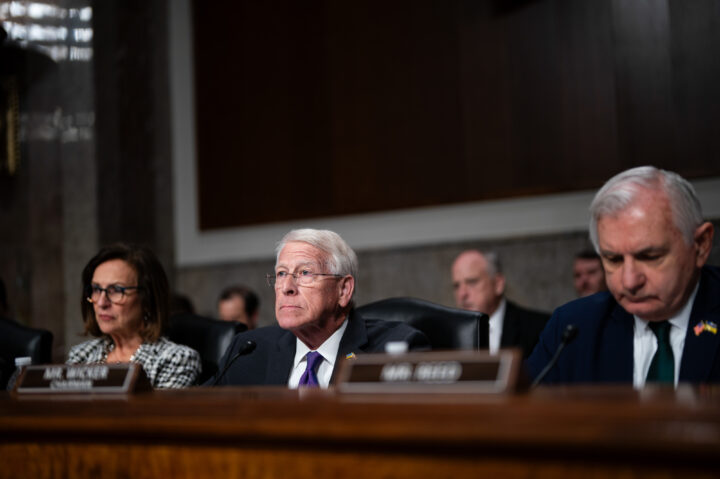
Al Drago/Bloomberg via Getty Images
Sen. Roger Wicker (R-MS), chairman of the Senate Armed Services Committee, and Sen. Jack Reed (D-RI), ranking member of the Senate Armed Services Committee, during a confirmation hearing in Washington, DC, US, on Tuesday, April 1, 2025.


 Add JewishInsider on Google
Members of the Senate Armed Services Committee from both parties voiced concerns with Elbridge Colby, under secretary of defense for policy, and his office at the Pentagon, at a committee hearing — for the second time this week.
While Thursday’s proceedings, a confirmation hearing for Alex Velez-Green, nominated to be Colby’s top deputy and who has been a senior advisor to him in an interim capacity, were generally less heated than a Tuesday hearing with nominee Austin Dahmer, lawmakers reiterated concerns with a lack of consultation by Colby’s team and alleged rogue decision-making on a range of issues by the office.
“Many of this committee have serious concerns about the Pentagon’s policy office and how it is serving the president of the United States and the Congress,” Sen. Roger Wicker (R-MS), the chairman of the committee, said in his opening statement. “In many of these conversations, we hear that the Pentagon policy office seems to be doing what it pleases without coordinating, even inside the U.S. executive branch.”
Wicker, pushing back on a defense offered earlier this week by Dahmer — who dismissed many concerns as fallacious and based on inaccurate media reporting — said that the issues raised by committee members were based on their own conversations with other administration officials and United States allies.
“Either all of these other administration officials and senior foreign officials are deliberately misleading us or we have a problem coming from this office,” he continued.
He said that the policy office can begin to rectify those issues by meeting “its statutory requirement to consult with this committee … rather than simply informing us of a decision after the fact.”
“We need a process that works for the president and the [Congress]. Unfortunately, we do not have such a process at this moment,” Wicker said, adding that progress will require a “change in a mindset” from the policy office.
Sen. Rick Scott (R-FL) added that, “the perception is that there’s some disagreement between what has been put out [by the policy office] and what the president wants. And I think it’s pretty important that you guys figure out how to stop that.”
Velez-Green generally took a conciliatory posture, pledging to communicate and consult with lawmakers whenever possible and appropriate. He also insisted that the policy office and the entire Department of Defense have been diligent in ensuring they are fully aligned with the president’s policy.
But Velez-Green also insisted that the policy office had not directed a pause in U.S. arms transfers to Ukraine, which was later publicly overridden by President Donald Trump, who said he had not been aware of or instructed any such moves. Multiple Senate Republicans pointed to a news release from the Pentagon that specifically stated that such a pause had been implemented.
Velez-Green also denied media reports that Colby had opposed the deployment of additional U.S. forces to the Middle East during the war between Israel and Iran.
Lawmakers again raised concerns that they and U.S. allies in Romania had been notified only days ahead of time that the U.S. would be withdrawing troops from Romania, and that lawmakers were only provided a notification after the decision had been made rather than consulted ahead of time.
“Congress was not consulted about this. I think I can say with certainty about that,” Wicker said.
Sen. Eric Schmitt (R-MO) was the only lawmaker to offer an unequivocal defense of Colby and his office, accusing those criticizing Colby over both policy decisions and communication issues of attempting to block his policy preferences.
“I think much of the criticism, which is cloaked in terms of transparency and communication, really is just an effort to undermine a shift in our foreign policy orientation, which I support, which is to realism, as opposed to some of the failed points of view that have dominated permanent Washington over the last 30 years,” Schmitt said, adding that criticisms of Colby and his team reflect “resistance from those invested in maintaining the foreign policy status quo that has repeatedly failed the American people.”
More Stories

Fuentes’ following
New report documents foreign engagement driving online antisemitic activity
blake's backtrack
In 2020 AIPAC position paper, Michael Blake vowed to support Israel, highlighted Black-Jewish unity

academic adversity
Columbia antisemitism task force report finds all its Middle East faculty are anti-Zionist
senator says
Lindsey Graham calls on Saudi Arabia to ‘knock it off’

doha forum dispatch
Hillary Clinton reiterates concerns about anti-Israel ‘propaganda’ targeting American youth

BISS' BACKTRACK
Daniel Biss reversed position on aid to Israel after launching congressional campaign
Please log in if you already have a subscription, or subscribe to access the latest updates.