












































Columbia antisemitism task force report finds all its Middle East faculty are anti-Zionist
The report calls for more ideological diversity among faculty, while recommending a balance between free expression and preventing discrimination
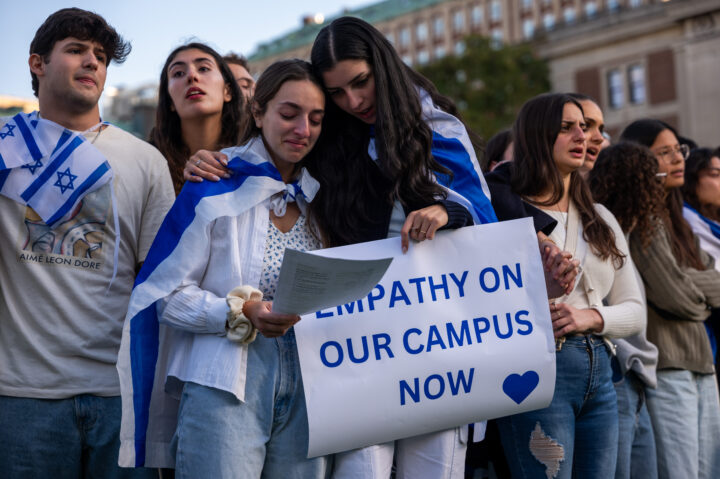
Spencer Platt/Getty Images
Columbia students participate in a rally and vigil in support of Israel in response to a neighboring student rally in support of the Palestinians at the university on October 12, 2023 in New York City.


 Add JewishInsider on Google
The Columbia University task force overseeing efforts to combat antisemitism on campus released its fourth and final report on Tuesday, spotlighting Columbia’s lack of full-time Middle East faculty who are not explicitly anti-Zionist.
According to the report, “Columbia lacks full-time tenure line faculty expertise in Middle East history, politics, political economy and policy that is not explicitly anti-Zionist.” The absence of ideological diversity is having an impact on course offerings — in listening sessions, the task force said it heard from students that classes at the university more often than not treat Zionism as entirely illegitimate.
The report calls on the university to “work quickly to add more intellectual diversity to these offerings” and to “establish new chairs at a senior level in Middle East history, politics, political economy and policy.”
Furthermore, it claims that “academic resources available for teaching and research on Jewish and Israeli topics at Columbia are insufficient, especially in comparison to the resources available for teaching and research on other parts of the Middle East. The University should work quickly and energetically to build up its capabilities here, through academically first-rate full time tenure line additions to the faculty and the curriculum.”
The report also cites numerous instances in which the academic freedom of Jewish and Israeli students was not protected in classrooms and suggests remedies — while trying to find a delicate balance between allowing for free expression and cracking down on discrimination.
“We urge the University to protect freedom of expression to the maximum extent possible while also complying with antidiscrimination laws,” states the report, titled The Classroom Experience at Columbia: Protecting the Academic Freedom of Faculty and Students. “Censorship has no place at Columbia. Neither does discrimination.”
Columbia University Acting President Claire Shipman said in a statement on Tuesday that the university will “continue to work on implementing the recommendations of the task force and addressing antisemitism on our campus.”
“We have also been working this semester to focus on discrimination and hate more broadly on our campuses — which has long been a strong recommendation of the task force. All of this work must become part of our DNA,” said Shipman.
Columbia’s Task Force to Combat Antisemitism was formed in November 2023 as a response to a surge of antisemitism on campus that began as an immediate response to the Oct. 7, 2023, terrorist attacks in Israel. Throughout the following two years of war in Gaza, scenes of masked anti-Israel protesters barging into classrooms and hourslong demonstrations in the center of campus calling for an “intifada revolution” became commonplace at Columbia, which has faced some of the worst antisemitic incidents of any college campus since Oct. 7.
The new report is the first one released since Columbia reached a deal with the Trump administration in July to restore some $400 million in federal funding.
The funding was frozen by the government in March due to the university’s record dealing with antisemitism. The campus has seen less turbulence since the deal was struck and reforms aimed at combating antisemitism — some based on the task force’s earlier recommendations — were announced over the summer.
The 13-member task force, which is led by by Ester Fuchs, professor of international and public affairs and political science; Nicholas Lemann, professor of journalism and dean emeritus of Columbia Journalism School; and David Schizer, professor of law and economics and dean emeritus of Columbia Law School, suggested a range of free expression and anti-discrimination policies that Columbia could adopt.
Among the recommendations are that the university disclose, before students enroll in a course, if the material has the potential to cause students to feel excluded or silenced. If students are not aware in advance, or if it is a required course, and a controversial topic — such as the Middle East — is not the stated topic, “it’s not appropriate to make it a central part of the course,” the report states.
The authors write that academic freedom “entails openness to scholars and students from other countries.” As such, the report states that boycotts of faculty, students, researchers or scholars from other countries “are not consistent with academic freedom.” The academic boycott movement consistently targets Israel, “proposing to restrict the research, teaching, and studying opportunities available to a cohort whose members are overwhelmingly Jewish,” the report continues. Student protesters at Columbia have frequently demanded that the university end its partnership with Tel Aviv University.
In addition, the task force calls for consistency across all university anti-discrimination policies to include Jewish and Israeli students and for applying anti-discrimination policies in regards to classroom disruptions targeting students or instructors for their identity in a protected class.
The latest report builds upon a series of earlier ones released by the antisemitism task force in March 2024, August 2024 and June 2025, each offering solutions to a different key issue impacting Jewish students at the Ivy League university. Each report was based in part on two dozen listening sessions the task force conducted with hundreds of Jewish and Israeli students at Columbia.
The 70-page fourth and final report includes recommendations from the three prior reports and recaps several of the most egregious incidents of antisemitism in the classroom at Columbia since Oct. 7. Those include reports of several instructors encouraging their students, during class, to participate in the 2023-24 academic year’s anti-Israel protests. Some professors held their classes or office hours within anti-Israel encampments (where in several cases it was indicated Zionists were not welcome).
Editor’s note: After publication, Columbia’s Task Force to Combat Antisemitism updated language in the report to read: “Columbia would benefit from full-time tenure line faculty expertise in Middle East history, politics, political economy and policy that is not explicitly anti-Zionist.”
More Stories
ON THE HILL
2026 defense bill includes unconditional repeal of Syria sanctions, Iraq war authorizations

ALL OUT BLITZ
Robert Kraft’s latest Super Bowl ad targets antisemitic bullying
Primary Pressure
DMFI focusing ire on anti-Israel Democrats running in swing districts
rabbinic rebuke
Over 800 rabbis speak out against Mamdani as threat to ‘safety and dignity of Jews in every city’

HEZBOLLAH HIT
Israel kills Hezbollah chief of staff in Beirut airstrike

PAC Pushback
New super PAC looks to blunt Kat Abughazaleh’s surge in Chicago-area district
Please log in if you already have a subscription, or subscribe to access the latest updates.
 Continue with Google
 Continue with Apple