





































































Top D.C. Jewish official urges Jamie Raskin to withdraw from anti-Israel resolution
JCRC of Greater Washington CEO Ron Halber: ‘It’s difficult when two-thirds of our community is voting for a political party whose base is hostile to Israel’
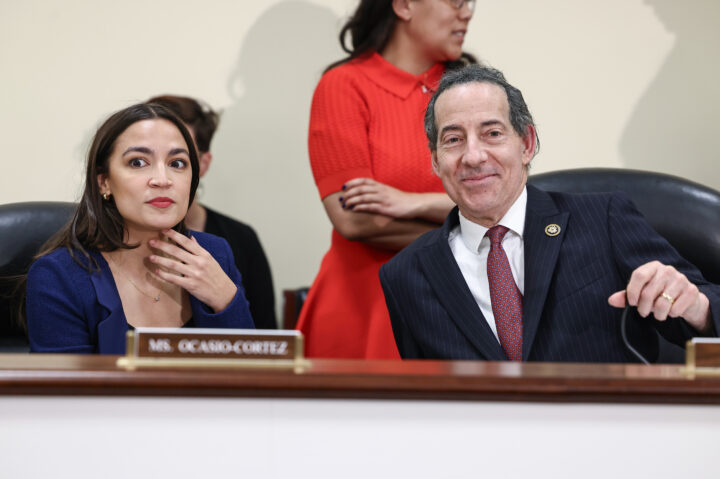
Jemal Countess/Getty Images for Court Accountability
Rep. Jamie Raskin (D-MD) chats before a roundtable discussion on Supreme Court Ethics conducted by Democrats of the House Oversight and Accountability Committee at the Rayburn House Office Building on June 11, 2024 in Washington, DC.


 Add JewishInsider on Google
Ron Halber, the CEO of the Jewish Community Relations Council of Greater Washington, strongly criticized Rep. Jamie Raskin (D-MD) over his recent decision to support legislation that seeks to severely restrict U.S. aid to Israel, casting the congressman’s move as part of a troubling pattern that has sparked concern among pro-Israel activists in his Maryland district.
“Jamie’s signing on that legislation was extremely disappointing,” Halber said in an interview with Jewish Insider on Tuesday, referring to the Block the Bombs Act, a bill led by far-left lawmakers that would place unprecedented new conditions on U.S. weapons transfers to Israel.
Raskin, who became a co-sponsor of the bill earlier this month, has not issued any statement regarding his decision.
“It unfortunately follows his signing on to other similar letters and a vote against additional arms to Israel last year, which really raised a lot of people’s eyebrows,” Halber, who said he considers Raskin a friend, told JI.
Halber said that he had spoken with Raskin, one of the most prominent progressive Jewish lawmakers in Congress, three times over the last two days, asking him to withdraw his name from the bill and instead issue a statement expressing the concerns about the war in Gaza that had motivated him to back the controversial legislation.
Raskin said he would be considering the request and indicated he was “not opposed to Israel using arms in other theaters” outside of Gaza, according to Halber, who described “a very honest and frank conversation” about the bill, which was introduced in May in response to the worsening humanitarian crisis in the war-torn enclave.
While he acknowledged that Raskin is “pulled by both being a leader of the Progressive Caucus and by his own progressive Zionism,” Halber said that the legislation represents “a bridge too far” for the pro-Israel community. The bill effectively amounts to an arms embargo on Israel, he said, arguing that it “seeks to unilaterally disarm one of our closest allies” as Israel defends itself on multiple fronts.
“I’m hoping that Jamie will take his name off the bill and use a statement to express his concerns,” Halber told JI, noting that the congressman has also fielded messages from several Jewish leaders leaders in his Montgomery County district who have aired objections. “If he doesn’t, we will be disappointed, but that’s his decision to make and he has to live with the ramifications of his decision,” Halber added. “I don’t see how that helps him.”
Natalie Krute, a spokesperson for Raskin, declined multiple requests for comment about his decision to back the bill, and did not immediately respond to JI on Tuesday regarding his recent conversations with Halber.
Halber’s private engagement with Raskin, who joined 32 other lawmakers in supporting the bill, underscores the challenges that mainstream Jewish groups are now facing as even some of the most reliable defenders of Israel in the Democratic Party shift away from reflexively backing the Jewish state, amid growing outrage over the crisis in Gaza.
“It’s difficult when two-thirds of our community is voting for a political party whose base is hostile to Israel,” Halber said of the waning support for Israel among Democrats. “I think a lot of my colleagues are also finding this a very difficult era,” he added.
Halber said he had also recently spoken with Sen. Angela Alsobrooks (D-MD) after she faced scrutiny from Jewish leaders this month for voting in favor of Sen. Bernie Sanders’ (I-VT) resolutions to block some U.S. arms sales to Israel, despite vowing to oppose such efforts during her Senate campaign last year.
“I’m convinced that her vote was more about sending a message of moral outrage to the Israeli government about the number of children who are malnourished in Gaza,” he said of their discussion, adding he was “a little more forgiving” in assessing her decision because it had coincided with a surge of media coverage about the humanitarian crisis in Gaza.
Alsobrooks was among 27 Senate Democrats, the majority of the caucus, who voted earlier this month to block shipments of U.S. aid to Israel — marking a dramatic turn against the Jewish state for the party. “While I didn’t like that Democratic senators voted” for the resolutions, “it was understandable, and they knew it wasn’t going to pass,” Halber said on Tuesday. “The question is, if it was going to pass would they have supported it — and I hope not.”
Even as the Block the Bombs bill is also not expected to pass, Halber indicated that he viewed Raskin’s move as a more egregious offense, calling it a “safe way” to register discontent with Israel’s conduct in Gaza that nevertheless “went too far” for his heavily Jewish district.
“Obviously, he’s trying to maintain a leadership position within the House Progressive Caucus,” Halber said of the congressman’s thinking. But on his home turf, “there are a lot of” constituents who do not support imposing sweeping new conditions on Israel, he told JI.
Still, Halber suggested that his lobbying to convince Raskin to withdraw his name from the bill is part of a broader effort to “push back against” the growing influence of what he called the “radical left,” whose views on Middle East policy he described as a “huge danger” to Israel’s continued security in the region.
“Once the war comes to an end, the whole Jewish community is going to have to re-strategize,” Halber said of the challenges ahead as his organization and others like it reckon with their traditional approach to engaging on such issues. “We have a lot of work to do with young people and with Democrats and independents.”
The war in Gaza “is going to impact Israel’s image for years to come,” Halber predicted. “Hopefully, once the media isn’t covering it every day, we can provide more context about what happened” and help “rebuild” Israel’s reputation among skeptical voters.
More Stories

TEXAS TALK
Two Republicans condemned by Jewish groups looking to make comebacks in Texas

center stage
Quincy Institute among anti-Israel sponsors of Doha Forum

SCOOP
Bipartisan group of lawmakers urges EU to designate IRGC as terrorist organization, ahead of key meeting

Pastor’s polemic
Contender to succeed Jasmine Crockett blasted Israeli ‘apartheid’ in sermon on Oct. 8
blake's backtrack
In 2020 AIPAC position paper, Michael Blake vowed to support Israel, highlighted Black-Jewish unity

DEVELOPING
Driver repeatedly crashes car into Chabad Lubavitch HQ; no injuries reported
Please log in if you already have a subscription, or subscribe to access the latest updates.