
























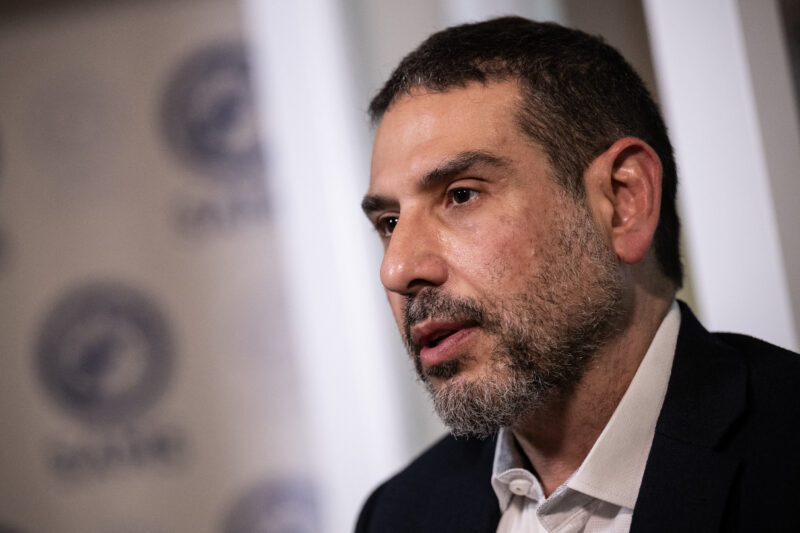





















































‘I’m not an investment advisor, but you can see that if you were not in Israel in the past two years, you probably missed out, if Israel was not part of your portfolio,’ Seffy Zinger, chair of the Israel Securities Authority, told JI

Patrick T. Fallon / AFP via Getty Images
Laurence D. Fink (R), co-founder, chairman and CEO of BlackRock, speaks next to Milken Institute chairman Michael Milken during the 29th annual Milken Institute Global Conference at the Beverly Hilton in Beverly Hills, California on May 5, 2026.


 Add JewishInsider on Google
LOS ANGELES — The Israeli financiers, investors and entrepreneurs who attended last week’s Milken Institute Global Conference in Beverly Hills almost couldn’t make it. Just weeks earlier, after all, the country’s airspace had been largely closed as war raged with Iran.
But aside from their slight fear that the fragile ceasefire would fall apart and leave them stranded in the United States, the Israelis who participated in the marquee conference of global finance brought an upbeat attitude about Israel’s economy, even two-and-a-half years into near-constant war that began with Hamas’ Oct. 7, 2023, attacks.
“When the war began, I think none of us — none of the regulators in Israel, and almost none of the players or the investors in Israel — thought or believed that after two-and-a-half years of war, Israel would show such growth, such resilience,” Seffy Zinger, chair of the Israel Securities Authority, told Jewish Insider in an interview. (The ISA is Israel’s equivalent of the U.S. Securities and Exchange Commission.)
Zinger was at Milken to spread the message that global financiers should consider investing in the Israeli economy, and in particular the Tel Aviv Stock Exchange, despite the doom-and-gloom headlines about the Middle East.
“I’m not an investment advisor, but you can see that if you were not in Israel in the past two years, you probably missed out, if Israel was not part of your portfolio. So I think Israel is becoming a very interesting place economically,” he said.
The shift away from Israel in American politics did not appear to be reflected at this gathering of global business elites: Natti Ginor, a managing director at Jefferies and the bank’s head of Israel investment banking, pitched Israel at the conference as a financial capital in the Middle East. Blackstone’s Tel Aviv-based senior managing director, Yifat Oron, was also there talking about her work leading the firm’s investments in Israel.
“When we are talking to investors and the big players, what I see is a lot of interest in Israel, and I think the economy and the numbers speak for themselves,” said Zinger.
Dror Barak traveled to Los Angeles from Israel to meet developers and investors from across the Middle East, including Saudi Arabia, the United Arab Emirates and the Palestinian territories. He is the founder of Align Capital, an infrastructure-focused private equity firm that is working on projects related to IMEC, the India-Middle East-Europe Economic Corridor — a planned project meant to further economic cooperation across wide swathes of the world. Its development has stalled since the Oct. 7 terror attacks and the ensuing war, but behind the scenes, progress is being made.
“The war, I don’t like to say it, but with all the bad things it also pushed us toward a new era of cooperation,” Barak told JI last week. “The war made us on the same side. It’s the first time in history that we, the UAE [and] Saudi are on the same side. We are all against, publicly or less publicly, Iran. With the United States, of course. So this is a very, very, very dramatic thing, and it’s changed dramatically the nature of our relationship.” IMEC has been floated as an alternative for global shipping amid turbulence in the Strait of Hormuz.
Barak acknowledges that Israel’s reputation has suffered: “Yes, it’s an issue,” he said. But he argued that the work of investing in cross-regional infrastructure must happen, even if the geopolitical situation remains unresolved.
“I’m not waiting for the American public to dedicate my direction, and I’m not waiting for [Israeli Prime Minister Benjamin Netanyahu] or [President Donald Trump] to do some peace,” said Barak. “We promote Arabs and Jews working together. So everywhere that you are looking, I think that we are doing the right thing — the right thing for Israel, the right thing for the region and the right thing for the global politics that want to support the right forces.”
Last year was a banner one for Israeli startups, and the country’s GDP rebounded last year after slowing in 2023 and 2024. But challenges remain. Bentzion Levinson, founder and CEO of Heven AeroTech, an American company with a large Israeli workforce, said there were times that more than one-third of his employees were out of the office doing reserve duty in the Israeli military.
“To this day, we have an average of 10 to 20% of our employees in reserves, around the clock. So I think it’s a challenge. But challenges build strength,” Levinson told JI in Los Angeles. His company’s creation of pioneering long-range stealth drones has driven contracts with the U.S. military and earned a unicorn valuation.
“A lot of things are taking a toll on families [and the] personal, but I think people are strong and they realize that there’s no other choice,” said Levinson. “I think it’s gonna be a decade of significant growth in Israel, especially in the defense tech world … it’s a challenge, but I think the Israeli people can overcome it.”
Zinger, the ISA chair, was attending Milken with his chief of staff, who spent nearly 400 days serving in the reserves after Oct. 7. Responsibilities got juggled; some days the staffer would work three days and do reserve duty for two days. There was no choice but to adapt. And that flexibility, Zinger argued, is part of why Israel’s economy has performed better than anyone expected during the war.
“I think this is part of the strength of the Israeli community and society, exactly these kinds of things, and of course, without that strength, the performance that we see could not have happened,” said Zinger. “It’s something that I think we learn how to live with.”
Addie Lerner and Tali Vogelstein raised $72 million in their first round of funding, one of the largest sums for a first-time fund — woman-led or otherwise

In February, Avid Ventures officially launched after bringing in a haul of $72 million. To the fund’s founders, that number meant more than just an attention-grabbing sum they could use to launch their new venture capital fund.
“We love that it’s four times chai,” said Addie Lerner, the firm’s founder and managing partner, referring to the number 18, associated with the Hebrew word chai, which means “life.” The number’s significance extends beyond Judaism: “$72 million is actually one of the largest [amounts to be raised by a] first-time fund, especially by female leaders,” Lerner explained.
Founding investors Lerner, 31, and Tali Vogelstein, 25, make up Avid’s two-person team. As a new fund, Avid is looking for a way to gain a strategic advantage in a crowded field of VC firms. And when investing in companies’ early Series A and Series B rounds, venture firms get competitive: “It leads to a lot of sharp elbows, and it leads to investors trying to get what’s best for their firm, and not necessarily what’s best for the founder and their company,” Lerner told Jewish Insider. Her goal is for Avid to become indispensable to company founders.
Avid’s proposition is simple: “Let’s write smaller checks into these large rounds, where we’re going to be disproportionately helpful,” said Lerner. In other words: Don’t try to compete with the bigger firms investing several million dollars, but rather make a smaller investment between $500,000 and $1 million, while cultivating an advisory role as “a strategic finance advisor or strategic outsourced chief financial officer.” Avid wants startup founders to learn to rely on Lerner and Vogelstein after the Series A round, and then they’ll come back and write a much larger check in Series B, the next round of funding.
Both women grew up involved in their local Jewish communities: Newton, Mass., for Lerner, and Baltimore for Vogelstein, though both now live in New York.
“I grew up in a Reform Jewish family, where Israel was actually always part of the conversation,” Lerner recalled. As an undergraduate at Princeton, she studied Middle East policy and Arabic. “I thought I was going to go work at the State Department and solve Middle East peace, and then quickly got disillusioned with that career path. So I did a full 180 and I went to go work at Goldman Sachs after school.” She then worked at the investment firm General Atlantic and the venture firm General Catalyst, before deciding to start a firm of her own.

Tali Vogelstein
For a year, Avid was Lerner’s one-woman show, and she brought in the firm’s anchor investors before the COVID-19 pandemic began. Vogelstein, who graduated from the Wharton School of Business at the University of Pennsylvania and then worked at Bessemer Venture Partners, joined Avid in August after a mutual friend put her in touch with Lerner. “I was just so impressed with [Lerner] and her strategy and vision for Avid, and I loved the thesis that she was building Avid around, which is that investing in a founder startup is really a privilege that should be earned,” Vogelstein said.
A connection to Israel is a key part of both partners’ identities, and Israel will be one of several countries in which they plan to invest. Vogelstein spent a year there before college, and Lerner has been to Israel on more than a dozen business trips.
“Israel has a very near and dear place in both of our hearts, and we also think we can get some really incredible returns by investing in Israeli companies,” said Vogelstein. She added that she spent a summer interning in Israel through the program Birthright Excel, which she believes has contributed to Israel’s startup culture — as has the Israeli Defense Forces: “We think the IDF certainly contributes to the mindset where founders are not afraid of failure.”
Vogelstein noted that some investors worry that Israeli companies don’t have the capacity to become a “unicorn,” a rare company that achieves a $1 billion valuation, due to the limited size of the Israeli market. But this isn’t a concern for Avid, which looks for Israeli companies that have a global focus. “More and more, Israeli companies are built either entirely in Israel, but more frequently, internationally, like Rapyd,” Lerner added, referring to an alternative payments company in which Avid has invested. Rapyd, which was recently valued at $2.5 billion, was founded in Tel Aviv but now has offices in San Francisco, Singapore and London.
As Jewish investors with an interest in Israel, Lerner and Vogelstein say people often make the assumption that Israel is their only focus. “Folks have had a bit of a misconception, like, ‘Oh, so you’re investing only in Israeli companies?’ No, we’re two Jewish women who have done a lot in Israel, and we hopefully will invest in someone in Israel, but it’s not all we do,” Lerner explained.
Still, even in the U.S., the Jewish community has been central to the firm’s launch. One of Avid’s anchor investors is Schusterman Family Investments, tied to philanthropist Lynn Schusterman. “They’ve been just really fabulous partners to work with,” Lerner said, but noted that she couldn’t say much more because the Schusterman family, which is more widely known for its philanthropic giving than its investment arm, does not “disclose a lot about their investment activities.”

Addie Lerner
Avid has already made a number of early investments in startups — mostly in the fintech, or financial technology, sector — including Alloy, an identity management platform for financial institutions; Nova Credit, which is building a global credit bureau; and the women’s co-working space The Wing.
“We actually built Avid out of The Wing,” Lerner said, although the COVID-19 pandemic shuttered The Wing’s office spaces. The investment was centered around a digital platform The Wing was building out, to connect members around the world for mentorship opportunities and online events. The pandemic, as well as internal controversies, led to the co-working company taking a major financial hit. Although Lerner and Vogelstein celebrate the firm’s identity as woman-led, they aren’t interested in exclusively backing woman-led companies — The Wing was just one piece of their portfolio.
Still, Lerner and Vogelstein have heard from people who assume that, as women, they invest only in women. “We’re a woman-led firm that is investing in really awesome founders and companies, and the fact that we’re woman-led is cool but unrelated,” she explained. “Occasionally, we’ll get in front of someone, and they’ll be like, ‘Oh, so you only invest in women, right?’ No, we are women, we don’t only invest in women.”
Some of the early news coverage Avid received in tech and finance publications centered on the extreme rarity of a woman-only venture firm. “As of 2019, the majority of venture firms — 65% — still did not have a single female partner or [general partner] at their firm, according to All Raise. So naturally, anytime we hear of a new female-led fund, our ears perk up,” TechCrunch wrote last month in an article about Avid. (All Raise is a nonprofit that seeks to help women succeed in VC; Lerner has been active in the organization’s New York chapter.)
“I’m pretty used to being the only woman in the room,” Lerner told JI. She was the only woman on her teams at both Goldman Sachs and General Atlantic, but she believes those companies want to improve: “Diversity continues to be a big focus for those firms, and I’m glad to see diversity — and not just gender diversity, but diversity of all kinds — really evolve at those firms,” Lerner said. She added that in the early-stage venture capital world, she is seeing more women than she used to.
Diversity, broadly defined, is a value that Avid considers when making investments, and it’s something that the firm touts in its marketing. “We are really proud that 40% of the 50 individual [limited partners] who invested in Avid are women,” Lerner said, and having women involved at all stages of the investment process “creates a virtuous cycle.” But ultimately, the firm invests in companies it views as promising, independent of who runs them: “Our strong belief,” Lerner explained, “is that this can and should happen in a more organic way, versus any sort of intentional focus or quotas.”
Please log in if you already have a subscription, or subscribe to access the latest updates.
 Continue with Google

 Continue with Apple