










































U.N. Security Council backs Trump’s Gaza plan
The adoption of the U.S.-led resolution provides an international legal framework for the international stabilization force to deploy in Gaza
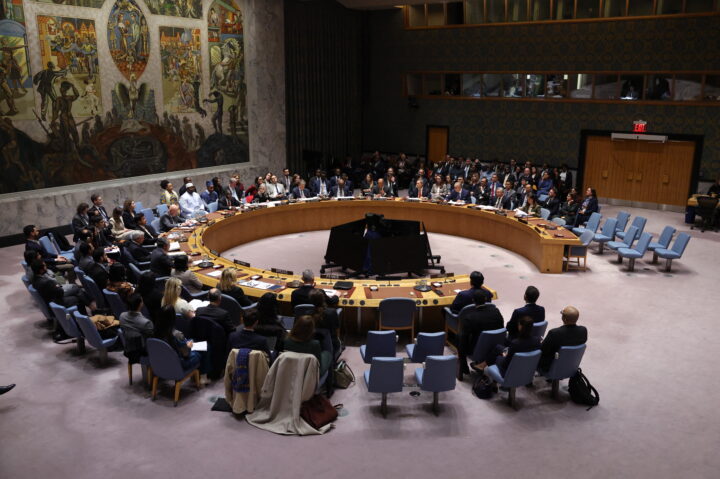
ANGELA WEISS/AFP via Getty Images
Ambassadors and representatives to the United Nations meet at the U.N. Security Council to vote on a U.S. resolution on the Gaza peace plan at the U.N. Headquarters in New York City, Nov. 17, 2025.


 Add JewishInsider on Google
The U.N. Security Council adopted a U.S.-led resolution on Monday backing President Donald Trump’s peace plan for Gaza, including the creation of an international security force, in a move that could boost efforts to advance into the next phase of the Israel-Hamas ceasefire.
“Congratulations to the World on the incredible Vote of the United Nations Security Council, just moments ago, acknowledging and endorsing the BOARD OF PEACE,” Trump posted to Truth Social following the vote. “This will go down as one of the biggest approvals in the History of the United Nations.”
In the first phase of Trump’s 20-point peace plan, originally presented in September, the Israel Defense Forces have partially withdrawn to a “yellow line” dividing Gaza, while Hamas has returned all of the living hostages and all but three of the deceased hostages’ bodies.
However, the plan has faced significant roadblocks, and questions remain about the feasibility of implementing the following phases, including effectively disarming Hamas and determining who will govern Gaza.
Monday’s vote follows coordinated diplomacy between Washington and Arab partners aimed at reviving momentum behind the U.S. plan, including hosting a summit in Sharm El Sheikh, Egypt, last month and issuing a joint statement of support last week.
With the adoption of the resolution, the U.N. showed a rare consensus on Gaza — 13 countries voted in favor and none against, with Russia and China abstaining. Experts told Jewish Insider that moving to the second phase of the plan now becomes more plausible — even if challenges remain.
“The vote on the U.S.-drafted resolution is incredibly significant,” said Dana Stroul, a senior fellow at The Washington Institute for Near East Policy, who added that it provides “an international legal framework for the international stabilization force to deploy in Gaza, which is required for certain countries to send forces, like Indonesia.”
Prior to the vote, the White House has had difficulty recruiting countries to provide troops for the security force.
“What is being proposed is an enormous logistical feat, not to mention a high-risk environment where a terrorist organization is still active, the civilian population is in desperate need of humanitarian aid and local security, and Israeli forces remain on the ground,” said Stroul. “Foreign governments are concerned about their forces being attacked by Hamas, or being caught in the middle of Israeli security operations, and want clarity on the command and control, important details like logistical support and lodging, and the specifics of the actual mission.”
A key hurdle will be defining the role of the stabilization force. David May, a senior research analyst at the Foundation for Defense of Democracies, said there has been confusion over whether the ISF would “maintain the peace or enforce it.”
Jonathan Ruhe, a fellow at the Jewish Institute for National Security of America, echoed the importance of determining the role such a force would play in Gaza.
“The ISF likely will have lots of participants if the mission is limited to non-kinetic roles like aid distribution, border security, guarding camps, etc., all of which are important,” said Ruhe. “But Hamas thinks it won the war, and it won’t give up without a real fight. Phase 2 will be difficult for everyone if Israel has to do all this heavy lifting, so the success of Trump’s plans depends heavily on resolving the question of who, other than Israel, will actually enforce the peace?”
With the terror group still active in Gaza, few countries have been willing to risk sending soldiers into a conflict that “doesn’t involve them,” according to May.
“Without foreign forces on the ground, the options are either hoping that Hamas will disarm itself and give up its governance position, or leaving Israel to resume military options to do the disarming,” said Stroul.
At the same time, Hamas has sought to deter the implementation of the next phase — which calls on the group to relinquish its arms and governing authority.
“Hamas blew by the 72 hours for returning all hostages, living and dead, and continues to attack Israeli forces,” said May, referring to commitments the terror group agreed to in the first phase of the ceasefire. “Hamas always tests the limits of agreements with Israel, and it has little incentive to carry out a ceasefire plan that ultimately calls for the terrorist group’s destruction.”
“It should not be a surprise that a terrorist organization will try a variety of means to survive, from inflicting violence against Palestinians outside the yellow line to intimidating them into submission, insisting on distinguishing between different kinds of weaponry it may be willing to relinquish to appear reasonable, or attempting to present itself as a legitimate representative of the Palestinian national dialogue,” said Stroul.
Even as Washington and Arab governments moved the plan forward diplomatically, Israeli Prime Minister Benjamin Netanyahu and right-wing members of his government reiterated their opposition to a Palestinian state over the weekend, a stance that contrasts with the resolution, which contains language on creating “a pathway to Palestinian self-determination and statehood.” This wording was also present in the original plan released by Trump and agreed to by Netanyahu.
“The rhetoric coming out of Netanyahu’s right-wing coalition this weekend is incredibly ill-timed and will fuel those looking to blame Israel for failure to move from Phase 1 to Phase 2 of the plan,” said Stroul. “By appearing to renege on this issue, Netanyahu is setting himself to be on the opposite side of the Palestinian question from Trump, and risking serious daylight between the U.S. and Israel on Gaza at a high-risk moment.”
May said the inclusion of the clause “may have helped make the resolution more palatable to the other Security Council members,” but added that it will likely be out of the question for Israel moving forward.
“Following the popular support among Palestinians for the Oct. 7 atrocities, a Palestinian state on Israel’s borders is a nonstarter for most Israelis,” said May. “It is not worth it for Israel to risk the stabilization of Gaza on the lip service paid to a two-state solution that is dead in the water for most Israelis.”
Leading up to the vote, Russia had presented a counterproposal that diverged from the U.S. draft resolution in advocating that the West Bank and Gaza be joined as a state under the Palestinian Authority.
“This is really Russia seeking any way to assert influence in an attempt to make itself relevant,” said Stroul. “Moscow sees anything that keeps the U.S. tied down in the Middle East in a state of conflict, in tension with its longstanding allies and partners, as beneficial.”
Ruhe said Russia’s counterproposal was an attempt to throw “wrenches in America’s gears.”
“Russia was conspicuously absent from the Egypt peace summit, so this is one way Moscow tries to reassert itself,” said Ruhe. “The U.S. decision to mention a pathway to a Palestinian state probably owes more to our partners’ priorities than to Russian pressure, though Moscow certainly will try to claim this as a win anyway.”
The next part of Trump’s proposal also includes the increased entry of humanitarian aid into Gaza and the rebuilding of critical infrastructure. However, like other key elements of the plan, experts said it remains contingent on Hamas’ presence.
May said the full recovery of Gaza will remain incomplete “until Hamas is disarmed and there are troops on the ground to keep the peace.”
“No one is willing to start reconstructing Gaza if Hamas is still active on the ground,” said Stroul. “This is the fundamental choice for Hamas: it can choose to disarm and stay in Gaza, or receive amnesty and leave. But if it insists on having a say in the future governance of the Strip, then nothing beyond humanitarian aid will flow into Gaza; Palestinians will have no prospects for rebuilding their lives; and the potential for a return to open conflict rises.”
More Stories
TERROR TAGS
Florida designates Muslim Brotherhood, CAIR as terrorist organizations

on the agenda
Trump meeting with Netanyahu at Mar-a-Lago later this month
blake's backtrack
In 2020 AIPAC position paper, Michael Blake vowed to support Israel, highlighted Black-Jewish unity
JOHNSON'S JOURNEY
House Speaker Mike Johnson headed to New Square on Sunday to help Mike Lawler
WATERED DOWN
House amendment to Muslim Brotherhood bill removes key terrorism designation, sanctions provisions