















































New Yale Youth poll finds Gen Z fueling rise in antisemitic views
The survey found 64% of young conservatives ages 18-34 agreed with at least one antisemitic statement
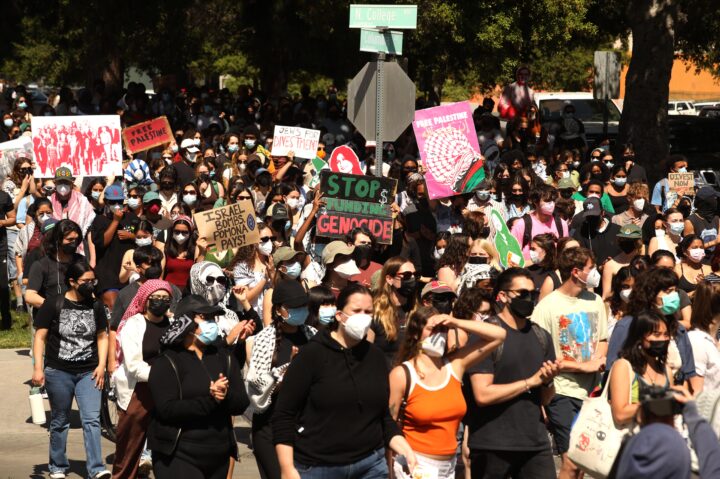
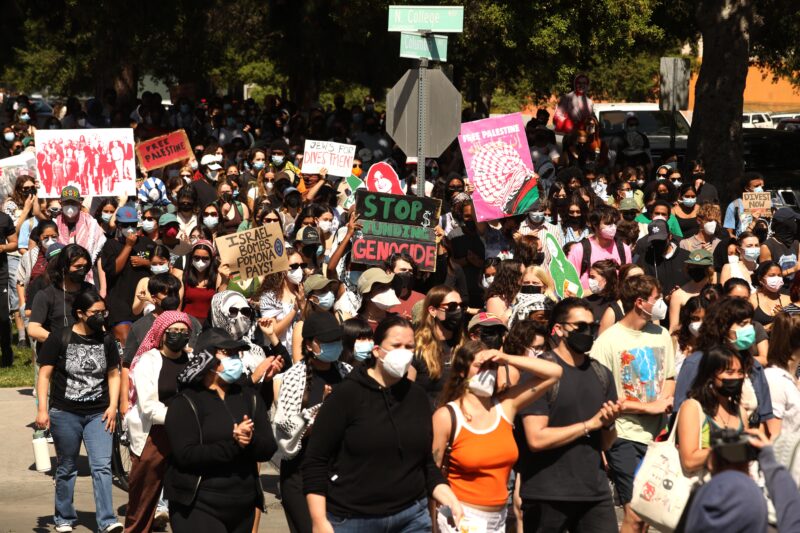
Genaro Molina/Los Angeles Times via Getty Images
Pomona College students march to Alexander Hall where 20 students were arrested during a sit-in at on Pomona Campus in Claremont on April 11, 2024.


 Add JewishInsider on Google
Younger voters hold overwhelmingly more critical views of Israel and of the Jewish people than older generations, a new survey finds in keeping with other recent research on the issue, with antisemitic beliefs strongest among the most conservative cohort.
The Yale Youth Poll, an undergraduate-led research group based at Yale University, surveyed over 3,400 American voters for their views on Israel, Zionism and antisemitism between Oct. 29-Nov. 11, with over half of respondents under the age of 35.
On a basic assessment of whether the American Jewish community has had a positive or negative impact on the United States, over half (54%) of all respondents answered positive, while the same was true of only around a third (35%) of 18-22-year-olds.
In a list of antisemitic statements — including “Jews in the United States are more loyal to Israel than to America,” “It’s appropriate to boycott Jewish American-owned businesses to protest the war in Gaza” and “Jews in the United States have too much power” — 70% of respondents overall disagreed with all three; however, only 57% of 18-22-year-olds and 60% of 23-29-year-olds said the same.
Among those ages 18-34 who self-identified in their responses as “extremely conservative,” a sizeable majority of 64% said they agreed with at least one of the listed statements, far more than any other subgroup of younger voters — 38% of 18-34-year-olds overall said the same, already a notable minority.
Younger people also had overwhelmingly negative views of Zionism: Given a list of possible definitions of the ideology, respondents overall most commonly identified the “positive” definitions, including “self-determination and statehood for the Jewish people,” “the continued existence of Israel in the face of calls for its destruction” and the Jewish people having an equal “right to statehood,” as accurate.
Among voters ages 18-22, however, the most commonly selected definitions described Zionism as “maintaining a Jewish demographic majority in Palestine by driving out the native Palestinian population,” (36% vs. 17% of all respondents), creating “a nation-state where Jews get more rights than others,” (33% vs. 15% overall) and “a form of racism and apartheid against Palestinians” (31% vs. 13% overall). Fifteen percent of respondents under 30 said they believe that Israel should not exist, compared to 5% overall.
The younger cohort’s view of what qualifies as antisemitism was also distinct — asked if comparing the Israeli government’s policies to the Nazis constitutes a form of anti-Jewish prejudice, 46% of 18-34-year-olds said no, compared to 28% of respondents overall. Seventeen percent of younger voters said they did not believe use of the phrase “globalize the intifada” was antisemitic, compared to 12% overall, and 67% said calling the war in Gaza a genocide did not constitute antisemitism, compared to 47% overall.
Nearly half (46%) of 18-22-year-olds think the U.S. should cut off all military aid to Israel compared to 23% of all respondents. This hostility to Israel, as with most of the survey’s findings, decreased with age to only 13% of respondents aged 65 and older.
More Stories

STANDING TOGETHER
New York Jewish community comes out in solidarity with Park East Synagogue at major rally
eye on the prize
Virginia lawmaker with history of anti-Israel rhetoric eyes 2026 congressional run

TEXAS TALK
Two Republicans condemned by Jewish groups looking to make comebacks in Texas

COMMUNITY CONCERN
Jewish leaders, lawmakers, scramble to protect synagogues amid threatening anti-Israel protests

exclusive
Schumer, Senate Democrats introduce resolution condemning Fuentes, Carlson