


































Trump’s national security strategy balances global engagement with ‘high bar’ for intervention
The Trump administration believes ‘rigid adherence to non-interventionism is not possible,’ contrary to the isolationist wing of the GOP

Tasos Katopodis/Getty Images
U.S. President Donald Trump stops and talks to the media before he boards Marine One on the South Lawn at the White House on June 15, 2025 in Washington, DC.


 Add JewishInsider on Google
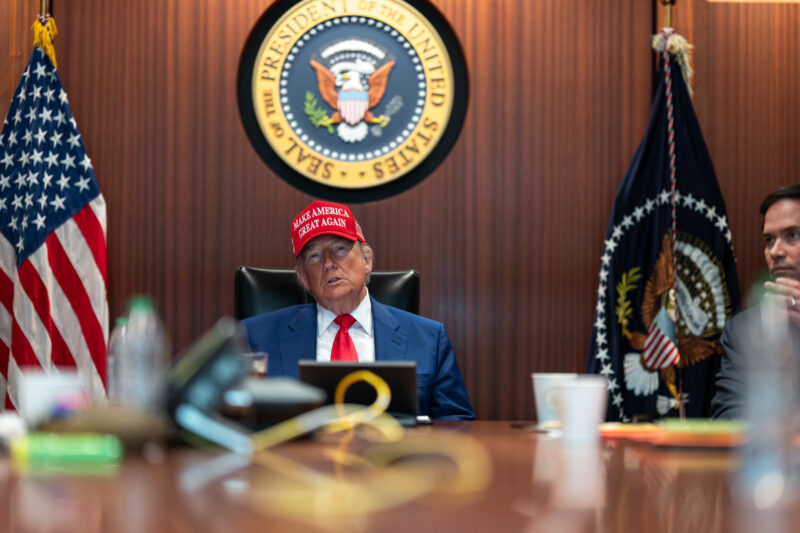
As an ideological battle plays out in the Republican Party over whether America should adopt an engaged approach to global affairs or take a more restrained one, a new National Security Strategy authored by the Trump administration offers a clear-cut answer — presenting America as deeply engaged, so long as the policies adopted by Washington are deemed to put “America First” by President Donald Trump.
Trump has no qualms about using unusual strategies to achieve his national security aims (what the 29-page document refers to as his “unconventional diplomacy”), but the strategy paints a picture of a president who is intently focused on his global legacy and on shoring up his image as “the president of peace.”
“For a country whose interests are as numerous and diverse as ours, rigid adherence to non-interventionism is not possible,” the strategy states. “Yet this predisposition should set a high bar for what constitutes a justified intervention.”
The document takes aim at prior American commanders-in-chief, saying such documents authored by past administrations became “bloated and unfocused” by focusing on the entire world. “Not every country, region, issue, or cause — however worthy — can be the focus of American strategy. The purpose of foreign policy is the protection of core national interests; that is the sole focus of this strategy,” the document asserts.
The president abhors the use of traditional foreign policy language to try to categorize his approach, the strategy makes clear: “President Trump’s foreign policy is pragmatic without being ‘pragmatist,’ realistic without being ‘realist,’ principled without being ‘idealistic,’ muscular without being ‘hawkish’ and restrained without being ‘dovish.’ It is not grounded in traditional, political ideology. It is motivated above all by what works for America — or, in two words, ‘America First,’” according to the document.
Yet what is clear from the strategy is that Trump remains captivated by the world’s challenges and believes he can help remedy them. In a letter introducing the strategy, Trump writes that he has achieved a historically “dramatic … turnaround” on matters of foreign affairs.
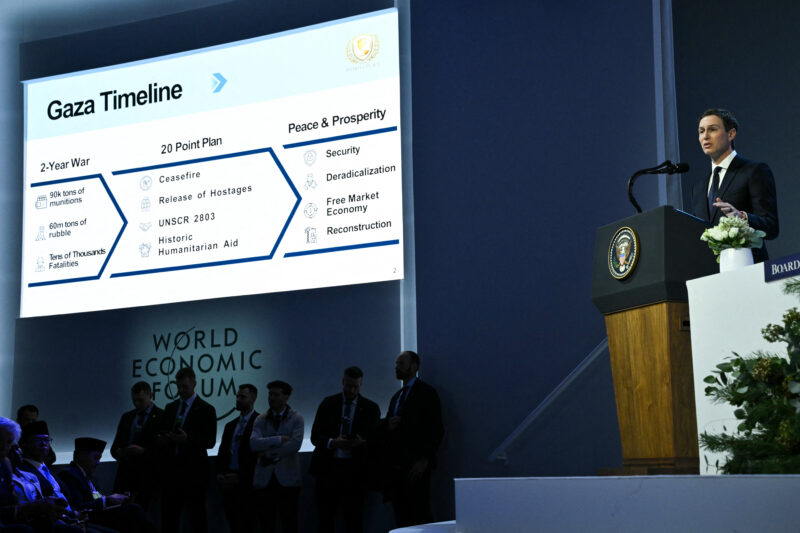
Border security is a key focus — he touts his restoration of “the sovereign borders of the United States” and the deployment of the military “to stop the invasion of our country” — alongside culture war issues, with Trump saying the U.S. has rid the military of “radical gender ideology and woke lunacy.” He names the global conflicts he has played a role in helping to resolve, including “ending the war in Gaza with all living hostages returned to their family” and “obliterat[ing] Iran’s nuclear enrichment capacity” when America bombed Iran’s nuclear sites in June.
Trump’s key goal in the Middle East appears to be to keep Iran in check, though Iran is only mentioned three times in the report. In the first national security strategy of Trump’s first term, in 2017, Iran was mentioned 17 times.
“We want to prevent an adversarial power from dominating the Middle East, its oil and gas supplies and the chokepoints through which they pass while avoiding the ‘forever wars’ that bogged us down in that region at great cost,” the strategy states, without naming a particular adversarial power.
America historically prioritized the Middle East because of its dominant role in supplying energy, its position as “a prime theater of superpower competition” and seemingly needless conflict, the strategy states. The Trump administration argues the energy question takes less priority, with America now a net energy exporter; and that superpower competition has faded, with America in “the most enviable position, reinforced by President Trump’s successful revitalization of our alliances in the Gulf, with other Arab partners and with Israel.”
Conflict, the strategy asserts, “remains the Middle East’s most troublesome dynamic.” But it argues that Iran, “the region’s chief destabilizing force,” was “greatly weakened” by Israel’s actions after the Oct. 7 attacks two years ago and by U.S. involvement in the June war.
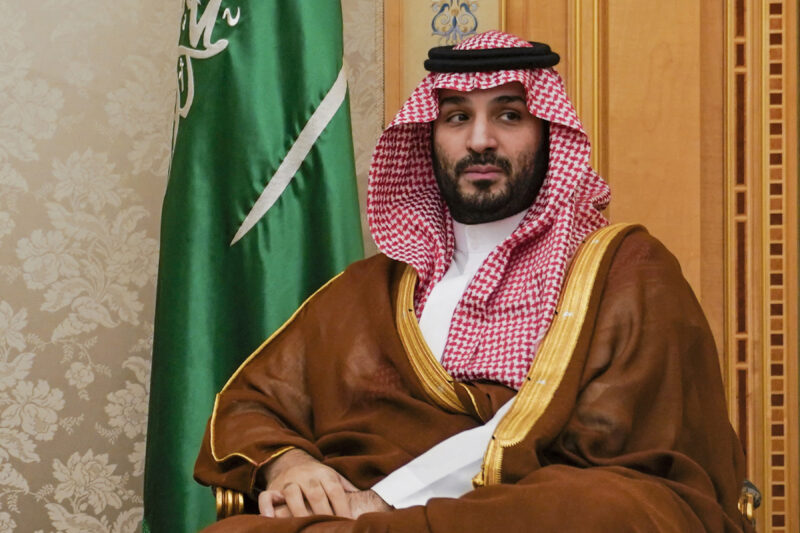
Trump visited Saudi Arabia in May, the first major international trip of his second term, and he recently welcomed Saudi Crown Prince Mohammed bin Salman to Washington. Both of these meetings were focused on investment and building economic ties between the U.S. and Gulf nations. The national security strategy makes clear that this is a core goal for Trump.
“The region will increasingly become a source and destination of international investment, and in industries well beyond oil and gas,” the strategy states. “We can also work with Middle East partners to advance other economic interests, from securing supply chains to bolstering opportunities to develop friendly and open markets in other parts of the world such as Africa.”
The Trump administration praised partners in the Middle East for combating radicalism, but also said the U.S. will no longer try to goad Gulf nations into democracy.
Continuing to fight radicalism in the region “will require dropping America’s misguided experiment with hectoring these nations — especially the Gulf monarchies — into abandoning their traditions and historic forms of government,” the strategy states. That pledge marks a significant shift from the Biden administration’s approach, which called for strengthening democracy around the world. The word “democracy” appears just three times in Trump’s national security strategy, and not as a goal of American foreign policy.
The White House said expanding the Abraham Accords will remain a policy priority. Other “core interests” include maintaining the security of Gulf energy supplies, ensuring that terrorism cannot be allowed to grow and reach the U.S. and “that Israel must remain secure.”
“But the days in which the Middle East dominated American foreign policy in both long-term planning and day-to-day execution are thankfully over,” the strategy asserts, “not because the Middle East no longer matters, but because it is no longer the constant irritant, and potential source of imminent catastrophe, that it once was. It is rather emerging as a place of partnership, friendship, and investment — a trend that should be welcomed and encouraged.”
More Stories

data diaries
New Yale Youth poll finds Gen Z fueling rise in antisemitic views

TEXAS TALK
Two Republicans condemned by Jewish groups looking to make comebacks in Texas

center stage
Quincy Institute among anti-Israel sponsors of Doha Forum

COMMUNITY CONCERN
Jewish leaders, lawmakers, scramble to protect synagogues amid threatening anti-Israel protests

Pennsylvania pitch
Obando-Derstine runs as pro-Israel immigrant advocate in crowded swing-district Pa. primary
SCOOP
Jewish leaders invited to meet with Saudi Defense Minister Khalid bin Salman in D.C.
Please log in if you already have a subscription, or subscribe to access the latest updates.