























































Pentagon needs to follow Trump’s lead, GOP senators say after Ukraine aid fracas
The GOP lawmakers’ comments come after the president, taking a tougher line against Putin, overruled top Defense Department officials

BRENDAN SMIALOWSKI/AFP via Getty Images
US Under Secretary of Defense for Policy Elbridge Colby (R) and US Secretary of Defense Pete Hegseth look on during a meeting with Foreign Affairs Minister of Peru Elmer Schialer and Defense Minister of Peru Walter Astudillo at the Pentagon in Washington, DC on May 5, 2025.


 Add JewishInsider on Google
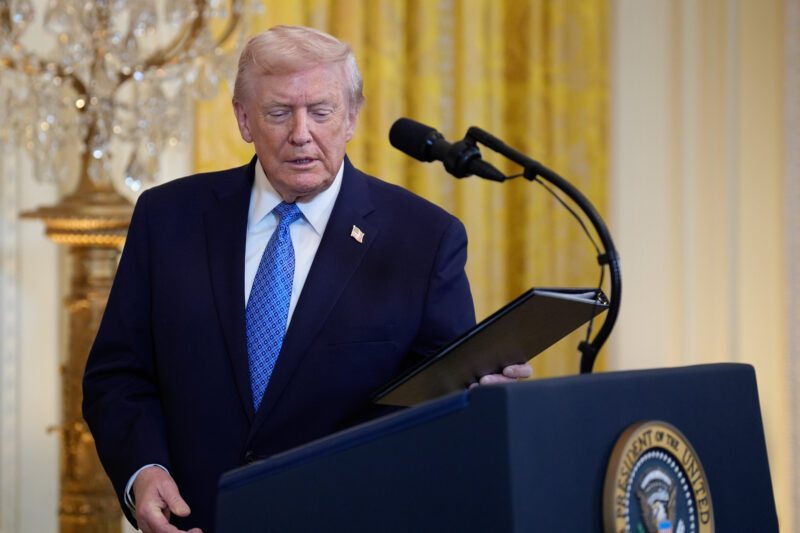
Senate Republicans on Tuesday emphasized that Trump administration officials need to follow the president’s lead on foreign policy, after President Donald Trump publicly overrode a Defense Department-instituted halt on weapons for Ukraine.
The public back-and-forth indicated discord between the president and the Pentagon. Trump on Tuesday appeared to suggest he was out of the loop about the Ukraine military freeze; when a reporter asked him who had ordered the halt, Trump responded, “I don’t know, you tell me.”
Top Pentagon policy official Elbridge Colby reportedly led the move, citing a review allegedly showing U.S. missile defense interceptor shortages. Secretary of Defense Pete Hegseth approved the decision without informing the White House, CNN reported, and Trump did not specifically direct him to halt the weapons transfers. Politico reported that a series of other unilateral moves by Colby have surprised and frustrated Trump administration officials and U.S. allies.
Trump’s own policy on Ukraine as it defends itself against Russian aggression has been inconsistent since taking office, but in recent months he has grown publicly frustrated with Russian President Vladimir Putin’s approach to the war. Trump is now also backing a bipartisan Senate sanctions bill targeting Russia, according to the bill’s lead sponsor, Sen. Lindsey Graham (R-SC).
Republican hawks on Capitol Hill praised Trump’s decision to reinstate U.S. aid to the country, with several warning Pentagon officials against working at cross purposes with the president, though they declined to directly address the behind-the scenes machinations.
“Policy on defense and otherwise, it’s clear, is set by the president, it’s not set by his underlings,” Sen. John Kennedy (R-LA) told Jewish Insider, adding that he thinks that Trump’s own position on the issue has hardened because “President Trump is rapidly becoming fed up with President Putin and starting to see him for what he is, which is a pirate and a liar” who only responds to pressure.
Kennedy denied that the Pentagon had been at odds with Trump, however, adding, “Whether you like it or dislike it, the people who generally get crosswise with the president that work for him only do it one time.”
Sen. Thom Tillis (R-NC) told JI, “Generally speaking, I don’t think [Trump] likes people getting out ahead of him. So they need to coordinate that. I assume they did, it could have just been one situation, but you need to coordinate with the president.”
Tillis added that “anything that cuts short or challenges Ukraine’s resupply and support is a bad idea, and it’ll be a disastrous mistake.”
Sen. Mike Rounds (R-SD) told JI, “I’m in favor of additional aid for Ukraine. Whether it is simply a matter of having the Department of Defense get very clear orders from the president, or if it’s a matter of clarifying for the rest of the world to hear that we’re not walking away from Ukraine, I think it’s a very important message to send.”
Sen. Mitch McConnell (R-KY), the former Republican Senate leader, offered the most pointed criticism of those in the administration who have advocated for cutting off aid to Ukraine.
“This time, the President will need to reject calls from isolationists and restrainers within his Administration to limit these deliveries to defensive weapons,” McConnell said in a statement. “And he should disregard those at DoD who invoke munitions shortages to block aid while refusing to invest seriously in expanding munitions production. The self-indulgent policymaking of restrainers — from Ukraine to AUKUS — has so often required the President to clean up his staff’s messes.”
According to Politico, Colby independently ordered a review of the AUKUS submarine pact with the U.K. and Australia, which also surprised other elements of the Trump administration.
Sen. Roger Wicker (R-MS), the chair of the Senate Armed Services Committee, declined to comment on “palace intrigue” and said he was “just glad to see Washington, D.C., on a bipartisan basis moving in the right direction in favor of the good guys.”
“Facts become clearer, and more and more people, including the president and members of the administration, are coming to the realization that Putin wants nothing but conquest, and if he gets it in Ukraine, he won’t stop there,” Wicker told JI. “So it’s just a matter of the truth coming to light.”
Sen. Ted Budd (R-NC) suggested that the change had come about as a result of new information, rather than discord within the administration.
“Well, I think all of us have the right to change your mind when you have new information, so he’s not happy with the situation,” Budd said. “Again, I think all of our hearts are supportive of Ukraine. We want to make sure they have the right leadership, and transparency that they’re doing the right thing. So I think he’s making the right decision with the information that he’s given in real time.”
Sen. Markwayne Mullin (R-OK) said he wasn’t familiar with the exchange between Trump and the Pentagon, but noted concerns about U.S. stockpiles.
“I don’t know what the back-and-forth is,” Mullin said. “I know what we’re trying to do right now is build up our stockpiles, because we let things get pretty low with some of our missile systems, but I haven’t heard the back and forth between Trump and the Pentagon.”
Among Democrats, Sen. Jeanne Shaheen (D-NH), the ranking member of the Senate Foreign Relations Committee, called out Colby and Hegseth by name.
“I am pleased that President Trump appears to have reversed course on the dangerous and shortsighted decision made by Secretary Hegseth and Under Secretary Colby to continue critical assistance to Ukraine,” Shaheen said in a statement. “Unfortunately, last week’s decision sent exactly the wrong message. And it came with a tragic human cost.”
Analysts outside the administration emphasized that Trump’s policy is his own and hard-liners inside the Pentagon should be mindful that their views are not necessarily the same as Trump’s.
“I think over the last few years, it has been very, very clear that the only person who speaks for President Trump is President Trump,” Carrie Filipetti, the executive director of the Vandenberg Coalition and an official in the first Trump administration, told JI. “There are a lot of people, specifically within the Pentagon, that are much more ideological, who have assumed that President Trump shares their ideology, when really President Trump has always been much more flexible and responsive.”
Filipetti added that, from her experience in the first Trump administration, the president could get frustrated when officials “tried to speak for him” or “got over their skis and assumed that they knew the direction he was going in.”
She said that the administration’s recent moves, as well as some of Trump’s hawkish policies dating back to his first administration, show that the calculated use of force and economic power are key to Trump’s foreign policy.
“This is really a vindication of what Trump has always said was America First, which includes the willingness to use force if he can see how it will prevent a longer-term conflict,” Fillipetti explained. “Right now, I think the people who have pushed for a more hawkish policy are gaining more influence, partially because they’re proving that the goal was never to start wars. The goal was to end wars by using force and strength as a deterrent.”
Heather Conley, a nonresident senior fellow at the American Enterprise Institute and the former president of the German Marshall Fund, said it seemed clear that the Pentagon had not coordinated its moves with other parts of the administration or Congress, catching the White House off-guard.
“I think this was probably a very important lesson that the senior leadership in the Pentagon learned: that there’s no independent review, that these things are all connected and are all highly political and need to be coordinated with the White House, and Congress, most certainly, as well,” Conley said. “I think this will be a reinforcing lesson for the Pentagon to not get ahead of the president.”
Referencing Colby specifically, Conley said, “He may have very strong views about what is needed, but the president is shaping this policy, he’s shaping it every hour and every day, and that means it’s moving very quickly. … [Administration officials] have to be in alignment for there to be success. And they also may not be able to pursue their own independent view of where things should go.”
Conley said that the capability review that prompted the cutoff was necessary — given proper coordination — for any administration, in light of the multiple draws on American weapons reserves.
She said that the situation highlights the need for the U.S. to significantly accelerate its missile-defense production capacity and find ways to prompt Ukraine to expand its domestic production capacity, explaining that the U.S. lacks the ability to produce sufficient interceptors to cover Ukraine, the Middle East and potentially Taiwan.
Conley also noted that this isn’t the first time the Pentagon has appeared to be acting out of step with the White House, pointing to moves by Hegseth on Ukraine policy dating back to February.
Administration spokespeople have denied any discord or lack of coordination within the administration.
Kingsley Wilson, the Pentagon’s press secretary, told CNN in a statement that said in part, “Secretary Hegseth provided a framework for the President to evaluate military aid shipments and assess existing stockpiles. This effort was coordinated across government.” White House press secretary Karoline Leavitt said that Trump “has full confidence in the secretary of defense.”
The Department of Defense and National Security Council did not respond to requests for comment.
Jewish Insider’s congressional correspondent Emily Jacobs contributed reporting.
More Stories
heated exchange
Sen. Van Hollen attacks Maryland Jewish community liaison Ron Halber as Netanyahu ‘apologist’

olive branch
Rabbi Ammiel Hirsch, outspoken backer of Israel, leaves meeting with Mamdani ‘encouraged’
ANALYSIS
Most Jewish voters oppose Mamdani — but remain divided on an alternative

diplomats declared
Israel approves new consuls-general in San Francisco, Houston
temple talks
Khanna addresses California synagogues on Israel policy, antisemitism
