





















































Some Senate Democrats voiced concern over the stability of the ceasefire agreement and Israel’s commitment to abiding by it
Samuel Corum/Sipa/Bloomberg via Getty Images
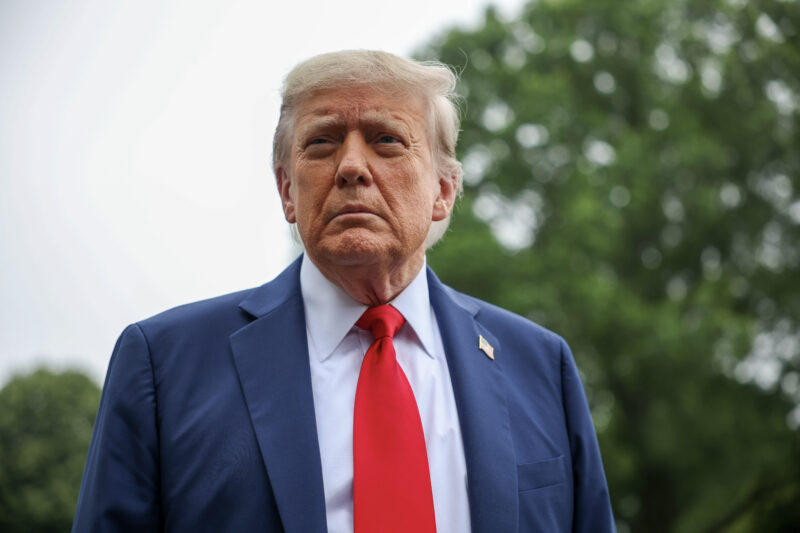
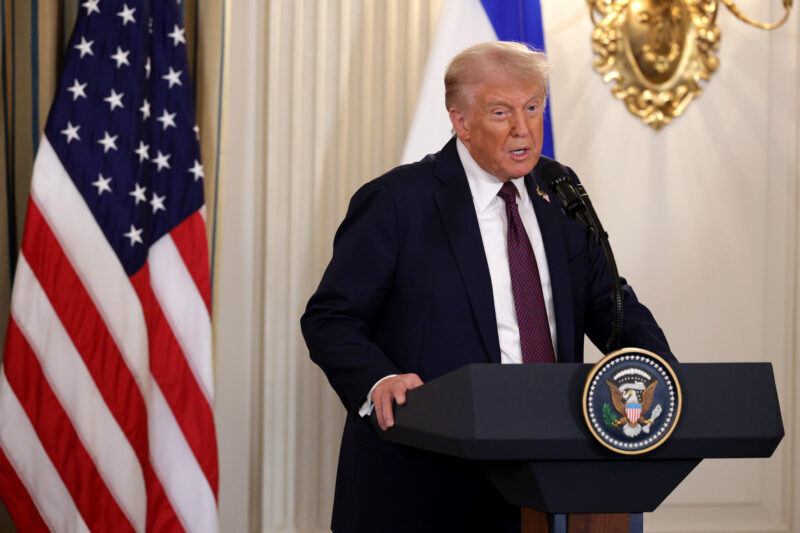
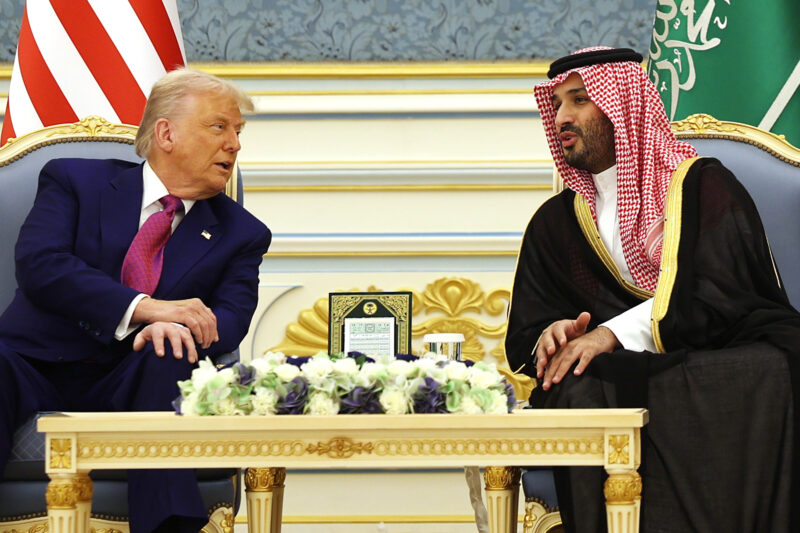
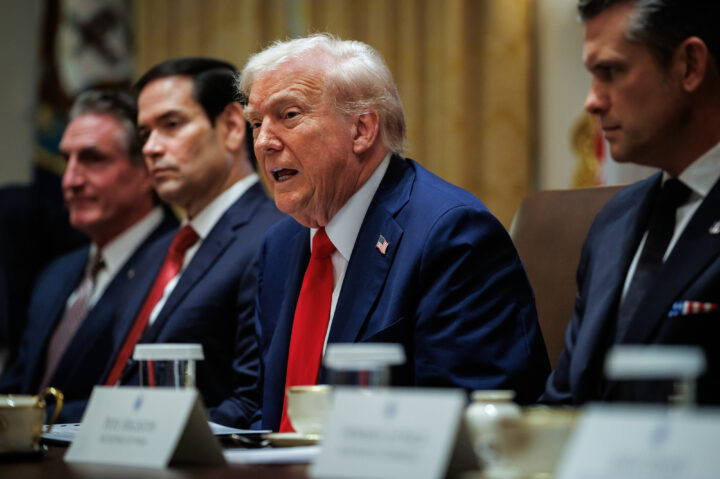
President Donald Trump during a Cabinet meeting at the White House in Washington on Oct. 9, 2025.


 Add JewishInsider on Google
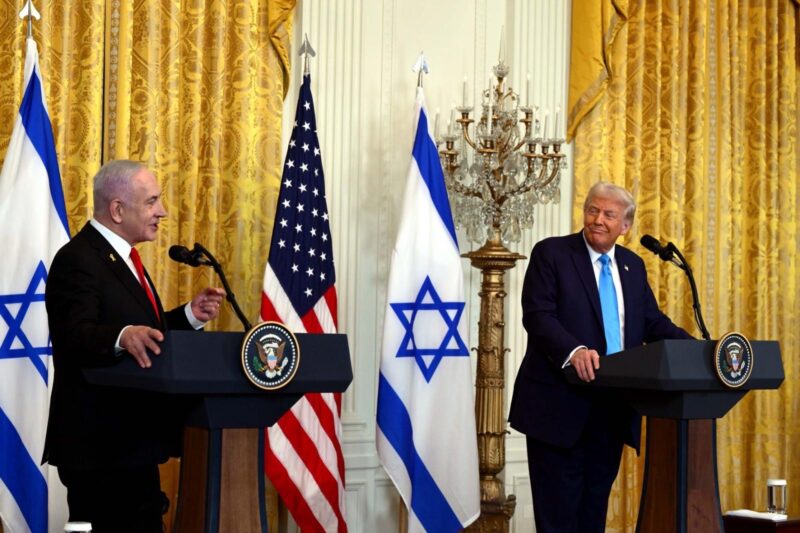
President Donald Trump defended Israeli Prime Minister Benjamin Netanyahu’s decision to order what the prime minister called “forceful” strikes on Hamas targets in Gaza on Tuesday in response to ceasefire violations by the terror group, dismissing concerns that the actions could upend the deal.
“They killed an Israeli soldier, so the Israelis hit back and they should hit back. When that happens, they should hit,” Trump told reporters aboard Air Force One on Tuesday evening. “Hamas is a small thing, but they kill people. They grew up killing people, and I guess they don’t stop. Nobody knows what happened to the Israeli soldier, but they say it was sniper-fire and it was retribution for that. I think they have a right to do that.”
“Nothing’s going to jeopardize that [the ceasefire],” he continued. “Hamas is a very small part of peace in the Middle East, and they have to behave. They’re on the rough side, but they said they would be good, and if they’re good, they’re going to be happy. If they’re not good, they’re going to be terminated. Their lives will be terminated, and they understand that.”
The Associated Press reported at least 80 killed in the strikes, including dozens of children. The Israeli army said it had hit dozens of terror targets and struck over 30 terrorists holding command positions within terrorist organizations operating in Gaza.
Initial reaction to Netanyahu’s decision to strike in Gaza fell largely along party lines, with Israel’s Republican allies in the Senate defending the Jewish state’s actions as self-defense while Democrats expressed concerns that the ceasefire in Gaza could be in jeopardy.
“You’re going to see a lot of this,” Sen. John Kennedy (R-LA) told Jewish Insider of the renewed skirmishes in Gaza. “I mean, the Hamas soldiers are not terribly civilized, and the fact that there’s a ceasefire is of no moment to many of them. You’re periodically going to see them continue to shoot at the Israeli soldiers, and when they do, the Israeli soldiers are going to shoot back and kill them.”
“Eventually the really stupid Hamas members will stop doing it, because they’ll be dead,” the Louisiana senator continued. “But this is gonna happen. I mean, you’re not talking about sane people.”
Sen. Pete Ricketts (R-NE) suggested “we ought to expect” the Israelis to still conduct operations in Gaza given Hamas’ actions targeting IDF troops and Palestinian civilians since the ceasefire went into effect.
“Hamas is a terrorist organization. They are going to continue to commit acts of violence, and Israel is going to need to respond,” Ricketts told JI. “That’s why it’s imperative that the Gulf states work together to get an international police force to be able to keep peace in Gaza while we go through this transition.”
Sen. James Lankford (R-OK) said he felt it was “entirely appropriate” that Israel struck Hamas targets in order to protect Israeli forces.
“Because Hamas is attacking the IDF, that is entirely appropriate for Israel to defend itself — today, yesterday, tomorrow. If Hamas is attacking them, violating, obviously, the ceasefire and attacking IDF soldiers, Israel has been very clear: If you shoot us, we’re going to actually stop you,” Lankford told JI.
Sen. Lindsey Graham (R-SC), who offered his support for further Israeli confrontation with Hamas earlier this week, wrote on X on Tuesday afternoon that he was in “total support” of “the recent military action by Israel against Hamas.”
“Without Hamas being disarmed and removed from power permanently, there will be no pathway to stability and peace in the Middle East. Hamas is killing their opposition and consolidating their power,” Graham wrote. “If Israel believes it is necessary to reengage Hamas militarily, so be it. They have my complete backing.”
Sen. Rick Scott (R-FL) concurred with his GOP colleagues, telling JI, “If Hamas is going to strike Israel, they [Israel] don’t have a choice. They have to strike back. It’s too bad, but they don’t have a choice.”
Sen. Mike Rounds (R-SD) surmised that Israel launched the strikes because Hamas was not honoring their side of the ceasefire deal by refusing to disarm.
“I think the reasoning for it was: Hamas is supposed to be planning on disarming, but I suspect that there’s probably some portions of Hamas that don’t want to disarm, and they’re probably regrouping,” Rounds told JI. “If [Netanyahu] can take out some more of those terrorists, I think he probably decided he would do it now as opposed to later.”
“We want that ceasefire to be successful, but it means Hamas has got to give up their weapons,” he added.
Sen. Ted Budd (R-NC) wrote on X on Tuesday that, “Hamas is in direct violation of the ceasefire, including deceptively & cruelly obstructing the return of deceased hostages to their families. The @IDF’s actions are a result of Hamas’ repeated violations & their targeting of Israeli troops.”
The North Carolina senator declined to elaborate when asked by JI at the Capitol about the developments, noting that he wanted to hold off on commenting further until he had been fully briefed on the situation.
Some Senate Democrats who have been critical of Israel’s actions in Gaza since Hamas’ Oct. 7, 2023, attacks on the Jewish state said they hoped the latest developments would not completely upend the ceasefire deal.
“It is very troubling,” Sen. Tim Kaine (D-VA) said of Netanyahu launching the strikes. “I give President Trump a lot of credit for really working hard to get him [Netanyahu] to accept the deal. He wouldn’t have accepted it before.”
Kaine questioned if Netanyahu was aiming to derail the ceasefire, and noted that such a development would upend current efforts by the U.S. to bring more Gulf states into the Abraham Accords.
“My question is: Is he trying to undo the deal?” the Virginia senator asked of Netanyahu. “If he’s trying to undo the deal, then he’s got another problem, which is [that] they [the U.S.] want more nations in the Abraham Accords, and those nations have said we’re not coming in unless there is a path forward to Palestinian autonomy.”
Sen. Mark Kelly (D-AZ) told JI that he was waiting to be briefed before speaking publicly, but said it would be “unfortunate if we wound up in a situation where this unravels.”
Middle East experts with whom JI spoke described Israel’s strikes against Hamas as necessary for its security, and dismissed concerns that Israel was acting without U.S. involvement or trying to disrupt the deal, while others expressed concern regarding Washington’s ability to constrain the Israelis.
“Israel has shown considerable patience and restraint in the face of multiple Hamas violations of its ceasefire obligations, but attacks on its personnel are something no government can accept,” Rob Satloff, executive director of The Washington Institute for Near East Policy, told JI. “Hamas’ violations are real and serious, deserving of an appropriate response.”
Mona Yacoubian, director and senior advisor of the Middle East Program at the Center for Strategic and International Studies, remained skeptical over Israel’s decision to strike. She said the operation could reflect a developing pattern where Israel takes military action with or without U.S. cooperation, and argued that Washington should be willing to adjust accordingly to “enforce” and monitor the ceasefire arrangement.
“Although we are still very much in the ‘fog of war,’ it does not appear that the United States approved the strike or necessarily even agrees with Israel’s interpretations that Hamas violated the ceasefire,” Yacoubian told JI. “We are likely seeing the beginnings of a ‘new normal’ where Israel strikes as it sees necessary. The key question is whether or not the United States will acquiesce to that.”
Gaith al-Omari, a senior fellow at The Washington Institute, predicted that the breakout of strikes was an isolated episode that would be “contained.”
“The current escalation is concerning but not surprising. Ceasefires take a while to solidify and stabilize, whether because of accidents or because the sides testing the limits of the ceasefire,” al-Omari said. “The challenge facing the U.S. now is how to balance supporting Israel’s right to respond to Hamas’ violations while at the same time ensuring that this round of escalation does not spin out of control.”
Hamas has launched several attacks on Israeli soldiers in recent days
Elke Scholiers/Getty Images
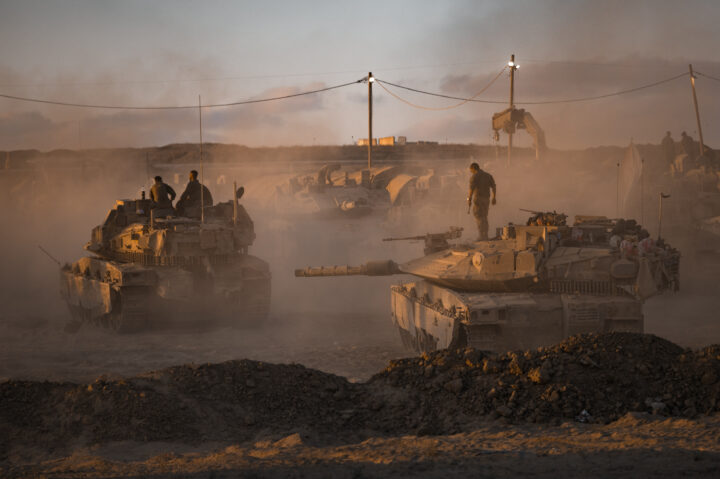
IDF soldiers prepare tanks on August 18, 2025 near the Gaza Strip's northern borders, Israel.
U.S. Middle East envoy Steve Witkoff and Jared Kushner arrived in Israel on Monday morning to discuss the next phase of the Gaza ceasefire, a day after Hamas killed two IDF soldiers and the Israeli Air Force struck in Rafah in response.
Hamas terrorists shot an anti-tank missile at heavy machinery used by the IDF to destroy the terrorist organization’s tunnels in Rafah, killing two soldiers on Sunday. Hamas claimed that the explosion was due to the machinery driving over an IED, but the IDF suspected the attack was part of an attempt to capture soldiers, Walla! News reported.
There have been several other recent attacks by Hamas, including two on Friday in which terrorists emerged from tunnels and shot at IDF soldiers.
Israeli Prime Minister Benjamin Netanyahu instructed the heads of Israel’s defense establishment to “take strong action against terrorist targets in the Gaza Strip,” his office stated soon after the Israeli strikes on Sunday. The Israeli army, however, announced on Sunday night, “In accordance with the directive of the political echelon, and following a series of significant strikes in response to Hamas’ violations, the IDF has begun the renewed enforcement of the ceasefire. The IDF will continue to uphold the ceasefire agreement and will respond firmly to any violation of it.”
The Rafah strikes came nearly a week after the ceasefire between Israel and Hamas came into effect. Hamas was supposed to free all 48 hostages that remained in Gaza at the time within 72 hours, according to the summary of the 20-point plan released by the White House. However, it only released the 20 living ones, and has been gradually handing over the bodies of deceased hostages; 16 bodies remain in Gaza.
In addition, Hamas terrorists have repeatedly launched attacks on Israeli soldiers, and Palestinians have crossed into areas in which IDF troops are deployed, in accordance with the ceasefire deal, leading the soldiers to shoot and kill several of them.
National Security Minister Itamar Ben-Gvir, leader of the far-right Otzma Yehudit party, called for “a full renewal of the fighting in the [Gaza] Strip, at full force. False imaginings that Hamas will change its skin or will even fulfill the agreement it signed have turned out, as expected, to be dangerous to our security. The Nazi terrorist organization must be fully destroyed, as soon as possible.” Israeli Finance Minister Bezalel Smotrich simply posted: “War!”
The first phase of President Donald Trump’s deal had Israel withdraw to the “yellow line,” moving out of Gaza City and other areas, but remaining in control of 53% of Gaza, including Rafah. The IDF began posting concrete blocks painted yellow along that line on Sunday morning, as a warning to “Hamas terrorists and Gaza residents that any violation or attempt to cross the line will be met with fire,” Israeli Defense Minister Israel Katz said when he announced the erection of the physical boundary on Friday.
Hamas has also been clashing with and executing members of rival gangs and Gaza residents it has accused of collaborating with Israel. The State Department released a statement on Saturday warning that a Hamas “attack against Palestinian civilians would constitute a direct and grave violation of the ceasefire agreement” and, should they continue, “measures will be taken to protect the people of Gaza and preserve the integrity of the ceasefire.”
Netanyahu’s office announced on Saturday night that the Rafah crossing, the main entrance for goods into Gaza, would remain closed as long as Hamas does not release the hostages’ bodies. However, IDF soldiers posted videos to social media of trucks of fuel entering Gaza on Sunday.
Witkoff and Kushner, who has a key role in the administration’s Middle East efforts, are expected to start talks with Jerusalem about the second phase of the ceasefire deal, in which Hamas would be disarmed, Gaza would be demilitarized, the IDF would withdraw further and be replaced by an international stabilization force, and a technocratic government would be installed in Gaza, under the supervision of a Peace Board led by Trump and including former U.K. Prime Minister Tony Blair.
This story was updated on Oct. 20, 2025, at 04:20 a.m. ET.