




























Khanna addresses California synagogues on Israel policy, antisemitism
The California congressman, an outspoken critic of Israel, praised moderate Govs. Andy Beshear and Josh Shapiro as ‘offering a vision of how we move forward’
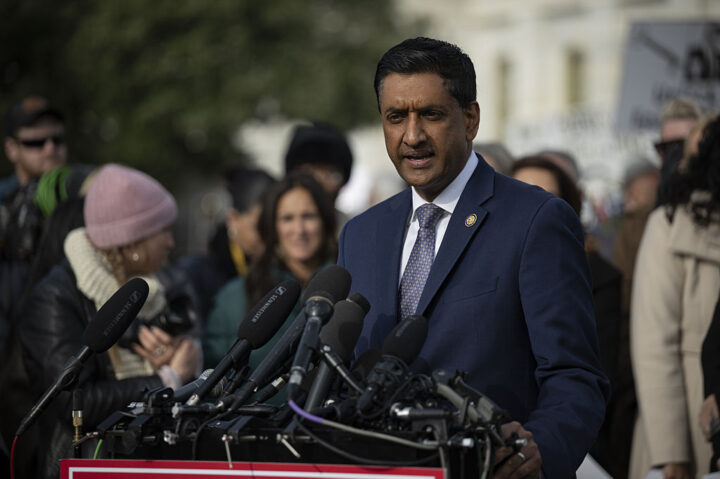
Celal Gunes/Anadolu via Getty Images
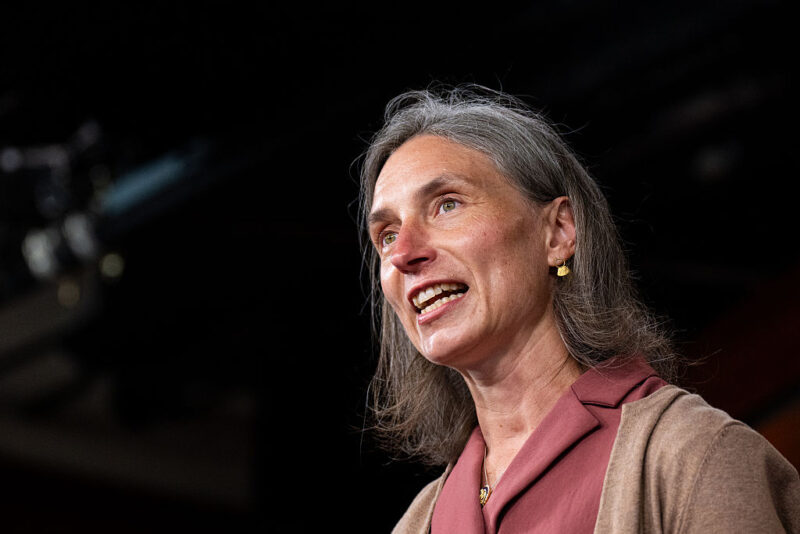
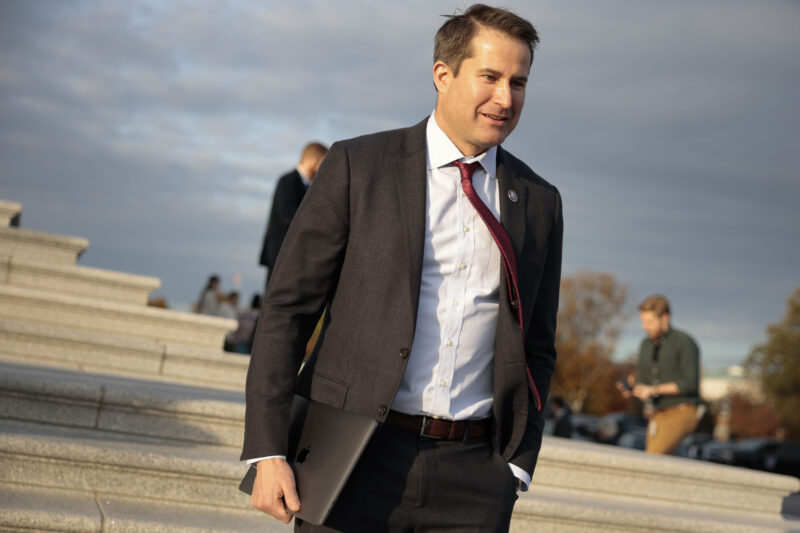
Rep. Ro Khanna (D-CA) speaks during the press conference on the Epstein Files Transparency Act with the Epstein abuse survivors at the US Capitol in Washington, DC, on November 18, 2025.


 Add JewishInsider on Google
Rep. Ro Khanna (D-CA), who has repeatedly made headlines for his sharpening criticism of Israel’s operations in Gaza while bashing pro-Israel groups, addressed two synagogues in his district this weekend about Israel policy and antisemitism, fielding questions from congregants.
Khanna, considered to be a 2028 presidential contender, addressed Congregation Beth Am in Los Altos after Friday evening Shabbat services, and Congregation Emanu-El in San Jose on Saturday. Khanna’s office shared excerpts of both events with Jewish Insider.
Though Khanna is co-sponsoring a resolution describing the war in Gaza as a genocide, he gave a somewhat equivocal response on the issue at Congregation Beth Am, saying that there is significant disagreement on the use of the term, even within his own family, and acknowledging that its usage is “emotionally charged.”
“I believe that people of good faith can disagree on what to call it. I have said that I would defer to the international bodies and that the United States should follow international law,” Khanna continued. “What I do know is that what happened, in my view, was not right. Even though Israel was attacked and Oct. 7 was a terrorist attack, I think [Israeli Prime Minister Benjamin] Netanyahu’s response was disproportionate.”
Asked about former Israeli Prime Minister Golda Meir’s famous maxim, “If the Arabs put down their weapons today, there would be no more violence. If the Jews put down their weapons today, there would be no more Israel,” Khanna said that the “history is so complex.”
He said that both Israelis and Palestinians have strong claims to the land, while acknowledging that Israel had previously agreed to a partition of the state while the Palestinians rejected the existence of Israel.
“Obviously it’s a complex situation,” Khanna said. “All I can say is, now it seems to be the best chance for peace — is for both people to have a state basically under a 1967 framework with some adjustments as the way forward. … I don’t think the cycle of violence can continue. I think we have to try.”
He said that would require backing from regional powers in the Arab League and Palestinian guarantees of Israeli security, as well as the removal of Hamas from power. But he also acknowledged that Israelis “don’t trust the idea, even the left, of giving Palestinians a state because of what happened on Oct. 7.”
He emphasized that he believes that Israel “should exist as a Jewish and democratic state,” emphasizing that others on the left disagree with him on that point.
Khanna argued that he had “initially defended for a few months [after Oct. 7] Israel’s right to self-defense” and faced protests for doing so, “but by December, when Netanyahu had destroyed about eight out of 10 of the Hamas battalions and when President [Joe] Biden had the first deal for hostages, I thought that the military solution to the war was over. I did not think they would achieve more militarily.”
He added that he does not think that it is possible to remove Hamas from power in Gaza by military means, and that the “cost of human life was way too high [in the war] … that this was not advancing peace and it was not a proportionate response in terms of achieving a better outcome for people in Gaza or Israel.”
He said he did not think the U.S. should have continued providing offensive weapons to Israel while the war was ongoing.
Khanna said he has told Netanyahu that he may have won the battle against Israel’s terrorist enemies but is “losing the war. You’re losing every American under 50 and you need the United States.”
Khanna asserted that there is a significant generational divide among Jewish Americans and Americans on Israel and Gaza — “one of the starkest generational divides that I’ve seen, not just among the Jewish-American community, but in general.”
He suggested that New York City Mayor-elect Zohran Mamdani’s outspoken anti-Israel stance was a major reason the democratic socialist won the mayoral race, and that a “staggering amount” of young Jewish Americans supported Mamdani.
Polling has shown that a majority of Jewish New Yorkers voted against the mayor-elect and that a strong majority of Jews of all ages remain strongly connected to Israel.
Khanna said that he’s also seeing a similar trend among young Republicans, citing a conversation with a Republican friend, whose son told Khanna that Israel is the only issue on which he agrees with the congressman.
Asked about the future of Israelis living beyond the Green Line in the West Bank, Khanna — who has been pushing for the United States to unilaterally recognize Palestinian statehood — said that issue would have to be negotiated between Israel and the Palestinians.
“Some of them, they probably would have to leave, like they did when [former Israeli Prime Minister Ariel] Sharon vacated Gaza,” Khanna said. “Some, if they stayed, there probably has to be some negotiation or compensation for that.”
Some critics, including fellow Democrats, of Khanna’s statehood recognition proposal say that outstanding issues such as Israeli and Palestinian borders, which must be resolved in negotiations, are one reason not to recognize Palestinian statehood at this point.
Khanna said that there can be “zero tolerance for antisemitism” and that political leaders need to call it out, regardless of which side of the aisle it comes from. “It can’t become a political football,” he added.
The California congressman himself has on multiple occasions faced criticism for associating with known antisemites — including appearing at an anti-Israel conference alongside speakers who defended terrorism and posting on social media a clip that included a prominent antisemitic conspiracy theorist — backpedaling on those associations after the fact.
Khanna said he created a point of contact in his office for individuals facing antisemitic discrimination to report their experiences. Many who have contacted him, he said, have been young people — Jewish clubs unable to bring speakers to campus, students uncomfortable in their classrooms — as well as a Jewish person feeling uncomfortable at their place of employment.
“I have, in a number of instances, reached out and said I don’t think that that’s acceptable,” Khanna said. “We need to make sure that this community is accept[ing] and open to people of all different backgrounds.”
He also said that more education about the Holocaust is critical and that the Department of Justice must have the resources it needs to protect Jewish communities and prosecute antisemitic hate crimes and threats.
Khanna also spoke about what he views as the future of the Democratic Party — notably offering support for two moderate Democratic governors while implicitly distancing himself from his home state’s governor.
“The last thing we need is the pundits for the party picking who the next leader should be,” Khanna said. “We need people to go earn it. … Go campaign, go work hard, share your vision with people, see if it resonates, have a primary of 10, 15 thoughtful people sharing the vision for the country, and don’t anoint who the next leader should be. That will be a colossal mistake.”
He praised Kentucky Gov. Andy Beshear and Pennsylvania Gov. Josh Shapiro — both of whom are more moderate than Khanna — as “offering a vision of how we move forward.”
But he said he “completely reject[s]” those in the party who push for fighting “fire with fire” — an implicit dig at California Gov. Gavin Newsom, who has adopted a Trumpian posture on social media to criticize the president and Republicans.
Khanna said he wants to pursue a “positive vision” to “heal this country” and “move this nation forward,” focusing on a “unifying economic message” — ”I call it economic patriotism as a new national purpose. Americans working together to build up every town so that every family has a chance of success in a modern economy, and so we can be a cohesive, multiracial democracy that leads the world.”
Though he has said he believes that Senate Minority Leader Chuck Schumer (D-NY) should step down from his leadership position and called for “the old guard to make way” and let a “new generation of leadership” take charge, he said that he would support House Minority Leader Hakeem Jeffries (D-NY) as speaker of the House if the Democrats retake the chamber.
More Stories
diplomats declared
Israel approves new consuls-general in San Francisco, Houston
LAYING DOWN THE LAW
Trump: ‘Final documents are being drawn’ to designate Muslim Brotherhood as terrorist group

HEZBOLLAH HIT
Israel kills Hezbollah chief of staff in Beirut airstrike
TEXAS TALK
Two Republicans condemned by Jewish groups looking to make comebacks in Texas
MICHIGAN MOVES
Haley Stevens maintains support for Israel as her primary rivals battle over anti-Israel lane