










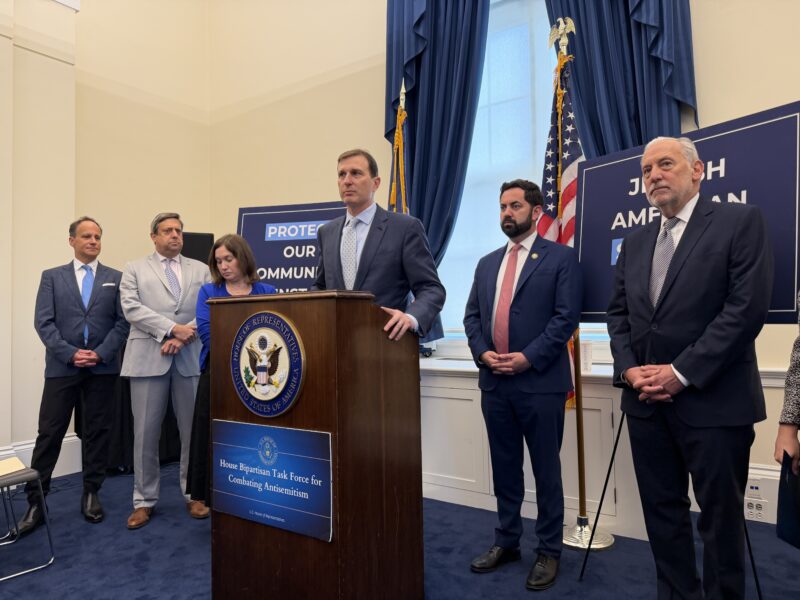





















The freshman New York congressman also said that Israel must do more to pursue an end to the war, make its case to the world and provide aid in Gaza

Spencer Platt/Getty Images
Westchester County Executive George Latimer speaks to supporters after winning his race against Democratic incumbent Representative Jamaal Bowman in the 16th Congressional District of New York's Democratic primary.


 Add JewishInsider on Google
Having recently returned from a trip to Israel, Rep. George Latimer (D-NY) is emphasizing that Israel’s critics in the United States and around the world are overlooking Hamas’ key role in perpetuating the conflict and contributing to the humanitarian issues in Gaza, strengthening the terrorist group’s position and insulating it from external pressures.
At the same time, the New York Democrat also said that Israel must do more to pursue an end to the war, make its case to the world and provide aid in Gaza.
Latimer, speaking to Jewish Insider last week, said that the trip, organized by the AIPAC-affiliated American Israel Education Foundation for Democratic freshmen and leading Democratic lawmakers, had reinforced his view that the situation on the ground is more complicated than the more simplistic narratives demonizing Israel that have been spread by some critics and media.
“When you see on the ground, you understand it is not a simple black-and-white situation,” Latimer, a first-term congressman from Westchester County, N.Y., who sits on the House Foreign Affairs Committee, said. “People come up to me and say, ‘Israel is practicing genocide. What they’re doing is evil and we need to stop it.’ And then you get on the ground and you realize how much more complicated it is than that.”
He said that American critics of Israel fail to acknowledge Hamas’ “role in all of this and its contributory actions.” He said he sees a “lack of appreciation here in the United States that Hamas is committed — has shown no signs to want to sit, talk peace, have a cessation of hostilities. … That makes it very, very hard to plot a strategy, if the other side is completely intransigent.”
Latimer said the situation is comparable to overlooking the fact that the U.S. entered World War II because Japan bombed Pearl Harbor, or that the U.S. invaded Afghanistan because of the 9/11 attacks. He said that the “mindset” that motivated such attacks doesn’t disappear overnight, and can take protracted conflict to address.
At the same time, he said that “there’s a gap between what [the Israeli government] needs to be doing and what it is doing, and it’s a serious gap.” He said he doesn’t see proposals to relocate the population of Gaza out of the enclave, discussed during a meeting with Israeli Prime Minister Benjamin Netanyahu, as “workable” or “humane.”
He addressed friction within Israeli society over Israel’s war plans in Gaza, and said that Netanyahu’s decision-making may be shaped by his far-right coalition members, adding that “if there’s no movement from Hamas, what can you ask Israel to do unilaterally?”
“So Netanyahu’s strategies present as intransigent in the face of intransigence on the other side,” Latimer continued. “You need some joint breakthrough where both sides step back from the path that they’re on, and both sides have to be willing to do that, if you can expect the other side to also then do that.”
He noted the difficulty of forcing a dug-in enemy like Hamas to surrender, comparing it to the challenge of forcing a Japanese surrender during WWII.
Latimer unseated Rep. Jamaal Bowman (D-NY), a vocal Israel critic, in the 2024 Democratic primary, boosted by significant support from his district’s Jewish community as well as national pro-Israel groups.
Latimer told JI he thinks Israel has not done enough to try to win over or influence global opinion in its favor. Latimer said he believes that the Israeli government views such efforts as a lost cause and not worth attempting.
“There’s a case to be made [for Israel]. But in lieu of that, the rhetoric is all what Israel is doing and not doing, and how evil they are, when, in fact, all of this came from an attack that was horrific on Oct. 7,” Latimer said.
He said that there have been “atrocities” on the Israeli side, pointing broadly to settler violence in the West Bank, but said that “the question is, overall, are you weighing all of these things together, or as the world opinion, and much of the United States opinion, particularly among younger people, has been framed completely around ‘Israel bad,’” ignoring the “evil that’s been done on behalf of the other side of this. That is a contributing reason why we’re in the situation we’re in.”
“The fact that people are starving is horrific. But as long as the world blames Israel for it solely, Hamas is winning. Why would they change any strategies?” Latimer said. “The leaders of Hamas are not sitting in the tunnels. … They’re sitting in the safety of the protection of [Turkish President Recep Tayyip] Erdogan or over in Qatar. Therefore, they’re not under the pressure.”
Latimer said that the food supply in Gaza was a key issue he examined on the trip, calling starvation in Gaza a “legitimate” problem.
He said that the current four Gaza Humanitarian Foundation aid distribution sites are “nowhere near enough,” given the “massive number of people that need to be fed and housed.”
But he added that Hamas being “unwilling to cooperate” in the safe delivery of aid is an impediment to efforts to improve the humanitarian situation and that the United Nations “in the eyes of the Israelis, has lost credibility.”
He said that the best path forward would likely be for a coalition of Arab countries to take the lead of a humanitarian aid distribution entity: “We need to have a third party that has credibility.”
“Israel is not doing enough to solve the problem, and Hamas is doing things to prohibit the problem from being solved,” Latimer said, calling on Israel to work to increase the number of food distribution centers and strengthen supply lines and on Hamas to stop attempting to intercept food and sow chaos at distribution sites.
“The fact that people are starving is horrific. But as long as the world blames Israel for it solely, Hamas is winning. Why would they change any strategies?” he said. “The leaders of Hamas are not sitting in the tunnels. … They’re sitting in the safety of the protection of [Turkish President Recep Tayyip] Erdogan or over in Qatar. Therefore, they’re not under the pressure.”
“What I saw in September 2005 gave me hope. What I see when I go back 20 years later is, you shake your head and you go, ‘Why did it turn out this way?’” Latimer said. “Did it turn out this way because Israel wanted it to turn out this way? Israel didn’t want Oct. 7. Israel didn’t want all of its young men in the reserves and active duty, constantly on a wartime footing.”
He declined to weigh in definitively — citing the limited information at his disposal and his limited power as a lone congressman — on whether the U.S. needs to increase pressure on its allies in Turkey or Qatar to expel or detain those Hamas leaders, but said that “clearly there has been insufficient pressure on Hamas” because its leaders have shown no urgency to return the hostages, negotiate in good faith or participate in un-corrupted food distribution.
Latimer said he first traveled to Israel two decades ago, just after the Israeli disengagement from Gaza, and that there was hope at the time that the Israeli withdrawal would “allow the opportunity for Gaza to experience peace and some kind of growth.”
“What I saw in September 2005 gave me hope. What I see when I go back 20 years later is, you shake your head and you go, ‘Why did it turn out this way?’” Latimer said. “Did it turn out this way because Israel wanted it to turn out this way? Israel didn’t want Oct. 7. Israel didn’t want all of its young men in the reserves and active duty, constantly on a wartime footing.”
He said that if Gaza’s leaders had pursued growth and development over the past 20 years, “we could be in a very different place today,” but instead Hamas seized power and used Gaza as a platform to attack Israel.
Asked about recent decisions by European countries to unilaterally recognize a Palestinian state, which came around the time of Latimer’s trip, the congressman said that he supports a two-state solution, but one that “comes out of a negotiated process,” noting the many outstanding issues to be worked through.
“You cannot expect Israel to survive with a hostile entity interspersed with its borders, and yet be its own country. And there has to be a sense that this country can function and provide its services to its people and maintain civil control. None of those things are automatically in place yet, so I don’t know what we’re recognizing in substance,” Latimer said.
“I think what we’re recognizing in symbolism is European countries that basically are saying, ‘We need to have a two state solution,’ and probably their population is reacting to what’s happening in the moment and putting pressure on their governments to do this,” he continued.
“The Palestinian Authority certainly has a steep mountain to climb, but right now, they’re the best hope that you have of a presence — and certainly it’s not Hamas, it’s certainly not coming out of any of the groups that Iran is backing or has backed,” Latimer said.
Based on the delegation’s meeting with Palestinian Authority leaders, Latimer said that he believes there is an “intent” and “willingness” in the PA to pursue needed reform and bolster credibility with the Palestinian population.
“How much success they’re going to have with the civilian population to accomplish those things — it’s going to be a tall task,” he said.
At the same time, he noted that some Arab governments such as those in Jordan and Egypt maintain cooperative relationships with Israel even as many of their citizens remain hostile.
“The Palestinian Authority certainly has a steep mountain to climb, but right now, they’re the best hope that you have of a presence — and certainly it’s not Hamas, it’s certainly not coming out of any of the groups that Iran is backing or has backed,” he continued.
In the long term, Latimer added, the Abraham Accords represent a path forward for the region, and said that moderate Sunni Arab states want to see a viable and demilitarized Palestinian Authority government that can credibly govern the Palestinian people.
Both Reps. Julie Fedorchak and Randy Fine slammed European leaders, saying they are making it harder to get hostages released

Tom Williams/CQ-Roll Call, Inc via Getty Images)Kayla Bartkowski/Getty Images
Reps. Julie Fedorchak (R-ND) and Randy Fine (R-FL)
Returning from a trip to Israel, two first-term House Republicans blasted European nations and others that have recently hardened their positions toward Israel, saying that those decisions had set back efforts to free the hostages and end the war.
One of the lawmakers who visited Israel with the AIPAC-affiliated American Israel Education Foundation also indicated that she had not heard in meetings with Israeli leaders a concrete plan for bringing the war to an end.
Rep. Julie Fedorchak (R-ND) told Jewish Insider she had been interested during the trip to examine the increasing hostility by European countries and others toward Israel, including their decisions to recognize a Palestinian state, and their public postures blaming Israel for the humanitarian issues in Gaza.
“It is not supported by the facts on the ground. … Europe’s actions definitely set back the … negotiations for Hamas releasing the existing hostages — potentially resulting in them dying,” Fedorchak said. “It’s maddening that these countries that should know better, or should take the time to find out better, are taking these very unhelpful positions.”
She called on the European leaders and others criticizing Israel to visit the sites of the Oct. 7, 2023, Hamas attacks and meet with Hamas’ victims, calling it “almost unfathomable that people are blaming Israel.”
“Go talk to the families whose houses were invaded, and the parents of 15-year-olds who died being shot at in a safe room, trying to hold the door from the terrorist on the other side,” Fedorchak said, “families who had to watch their women be raped and abused. The 300 young people that were killed at the music festival.”
Rep. Randy Fine (R-FL) told JI that it was critical for the group, and for supporters of Israel in general, to “continue to make clear the lie being spread about starvation” — which Israeli Prime Minister Benjamin Netanyahu has insisted does not exist in the enclave while President Donald Trump has said there is “real starvation.”
Fine also said it was crucial to “stand up to these countries like France and the U.K. and Canada and Australia that have fully embraced Muslim terror and want to reward it.”
He likewise argued that the European countries’ actions had extended the war. Fine said he’s not worried, however, about longer-term fallout from the shift away from Israel by some of its longtime European allies.
“I’ve always thought Israel needs to stop caring about what the world thinks and take care of itself,” he said. “There’s lots of antisemites in the world, they’re always looking for an excuse. … All of this stuff is simply an excuse to let your inner antisemitism out. That’s all any of it is.”
Fedorchak indicated that Israeli leaders had not laid out a concrete plan for how they would bring the war to an end.
“The big question of how do you end this, and how do you get out of it with the hostages alive — I didn’t ever hear a real great plan for that. I think that’s a million-dollar question,” Fedorchak said, highlighting concerns about the hostages being held in potentially booby-trapped tunnels, the risks to Israeli soldiers in the ongoing military campaign and the likelihood that further concessions to Hamas in negotiations will further embolden the terror group.
“I was frustrated that a long-term solution — or even an immediate solution for the war — is very elusive. I wish that it hadn’t gone on so long. I wish that when the hostages were first taken, the whole world would have stood with Israel and tried to get them back right away … so it wasn’t allowed to drag out so long,” she said.
Fine said that specific plans for ending the war would be sensitive for Israel to share, but that the goals remain the same, of bringing home the hostages and ensuring that terrorists do not continue to control Gaza.
“It has to get to an end point, so I am confident that it will get there,” Fine said. “I’m disappointed that I think these European countries, in their publicly backing Hamas, drag it out. If I was in Taiwan right now, I’d consider going into China and killing a bunch of people, because that seems to be the great way to get your country recognized.”
Fedorchak said she was struck by how the ongoing hostage crisis “has pretty much frozen in time that invasion in Israel, and everybody is reliving it pretty much constantly,” adding that the ongoing hostage situation is an “an ongoing, terrible human rights offense by Hamas.”
She added that the trip had highlighted the proximity of the threats that Israel faces: The lawmakers were forced to take shelter from a rocket attack on their first night in Israel. “You can’t appreciate what that’s like if you don’t go there and see it.”
The group also met with leadership from the Gaza Humanitarian Foundation.
Fine said that the meeting was an opportunity to learn more about its efforts — including that “they haven’t used any lethal force at all since they set up their sites,” he said.
He also noted that the GHF leaders told the group they had been trying to work with Hamas, “but the U.N.’s not interested in working with them, because the U.N. is an offshoot of Hamas.”
Fedorchak said that GHF leadership gave the impression that the organization was “making progress” in expanding aid deliveries and aiming to open more distribution sites.
She said the U.S. should continue providing humanitarian aid and called on other nations to do so as well, calling it “critical” to protecting and supporting the Palestinians “that are really stuck there” as Israel continues its efforts to defeat Hamas, either through military means or a Hamas surrender.
“Hamas still has a stranglehold on the leadership and governing in Palestine or in Gaza, and they’re a terrorist organization with the [goal] of eliminating Israel,” Fedorchak said. “So that’s not going to work long term there. I don’t envision any time where Hamas can lead Gaza and provide peace and economic stability for the people there and for their neighbors to the east and north of Israel. So Hamas has to go.”
Nevertheless, Fedorchak said she came away feeling hopeful about the potential future beyond the war, saying that there’s “a lot of promise” for expanding the Abraham Accords and ultimately “hopefully providing an opening for a new pro-peace Palestinian leadership to take root in Gaza and the West Bank.”
Fine, who has traveled to Israel before and has quickly built a name for himself as a combative supporter of Israel in his short time since taking office, said he was grateful for all of the colleagues who joined the trip and showed their support for Israel.
“It was good to see that the anti-Israel voices are small and they are loud,” Fine said. “The vast majority of my colleagues, I think, are even more pro-Israel now than they were before. … I don’t think we can give too much attention to the antisemites in Congress. I think the vast majority of Republicans are more pro-Israel now than they were before, not less.”
He argued that an overlapping trip by House Speaker Mike Johnson (R-LA) — during which Johnson offered support for Israel asserting full sovereignty over the West Bank, which Fine refers to by its biblical name, Judea and Samaria — is a signal of Republicans’ continued and increased affinity for the Jewish state.
Addressing those — including some Republican lawmakers — who’ve grown frustrated with Israel’s leadership and the war in Gaza, Fine said that “their frustrations are misplaced.”
“The … people who it appears are starving in Gaza are the hostages,” he said. “The responsibility for all of this lies with the Muslim terrorists. This all ends if they release the hostages and surrender.”
Fedorchak said that the visit had given her “a greater appreciation for the value of America and our willingness to stand up for the ideals” that the U.S. shared with Israel and its allies.
“I appreciate that the U.S. is willing to be on the front lines defending that, and the partnership with us and Israel is obviously central to Israel’s ongoing strength and existence in the Middle East,” she said. “It’s really valuable to have an ally like Israel in the Middle East.”
Fedorchak said she was deeply impressed with Israel’s “resourcefulness,” both in developing impressive weapons and defensive systems as well as in agriculture, and with Israelis’ focus on family, patriotism and national service.
Fine noted that the group had also received a briefing about the atrocities committed against the Druze in Syria, and condemned the international community for its comparative lack of attention on that crisis. “Nobody cares when you see Druze being slaughtered in Syria … no Jews, no news,” he said.
Asked about whether the U.S. should adjust its policy toward the new Syrian government in response to the attacks against the Druze, Fine declined to weigh in specifically, while reiterating that the situation is “dire” and is being overlooked.
In addition to the large group meetings, Fine said he’d taken several one-on-one meetings at the request of Israeli leaders, including with Finance Minister Bezalel Smotrich, Knesset Constitution, Law and Justice Committee Chairman Simcha Rothman and members of Israel’s foreign ministry.
He said that those meetings had also focused on Israeli security issues — ”making sure Israel is safe and secure, Jews are safe and secure and having zero tolerance for Muslim terror.”
Fine also said that he was stopped by Israelis repeatedly during the trip who recognized him and were “appreciative of the stands that I’ve taken, about wearing a kippah.”
The delegation, which makes up a third of freshman Democratic House members, demonstrates the organization’s continued pull even amid heightened tensions between Dems and Israel

President Isaac Herzog on X
Israeli President Isaac Herzog meets a delegation of House Democrats in Jerusalem on August 11, 2025.
A group of 14 House Democrats, including 11 first-term lawmakers, are currently visiting Israel with the AIPAC-affiliated American Israel Education Foundation.
The group includes Reps. Tim Kennedy (D-NY), Gil Cisneros (D-CA), Josh Riley (D-NY), Nellie Pou (D-NJ), Wesley Bell (D-MO), Laura Gillen (D-NY), Johnny Olszewski (D-MD), Eugene Vindman (D-VA), Luz Rivas (D-CA), Herb Conaway (D-NJ) and George Latimer (D-NY).
They make up a third of the 33 freshman Democratic members of the House — a sign of AIPAC’s continued pull among more centrist pro-Israel Democrats even as progressives have sought to make the group politically toxic. An AIEF-sponsored Republican trip which visited Israel last week included around the same number of freshmen lawmakers.
The trip comes at a time when tensions, even among Israel’s most vocal Democratic supporters, and the Israeli government are at a high point, amid concern with the humanitarian crisis in Gaza and Israel’s newly finalized plans to expand the war and conduct a military takeover of Gaza City.
The Democratic delegation also includes Reps. Steny Hoyer (D-MD), Pete Aguilar (D-CA) and Brad Schneider (D-IL). Aguilar is the No. 3 Democrat in the House.
The Democratic group met with Israeli President Isaac Herzog on Monday, who said that the “visits show the bi-partisan, steadfast alliance between the United State[s] and Israel, and of the true shared values between our peoples.”
“I told them that Israel continues to operate in accordance with international law, that it was dramatically increasing the flow of humanitarian aid to Gaza, and that Israel continues to strive with all its might and in every way possible to bring our hostages home,” Herzog said in a statement. “I also made clear that Hamas continues to hold, starve, torture and abuse the hostages, holding 50 still in captivity, in a deliberate and flagrant crime against humanity. I told them it was Hamas which was looting and stealing the aid, preventing the distribution to the civilians in Gaza. And that Hamas was blocking and rejecting a deal that would bring an end to the suffering.”
The Democratic group also appears to have visited the City of David.
Please log in if you already have a subscription, or subscribe to access the latest updates.
 Continue with Google
 Continue with Apple