















Trump signals Syria will join U.S.-led anti-ISIS coalition
The president said to expect an announcement after meeting with President Ahmad al-Sharaa, on a move that JINSA’s John Hannah called a ‘sweeping ideological reversal’
Syrian Presidency
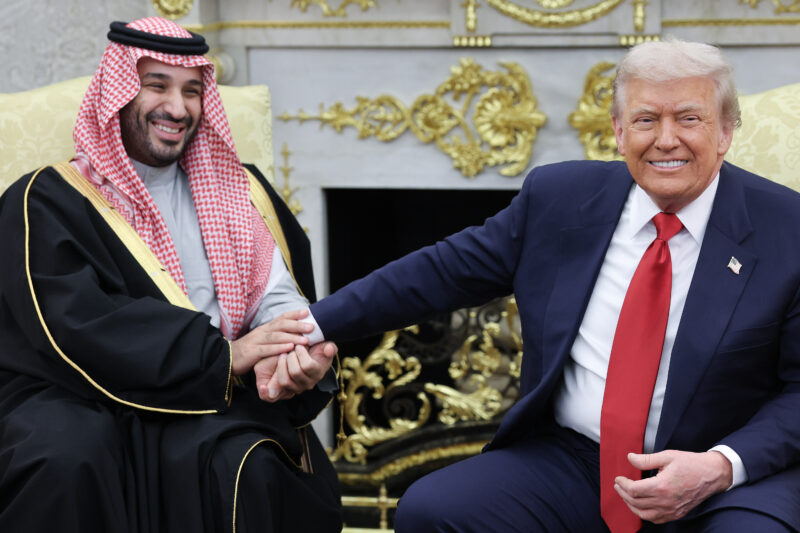
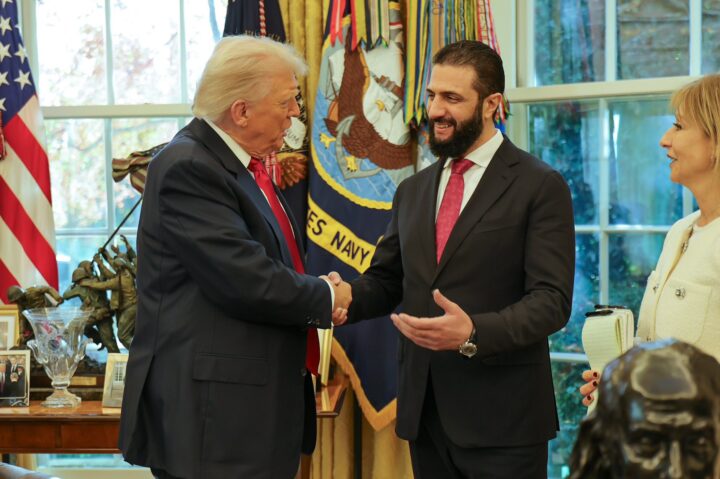
President Donald Trump greets Syrian President Ahmad al-Sharaa in the Oval Office on Nov. 10, 2025.


 Add JewishInsider on Google
President Donald Trump indicated that he expects Syria to join the U.S.-led coalition against the Islamic State during his meeting with Syrian President Ahmad al-Sharaa on Monday at the White House.
“Yes, you can expect an announcement on Syria,” Trump said to reporters in the Oval Office. “We want to see Syria become a country that’s very successful. And I think this leader can do it. I really do.”
By joining the agreement, Syria would follow 89 countries that have committed to the pact’s goal of “eliminating the threat posed by ISIS.” The group was established in 2014 as part of a response to territorial gains made by the Islamic State after the collapse of Iraqi security forces in Mosul.
Following the fall of Syria’s longtime dictator Bashar al-Assad last December, al-Sharaa has sought to establish control over the war-ravaged nation and assert the authority of his new transitional government. However, the emergence of ISIS cells that have regrouped across Syria over the past few years pose a threat to this task.
In 2025, ISIS has grown into a “small, flexible network” that seeks to establish a presence in eastern Syria, according to the Middle East Institute (MEI). An MEI report indicated that local security forces estimate there are between 2,500 and 3,000 active ISIS fighters in the country, calling the group the “most dangerous post-war security challenge” for al-Sharaa’s government.
Reports have indicated that ISIS is aiming to reactivate cells and amp up recruitment efforts in Syria through prisons and displacement camps.
John Hannah, a senior fellow at the Jewish Institute for National Security of America, said that by joining the coalition, al-Sharaa’s forces can work “hand in hand under U.S. direction to systematically crush ISIS across the country and take full responsibility for the massive detention camps at places like Al Hol [refugee camp].”
Al-Sharaa’s efforts to join the coalition show a commitment by Damascus to ensure ISIS does not pose a further threat to stability and marks a significant step in the changing relationship between the U.S. and Syria.
“It’s obviously an important step,” said Hannah. “What’s intriguing in this case, however, is that al-Sharaa, the one-time fanboy of former ISIS leader Abu Omar Al Baghdadi and Al-Qaida franchise commander, is joining an anti-jihadist posse led and directed by the United States — the poster-child of the decadent, colonial and infidel West that also happens to be the primary patron of the world’s only Jewish state. That kind of sweeping ideological reversal is just not something you see every day. It certainly merits notice and should be welcomed.”
Ahmad Sharawai, a research analyst at the Foundation for Defense of Democracies, said it would be a “significant milestone” should Syria join the anti-ISIS coalition and help Damascus’ new government “domestically and internationally.”
“Externally, such a move would align Syria with the U.S.-led bloc in the region and help end its international isolation by presenting it as a credible counterterrorism partner,” said Sharawi. “Over the past year, we’ve already seen indications of this alignment, with reports of Syrian forces assisting coalition operations. A formal decision to join would only reinforce this new trajectory.”
In 2019, the coalition was able to eliminate ISIS’ quasi-state in Syria with help from the Kurdish-led Syrian Democratic Forces (SDF) — Washington’s main counterterrorism partner in the country since 2015. By signaling an openness to enter the coalition, experts told Jewish Insider that al-Sharaa’s government is hoping to position itself as the primary partner to counter ISIS rather than the SDF.
“The new Syrian government has consistently demanded the SDF’s integration into national forces but has faced U.S. resistance that preserved the SDF’s leverage,” said Sharawi. “By entering the coalition, Damascus can argue that it, and not the SDF, would serve as Washington’s sole counterterrorism partner, thereby diminishing the SDF’s bargaining power in integration talks.”
Al-Sharaa has cooperated with the U.S. against the terrorist group for nearly a decade, sharing intelligence with officials regarding the whereabouts of key ISIS and Al-Qaida leaders, according to experts.
“[Al-Sharaa] has had a long history of throwing former jihadist allies under the bus whenever they’ve gotten in the way of his own single-minded focus on acquiring and holding onto power to build his vision of a new Sunni-dominated Syria,” said Hannah. “He’s been cooperating with CENTCOM on anti-ISIS missions under the radar for some time, quietly allowing it to do the dirty work of bumping off those who might serve as an alternative magnet for disgruntled Sunnis, former jihadists and foreign fighters who form the backbone of al-Sharaa’s support.”
But despite this, some have expressed concerns stemming from al-Sharaa’s past connection to Al-Qaida’s Syrian affiliate, which he broke from in 2016 and rebranded to Hayat Tahrir al-Sham (HTS). Al-Sharaa formerly had a $10 million U.S. bounty on his head due to these past ties.
“People said he’s had a rough past,” said Trump at the Oval Office meeting. “We all have rough pasts, but he has had a rough past. And I think, frankly, if you didn’t have a rough past, you wouldn’t have a chance.”
The move for now remains largely symbolic, with the exact terms of Syria’s role in the coalition likely to formalize “eventually,” according to The Wall Street Journal.
Syria’s ambassador to the U.N., Ibrahim Olabi, said the meeting between Trump and al-Sharaa also addressed a potential security agreement between Syria and Israel, something Washington has worked on mediating this year.
Trump has worked throughout his second term to integrate Syria’s new government into the international order; temporarily lifting U.S. all sanctions in May and again on Monday, easing export controls in August and removing al-Sharaa from a terrorist watchlist in November.
The White House is seeking the help of Congress to take another step, arguing for the complete removal of the Caesar Act sanctions, which Trump can only temporarily suspend, named after an Assad government whistleblower and enacted in 2019 in order to financially suffocate the former regime. With al-Sharaa’s government now in power, the sanctions are seen by some as a roadblock towards further normalization and investment in Syria’s rebuilding.
The Senate has moved to repeal the law as part of its version of the 2026 National Defense Authorization Act, but the House version does not have the same provision. Some lawmakers are holding out, saying that al-Sharaa must take steps to protect religious minorities and improve relations with Israel.
But others argue that the lack of investment due to the sanctions remaining in place could stymie the fledgling government and potentially allow for a further ISIS resurgence, according to the Middle East Institute.
Hannah said this moment may be the “tipping point” in getting the sanctions removed, adding that it is al-Sharaa’s “highest priority.”
“[Joining the anti-ISIS coalition] offers President al-Sharaa an avenue to strengthen his case for further U.S. support on sanctions relief and delisting efforts,” said Sharawi. “Syria remains designated as a State Sponsor of Terrorism, a status it has held since 1979, and participation in the coalition could give Washington the political cover to reconsider that designation.”
More Stories
diplomats declared
Israel approves new consuls-general in San Francisco, Houston
LAYING DOWN THE LAW
Trump: ‘Final documents are being drawn’ to designate Muslim Brotherhood as terrorist group

HEZBOLLAH HIT
Israel kills Hezbollah chief of staff in Beirut airstrike
TEXAS TALK
Two Republicans condemned by Jewish groups looking to make comebacks in Texas
MICHIGAN MOVES
Haley Stevens maintains support for Israel as her primary rivals battle over anti-Israel lane